
Whisk Fern (Psilotum nudum)
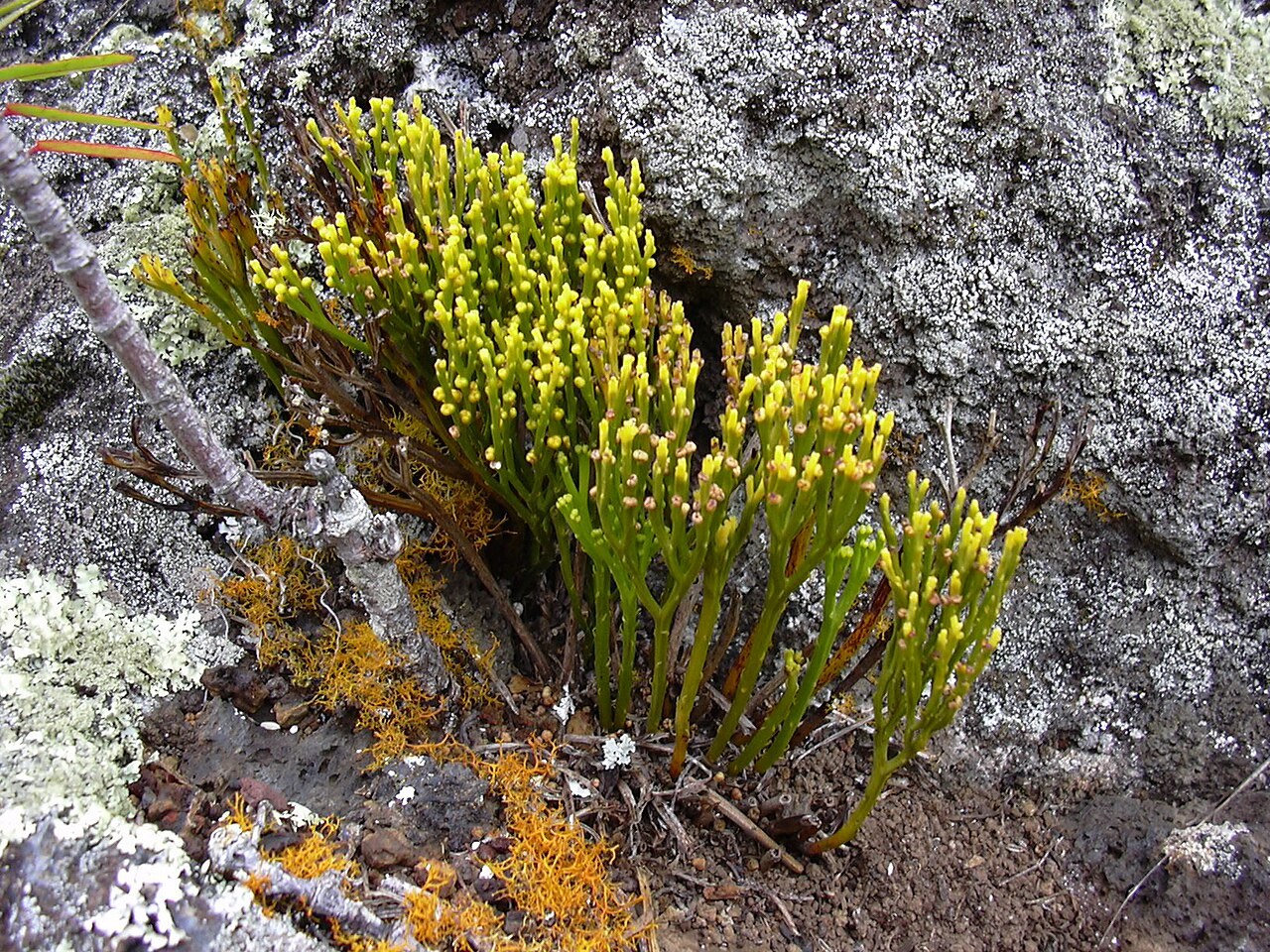
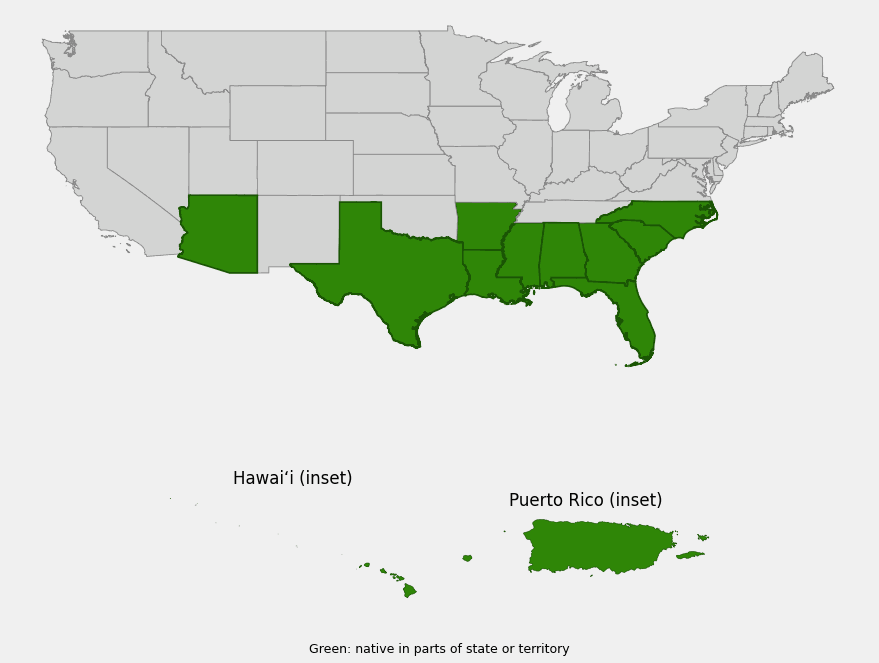
Psilotum nudum, the Whisk Fern, is one of the strangest plants in North America: a small, leafless, rootless tuft of green forking stems that looks like a little broom or whisk. USDA PLANTS also calls it whisk fern, and it is known as skeleton fork fern. In Hawaii, where it is native, it is called moa. It is native to Puerto Rico and the U.S. Virgin Islands, to Hawaii, and across the southern United States from the Carolinas and Florida to Texas and Arizona.
Whisk fern was once thought to be a living relic of the earliest land plants, because its body is so simple. Modern DNA studies place it among the ferns, as a close relative of the moonworts and adder’s-tongues. Its simple form is the result of losing leaves and roots, not of never having them.
This guide covers how to recognize whisk fern, where it grows in Puerto Rico and the mainland, how to grow it in a pot or a shady garden, and some of the curious history behind this little plant.
Identification
There is nothing else quite like a whisk fern. Once you know the forking green stems and yellow knobs, it is unmistakable.
Growth Form
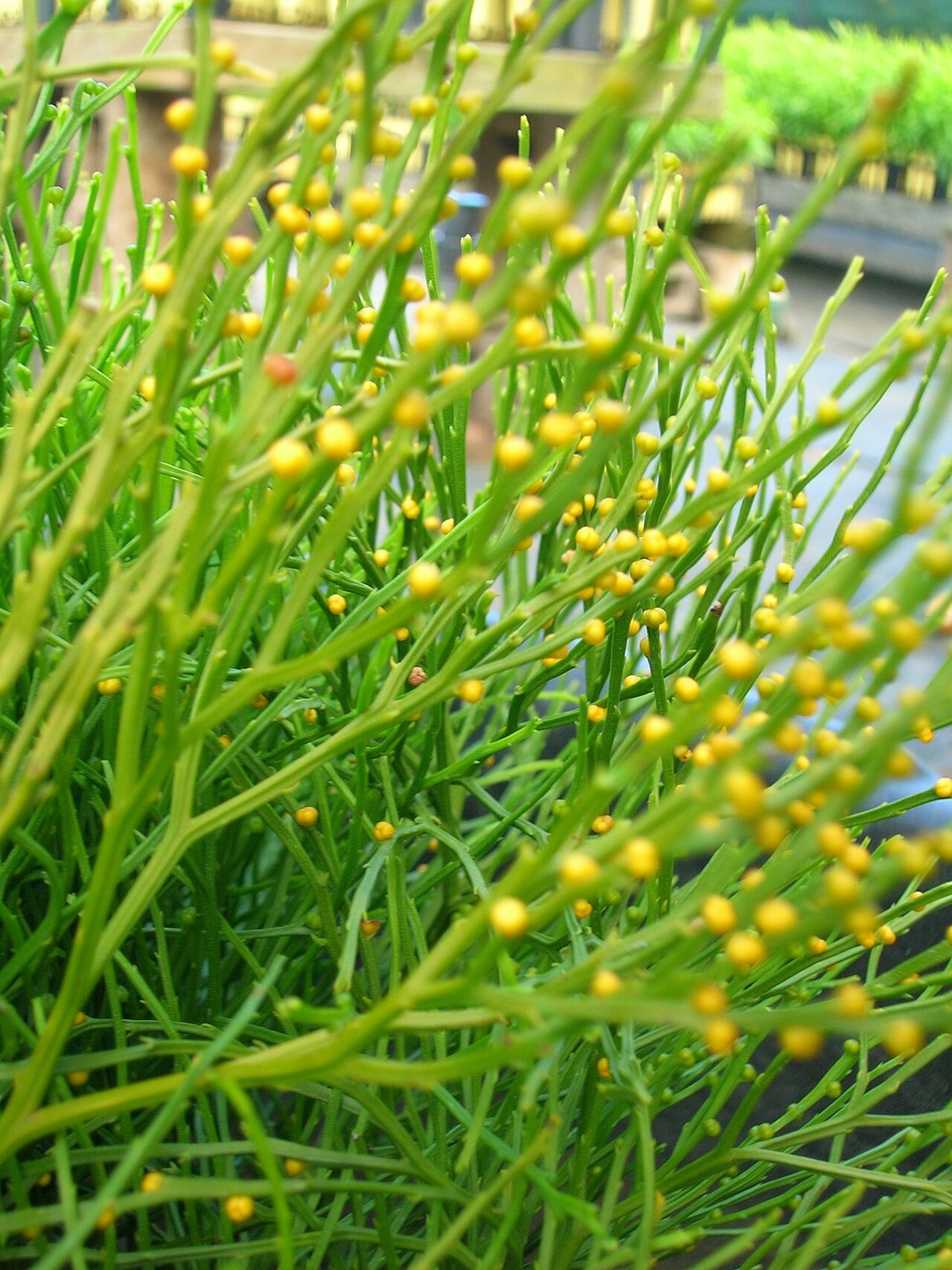
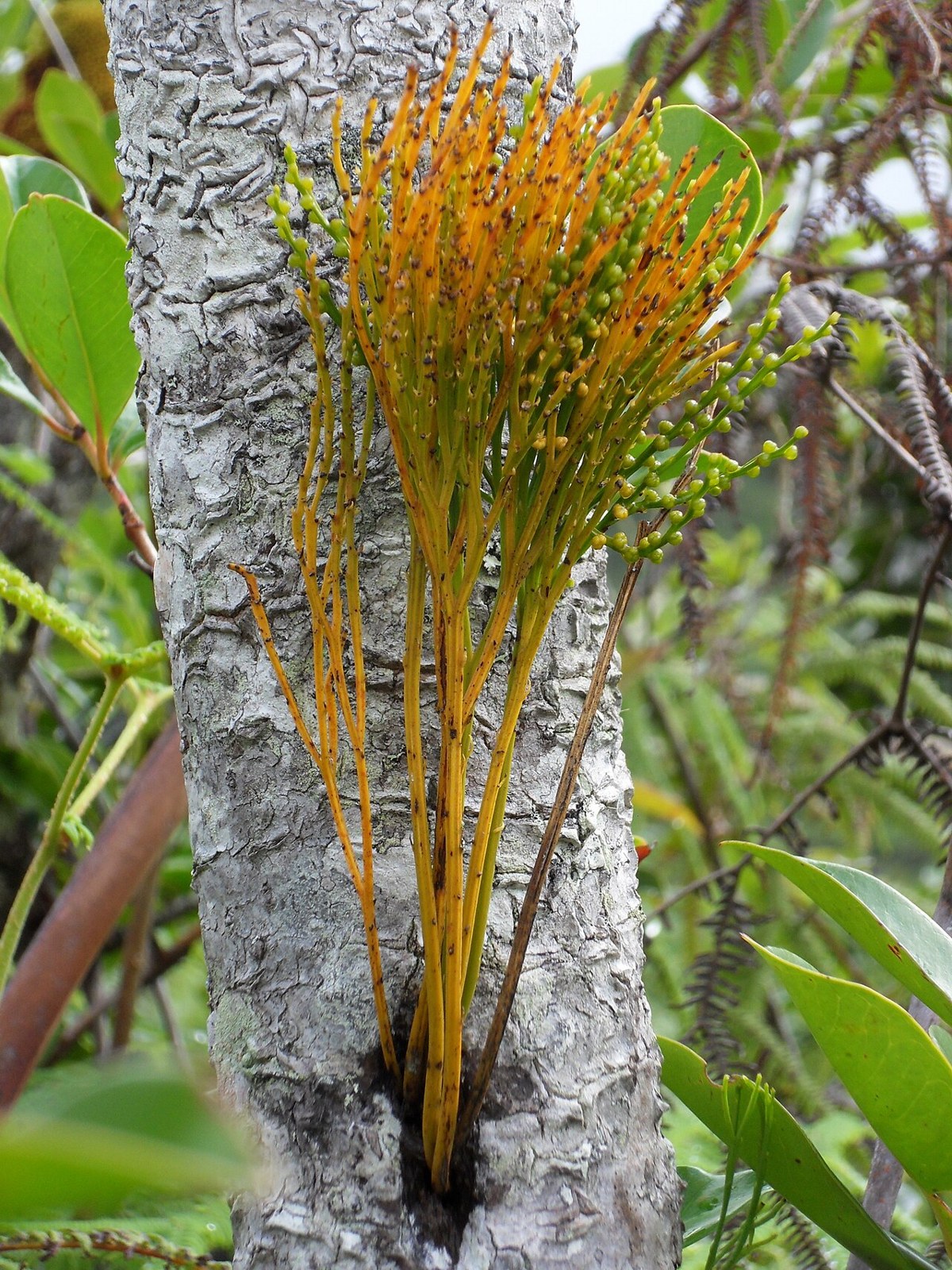
A small evergreen perennial, usually about 6 to 20 inches (15 to 50 cm) tall, that grows as an upright or drooping tuft of stems. The stems branch repeatedly in pairs (dichotomously), each fork making a Y. The upper stems are three-angled and grooved, bright green when growing in shade and yellowish green in sun. Epiphytic plants often hang down from their perch.
Stems and “Leaves”
Whisk fern has no true leaves. Instead, the stems carry tiny, scale-like bumps called enations, only about 1/16 inch (1 to 2 mm) long, spaced along the angles. The green stems do all of the photosynthesis.
No Roots
Whisk fern also has no roots. Below ground it has a branched, brown rhizome covered with fine hairs (rhizoids). The rhizome works with soil fungi, which help the plant take up water and nutrients.
Spores
There are no flowers or seeds. The spores are made in round, three-lobed capsules called synangia, about 1/8 inch (2 to 3 mm) across, set just above the tiny scales on the upper branches. They are green at first and turn bright yellow when ripe, then split open to release a fine powder of spores. The plant can also reproduce from small buds called gemmae on its rhizome.
Quick Facts
| Scientific Name | Psilotum nudum (L.) P. Beauv.; USDA common name: whisk fern |
| Family | Psilotaceae (whisk fern family) |
| Plant Type | Small evergreen leafless fern ally (terrestrial or epiphytic) |
| Mature Height | 6–20 in |
| Mature Spread | 6–12 in |
| Growth Rate | Slow |
| Sun Exposure | Partial shade to shade; tolerates some sun |
| Water Needs | Moderate; moist but well-drained, tolerates short dry spells |
| Soil Type | Humus-rich, well-drained soil, rock crevices, or organic matter on tree trunks |
| Soil pH | Acidic to slightly alkaline |
| Bloom Time | No flowers; spores produced much of the year |
| Flower Color | None (yellow spore capsules) |
| Fall Color | None; evergreen |
| Fruit | None; reproduces by spores and gemmae |
| Deer Resistant | Yes, rarely browsed |
| USDA Hardiness Zones | 8–11 |
Native Range
USDA PLANTS lists Psilotum nudum as native to Puerto Rico and the U.S. Virgin Islands, to Hawaii and the Pacific Basin, and to the lower 48 states, where it is recorded from Alabama, Arkansas, Arizona, Florida, Georgia, Louisiana, Mississippi, North Carolina, South Carolina and Texas. Worldwide it is found in tropical and subtropical regions of the Americas, Africa, Asia and Australia, with outlying populations in southern Japan, New Zealand and southern Spain.
In tropical forests it usually grows as an epiphyte, on tree trunks and among the roots of other epiphytes, or on rocks and old walls. In the southeastern United States it grows mainly in moist, shaded sites: on the bases of trees, on the old leaf bases of cabbage palms, on rotting logs and stumps, and in moist hammocks. In drier areas it hides in shaded rock crevices. It is common in Florida but rare and local toward the edges of its mainland range.
It is not listed under the U.S. Endangered Species Act, but it is uncommon at the northern edges of its range. It also turns up on its own in nursery pots and greenhouses, which is an easy way to obtain plants. Don’t pry plants off trees or rocks in the wild.
📋 Regional plant lists featuring Whisk Fern: Puerto Rico · North & South Florida · Alabama, Georgia & Mississippi · North & South Carolina · Arkansas, Louisiana, Eastern Oklahoma & Eastern Texas · Arizona & New Mexico · Hawaii
Growing & Care Guide
Whisk fern is a conversation piece rather than a showy plant, but it is easy to keep once established. It grows slowly, needs little attention and often appears by itself in pots of other plants. In Puerto Rico, Florida and Hawaii it can grow outdoors; farther north it does well in a pot indoors.
Light
Give it partial shade or bright, indirect light. It tolerates morning sun, and plants in brighter light turn a yellowish green. In deep shade it grows slowly but stays bright green.
Soil & Water
It needs a loose, well-drained mix rich in organic matter, such as potting soil with bark, or a pocket of humus in a rock wall or at the base of a palm. Keep it evenly moist but never waterlogged. Established plants can survive short dry spells, when the stems may yellow, and recover after rain.
Planting Tips
Because it has no roots, move it with its rhizome and the surrounding soil intact. Plant it in a shaded rock crevice, at the base of a tree or palm, in the old leaf bases of a cabbage palm, or in a small pot. It looks good in shaded rock gardens and terrariums.
Pruning & Maintenance
Little care is needed. Trim out old, brown stems at the base. It needs almost no fertilizer; a very dilute feeding once or twice a year is plenty.
Propagation
Divide established clumps, keeping a piece of rhizome with each section. Spores are difficult: the tiny underground gametophyte depends on soil fungi and grows very slowly. New plants often appear spontaneously in pots near an established plant.
Landscape Uses
- Shaded rock gardens: fits into crevices and walls
- Containers and terrariums: a slow-growing curiosity for small spaces
- Palm and tree bases: grows naturally among palm leaf bases and on trunks
- Teaching gardens: a living example of an ancient-looking plant form
- Low-maintenance shade: needs little water or fertilizer once established
Wildlife & Ecological Value
Whisk fern is a small plant with an unusual life, closely tied to the fungi that live in the soil and organic matter around it.
For Pollinators
As a spore-bearing plant, whisk fern has no flowers and offers nothing to pollinators. Pair it with flowering natives to support bees and butterflies.
For Birds
It offers little direct food for birds, but where it grows on trees and palms it is part of the community of epiphytes that shelter insects and other small animals birds feed on.
For Mammals
Whisk fern is not a known food for mammals, and its tough, wiry stems are rarely browsed.
Ecosystem Role
Whisk fern relies on partnerships with fungi. Its rootless rhizome works with soil fungi to take up water and minerals. Its spores grow into a tiny, colorless gametophyte that lives underground and gets its food from fungi rather than from sunlight, much like some orchids.
Cultural & Historical Uses
The name Psilotum comes from the Greek psilos, “bare” or “naked,” and the species name nudum also means “naked,” a double reference to the plant’s lack of leaves.
In Hawaii, where it is known as moa, the spores were collected and used like talcum powder to prevent chafing, and the stems were used in lei.
In Japan, where it grows wild in the south, whisk fern was a prized ornamental of the Edo period (1603–1867) under the name matsubaran, “pine-needle orchid.” Collectors named more than 100 garden varieties, and some are still grown today.
Frequently Asked Questions
Is whisk fern a fern?
Yes. It was long treated as a “primitive” fern ally, but DNA studies show it is a true fern, closely related to the moonworts and adder’s-tongue ferns. Its simple, leafless body is the result of evolutionary loss.
Why did a whisk fern appear in my flower pot?
Its tiny spores travel easily and the plant often comes in with nursery soil or potted palms. It is harmless and can be left in place or moved to its own pot with its rhizome intact.
Does it really have no roots or leaves?
It has no true roots or leaves. A hairy, branching rhizome anchors it and works with soil fungi to take up water, and tiny scale-like bumps on the stems stand in for leaves.
Is it native to Hawaii?
Yes. USDA lists it as native in Hawaii, where it grows on all the main islands and has the Hawaiian name moa.
How cold-hardy is it?
It tolerates light frost in protected spots in the Deep South, roughly to USDA zone 8, but it is best grown in a pot and kept indoors over winter farther north.

Looking for a nursery that carries Whisk Fern?
Our nursery directory does not yet include Puerto Rico. Browse the native plant nursery directory by state: Alabama–Arkansas · California · Colorado–Hawaii · Idaho–Kansas · Kentucky–Montana · Nebraska–Oklahoma · Oregon · Pennsylvania–Virginia · Washington · West Virginia–Wyoming