Adam’s Needle (Yucca filamentosa)
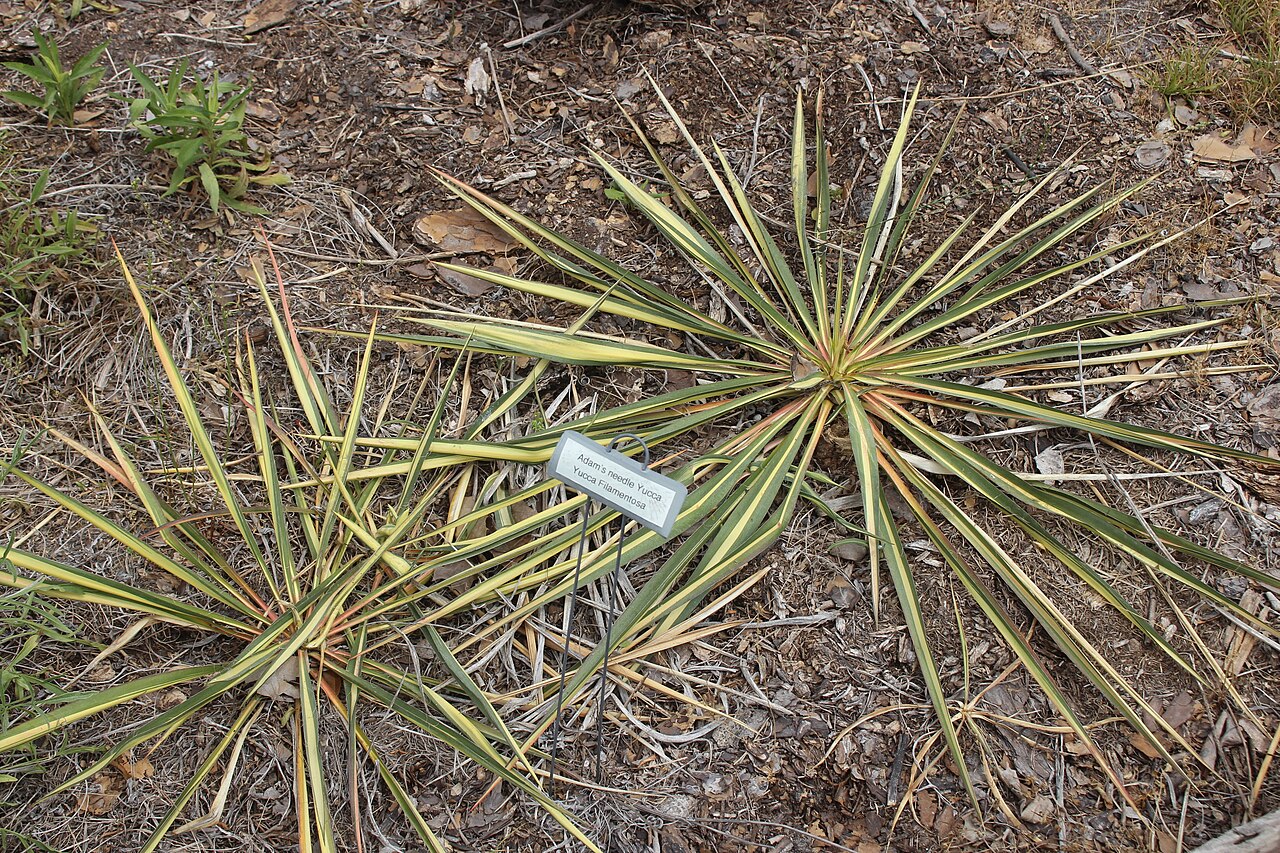
Yucca filamentosa, commonly called Adam’s Needle, is a trunkless, rosette-forming evergreen perennial native to the sandy soils of the southeastern United States. Its stiff, sword-shaped, blue-green leaves radiate from a short underground or barely visible stem, each leaf edged with pale, curling fibers that give the species its name. In early summer a single flower stalk shoots up from the center of the rosette, sometimes reaching 8 feet, hung with dozens of nodding, bell-shaped, creamy white flowers.
Adam’s Needle is one of the toughest and most recognizable native plants of the Southeast’s coastal plain, at home on sand dunes, sandhills and open pinelands where few other broad-leaved plants can compete with the heat, drought and poor soil. It has also become one of the most widely planted ornamental yuccas in North America, grown well outside its native range as a sculptural, low-maintenance accent plant. That popularity has let it escape cultivation and naturalize in parts of the Northeast, including Connecticut, Massachusetts and Rhode Island, where it is not native.
For southeastern gardeners working with hot, dry, sandy sites, Adam’s Needle offers bold year-round structure, a spectacular midsummer bloom and near-total indifference to drought and poor soil. It asks for almost nothing once established, and its bayonet-like leaf tips double as a natural deterrent to deer and foot traffic alike.
Identification
Adam’s Needle is unmistakable once its leaf margins are examined closely. The plant grows as a dense, stemless or very short-stemmed rosette of rigid leaves, usually 2 to 3 feet tall and wide, that slowly spreads by underground offsets into a colony of several rosettes.
Leaves
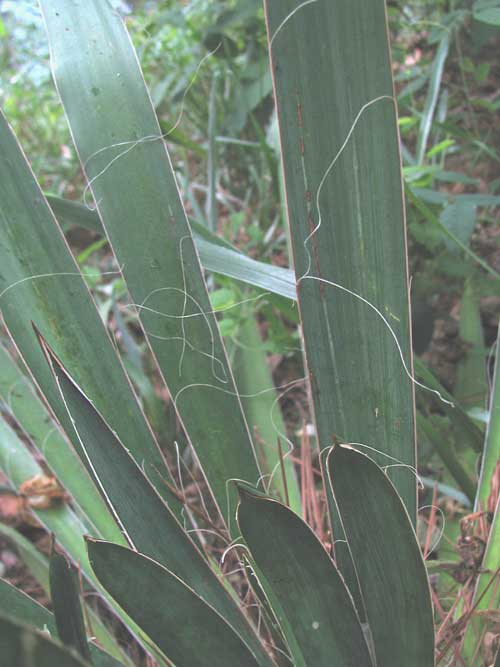
The leaves are stiff, flat to slightly concave, lance-shaped blades 1.5 to 2.5 feet long and 1 to 2.5 inches wide, tapering to a sharp, rigid terminal spine capable of puncturing skin. Leaf color ranges from dull blue-green to grayish green, sometimes with a whitish bloom. The single most reliable identification mark is along the leaf margins: fine, curly, pale fibers peel loose from the edges and coil like threads or wood shavings, a trait unique among the yuccas commonly grown in the Southeast and the source of the species name filamentosa.
Flowers
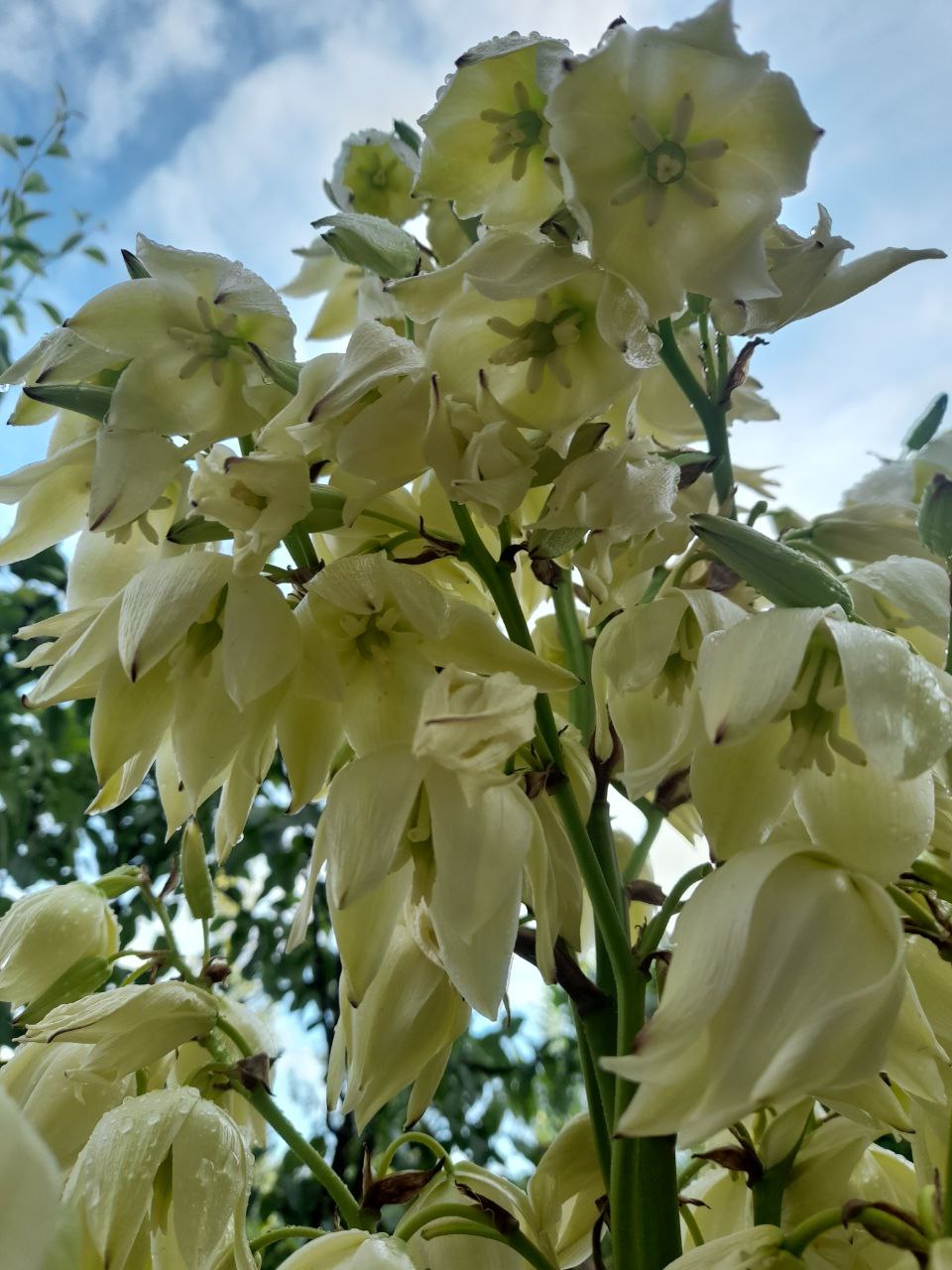
A stout flower stalk, or inflorescence, rises from the center of the rosette in late spring to midsummer, typically reaching 4 to 8 feet, occasionally more on vigorous plants. The upper half to two-thirds of the stalk carries a loose, branched cluster of large, nodding, bell-shaped flowers, each about 2 inches across, with six waxy, creamy white to pale greenish-white tepals. The flowers open mostly at dusk and through the night, when they release a light, sweet fragrance that draws their moth pollinators.
Fruit & Seeds
After pollination, flowers develop into dry, oblong, three-chambered capsules roughly 1.5 to 2 inches long that turn brown and split open at maturity in late summer and fall, releasing flat, black, papery seeds. Unlike the fleshy-fruited yuccas of the Southwest, Adam’s Needle produces a dry capsule, consistent with its dependence on yucca moths rather than birds or mammals for seed dispersal.
Quick Facts
| Scientific Name | Yucca filamentosa |
| Family | Asparagaceae (formerly Agavaceae) |
| Plant Type | Evergreen, clump-forming perennial (subshrub) |
| Mature Height | 2–3 ft foliage rosette; flower stalk to 4–8 ft |
| Mature Spread | 2–3 ft per rosette; colonies widen over time by offsets |
| Growth Rate | Slow to moderate |
| Sun Exposure | Full Sun to Part Shade |
| Water Needs | Low; excellent drought tolerance once established |
| Soil Type | Sandy, well-drained; tolerates poor, infertile soils |
| Soil pH | Acidic to neutral (about 5.5–7.0) |
| Bloom Time | June – July |
| Flower Color | Creamy white to pale greenish-white |
| Fall Color | None (evergreen) |
| Fruit | Dry brown capsule, 1.5–2 in, late summer–fall |
| Deer Resistant | Yes |
| USDA Hardiness Zones | 4–10 |
Native Range
Adam’s Needle is native to the Atlantic and Gulf coastal plain of the southeastern United States, from southeastern Virginia south through the Carolinas, Georgia and Florida, and west along the Gulf coast through Alabama, Mississippi and Louisiana. Within this range it is a true coastal plain specialist, rarely found far from sandy soils and rarely climbing into the Piedmont or mountains.
Typical habitat includes coastal and inland sand dunes, sandhills, dry open pine flatwoods and savannas, maritime scrub and forest edges, and old fields and roadsides on sandy soil. It thrives in full sun on the driest, most nutrient-poor sands where longleaf pine, turkey oak and wiregrass dominate, and it tolerates salt spray well enough to grow close behind coastal dunes.
Adam’s Needle is also one of the most widely cultivated native yuccas in American gardens, and its toughness has let it escape and persist well north and west of this native range. It is documented as naturalized, not native, on sandy or disturbed sites in Connecticut, Massachusetts, Rhode Island and parts of New Jersey and New York, and it is cultivated far beyond that; gardeners in those areas are growing an introduced ornamental, not a native plant, even though the species is native a few hundred miles to the south.
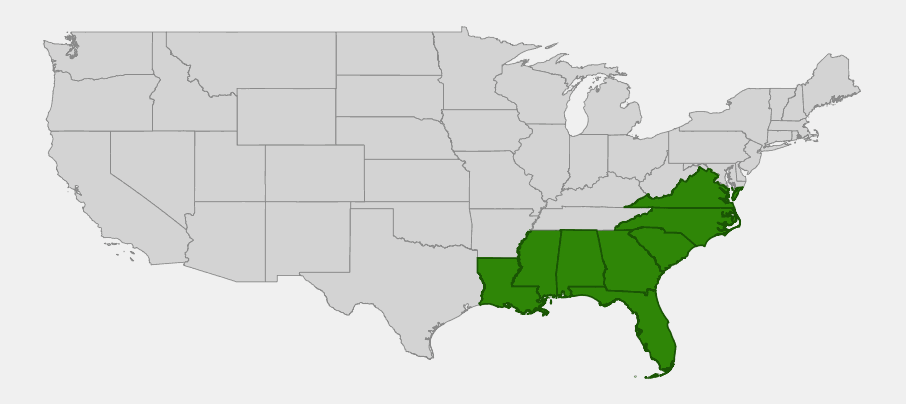
📋 Regional plant lists featuring Adam’s Needle: Maryland, Virginia & West Virginia · North Carolina & South Carolina · Georgia, Alabama & Mississippi · Arkansas, Louisiana, Eastern Oklahoma & Eastern Texas
Growing & Care Guide
Adam’s Needle is about as low-maintenance as native landscape plants get, provided it has the sharp drainage and full sun it enjoys in the wild. Once established, a single rosette can persist and slowly multiply for decades with no irrigation or fertilizer.
Light
Give Adam’s Needle full sun for the densest rosettes, strongest leaf color and most reliable summer flowering. It tolerates part shade, especially in the hottest part of its range, but plants grown in too much shade become loose and floppy and bloom poorly or not at all.
Soil & Water
Plant in sandy or well-drained average soil; this species has no tolerance for wet feet and will rot in heavy, poorly drained clay or soils that stay soggy after rain. Water new plants through their first summer to help roots establish, then step back. Established plants handle extended drought without supplemental water and are an excellent choice for the driest spot in the yard.
Planting Tips
Set out container-grown plants in spring or fall, at the same depth they grew in the pot, in a spot with sharp drainage, such as a slope, raised bed or sandy berm. Space rosettes at least 3 feet apart to allow for spreading offsets. Keep Adam’s Needle away from paths, patios and play areas; the rigid, spine-tipped leaves can puncture skin, and some gardeners clip the sharpest tips for safety near walkways.
Pruning & Maintenance
Remove the spent flower stalk after bloom and seed drop, cutting it near the base of the rosette; this tidies the plant and redirects energy to the leaves and offsets. Trim off any damaged or browned leaves at their base as needed. Established clumps rarely need dividing, but overgrown colonies can be thinned by digging and separating rooted offsets in spring.
Propagation
Adam’s Needle is most easily propagated by separating the rooted offsets, or “pups,” that form around a mature rosette; dig and replant them in spring once they have their own roots. It can also be grown from seed collected from ripe, dry capsules in fall, though seedlings take several years to reach flowering size.
Landscape Uses
- Dry, sandy and coastal gardens where few broad-leaved perennials can survive drought and salt spray
- Architectural accent for its bold, spiky rosette form and dramatic summer flower stalk
- Xeriscaping and rock gardens paired with saw palmetto and other drought-tolerant natives
- Security plantings beneath windows, where the sharp leaf tips discourage intruders
- Erosion control on sandy slopes and dunes, where its roots help stabilize loose soil
- Pollinator gardens, since the summer flower spike is a magnet for yucca moths and other night-flying insects
Wildlife & Ecological Value
Despite its tough, spiny appearance, Adam’s Needle supports a tightly woven and fascinating web of wildlife relationships, most famously with its namesake pollinator.
For Pollinators
Adam’s Needle depends almost entirely on yucca moths (Tegeticula species) for pollination, in one of the best-known examples of obligate mutualism in North American plants. A female yucca moth gathers pollen, carries it to another flower, and deliberately pollinates it before laying her eggs inside the developing ovary; her larvae then eat some, but not all, of the resulting seeds. Neither species can complete its life cycle without the other. Other night-flying moths and some bees visit the flowers as well.
For Birds
Small birds use the dense, spiny rosettes as protected nesting and escape cover, since few predators will push through the sharp leaves. The dry seed capsules are not a major food source for birds, though some may glean seeds from open, split pods.
For Mammals
The spine-tipped leaves make mature rosettes unappealing to deer and other browsers, which is part of why Adam’s Needle holds up so well in landscapes with heavy deer pressure. Small mammals, including rabbits, sometimes shelter among the leaf bases at the center of a dense clump.
Ecosystem Role
On the dry, nutrient-poor sands where it grows, Adam’s Needle’s extensive root system helps stabilize loose soil on dunes and sandhill slopes, and its evergreen rosettes add structure to open, fire-maintained pine communities where groundcover plants are otherwise low and sparse.
Cultural & Historical Uses
Indigenous peoples of the Southeast, including the Catawba, Cherokee and other coastal plain groups, historically used the tough, fibrous leaves of Adam’s Needle and related yuccas as a source of cordage, thread and basketry material, stripping and pounding the leaves to free the strong fibers. The roots, which contain natural saponins, were historically pounded and used as a soap substitute for washing.
Early European colonists and naturalists in the Southeast quickly took notice of the plant’s striking form, and by the 18th century Adam’s Needle was already being cultivated as an ornamental in American and European gardens, among the first North American native plants to achieve that kind of horticultural popularity. The common name itself reflects old folk naming conventions that paired a biblical figure, Adam, with the plant’s sharp, needle-tipped leaves.
That long cultivation history is also why the species now grows so far outside its native coastal plain range. Generations of gardeners planted it from Florida to New England for its drought tolerance and bold form, and in the Northeast some of those plantings have since escaped into sandy, disturbed ground, a reminder that even a native plant can behave like an introduced one once it is moved far from where it evolved.
Frequently Asked Questions
Is Adam’s Needle native to my state if I live outside the Southeast?
No. Adam’s Needle is native only to the coastal plain from Virginia to Louisiana. It is widely planted as an ornamental across much of the country and has naturalized on sandy ground in parts of New England, but outside its native southeastern range it should be considered an introduced garden plant, not a native one.
Are the leaf tips of Adam’s Needle dangerous?
Yes, the rigid leaves end in a sharp spine that can puncture skin or clothing, so site the plant away from paths, patios and play areas. Some gardeners trim the very tips for added safety without harming the plant.
Does Adam’s Needle need a yucca moth to set seed?
Essentially yes. Adam’s Needle relies almost entirely on yucca moths for pollination, so gardens without resident yucca moth populations may see abundant flowers but little or no seed set, even though the plant itself grows and blooms normally.
How long does it take Adam’s Needle to bloom?
A division or nursery-grown offset can bloom within a couple of years, while seed-grown plants typically need several years to reach flowering size. Established rosettes usually send up a flower stalk every year once mature.
Is Adam’s Needle deer resistant?
Yes, its stiff, spine-tipped leaves make it one of the more reliably deer-resistant native perennials for sunny, sandy sites, though no plant is completely immune to browsing under heavy deer pressure.

Looking for a nursery that carries Adam’s Needle?
Browse our native plant nursery directory: Virginia & South Carolina · North Carolina · Georgia & Florida · Alabama · Mississippi & Louisiana