
Bog Adder’s-mouth Orchid (Malaxis paludosa)
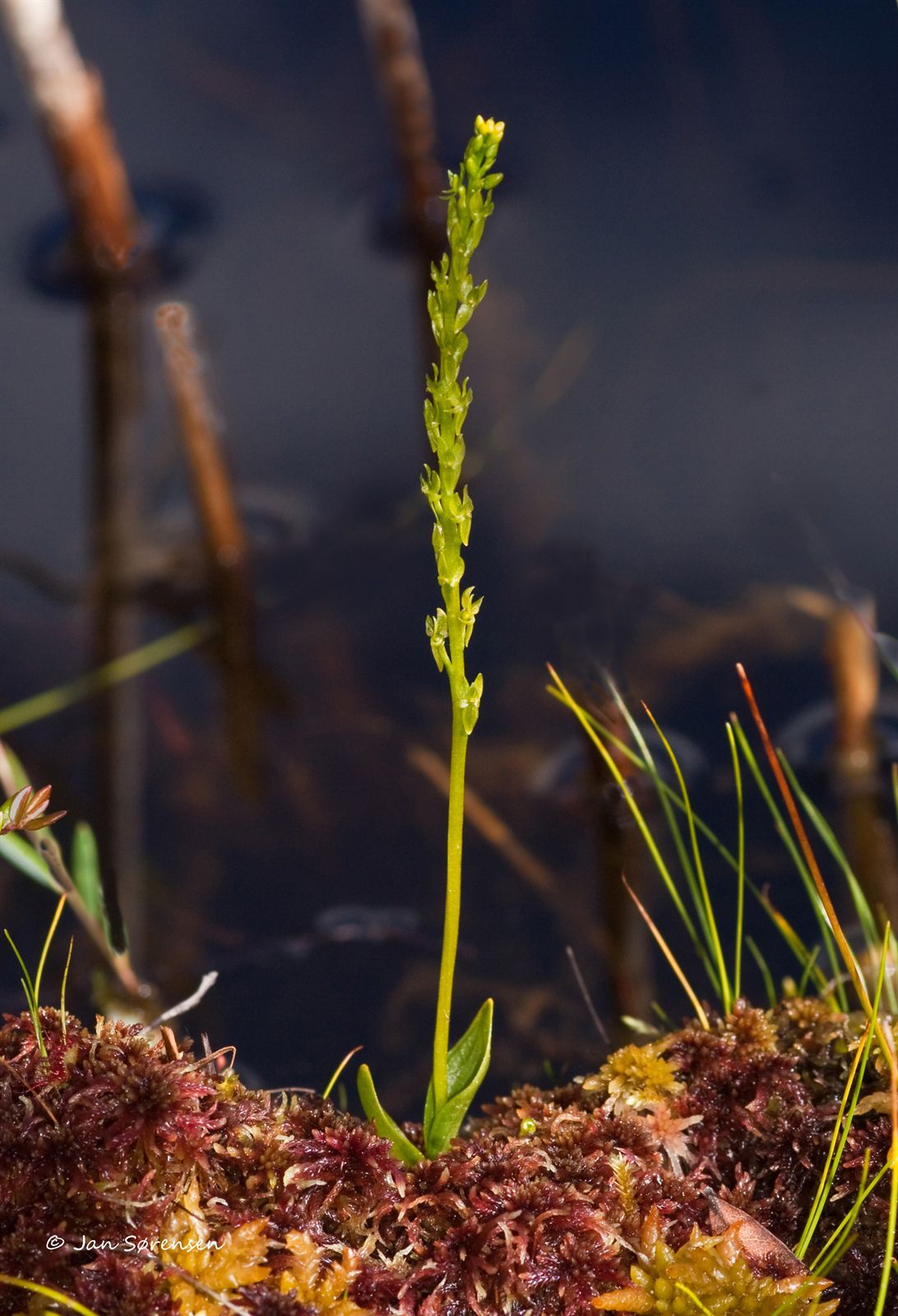
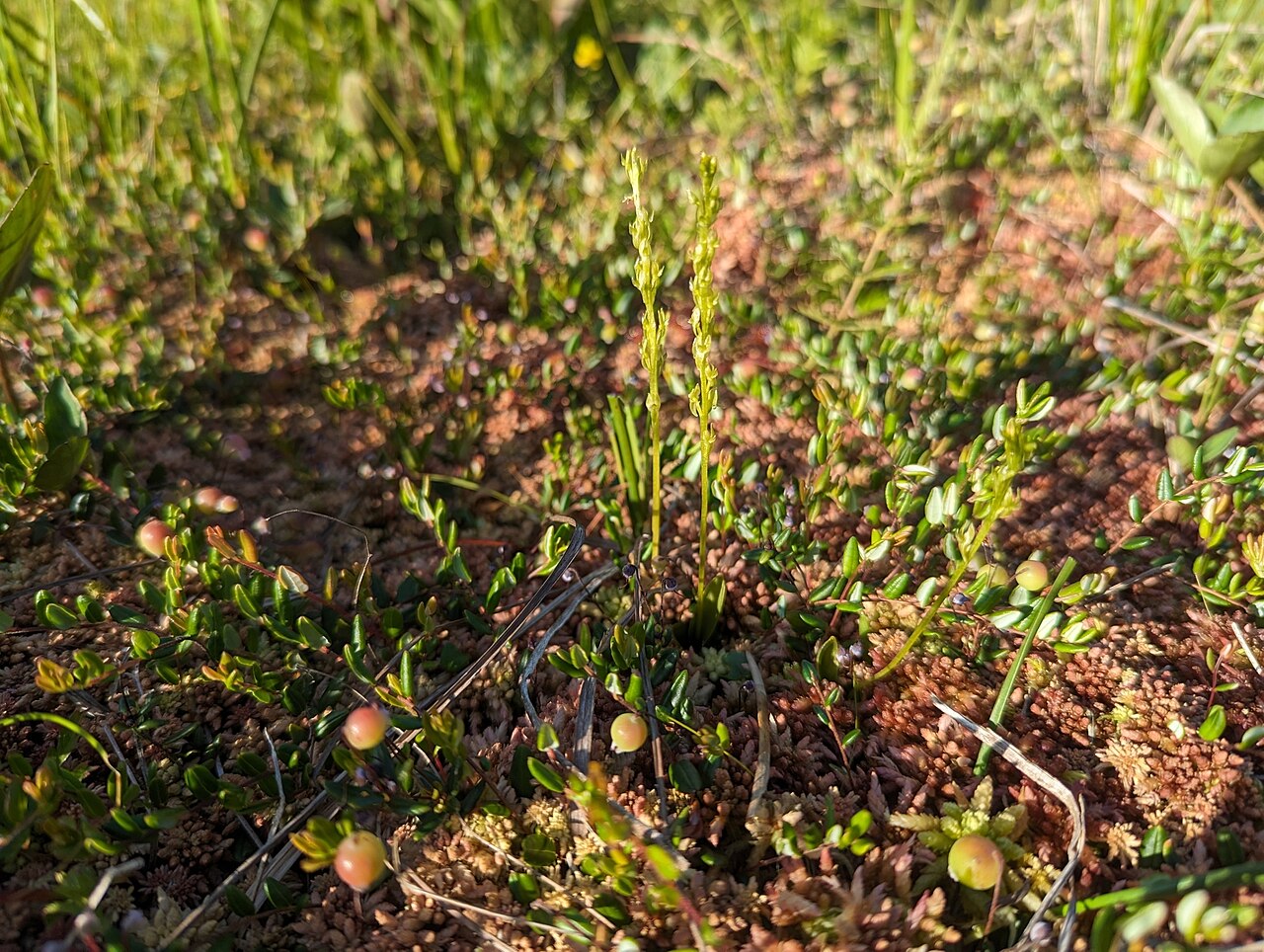
Malaxis paludosa, the Bog Adder’s-mouth Orchid or bog orchid, is one of the smallest and most elusive orchids in North America. A whole plant is usually 1 to 6 inches tall, with two or three small, pale green leaves and a slender spike of tiny greenish flowers in late summer. It grows perched in wet sphagnum moss in bogs and conifer swamps. Many botanists now place it in a genus of its own as Hammarbya paludosa.
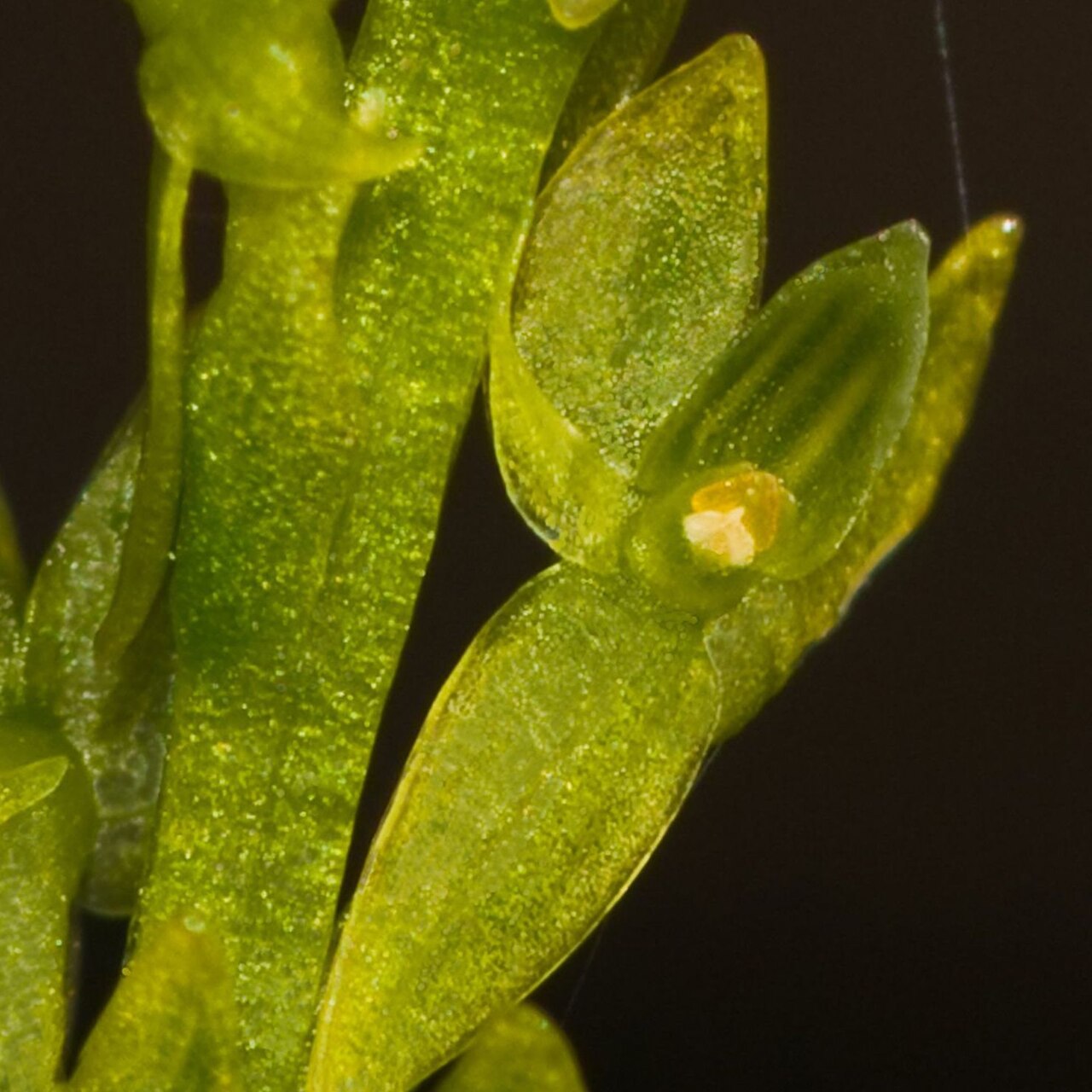
It is the only orchid known to produce tiny bud-like offspring, called gemmae, along the edges of its leaves. These drop off and can grow into new plants. Its flowers are unusual too: each flower stalk twists a full 360 degrees, so the lip points upward instead of down.
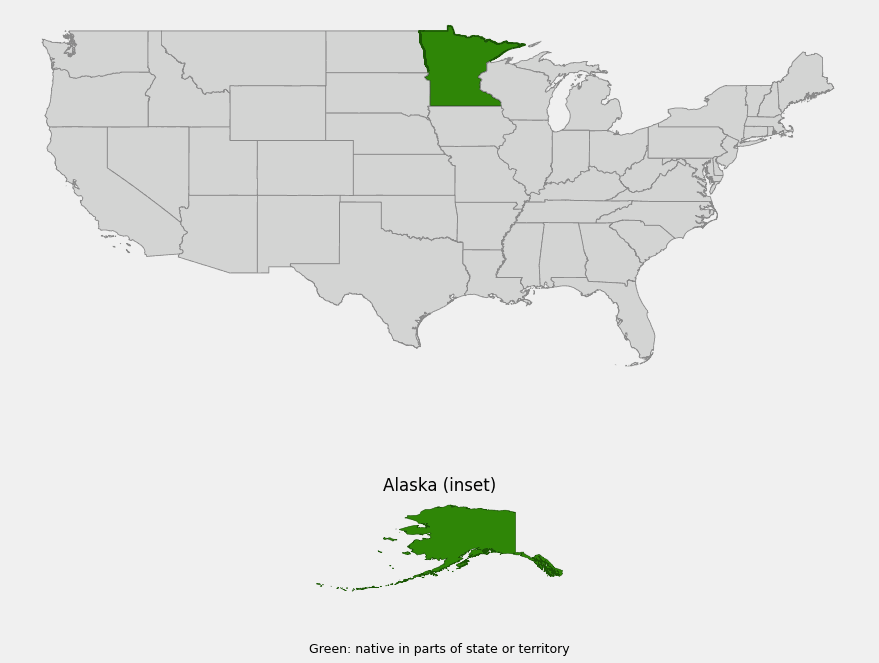
In the United States it is known only from Alaska and from a few small populations in northern Minnesota, where it is listed as endangered. It cannot be bought, grown in gardens or transplanted. This page is about recognizing and appreciating it. Never dig or disturb it: the plants depend on specific soil fungi and the wet moss they grow in, and they die when moved.
Identification
Look for a tiny, yellow-green orchid in wet sphagnum with two or three small, cupped basal leaves, a swollen bulb-like base, and a thin spike of minute green flowers with upward-pointing lips, from July to late August.
Growth Habit
Bog adder’s-mouth orchid is a small perennial, about 1 to 9 inches tall, but usually only a few inches. The base of the stem forms a small, bulb-like swelling (a pseudobulb), about 1/4 inch across, nestled in the moss. Plants are short-lived and flower only every year or two, so the number of plants visible at a site changes from year to year.
Leaves
There are two or three, occasionally four, small leaves at the base, about 1/2 to 1 1/4 inches long, oval, pale green or yellow-green, with edges that curl inward. In summer, tiny green bud-like gemmae often form along the leaf tips and edges; they fall off and can root in the moss as new plants.
Flowers
The flowering stem carries anywhere from a few to several dozen tiny flowers, usually 5 to 20, each about 1/12 inch wide and 1/6 inch tall. All parts are green except the lip, which is yellowish with green stripes. Because the flower stalk twists a full circle, the lip points upward and the larger sepal points down. The flowers have a faint, sweet, cucumber-like scent and are pollinated by tiny fungus gnats. It blooms from July to late August.
Fruit & Seeds
The fruit is a tiny capsule about 1/8 inch long, full of dust-like seeds that drift on the wind. As in all orchids, the seeds carry almost no food reserves and can germinate only after being colonized by the right soil fungus.
Look-alikes
Other small green orchids grow in northern wetlands. White adder’s-mouth (Malaxis monophyllos) and green adder’s-mouth (Malaxis unifolia) each have a single larger leaf and grow in swamps and woods, not usually on sphagnum. Loesel’s twayblade (Liparis loeselii) has two glossy, much larger leaves and flowers with the lip pointing down, as does the related large twayblade of drier woods. Bog adder’s-mouth’s tiny size, gemmae on its leaves, and upward-pointing lips set it apart.
Quick Facts
| Scientific Name | Malaxis paludosa (also Hammarbya paludosa) |
| Family | Orchidaceae (orchid family) |
| Plant Type | Tiny perennial orchid with a pseudobulb |
| Mature Height | 1–9 in (usually under 6 in) |
| Mature Spread | 1–2 in |
| Growth Rate | Slow; short-lived plants |
| Sun Exposure | Part shade to full sun in open bogs |
| Water Needs | Very high; constantly saturated moss |
| Soil Type | Living sphagnum or feather moss over peat |
| Soil pH | Acidic to near neutral (about 4.5–7.5) |
| Bloom Time | July–late August |
| Flower Color | Green, with a yellowish green-striped lip |
| Fall Color | None |
| Fruit | Tiny capsule with dust-like seeds |
| Deer Resistant | Not applicable; not a garden plant |
| USDA Hardiness Zones | 1–4 (wild only) |
Native Range
Bog adder’s-mouth orchid has a circumboreal range across northern Europe, Asia and North America, with large gaps, partly because it is rare and partly because it is so hard to spot. In North America it grows in Alaska, where it was first recorded in 1895, and across Canada in Yukon, the Northwest Territories, British Columbia, Alberta, Saskatchewan, Manitoba and Ontario. NatureServe ranks it as rare in most Canadian provinces.
USDA PLANTS lists it as native in Alaska and Minnesota. Alaska is its stronghold in the United States, and NatureServe considers it apparently secure there. The Minnesota populations, in the north of the state, are the southernmost known in North America. Each has fewer than 20 plants, and the Minnesota Department of Natural Resources has listed the species as endangered since 1984.
It grows in bogs and conifer swamps, on floating sphagnum mats and on mossy hummocks, where seeping water keeps the moss constantly wet. In northern Minnesota it occurs in rich conifer swamps under black spruce, northern white cedar, tamarack and balsam fir. In North America it is usually found at low elevations, from near sea level to about 1,000 feet.
📋 Regional plant lists featuring Bog Adder’s-mouth Orchid: Alaska · Michigan, Wisconsin & Eastern Minnesota
Can You Grow It?
No. Bog adder’s-mouth orchid is not sold by nurseries and cannot be grown in gardens. It depends on particular soil fungi for germination and continues to draw nutrients from them as an adult, and it needs constantly wet, living sphagnum moss. Plants dug from the wild die. In Minnesota it is a state-endangered plant, and disturbing it there may be illegal.
Light
In the wild it grows in open bogs and in the light shade of conifer swamps. In the southern part of its range it is often found in deeper shade, perhaps because shade keeps the moss cool and wet.
Soil & Water
It grows only in living sphagnum or feather moss kept saturated by seeping water. Draining a bog, or changing the flow of water through a swamp, is enough to eliminate it.
Planting Tips
Don’t try to plant it. If you want orchids for a bog garden, look for nursery-propagated plants of species that are grown in cultivation, and support the protection of wild peatlands where this orchid lives.
Pruning & Maintenance
The best care is to leave its habitat alone. Stay on boardwalks in bogs, since trampling compresses the moss and can crush plants that are almost invisible.
Propagation
In the wild it spreads by seed and by gemmae dropped from its leaves. Neither method works outside its habitat, and it has no place in home propagation. Never dig, pick or collect plants or seed.
Where to See It
- Alaska peatlands: bogs and wet muskegs in Alaska, its U.S. stronghold, in late summer
- Northern Minnesota swamps: rare; sites are usually kept confidential to protect them
- Boardwalks and guided walks: botanical field trips are the best way to see it without harming it
- Citizen science: photograph it and share records on iNaturalist or with state botanists; never collect it
Wildlife & Ecological Value
Bog adder’s-mouth orchid is a small part of the peatland ecosystem, but it is a good indicator of intact, undisturbed bogs with steady water flow.
For Pollinators
Its tiny green flowers are pollinated by fungus gnats and other very small flies, which pick up the pollen masses on their bodies. Studies in Minnesota found a fungus gnat carrying its pollen and noted that mosquitoes visit the flowers for nectar but are too large to pollinate them.
For Birds
It has no known direct value for birds.
For Mammals
Small mammals and insects eat some of its seed capsules; a Minnesota study found that about a third of the fruits were eaten.
Ecosystem Role
Like all orchids, it lives in partnership with mycorrhizal fungi, which it relies on to germinate and which continue to supply it with nutrients. These fungi also connect with other bog plants, so the orchid may draw some of its carbon from its neighbors through a shared fungal network.
Cultural & Historical Uses
Carl Linnaeus described this orchid in 1753 as Ophrys paludosa, from plants in the peat bogs of Sweden. The epithet paludosa means “of bogs.” In 1891 Otto Kuntze placed it in its own genus, Hammarbya, named after Hammarby, Linnaeus’s summer home; Flora of North America and USDA keep it in Malaxis.
Charles Darwin discussed it in his 1862 book on the fertilization of orchids, using its unusual upside-down flower structure in his study of how orchids evolved.
The name adder’s-mouth is used for the whole Malaxis group and is said to refer to the small flower’s resemblance to an open snake’s mouth. In Britain, where it is known as the bog orchid, it has become rare in England after centuries of peatland drainage.
Frequently Asked Questions
How big is the bog adder’s-mouth orchid?
Tiny. Most plants are 1 to 6 inches tall, with flowers only about 1/6 inch tall. It is easy to step on without seeing it.
Where does bog adder’s-mouth orchid grow in the United States?
Mainly in Alaska. A few small populations grow in northern Minnesota, where it is listed as endangered.
Can I grow bog adder’s-mouth orchid?
No. It isn’t sold and can’t be grown in gardens. It depends on specific soil fungi and constantly wet sphagnum moss. Never dig wild plants.
What makes this orchid unusual?
It produces tiny bud-like gemmae on its leaf edges that grow into new plants, which no other orchid is known to do, and its flowers twist a full turn so the lip points up.
Is it Malaxis or Hammarbya?
Both names are used. USDA and Flora of North America call it Malaxis paludosa; many other sources treat it as the only species in the genus Hammarbya.


