
Bog Cranberry (Vaccinium oxycoccos)
Vaccinium oxycoccos, known as Bog Cranberry, small cranberry (the USDA common name) or northern cranberry, is a tiny, creeping evergreen shrub of sphagnum bogs and acid peatlands across the northern parts of North America, Europe and Asia. In the United States it grows in Alaska, the northern tier of states from Washington and Oregon to Maine, and south in the East to Pennsylvania, Maryland, Virginia and West Virginia. Many references list it as Oxycoccus microcarpus or Oxycoccus palustris.
Bog cranberry is easy to overlook. Its thread-like stems creep over the surface of sphagnum moss, carrying tiny, pointed leaves only about 1/4 inch long. In early summer it produces delicate pink flowers with four strongly swept-back petals, like miniature shooting stars, followed in late summer and fall by round red berries that are often bigger than the leaves.
The tart berries are edible and have been gathered for food for thousands of years by Indigenous peoples and later by settlers, in North America as well as in Europe and Asia. Bog cranberry is a key plant of northern peatlands, a larval host for bog butterflies and a food source for birds and mammals. This guide covers identification, range, growing it in a bog garden and its value to wildlife.
Identification
Bog cranberry is a true miniature. Look for thread-thin trailing stems on sphagnum moss, tiny leaves with rolled edges and whitish undersides, nodding pink flowers and red berries on long, thin stalks.
Growth Habit
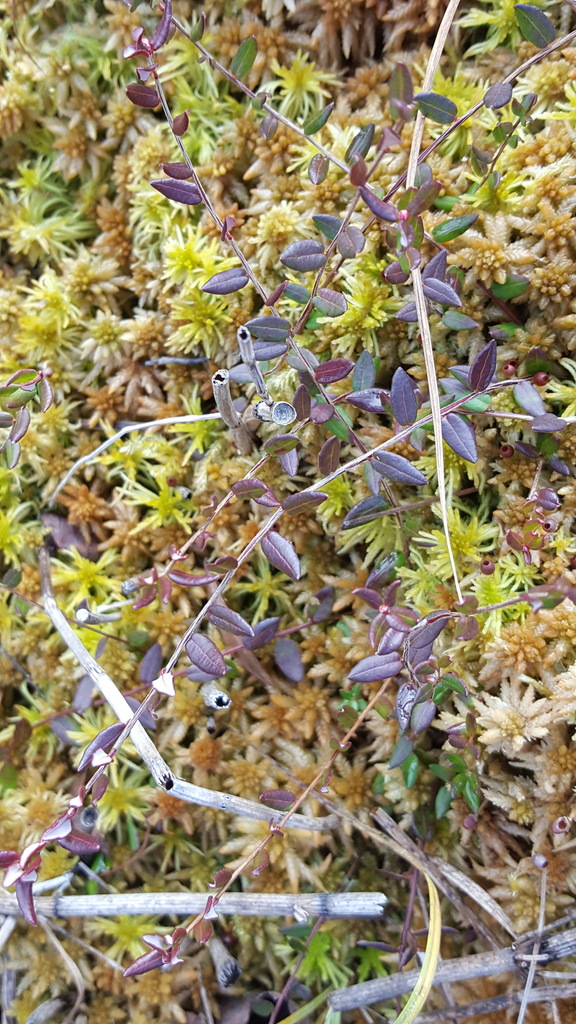
It is a prostrate, evergreen dwarf shrub with very slender, wiry, trailing stems that creep over and through sphagnum moss and root along their length. The stems may be a foot or more long but rise only an inch or two above the moss. Plants often form loose, interwoven mats across a bog.
Leaves
The leaves are alternate, leathery and very small, about 1/8 to 1/3 inch long, oval to triangular with pointed tips. The edges are rolled under, the upper surface is dark green and shiny, and the underside is pale whitish. In winter the leaves often turn reddish or purplish-bronze.
Flowers
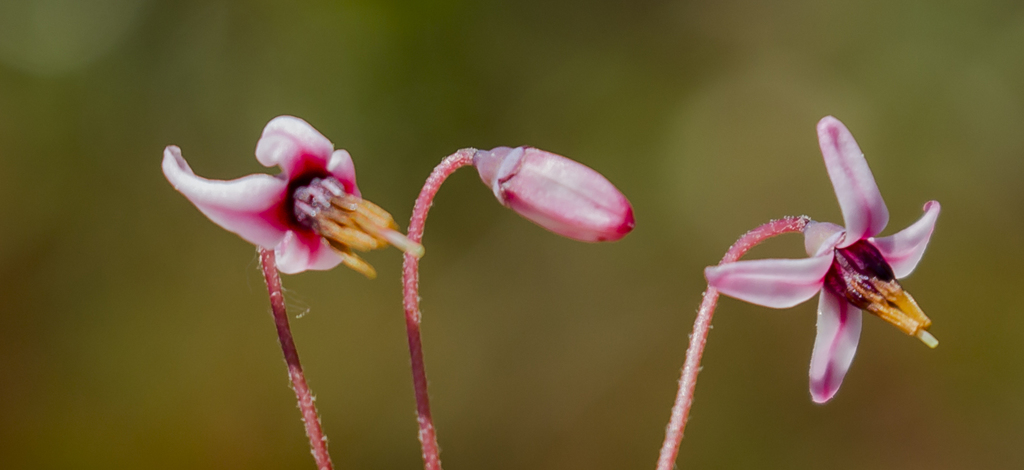
One to four flowers arise at the tips of the shoots on long, thin, reddish stalks. Each flower nods and has four pink petals, about 1/4 inch long, that curve sharply backward, exposing a pointed cone of yellow-brown stamens. The flowers bloom in June and July.
Fruit & Seeds
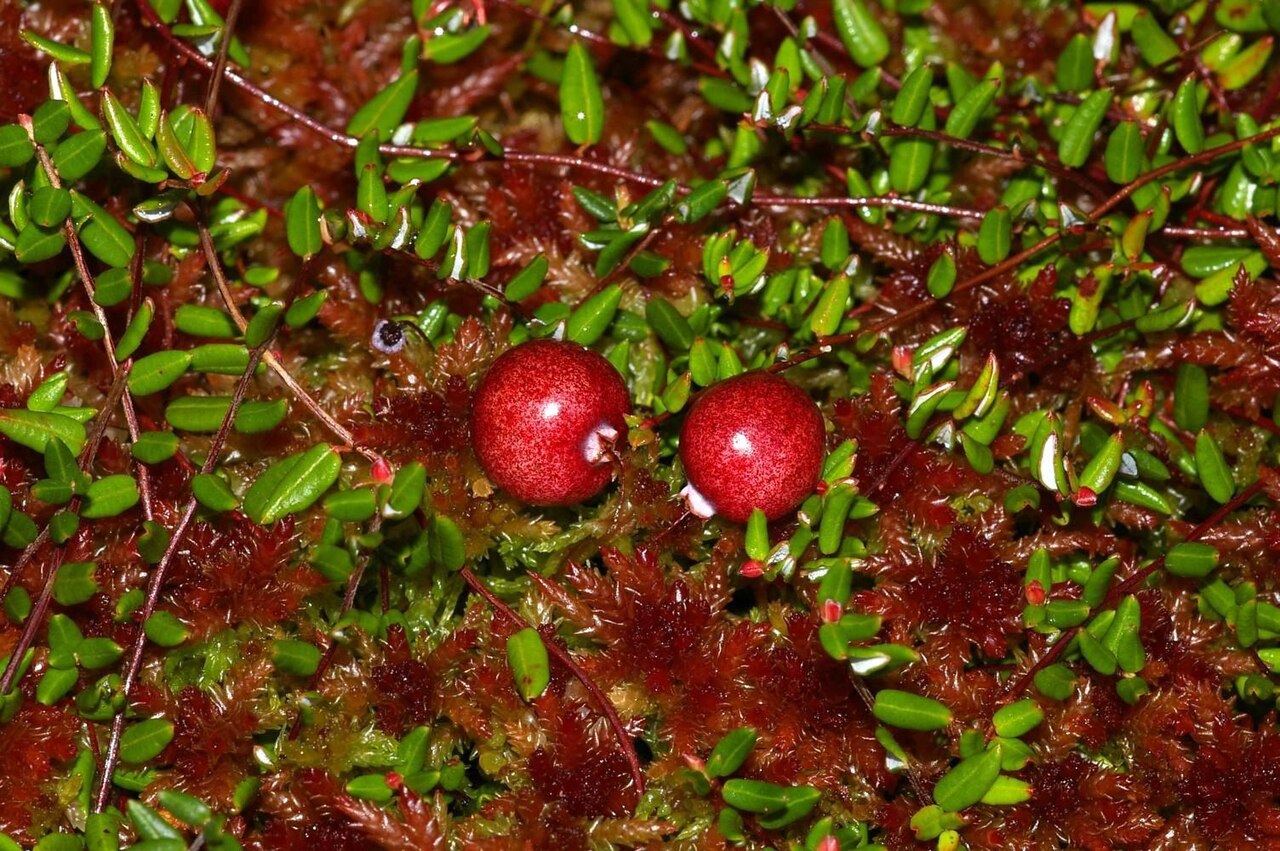
The berries are round, about 1/4 to 1/2 inch across, pale and often speckled at first, ripening to bright or dark red in late summer and fall. They are juicy, very tart and often remain on the plant over winter, sweetening a little after frost.
Look-alikes
American cranberry (Vaccinium macrocarpon), the commercial cranberry, has larger, flat, blunt-tipped leaves, flower stalks that arise along the stem rather than at the tip, and larger berries. Lingonberry (Vaccinium vitis-idaea) is upright, with larger, glossy, dotted leaves and bell-shaped flowers. Creeping snowberry (Gaultheria hispidula) also creeps over moss in bogs but has bristly stems and white berries.
Quick Facts
| Scientific Name | Vaccinium oxycoccos L. (syn. Oxycoccus microcarpus, Oxycoccus palustris) |
| Family | Ericaceae (heath family) |
| Plant Type | Creeping evergreen dwarf shrub |
| Mature Height | 1–3 in |
| Mature Spread | 1–3 ft (trailing stems) |
| Growth Rate | Slow |
| Sun Exposure | Full sun to partial shade |
| Water Needs | High; constantly wet |
| Soil Type | Sphagnum peat; wet, acidic, nutrient-poor soils |
| Soil pH | Strongly acidic, about 3.5–5.5 |
| Bloom Time | June–July |
| Flower Color | Pink |
| Fall Color | Leaves turn reddish to bronze in fall and winter |
| Fruit | Round red berry, about 1/4–1/2 in |
| Deer Resistant | Not well documented |
| USDA Hardiness Zones | 2–6 |
Native Range
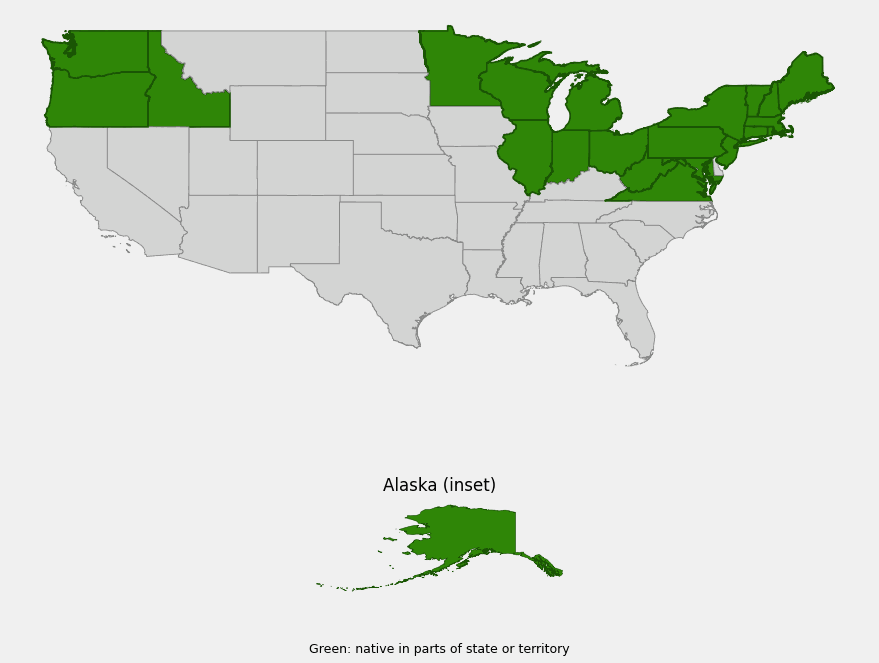
Bog cranberry is circumboreal, growing across the northern parts of North America, Europe and Asia. In North America it ranges from Alaska and Greenland across all of Canada and south into the northern United States. USDA PLANTS lists it as native in 22 states: Alaska, Washington, Oregon, Idaho, Minnesota, Wisconsin, Michigan, Illinois, Indiana, Ohio, Pennsylvania, New York, New Jersey, Maryland, Virginia, West Virginia, and all six New England states.
It is most common in the peatlands of Alaska, the upper Great Lakes states (Minnesota, Wisconsin and Michigan), northern New York and northern New England. Farther south, in Illinois, Indiana, Ohio, Pennsylvania, Maryland, Virginia and West Virginia, it is confined to scattered bogs, many of them relicts of the last ice age, and it is uncommon to rare. In the Pacific Northwest it grows in coastal and lowland bogs west of the Cascades and in scattered mountain bogs, including in northern Idaho.
Typical habitats are sphagnum bogs, poor fens, floating bog mats around ponds and lakes, black spruce and tamarack peatlands, and wet tundra. It needs constantly wet, very acidic, nutrient-poor peat and is rarely found on mineral soils.
📋 Regional plant lists featuring Bog Cranberry: Alaska · Western Oregon & Western Washington · Idaho, Eastern Oregon & Eastern Washington · Michigan, Wisconsin & Eastern Minnesota · Illinois, Iowa & Missouri · Ohio & Indiana · New York, Pennsylvania & Northern New Jersey · Delaware, Southern New Jersey & Long Island · Maryland, Virginia & West Virginia · Connecticut, Massachusetts & Rhode Island · New Hampshire, Maine & Vermont · North Dakota, South Dakota & Western Minnesota
Growing & Care Guide
Bog cranberry can be grown in a carefully built bog garden in cool northern climates, but it is a specialist’s plant. It is occasionally sold by native and carnivorous plant nurseries. Buy nursery-propagated plants only: never dig it from a bog, since bog plants are slow-growing and peatland habitats are easily damaged.
Light
It grows best in full sun to light shade. In the wild it grows on open bog mats and under scattered spruce and tamarack.
Soil & Water
It needs constantly wet, strongly acidic, nutrient-poor growing media, such as live sphagnum moss over peat. Water with rainwater, not hard tap water, and never fertilize. It does not tolerate drying out, alkaline soil or summer heat.
Planting Tips
Build a lined bog garden filled with peat and sand, or plant it in a large container kept standing in rainwater. Set plants into living sphagnum moss if possible, and combine them with pitcher plants, sundews, leatherleaf and other bog natives. It is happiest where summers are cool.
Pruning & Maintenance
No pruning is needed. Keep the moss surface moist and free of taller weeds and grasses. Mulch with sphagnum in winter in exposed sites.
Propagation
Root cuttings of trailing stems in moist sphagnum in summer, or layer stems by pinning them to the moss. Seeds need cold stratification and germinate slowly.
Landscape Uses
- Bog gardens: its fine, trailing stems, pink flowers and red berries make a delicate groundcover between pitcher plants and sundews.
- Wild edible interest: the tart berries can be used like commercial cranberries in sauces and preserves.
- Peatland restoration: it is an important component of sphagnum bog plant communities.
- Container water gardens: it can be grown in a peat-filled container kept wet with rainwater in cool climates.
- Nature study: bog walks on boardwalks in the northern states are the best way to see it flowering in June and fruiting in fall.
Wildlife & Ecological Value
Bog cranberry is a small plant with an outsized role in northern peatland food webs.
For Pollinators
Bumble bees and other native bees pollinate the flowers, often by vibrating them to release pollen (buzz pollination). The Xerces Society lists it as having special value to native bees. It is a larval host plant for the bog fritillary (Boloria eunomia), according to the Lady Bird Johnson Wildflower Center, and the bog copper butterfly (Lycaena epixanthe) also depends on wild cranberries.
For Birds
Grouse, ptarmigan, waterfowl, cranes and songbirds eat the berries, which are especially valuable in late winter and early spring because they stay on the plants under the snow.
For Mammals
Bears, foxes and small mammals eat the berries.
Ecosystem Role
Bog cranberry is a characteristic species of sphagnum bogs and helps define these acidic, carbon-rich peatland ecosystems. Its persistent berries provide food through the lean winter months.
Cultural & Historical Uses
The name oxycoccos comes from Greek words meaning “sour berry”. The English name “cranberry” is often explained as “crane berry”, because the nodding flowers resemble the head and bill of a crane.
Indigenous peoples across northern North America gathered wild bog cranberries for food and preserved them for winter. In northern Europe and Russia the same species is still widely harvested from the wild for juices, jams and sauces.
American cranberry (Vaccinium macrocarpon) is the species grown commercially in North America. Bog cranberry has smaller berries and is gathered from the wild rather than farmed.
Frequently Asked Questions
Are bog cranberries edible?
Yes. The berries are edible but very tart, like commercial cranberries. They are best cooked into sauces or jams. Only harvest where it is legal and abundant, and never damage the bog.
How is bog cranberry different from the cranberries in stores?
Store cranberries come from American cranberry (Vaccinium macrocarpon), which has larger leaves and berries. Bog cranberry is a smaller plant with tiny leaves and smaller berries.
Where does bog cranberry grow?
In sphagnum bogs and acid peatlands across Alaska, Canada and the northern United States, south to the mid-Atlantic in scattered bogs.
Can I grow bog cranberry in my garden?
Yes, in a bog garden or container of wet, acidic peat and sphagnum moss in a cool climate. Use rainwater, avoid fertilizer and buy nursery-propagated plants.
When does bog cranberry bloom and fruit?
It blooms in June and July. The berries ripen from late August into fall and often remain on the plants through winter.

Looking for a nursery that carries Bog Cranberry?
Browse our native plant nursery directory: Alaska · Connecticut · Idaho, Illinois & Indiana · Maine, Maryland, Massachusetts, Michigan & Minnesota · New Hampshire, New Jersey, New York & Ohio · Oregon · Pennsylvania, Rhode Island, Vermont & Virginia · Washington · West Virginia & Wisconsin

