
Southern Mountain Cranberry (Vaccinium erythrocarpum)
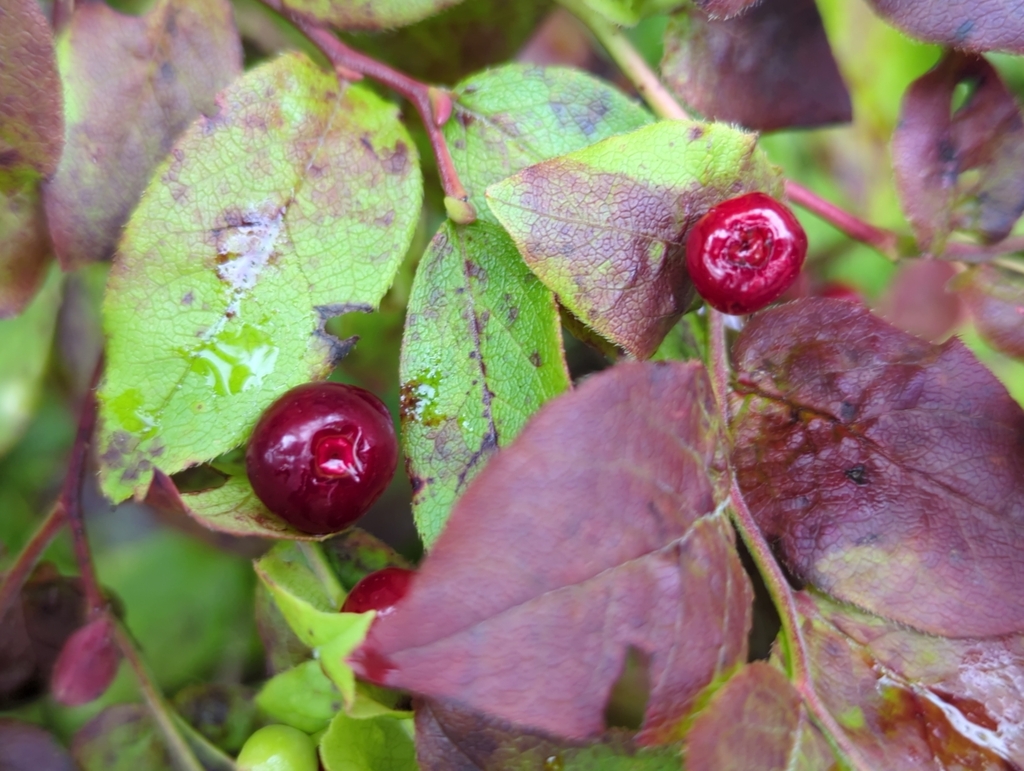
Vaccinium erythrocarpum, the Southern Mountain Cranberry, also called bearberry or mountain cranberry, is a deciduous shrub of the high Southern and Central Appalachians. It grows 1 to 5 feet tall, with thin, pointed, finely toothed leaves, and in early summer it hangs small pink flowers with curled-back petals beneath its branches, much like those of a cranberry. By late summer these become glossy, translucent scarlet berries that ripen to dark red.
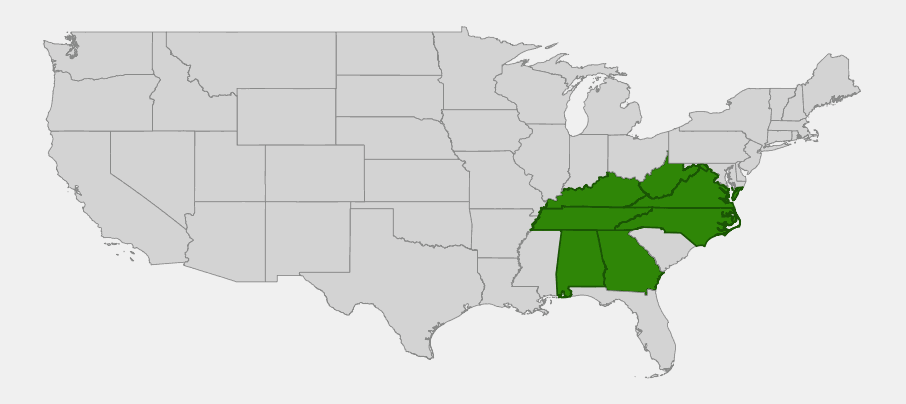
It is a true cranberry relative. Botanists place it in the cranberry group of Vaccinium (subgenus Oxycoccus), but unlike the low, trailing, evergreen bog cranberries, it is an upright, deciduous shrub of mountain forests. It grows mainly at high elevations in North Carolina, Tennessee, Virginia and West Virginia, with scattered records in Kentucky, Georgia and Alabama.
The berries are edible and taste much like other cranberries, though a shrub produces only a modest crop. It is uncommon in nurseries, but it is a lovely, little-known native for cool, shady, acidic gardens in the mountains, with pink summer flowers, red berries and red to purple fall color.
Identification
Look for a thin-twigged, deciduous shrub of high-elevation forests and heath balds with pointed, finely toothed leaves, nodding pink flowers with strongly curled-back petals in June, and glossy, translucent red berries in late summer.
Growth Habit
Southern mountain cranberry is a loosely branched, upright to spreading deciduous shrub, usually 1 to 5 feet tall. Its slender, green to reddish twigs are often slightly zigzag and finely hairy in lines. It spreads slowly by underground stems and can form small patches in good sites.
Leaves
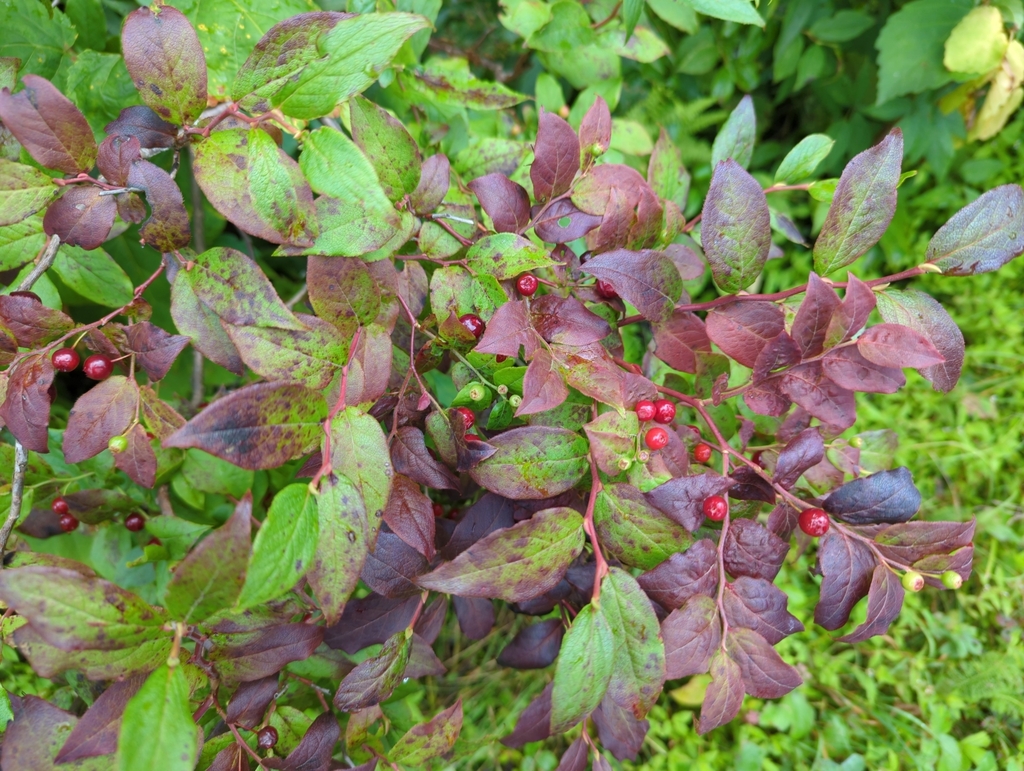
The leaves are alternate, thin, oval to lance-shaped, about 1 to 3 1/2 inches long, with long-pointed tips and finely toothed edges, each tooth tipped with a tiny bristle. They are bright green above and paler beneath. In late summer and fall they turn red, purple or bronze.
Flowers
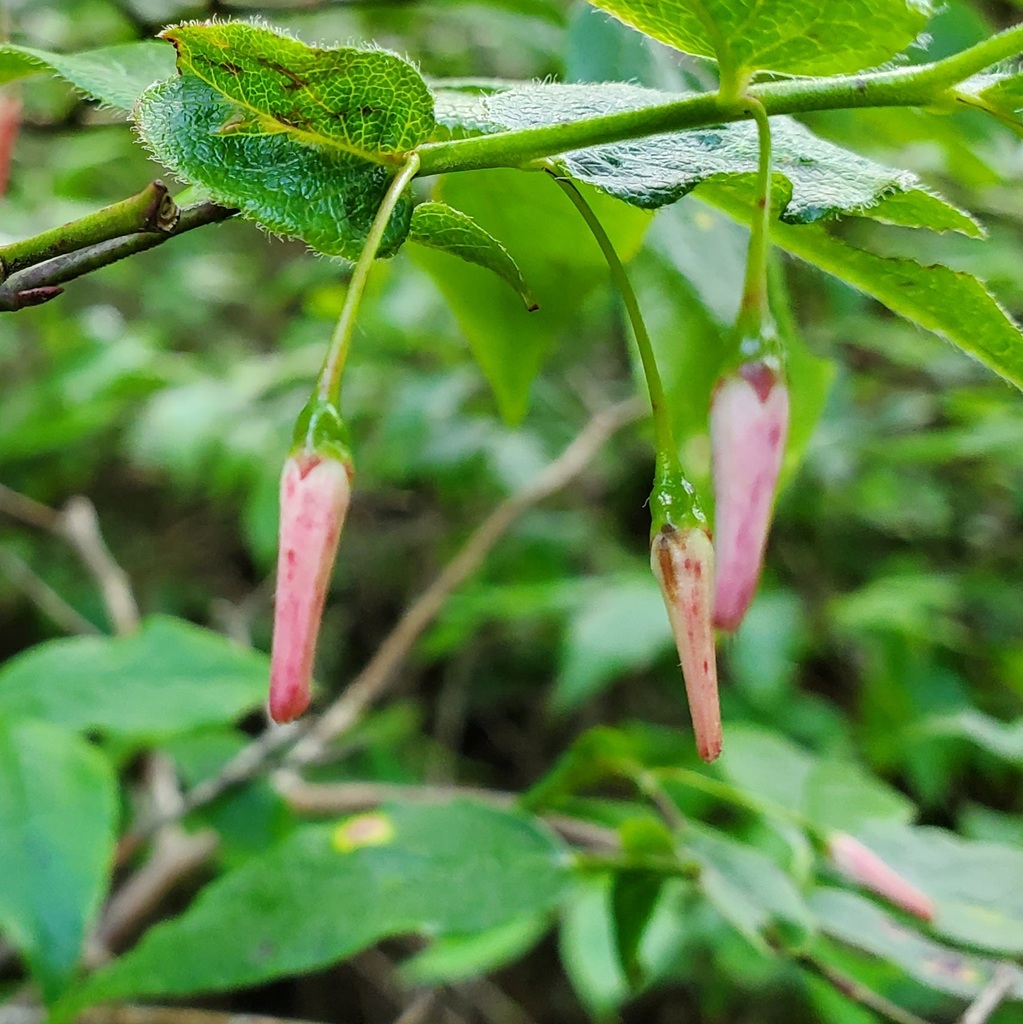
The flowers open in June and July, singly on slender, drooping stalks from the leaf axils on new shoots. Each is about 1/3 to 1/2 inch long, with four narrow pink to reddish petals that curl sharply backward, exposing a cluster of long stamens that point downward, like a tiny shooting star. This flower shape is typical of the cranberry group and very different from the bell-shaped flowers of blueberries and huckleberries.
Fruit & Seeds
The berry is round, about 1/4 to 3/8 inch across, glossy and translucent, ripening from scarlet to dark red or almost purplish-black from August into September. It is juicy and sour, much like other cranberries, and holds many tiny seeds.
Look-alikes
Blueberries such as highbush blueberry and huckleberries such as black huckleberry grow in the same mountains but have bell- or urn-shaped flowers and blue or black fruit. Bog cranberry and American cranberry have the same curled-back flowers and red berries, but they are tiny, trailing evergreen plants of bogs. The “bearberry” name is shared with Arctostaphylos uva-ursi, a low evergreen ground cover with leathery leaves.
Quick Facts
| Scientific Name | Vaccinium erythrocarpum |
| Family | Ericaceae (heath family) |
| Plant Type | Deciduous shrub |
| Mature Height | 1–5 ft |
| Mature Spread | 2–4 ft |
| Growth Rate | Slow |
| Sun Exposure | Part shade to full shade |
| Water Needs | Moderate; evenly moist |
| Soil Type | Acidic, humus-rich, well-drained, rocky or peaty soils |
| Soil pH | Strongly acidic (about 4.0–5.5) |
| Bloom Time | June–July |
| Flower Color | Pink to reddish |
| Fall Color | Red, purple or bronze |
| Fruit | Glossy, translucent red to dark red berries, August–September |
| Deer Resistant | No; browsed by deer |
| USDA Hardiness Zones | 5–7 |
Native Range
Southern mountain cranberry is native to the Southern and Central Appalachian Mountains. USDA PLANTS lists it from Alabama, Georgia, Kentucky, North Carolina, Tennessee, Virginia and West Virginia. It is most frequent in the high mountains of western North Carolina and eastern Tennessee (including the Great Smoky Mountains, Grandfather Mountain, the Black Mountains and the Roan Highlands), southwestern Virginia and the Allegheny highlands of West Virginia.
It is rare in Kentucky and Georgia, at the edges of its range. The Alabama record is an outlying one, from the southern tail of the Appalachians. Botanists once treated it as the same species as a shrub of Japan and China, now called Vaccinium japonicum, but the two are now usually considered separate, closely related species.
It grows at high elevations in red spruce and Fraser fir forests, northern hardwood forests, oak-heath forests, heath balds and rocky summits, as well as in mountain bogs and seeps. It usually grows in light to moderate shade, in cool, moist, very acidic, humus-rich soil.
📋 Regional plant lists featuring Southern Mountain Cranberry: Alabama, Georgia & Mississippi · Kentucky & Tennessee · North & South Carolina · Maryland, Virginia & West Virginia
Growing & Care Guide
Southern mountain cranberry is a plant for cool, moist, shady gardens with acidic soil, especially in the Appalachian region. It is rarely sold, so look for it at native plant nurseries and plant sales in the Southern Appalachians, and never dig it from the wild.
Light
Part shade to full shade. It grows naturally under spruce, fir and hardwoods and on shaded balds. Morning sun with afternoon shade works well in cooler mountain gardens; in hot, low-elevation gardens it needs shade.
Soil & Water
It needs very acidic (pH 4 to 5.5), humus-rich, well-drained but evenly moist soil, like other blueberry and cranberry relatives. Mulch with pine needles, shredded bark or leaf mold. Water during dry spells, especially in its first few years. It does not tolerate alkaline, compacted or hot, dry soil.
Planting Tips
It does best in the mountains and other cool-summer areas, roughly zones 5 to 7, and struggles in the heat of the Piedmont and Coastal Plain. Plant it at the edge of a woodland garden, among rhododendrons and mountain laurel, or in a shady rock garden where its pink flowers and red berries can be seen up close. Plant several together for a better berry crop.
Pruning & Maintenance
Little pruning is needed. Remove dead or crowded stems in late winter. Keep a deep mulch over the roots and avoid fertilizing with anything but a light, acidic organic fertilizer. Protect young plants from deer, which browse it.
Propagation
Grow it from seed cleaned from ripe berries and sown in fall on a moist, acidic mix (seeds need cold stratification), or from softwood cuttings taken in early summer and rooted with mist. It can also be divided from small rooted suckers at the edge of a patch.
Landscape Uses
- Woodland gardens: a delicate shrub for shaded, acidic beds
- Rhododendron and laurel plantings: shares their need for acid, humus-rich soil
- Edible landscapes: a small crop of tart, cranberry-like berries
- Wildlife gardens: berries for birds and mammals
- Mountain native gardens: a high-elevation Appalachian native for cool sites
Wildlife & Ecological Value
Southern mountain cranberry adds flowers in early summer and berries in late summer to the shrub layer of high Appalachian forests.
For Pollinators
The nodding flowers are visited mainly by bumblebees and other large bees, which buzz the flowers to shake pollen out of the downward-pointing stamens (buzz pollination), as with other cranberries and blueberries.
For Birds
The berries are eaten by birds such as ruffed grouse, thrushes and other birds of the high mountain forests, which spread the seeds.
For Mammals
Black bears, chipmunks and other mammals eat the berries, and white-tailed deer browse the twigs and leaves.
Ecosystem Role
It is part of the shrub layer of the Southern Appalachian spruce-fir forest and heath balds, rare habitats found only on the highest peaks. Along with blueberries and huckleberries, it supplies food for wildlife in late summer, and its flowers support native bees in early summer.
Cultural & Historical Uses
The species name erythrocarpum means red-fruited, from the Greek erythros (red) and karpos (fruit). The species was described by the French botanist André Michaux, who explored the high mountains of North Carolina in the 1790s.
Its closest relative is Vaccinium japonicum of Japan, Korea and China. This link between the Southern Appalachians and eastern Asia is a famous pattern in botany, shared by plants such as Fraser magnolia, sassafras, witch hazel and mayapple, which all have close relatives on both sides of the Pacific.
It goes by several local names, including bearberry, mountain cranberry and, more rarely, mountain blueberry. Its berries are edible, but the plants are scattered and produce small crops, so unlike its bog relative the American cranberry, it has never been grown commercially.
Frequently Asked Questions
Is southern mountain cranberry a real cranberry?
Yes. It belongs to the cranberry group of Vaccinium and has cranberry-like flowers and berries, but it is an upright, deciduous shrub of mountain forests, not a trailing bog plant.
Are southern mountain cranberries edible?
Yes. The ripe red berries are edible and taste tart, much like other cranberries. They can be used in sauces and jams.
Where does southern mountain cranberry grow?
Mainly at high elevations in the Southern and Central Appalachians of North Carolina, Tennessee, Virginia and West Virginia, with rare records in Kentucky, Georgia and Alabama.
Can I grow southern mountain cranberry in my garden?
Yes, in a cool, shady spot with very acidic, moist, humus-rich soil, best in mountain or cool-summer areas. Buy nursery-propagated plants and never dig wild ones.
Why is it called bearberry?
Black bears eat the berries. The name is also used for a different plant, Arctostaphylos uva-ursi, so the scientific name helps avoid confusion.

Looking for a nursery that carries Southern Mountain Cranberry?
Browse our native plant nursery directory: Alabama · Georgia · Kentucky · North Carolina · Tennessee & Virginia · West Virginia

