Red Spruce (Picea rubens)
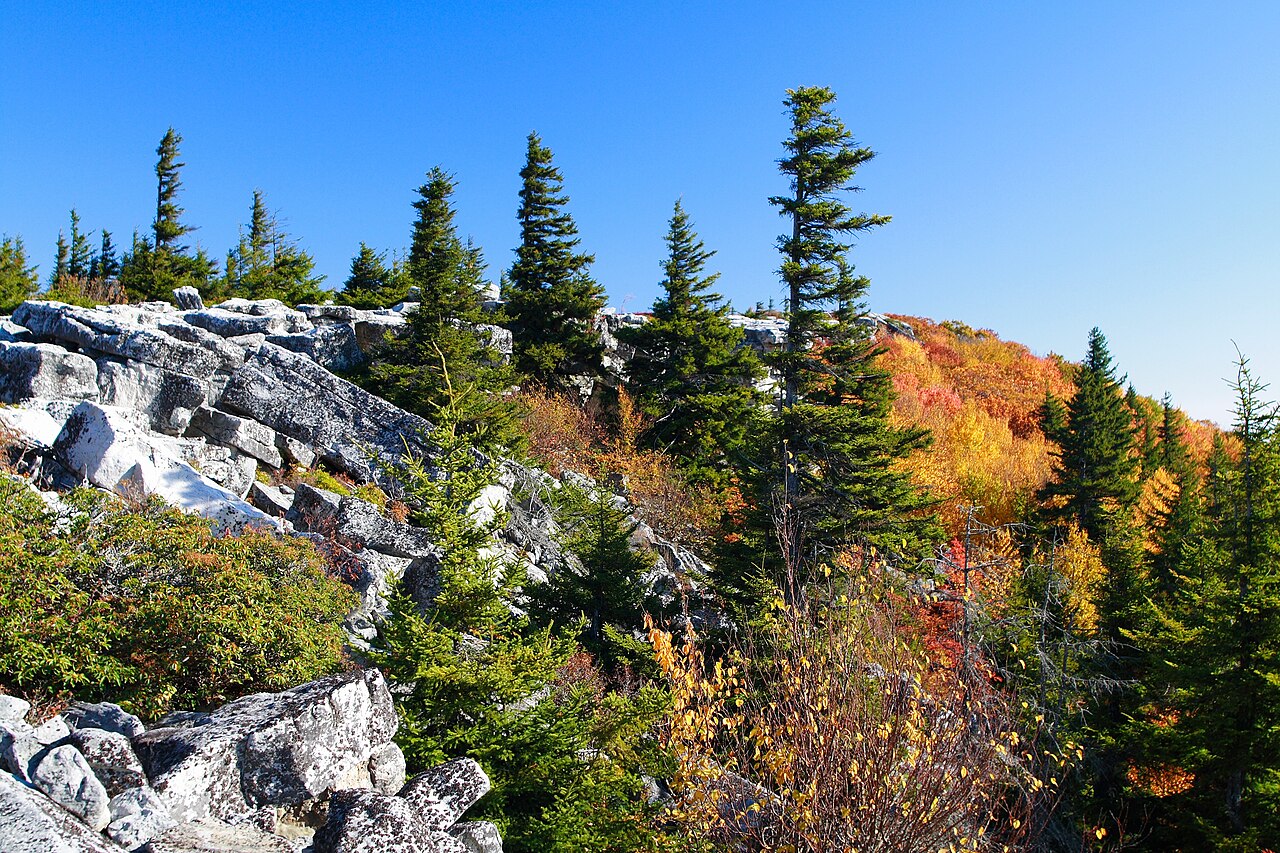
Red spruce is an evergreen of cool northeastern forests and the high Appalachian mountains. Short green needles and small hanging cones clothe a conical crown that can become a substantial, long-lived tree. It is not a heat-tolerant substitute for every ornamental spruce.
In the Carolinas, the setting matters especially. North Carolina’s high mountain forests can support red spruce, but a warm low-elevation yard has a very different climate. A regional listing that combines North and South Carolina should not be read as a recommendation for hot Piedmont or coastal conditions, or as evidence that red spruce is native in South Carolina.
For a suitable mountain property, this tree can contribute year-round structure and a sense of the local forest. For a small urban garden, its eventual scale, shallow roots and dislike of heat may make it a poor fit. Decide where a mature tree can live before being persuaded by the tidy outline of a young nursery specimen. Buy nursery-grown stock of an appropriate origin instead of removing seedlings from natural stands.
Identification
Needles and twig texture
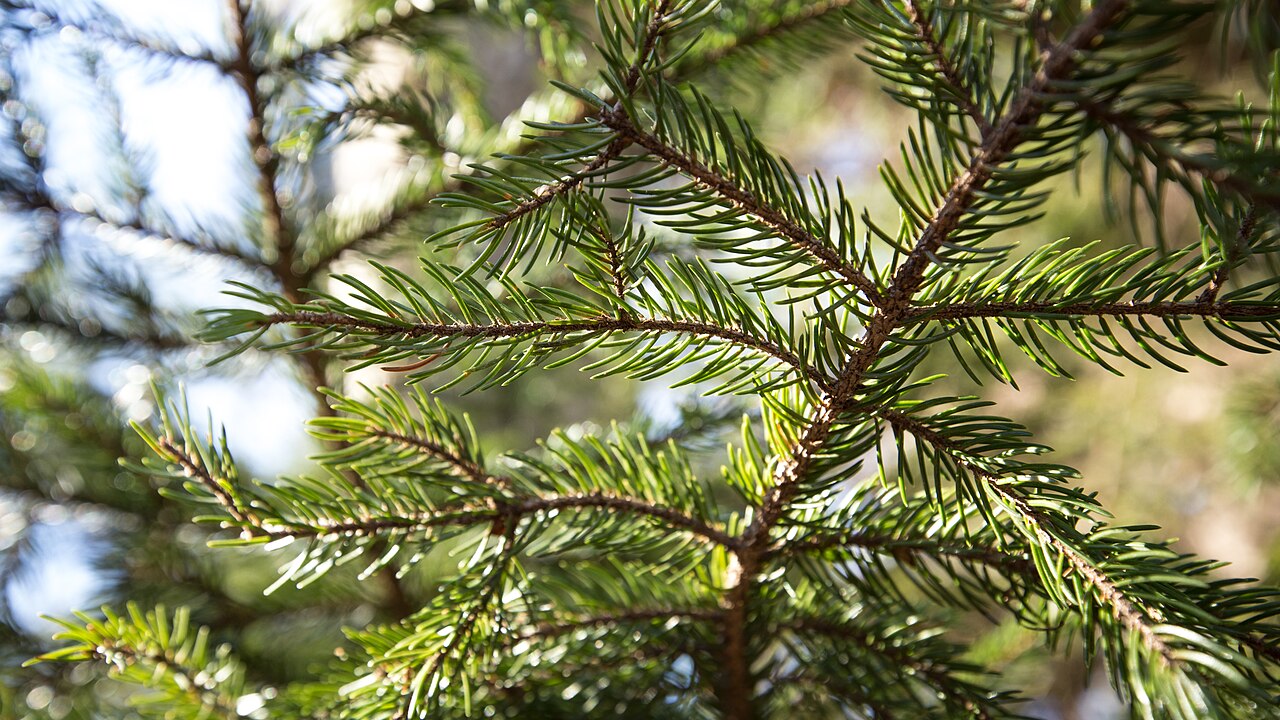
The needles are short, pointed and borne singly around the twig rather than bundled as in a pine. Spruce needles attach to small woody pegs, so a twig remains rough after needles have fallen. That is a useful contrast with fir. Use this alongside cones and a regional key; a single green branch is not enough to distinguish every spruce reliably.
Small hanging cones
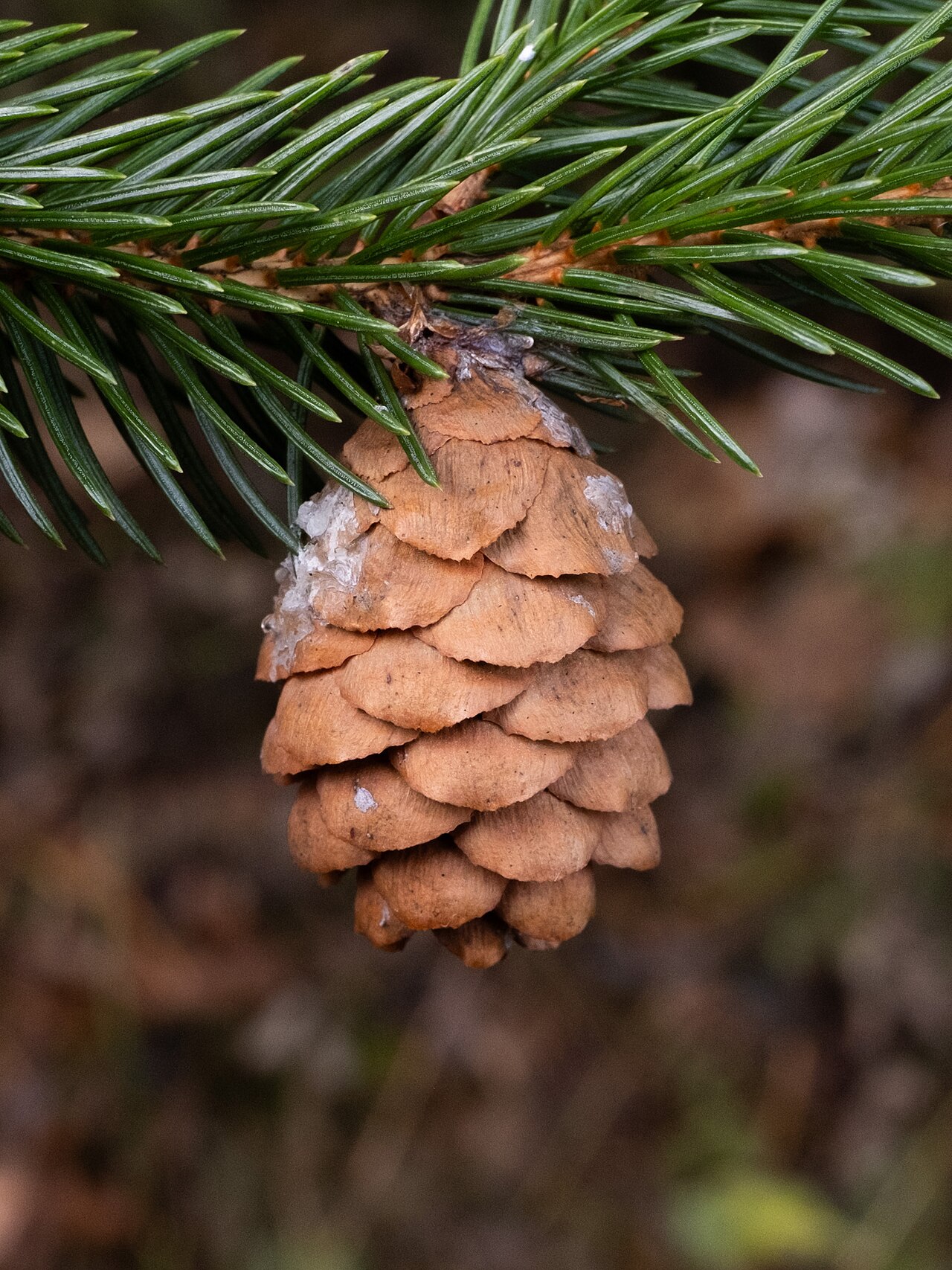
Mature seed cones hang below the branch and are much smaller than the long cones of Norway spruce. Red spruce cones are generally in the one-to-two-inch range, with rounded scales. Their reddish or purplish youthful color changes as they mature. A fallen cone should be associated with the tree above it carefully in mixed woodland, where wind and slope can move cones away from their source.
Crown and bark
Young trees typically have a narrow, orderly conical outline, while older crowns vary with exposure, crowding and damage. The bark becomes scaly rather than the smooth trunk of a young sapling. Do not use maximum published height as a promise for a garden; a windswept mountain tree and a sheltered forest tree can look dramatically different while belonging to the same species.
Red spruce, black spruce and fir
Red spruce can hybridize with black spruce, complicating identification toward the northern overlap. Fraser fir shares southern high-elevation forests but has a different needle attachment and upright cones that break apart on the tree. For a conservation planting, insist on a reliable botanical identification and local provenance instead of accepting a general spruce label.
Quick Facts
| Scientific Name | Picea rubens |
| Family | Pinaceae |
| Plant Type | Long-lived evergreen conifer |
| Mature Height | Typically 60–75 feet; taller in favorable forest sites |
| Mature Spread | Allow space for a full conical forest tree; do not treat as a small foundation evergreen |
| Growth Rate | Slow to moderate, strongly dependent on site and exposure |
| Sun Exposure | Full sun to partial shade; young trees tolerate shade |
| Water Needs | Reliable moisture with drainage; sensitive to drought and hot dry sites |
| Soil Type | Cool, acidic, humus-rich forest soil; often shallow over rock |
| Soil pH | Acidic; natural forest soils commonly around pH 4–5.5 |
| Bloom Time | Spring pollen and seed cones, not showy flowers |
| Flower Color | Young cones reddish to purplish; mature cones brown |
| Fall Color | Evergreen green to yellow-green needles |
| Fruit | Small hanging cones, usually about 1–2 inches long |
| Deer Resistant | Not a guaranteed browse-proof screen; protect young trees as needed |
| USDA Hardiness Zones | Cool-climate species; site temperature and summer moisture matter more than a winter zone alone |
Native Range
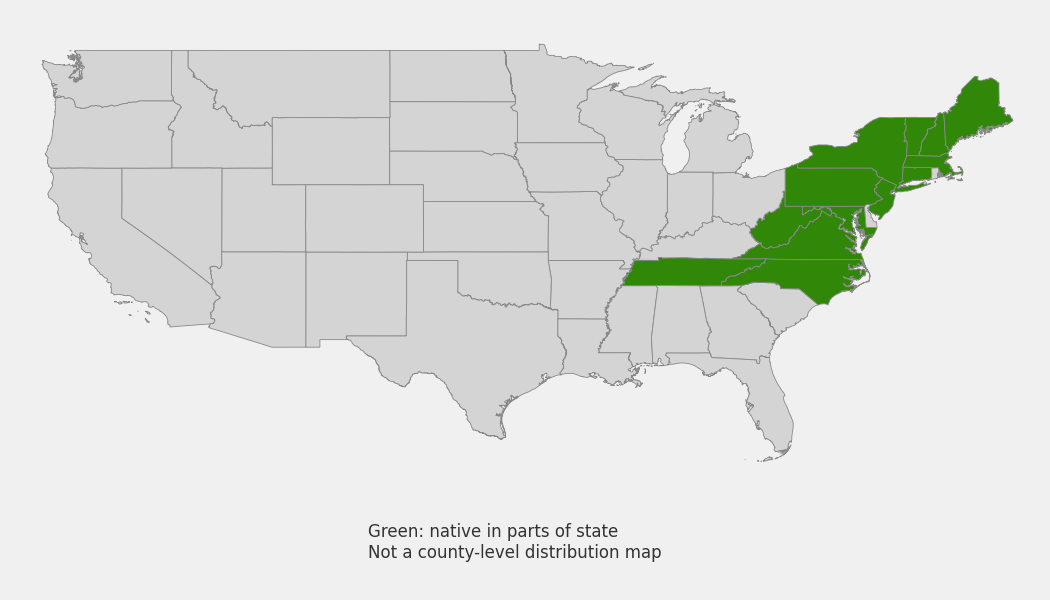
The U.S. Forest Service places the native range in northeastern North America and southward along the Appalachians to western North Carolina and eastern Tennessee. The U.S. map shades Connecticut, Maine, Maryland, Massachusetts, New Hampshire, New Jersey, New York, North Carolina, Pennsylvania, Tennessee, Vermont, Virginia and West Virginia. Eastern Canadian populations are important but are not represented on this U.S.-only map.
A shaded southern state can be misleading without an elevation note. In the southern Appalachians, Forest Service accounts associate the tree with elevations roughly 3,200–6,200 feet, with local variation. Cool, moist conditions and fog exposure help distinguish those sites from nearby valleys. North Carolina presence therefore does not imply that the coastal plain or a warm city lot is a suitable planting location.
South Carolina is not included in the native range treatment used for this guide. In the shared NC/SC regional table, the entry is retained with an explicit North Carolina mountain limitation. For restoration work, coordinate with a local forest or conservation program: planting a tree somewhere it can survive is different from restoring the composition and structure of a native spruce forest.
📋 Regional plant list: North Carolina and South Carolina
Growing & Care Guide
Start with the summer climate
Winter hardiness is only one part of tree suitability. Before planting, consider summer nights, rainfall, reflected heat and exposure to drying wind. A narrow strip between pavement and a sunny wall is not equivalent to a cool mountain forest. If the site regularly requires emergency watering just to keep other cool-climate conifers alive, choose a better-adapted native tree instead.
Give the mature crown room
Place the tree where its eventual crown will not need constant cutting to clear a building, walkway or utility line. Small nursery spacing can disguise the future scale of a forest species. Mark the proposed planting location and view it from several angles, including neighboring properties. A tree selected for natural form should not begin life in a spot that will force it into a repeatedly sheared hedge.
Keep the root flare at the surface
Set the visible root flare at the proper soil level and do not bury the trunk beneath backfill or mulch. Examine the nursery root system for circling roots before planting. A broad, appropriately prepared planting area is preferable to a narrow deep hole. Avoid compacting the surrounding ground with equipment once the tree is installed.
Protect the shallow rooting zone
Red spruce’s feeding roots occur close to the surface, making soil disturbance an important concern. Keep construction, repeated foot traffic and deep cultivation away from the root area. Use a modest organic mulch layer without piling it against the trunk. Rather than underplanting immediately with dozens of competing shrubs, allow the young tree to establish and preserve a low-disturbance zone around it.
Water by soil condition
During establishment, check moisture where the roots actually are. Give a thorough watering when needed rather than frequent tiny surface splashes, then allow drainage. Cool damp soil is not the same as a waterlogged hole. After heavy rain, check whether water remains trapped; after a windy dry period, check whether the original root ball has dried even when surrounding soil looks darker.
Avoid unnecessary pruning
Remove damaged branches when appropriate, but preserve a healthy central leader and natural branching pattern. Do not top the tree to solve a space problem that should have been addressed at planting. If a young leader is damaged, obtain tree-care advice early rather than allowing several competing leaders to develop unchecked. Large structural work belongs with a qualified arborist.
Seedlings and restoration stock
Seed propagation is possible, but seed origin and handling matter. For a habitat planting, use a grower or restoration program familiar with the target region instead of collecting random cones from an ornamental tree. Keep young stock labeled through every potting stage. A seedling grown far from its intended climate should be hardened and evaluated before being committed to a large project.
Monitor stress before treating pests
Needle loss, sparse growth and discoloration can have multiple causes, including site stress. Record whether symptoms begin on old or new growth and whether they affect one side or the whole crown. Check soil moisture and recent disturbance before assuming an insect is responsible. A local extension office can help distinguish a care problem from a pest issue and prevent unnecessary spraying.
Landscape Uses
- A natural-form evergreen on a cool mountain property within its native ecological setting.
- A component of professionally planned Appalachian forest restoration, using suitable local stock.
- A year-round structural tree in a spacious, cool-climate native landscape.
- An educational planting comparing spruce and fir needles, cones and forest niches.
Wildlife & Ecological Value
Forest structure
An evergreen crown provides a different seasonal structure from neighboring deciduous trees. Its value comes from being part of a functioning forest or mixed landscape, not simply from counting the number of trees planted. Preserve other native layers and avoid converting a diverse site into a single-species plantation merely because spruce is attractive.
Seeds and cover
Forest Service and extension accounts describe wildlife use of spruce seeds, foliage and cover. In a garden, allowing a healthy tree to retain its natural branch structure supports that role better than repeatedly stripping its lower branches for convenience. Keep the space beneath it compatible with the tree rather than forcing an irrigated lawn into every shaded corner.
Restoration is more than planting
Research in the central Appalachians documents the loss and recovery potential of spruce-associated forests after historical disturbance. Site preparation, competing vegetation and existing regeneration all influence outcomes. Homeowners near such habitat can contribute by protecting remaining trees and working with knowledgeable local programs rather than introducing unverified stock into sensitive natural areas.
Cultural & Historical Uses
Red spruce wood has been valued for lightness and resilience, with uses that include instruments, construction and paper. Those material qualities connect the species to both forest industry and craft traditions. A living landscape tree should nevertheless be chosen for its ecological and physical fit, not because an exceptional old forest tree supplied valuable timber.
Logging and subsequent disturbance greatly altered some Appalachian spruce forests. Modern Forest Service studies examine remaining stands and restoration opportunities rather than assuming that every place now dominated by hardwoods has always lacked spruce. Historical land use is part of the explanation for today’s landscape, and a current distribution map is not a complete record of former abundance.
Older references may use Picea rubra or other names now treated as synonyms of Picea rubens. Red spruce is also called yellow spruce or West Virginia spruce. These common names do not define separate species, and neither yellow nor red describes a promise of colorful foliage in a garden. The accepted scientific name is the safest label when ordering restoration stock.
Frequently Asked Questions
Can I plant red spruce anywhere in North Carolina?
No. Its natural southern setting is primarily the cool high mountains. Hot Piedmont and coastal sites may be unsuitable even if the winter hardiness zone seems acceptable.
Is it native to South Carolina?
South Carolina is not included in the native range used here. The shared Carolina table entry is specifically qualified for North Carolina mountain settings.
Why not plant it close to the house and prune it?
It is a full-sized forest tree. Repeatedly restricting the crown is a poor substitute for choosing a planting location with sufficient long-term space.
How can I tell spruce from fir?
Spruce needles sit on woody pegs and its cones generally hang down. Fir needles leave smoother twig surfaces and fir cones stand upright and break apart. Use a regional key for species-level identification.
Does moist soil mean a standing-water site?
No. Reliable moisture and drainage are both important. A waterlogged planting hole is not the cool, aerated forest rooting environment the tree needs.
Sources & Further Reading
- USDA Forest Service — Red Spruce, Silvics of North America
- USDA Forest Service — species ecology and native range
- NC State Extension — red spruce in cultivation
- USDA Forest Service — current distribution and environmental drivers
- USDA Forest Service — central Appalachian restoration research
Find Native Plants
Ask growers about nursery propagation and regional provenance. Browse our NC native plant nurseries, SC native plant nurseries directory for suppliers. Explore the native nursery finder.