
Creeping Primrose-willow (Ludwigia repens)
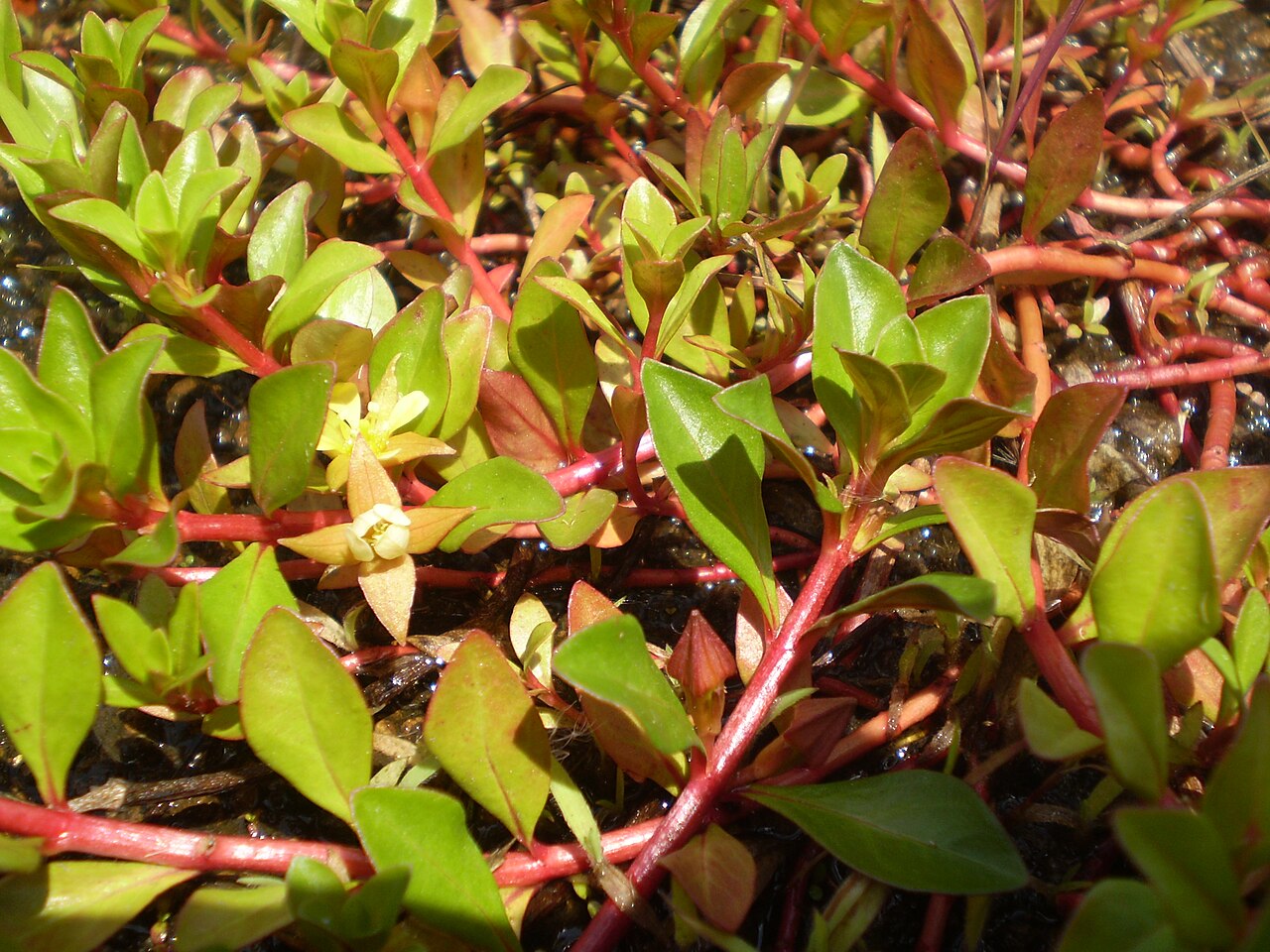
Ludwigia repens, known as Creeping Primrose-willow, red ludwigia or creeping water primrose, is a low aquatic and wetland perennial of springs, streams, ditches and muddy shores across the southern United States. Its trailing stems root at the nodes and carry pairs of glossy, rounded leaves that are green above and often red or purplish below. From spring to fall it bears small, four-petaled yellow flowers tucked into the leaf axils. It belongs to the evening primrose family (Onagraceae).
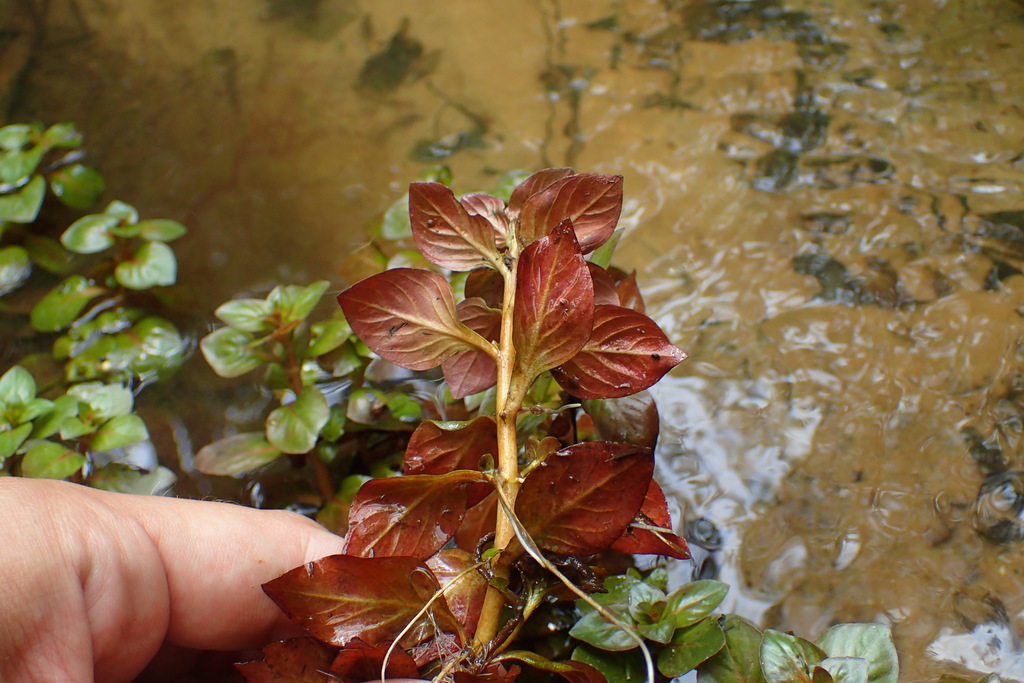
Few people know it from the wild, but many aquarium keepers know it as “Ludwigia repens,” one of the most popular red stem plants in the hobby. Under water it grows upright toward the light, and in good light its leaves turn copper, red or deep wine-purple. Outdoors it is a useful native for shallow pond margins, rain garden swales and spring-fed water gardens, where it forms loose, sprawling mats.
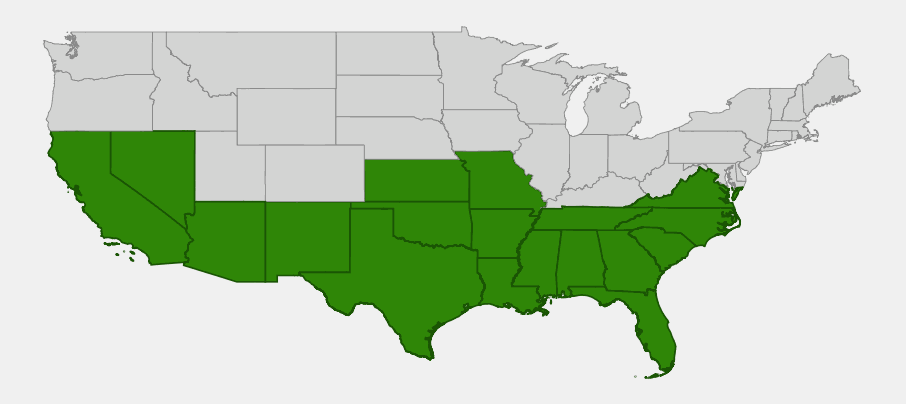
Creeping primrose-willow is native from Virginia and the Carolinas south to Florida and west through the Gulf States, Missouri, Kansas and Texas to New Mexico, Arizona, Nevada and California, and on into Mexico and the Caribbean. This guide covers how to identify it, where it grows, how to grow it in ponds and aquariums, and its role in spring-fed streams and wetlands.
Identification
There are many Ludwigia species in the Southeast, and several creeping ones look alike. Creeping primrose-willow is recognized by its opposite, stalked leaves, its small flowers with four yellow petals, and its short, four-sided capsules.
Stems & Growth Habit
The stems are smooth or nearly so, green to red, and creep over mud or float in shallow water, rooting at the nodes. The tips turn upward, so emergent plants form loose mats a few inches tall, while submerged stems can grow upright 1 to 2 feet long toward the surface. White, spongy floating roots sometimes form at the nodes in water.
Leaves
Leaves are opposite, elliptic to broadly oval or spoon-shaped, about ½ to 1½ inches long, narrowing to a short stalk. They are glossy green above, often reddish to purple beneath, and in strong light the whole plant can turn red. Submerged leaves tend to be thinner and narrower than emergent ones.
Flowers
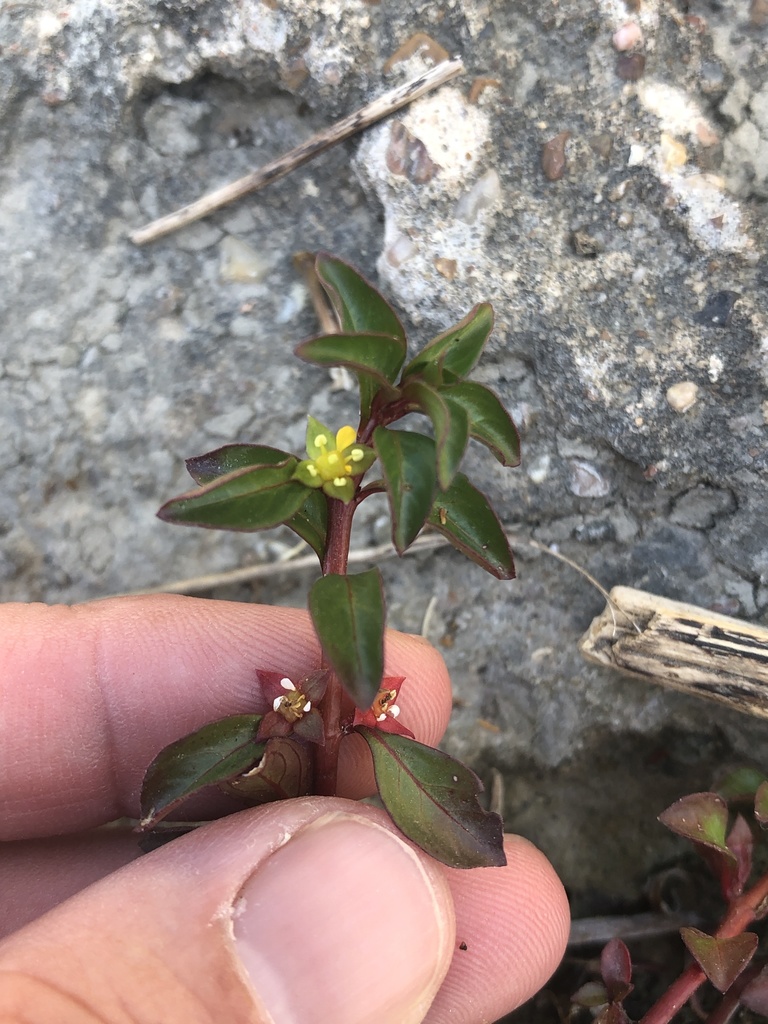
Flowers sit singly in the leaf axils, with no stalk or only a very short one. Each has four green, triangular sepals and four small yellow petals about ⅛ inch long, though the petals are sometimes reduced or absent. They bloom from spring into fall, and year-round in mild areas. Flowers form mainly on emergent stems; submerged aquarium plants rarely bloom.
Fruit & Seeds
The fruit is a small, four-sided capsule about ¼ inch long, crowned by the persistent sepals, with two tiny bracts at its base. It holds many minute seeds. Look-alikes include Floating Primrose-willow (L. peploides), which has alternate leaves and much larger, five-petaled flowers, and marsh seedbox (L. palustris), whose flowers usually have no petals.
Quick Facts
| Scientific Name | Ludwigia repens (syn. L. natans) |
| Family | Onagraceae (evening primrose family) |
| Plant Type | Creeping aquatic or wetland herbaceous perennial |
| Mature Height | 2–6 in emergent; submerged stems to about 2 ft |
| Mature Spread | 1–3 ft; spreads by rooting stems |
| Growth Rate | Moderate to fast |
| Sun Exposure | Full sun to part shade |
| Water Needs | Wet; mud, shallow water or fully submerged |
| Soil Type | Mud, sand, silt or gravel; tolerates limestone |
| Soil pH | About 6.0–8.0 |
| Bloom Time | April–October (year-round in mild climates) |
| Flower Color | Yellow |
| Fall Color | Leaves often red to purple in sun or cold |
| Fruit | Small four-sided capsule with tiny seeds |
| Deer Resistant | Moderate; rarely browsed in water |
| USDA Hardiness Zones | 6–11 |
Native Range
Creeping primrose-willow has a broad southern range. USDA PLANTS records it as native in 18 states: Virginia, North Carolina, South Carolina, Georgia, Florida, Alabama, Mississippi, Tennessee, Arkansas, Louisiana, Missouri, Kansas, Oklahoma, Texas, New Mexico, Arizona, Nevada and California. It continues south through Mexico to Central America and into the Caribbean.
In the East it is most common on the Coastal Plain, in blackwater and spring-fed streams, cypress swamps, ditches and pond edges, and it is abundant in the clear, spring-fed rivers of Florida. In Texas and Oklahoma it is a plant of springs and spring-fed creeks, including the famous limestone springs of the Edwards Plateau such as those at San Marcos and New Braunfels. In the Southwest and California it is scattered in springs, seeps, streams and irrigation ditches.
The plant sold in the aquarium trade as Ludwigia repens is often this species, but some aquarium “red ludwigias” are hybrids between L. repens and L. palustris or related species. Wild plants in the Old World, where it has escaped in a few warm springs and thermal waters, are introduced.
📋 Regional plant lists featuring Creeping Primrose-willow: North & South Florida · Alabama, Georgia & Mississippi · North & South Carolina · Maryland, Virginia & West Virginia · Kentucky & Tennessee · Arkansas, Louisiana, Eastern Oklahoma & Eastern Texas · South & West Texas · Illinois, Iowa & Missouri · Nebraska, Kansas & Eastern Colorado · Arizona & New Mexico · California & Nevada
Growing & Care Guide
Creeping primrose-willow is one of the easiest plants to grow, whether in an aquarium, a container water garden or the muddy edge of a pond. Buy it from aquarium shops or native aquatic nurseries, and never release aquarium plants into natural waters, even within its native range, since aquarium stock may be hybrids or carry snails and other hitchhikers.
Light
Outdoors, grow it in full sun to part shade. In aquariums it grows in moderate light, but bright light (and added CO₂ if available) brings out its best red and copper colors and keeps stems compact. In low light it turns green and leggy.
Soil & Water
It grows in any wet mud or in water up to about 1 foot deep outdoors. In aquariums it tolerates a wide range of conditions, roughly 60–82 °F (15–28 °C) and pH 6 to 8, and it appreciates a nutrient-rich substrate or root tabs, plus iron for good red color. Outdoors, roots and stems survive light freezes in the water, though top growth dies back in cold winters at the north edge of its range.
Planting Tips
Plant cuttings 3 to 6 inches long into the substrate, removing the lowest pair of leaves so the nodes can root. Space stems an inch or two apart in a tank for a bushy group. In ponds, set rooted pieces in shallow mud at the edge, or in pots of heavy soil set just below the water surface.
Pruning & Maintenance
In aquariums, trim stems when they reach the surface and replant the tops; the cut bases will branch. Outdoors, cut back mats that spread too far. It can spread vigorously in shallow, nutrient-rich water, so it is best kept to ponds and gardens within its native range.
Propagation
It roots easily from stem cuttings at any time during the growing season. Emergent plants also spread on their own by rooting stems, and seed sown on wet mud germinates readily in warm weather.
Landscape Uses
- Aquariums: a classic, easy red stem plant for midground and background planting
- Pond margins: a low, spreading cover for shallow, muddy edges
- Rain garden swales: in wet, sunny low spots within its native range
- Container water gardens: spills over the edge of tubs and bowls
- Spring and stream restoration: helps stabilize mud and shelter small aquatic animals
Wildlife & Ecological Value
In the wild, creeping primrose-willow is a small but common part of shallow, slow-moving freshwater habitats, where its tangled stems shelter many small animals.
For Pollinators
The small yellow flowers are visited by small bees, including sweat bees, and by flies. Many flowers also self-pollinate.
For Birds
Ducks, rails and other marsh birds eat its seeds and forage for insects and snails among its stems.
For Mammals
It has little importance for mammals, although muskrats and other wetland animals may eat it.
Ecosystem Role
Its mats of rooting stems shelter tadpoles, small fish, crayfish, aquatic insects and snails, and help hold mud and sand in place along stream edges and spring runs. In the clear springs of Texas and Florida it grows with other native aquatic plants that provide habitat for rare spring-dwelling fish, salamanders and invertebrates.
Cultural & Historical Uses
Johann Reinhold Forster described Ludwigia repens in 1771. The genus is named for Christian Gottlieb Ludwig (1709–1773), a German botanist and physician, and repens means “creeping.” For many years the same plant was also called Ludwigia natans, a name now treated as a synonym, and older aquarium books often use it.
The common name primrose-willow refers to the yellow, evening-primrose-like flowers and the willow-like leaves of the larger species in the genus. In the aquarium hobby, red ludwigia has been a favorite for decades, and growers have selected especially red-leaved forms.
Because it is so widely sold, creeping primrose-willow has escaped in a few places outside its native range, including thermal springs in Europe. Within its native range it is a quietly useful plant, one of the many small natives that hold spring runs, ditches and pond edges together.
Frequently Asked Questions
Is aquarium Ludwigia repens a native plant?
Yes, Ludwigia repens is native across the southern United States and south to Central America. Some plants sold under the name are hybrids or other species, so wild-collected or locally grown stock is best for outdoor native plantings.
Why are my Ludwigia repens leaves green instead of red?
Leaf color depends mainly on light. Bright light, good iron levels and somewhat limited nitrate bring out the red; in lower light the plant stays green. Both are normal.
Can creeping primrose-willow grow fully underwater?
Yes. It grows fully submerged in aquariums and spring runs, and it also grows emergent on mud. Submerged stems grow upright toward the light, while emergent stems creep and root at the nodes.
Is creeping primrose-willow invasive?
Within its native range it is a normal part of wetland plant communities and is not considered invasive. Outside its range, some Ludwigia species are serious invaders, so do not plant it in natural waters elsewhere, and never dump aquarium plants.
How do I tell creeping primrose-willow from floating primrose-willow?
Creeping primrose-willow has opposite leaves and tiny flowers with four small yellow petals. Floating primrose-willow (L. peploides) has alternate leaves and much larger, showy yellow flowers with five petals.

Looking for a nursery that carries Creeping Primrose-willow?
Browse our native plant nursery directory: Alabama, Arizona & Arkansas · California · Florida & Georgia · Kansas · Louisiana, Mississippi & Missouri · Nevada, New Mexico, North Carolina & Oklahoma · South Carolina, Tennessee, Texas & Virginia

