
California Aster (Corethrogyne filaginifolia)
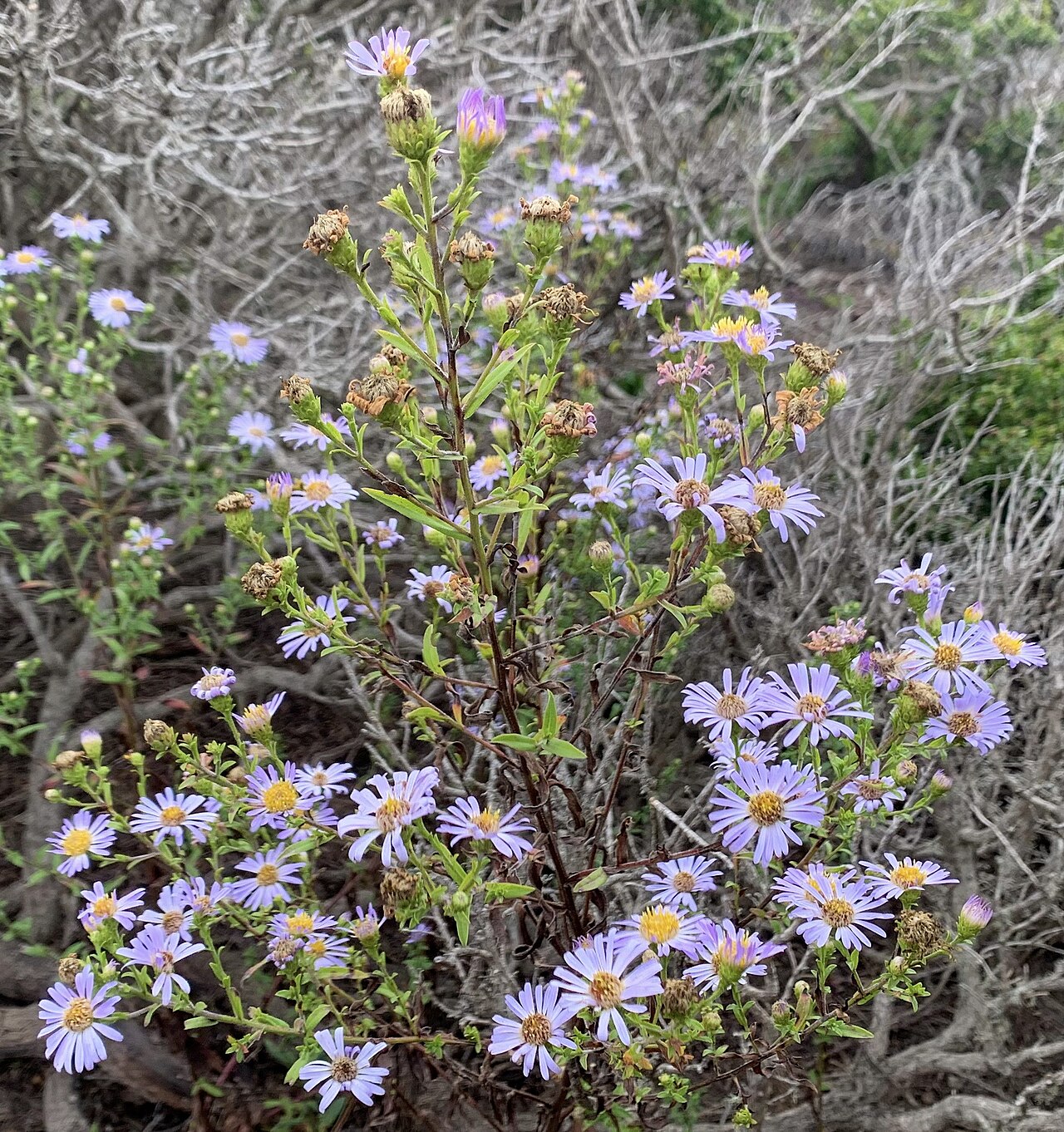
Corethrogyne filaginifolia, known as California Aster, common sandaster (the USDA PLANTS name) or sand aster, is a low, gray-woolly perennial of California’s coastal bluffs, dunes, chaparral and grasslands. From summer into late fall, when most of the landscape is dry and brown, it covers itself with aster-like flower heads about 1 to 1½ inches across: lavender, pink or nearly white rays around a bright yellow center.
It belongs to the sunflower family (Asteraceae). For several decades botanists placed it in the genus Lessingia, as Lessingia filaginifolia, and that name is still common in field guides, nursery catalogs and older floras. Current treatments return it to Corethrogyne, where it is the only species, though it is extremely variable. Many local forms that were once named as separate species or varieties are now included in it. The name “California aster” is also sometimes used for Symphyotrichum chilense, a different plant, so the scientific name helps avoid confusion.
California aster grows from southwestern Oregon through almost all of California’s coastal and foothill regions into Baja California, Mexico. It is drought tolerant, long-blooming and valuable to late-season pollinators, which makes it one of the most useful native perennials for dry California gardens. This guide covers identification, range, care and wildlife value.
Identification
California aster is easy to recognize by its combination of soft, gray-woolly foliage and lavender-to-white, aster-like flowers late in the season. Its growth form varies a lot, from flat mats on windy bluffs to upright, bushy plants inland.
Growth Habit
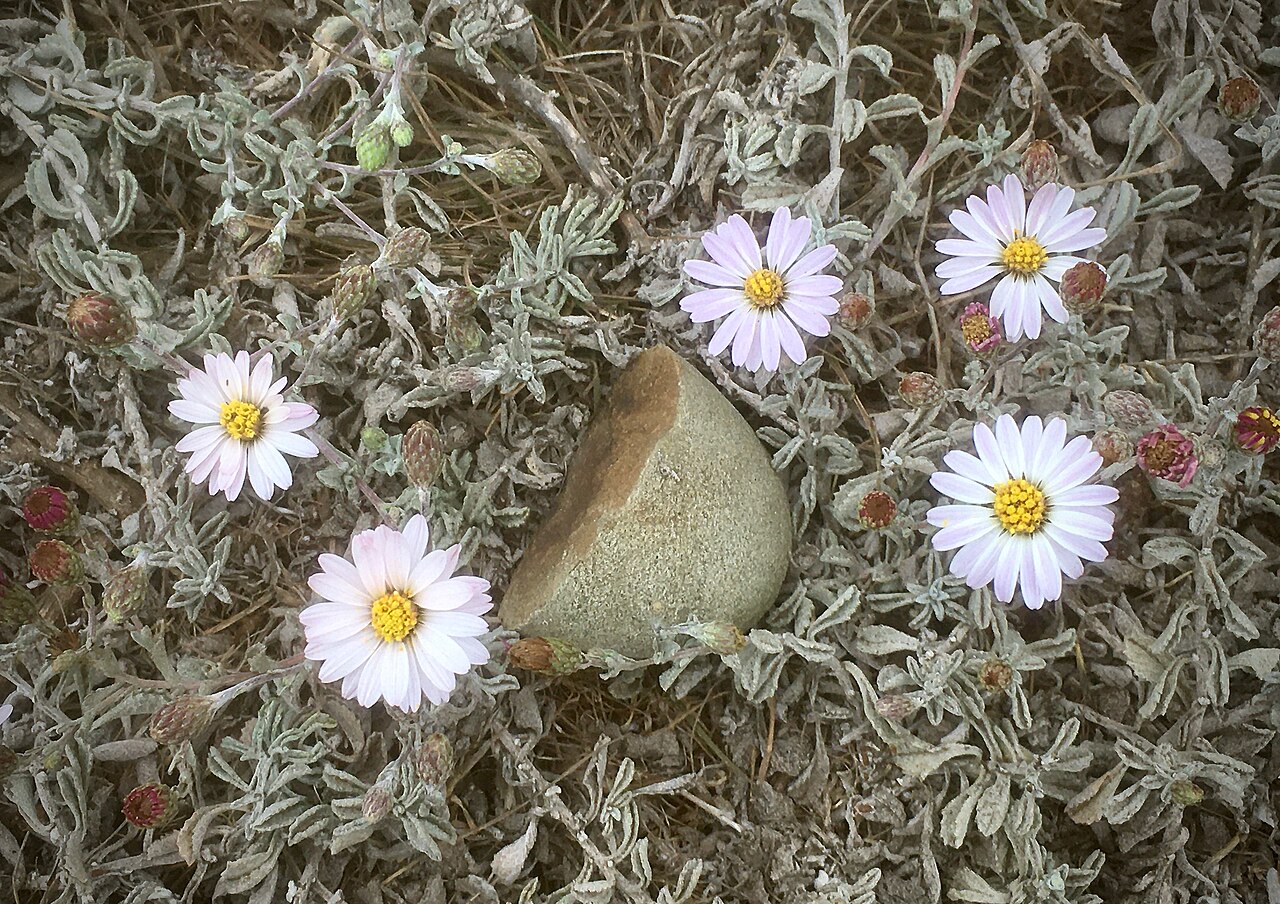
It is a perennial herb or low subshrub from a woody base and a deep taproot. On exposed coastal bluffs and dunes it often forms prostrate mats only a few inches tall and up to several feet across. Inland, in chaparral, grassland and open woodland, plants are usually upright to sprawling, 1 to 3 feet tall, with many branching stems. Low-growing coastal selections such as ‘Silver Carpet’ are sold as groundcovers.
Leaves
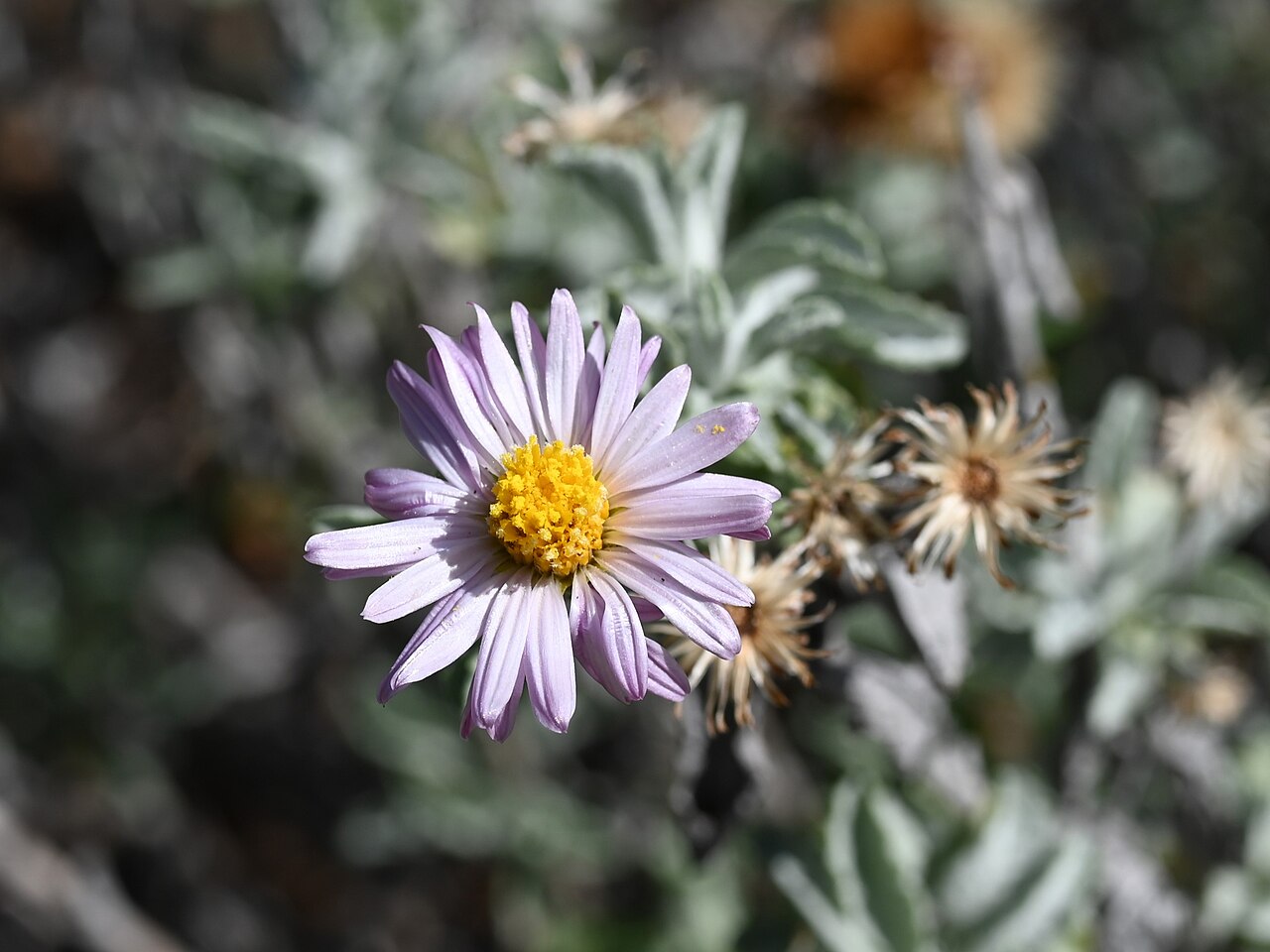
The leaves are alternate, simple and about 1 to 2 inches long, narrowly oblong to spoon-shaped. They are densely covered with white or gray woolly hairs, which give the plant its silvery look and help it conserve water. Lower leaves may have a few teeth or lobes, and leaves get smaller toward the tips of the stems. The name filaginifolia means “with leaves like Filago,” a genus of small, woolly cudweeds.
Flowers
Flower heads are borne singly or in loose clusters at the ends of branches. Each head has numerous narrow ray flowers, usually lavender, pink or violet but sometimes white, around a dense center of up to about 120 small yellow disk flowers. The bracts beneath the head are narrow, pointed and often purple-tipped, and they curl back as the head ages. Flowering usually starts in early summer and continues into fall, often into November and later on the coast.
Fruit & Seeds
The fruits are small achenes, each topped with a tuft of reddish to tan bristles (the pappus) that helps the seed drift on the wind. After flowering, the heads turn into small, bristly brown balls.
Look-alikes
Several Lessingia species have similar woolly leaves but usually lack well-developed ray flowers. Symphyotrichum chilense (Pacific aster) is greener and less woolly and spreads by rhizomes in moister ground. Telegraphweed and other goldenasters have yellow rays.
Quick Facts
| Scientific Name | Corethrogyne filaginifolia (syn. Lessingia filaginifolia); USDA common name common sandaster |
| Family | Asteraceae (sunflower family) |
| Plant Type | Perennial herb or low subshrub |
| Mature Height | 6 in–3 ft (low mats on the coast, taller inland) |
| Mature Spread | 1–4 ft |
| Growth Rate | Moderate to fast |
| Sun Exposure | Full sun |
| Water Needs | Low; drought tolerant once established |
| Soil Type | Well-drained sand, gravel, rocky soil or clay loam; tolerates serpentine |
| Soil pH | About 6.0–8.0 |
| Bloom Time | June–November (into winter on the coast) |
| Flower Color | Lavender, pink, violet or white rays with a yellow center |
| Fall Color | None; foliage stays gray-green |
| Fruit | Small achene with reddish bristles |
| Deer Resistant | Moderately; the woolly leaves are seldom heavily browsed |
| USDA Hardiness Zones | 8–10 |
Native Range
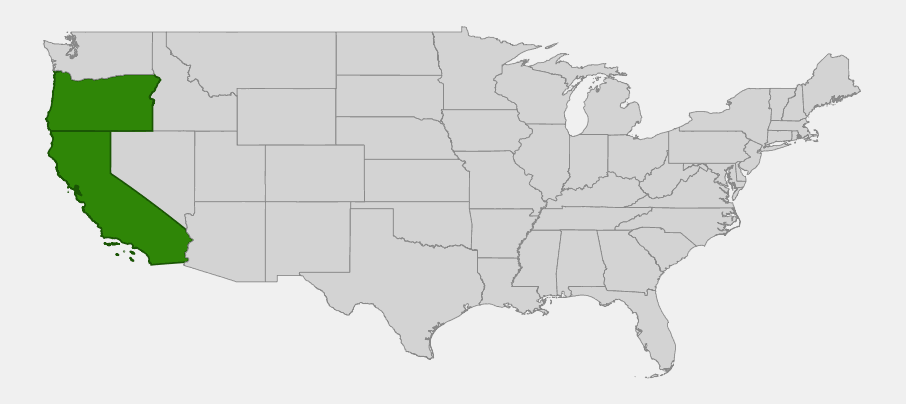
California aster is a Californian plant with a small extension north into Oregon and south into Mexico. USDA PLANTS records it as native in California and Oregon. In Oregon it is limited to the southwestern corner of the state, and in Mexico it continues into northern Baja California.
Within California it is one of the most widespread native perennials, found from the North Coast and Klamath Mountains through the Coast Ranges, the Sierra Nevada foothills, the Transverse and Peninsular Ranges, the Channel Islands and coastal Southern California. It avoids the true deserts and the highest mountains.
Its habitats are diverse: coastal bluffs and dunes, coastal sage scrub, chaparral, grassland, oak woodland and open conifer forest, plus serpentine soils and disturbed ground such as road cuts and burned areas. That wide habitat range explains its variability. Coastal plants tend to be low and densely woolly, while inland and mountain plants are taller and greener.
📋 Regional plant lists featuring California Aster: Not yet featured on a plantnative.org regional plant list (coverage for California and Oregon is still being developed).
Growing & Care Guide
California aster is a tough, low-water plant for sunny gardens in California and southwestern Oregon. It thrives on neglect, blooms for months in the dry season, and fits naturally into coastal sage scrub, chaparral and meadow-style plantings.
Light
Give it full sun. In part shade it becomes leggy and flowers less. On the coast it does well in full exposure to wind and salt spray.
Soil & Water
It needs well-drained soil and does best in sand, gravel or rocky slopes, though it also grows in clay loam if water does not stand. Once established it needs little or no summer water near the coast. Inland, an occasional deep watering in summer extends bloom. Overwatering and rich soil make plants floppy and short-lived.
Planting Tips
Plant from containers in fall or winter so the roots can establish with the winter rains. Space plants 1 to 3 feet apart depending on the form. Low coastal selections make good groundcovers on slopes, between stepping stones or at the front of a border, while upright forms suit meadows and dry banks. Combine it with buckwheats, sages and native grasses.
Pruning & Maintenance
After flowering ends in late fall or winter, cut plants back by about half to remove old flower heads and encourage dense new growth. Upright forms can be cut back harder. Plants may decline after several years; letting a few seedlings grow keeps the planting going. Avoid fertilizer and heavy mulch around the crown.
Propagation
Grow it from fresh seed sown on the soil surface in fall. Cuttings of new growth root fairly easily in spring, and they are the usual way named selections such as ‘Silver Carpet’ are propagated.
Landscape Uses
- Dry, low-water gardens: gray foliage and months of late-season flowers with little or no summer water
- Coastal gardens: tolerates wind, sand and salt spray on bluffs and near dunes
- Slopes and groundcover: low, mat-forming selections cover dry banks
- Pollinator gardens: an important late-summer and fall nectar source
- Habitat restoration: coastal sage scrub, chaparral, grassland and post-fire plantings within its range
Wildlife & Ecological Value
California aster blooms when few other native plants do, which makes it especially valuable for wildlife in California’s long dry season.
For Pollinators
From summer into fall the flowers are visited by many native bees, including bumblebees, sweat bees, leafcutter bees and long-horned bees, as well as butterflies, skippers, hover flies and other insects. Because it blooms late in the season, it helps fill the gap between spring wildflowers and the winter rains, when nectar is scarce.
For Birds
Seed-eating birds such as goldfinches, sparrows and towhees eat the small seeds in fall and winter. The insects drawn to the flowers also feed songbirds, and the low, dense plants offer cover for ground-foraging birds.
For Mammals
The woolly leaves are not a preferred food for deer, although they may nibble young growth. Rabbits and small mammals use the low plants for cover.
Ecosystem Role
California aster is an early colonizer of disturbed and burned ground in coastal sage scrub and chaparral, helping cover bare soil and hold slopes. Its deep taproot lets it persist through long droughts, and its wide range of forms lets it occupy habitats from foggy bluffs to hot inland slopes.
Cultural & Historical Uses
The species was first described in 1833 by William Jackson Hooker and George Arnott as Aster filaginifolius, from plants collected in California. In 1836 Augustin Pyramus de Candolle created the genus Corethrogyne, a name from the Greek for “broom” and “female,” referring to the brush-like tips of the style branches.
The plant’s naming history has been complicated. Botanists described dozens of local forms as species and varieties of Corethrogyne. In the 1990s they were combined and moved into Lessingia as Lessingia filaginifolia with several varieties, and more recently the group has been returned to Corethrogyne as a single, variable species. Gardeners will see both Corethrogyne filaginifolia and Lessingia filaginifolia on plant labels.
In gardens, California aster has become popular as interest in water-wise native landscaping has grown. Low, silvery coastal forms such as ‘Silver Carpet’ are widely sold as groundcovers, and the species is used in restoration of coastal sage scrub and grasslands throughout California.
Frequently Asked Questions
Is California aster the same as Lessingia filaginifolia?
Yes. Lessingia filaginifolia is an older name for the same plant. Current treatments place it back in the genus Corethrogyne as Corethrogyne filaginifolia, but both names are common in nurseries and field guides.
When does California aster bloom?
It usually blooms from early summer into fall, and on the coast it often continues into late fall or early winter. Its long, late bloom season is one of its main garden and wildlife values.
Does California aster need summer water?
Near the coast it usually needs no summer water once established. In hot inland gardens, an occasional deep watering in summer keeps it blooming longer. Too much water shortens its life.
Can I use California aster as a groundcover?
Yes. Low coastal forms, including the selection ‘Silver Carpet’, form silvery mats that work well on slopes and in dry, sunny areas. Upright inland forms are better in meadows and mixed plantings.
Is California aster a true aster?
It belongs to the same tribe of the sunflower family as true asters and looks very similar, but it is in its own genus, Corethrogyne. The common name refers to its aster-like flowers.

Looking for a nursery that carries California Aster?
Browse our native plant nursery directory: California · Oregon