
Painted Trillium (Trillium undulatum)
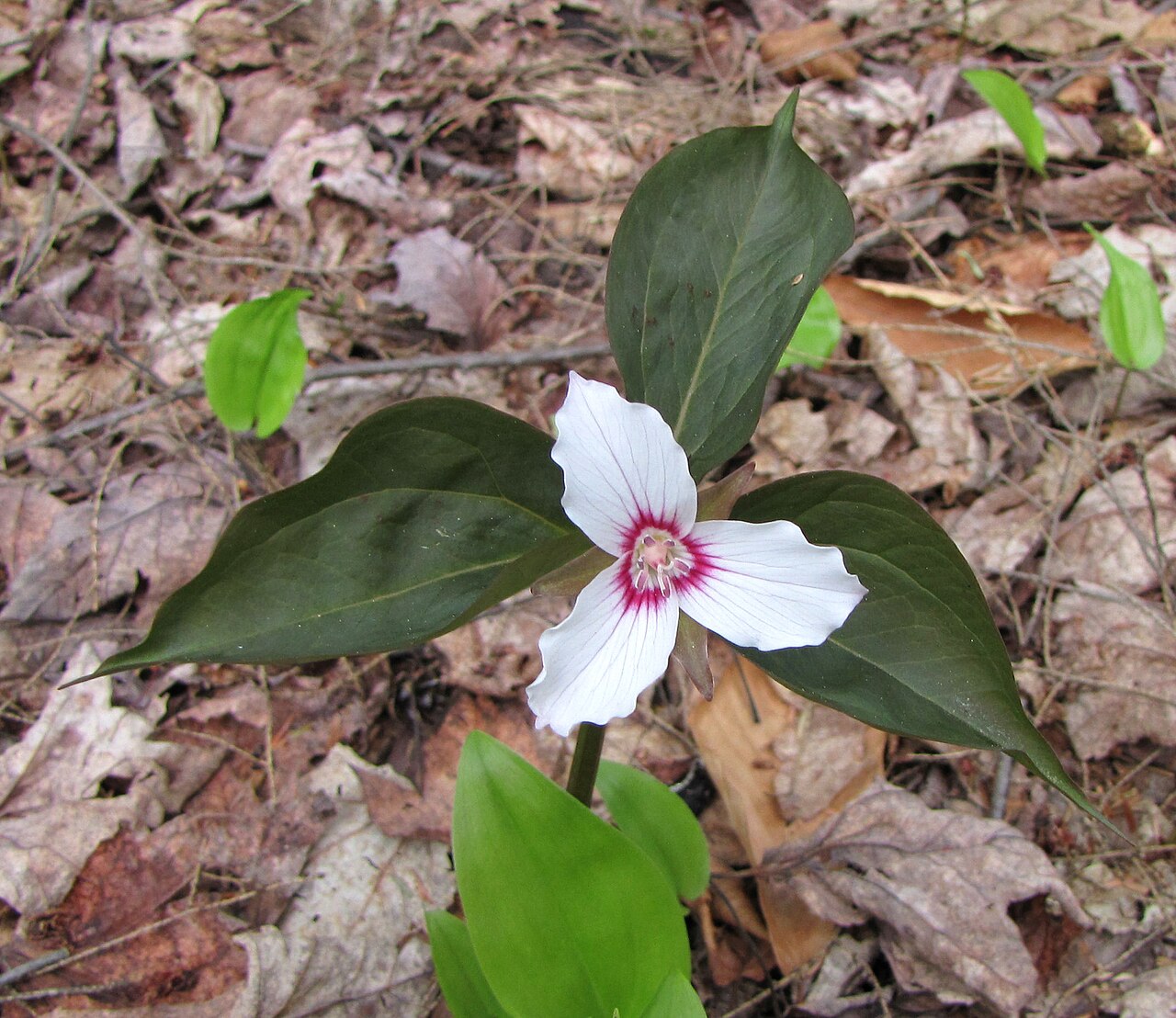
Trillium undulatum, the Painted Trillium, is one of the most beautiful wildflowers of the cool, acid forests of eastern North America. In spring a single stem rises from the forest floor with a whorl of three pointed leaves and one upright flower. The three white petals have wavy edges and a bold crimson or magenta V at the base, as if each had been touched with a brush, which gives the plant its common name. The species name undulatum means “wavy”, for the petal edges.
Painted trillium grows from Quebec and the Maritime provinces through New England and the Great Lakes region, and south along the Appalachian Mountains to northern Georgia. It is a plant of hemlock and spruce forests, northern hardwoods, rhododendron thickets and the edges of bogs, almost always in deeply acid, humus-rich soil. It belongs to the trillium family, now usually placed in Melanthiaceae.
Like all trilliums, it grows very slowly. Seedlings can take five to seven years or more to bloom, and wild plants should never be dug. Many trilliums sold cheaply are collected from the wild, so buy only from nurseries that propagate their own plants from seed. Painted trillium is also one of the more difficult trilliums to grow, and it does well only where its strongly acid, cool, moist conditions can be matched.
Identification
Painted trillium is easy to identify in bloom by its white petals with a crimson V at the base. Out of bloom it can be distinguished from other trilliums by its narrow-tipped, stalked leaves and its glossy red berry.
Rhizome & Stem
Each plant grows from a short, thick, horizontal rhizome a few inches below the surface. The single stem is smooth, green to reddish, and 8 to 20 inches tall. A mature rhizome may produce one or a few stems, and over many years a plant can become a small clump.
Leaves
At the top of the stem is a whorl of three leaves. Each is broadly oval to egg-shaped with a long, tapering, pointed tip, 2 to 7 inches long, on a short stalk (petiole). This combination is unusual among eastern trilliums, most of which have stalkless leaves. The leaves are dark bluish-green, often bronze or reddish when they first unfold, with three to five prominent veins.
Flowers
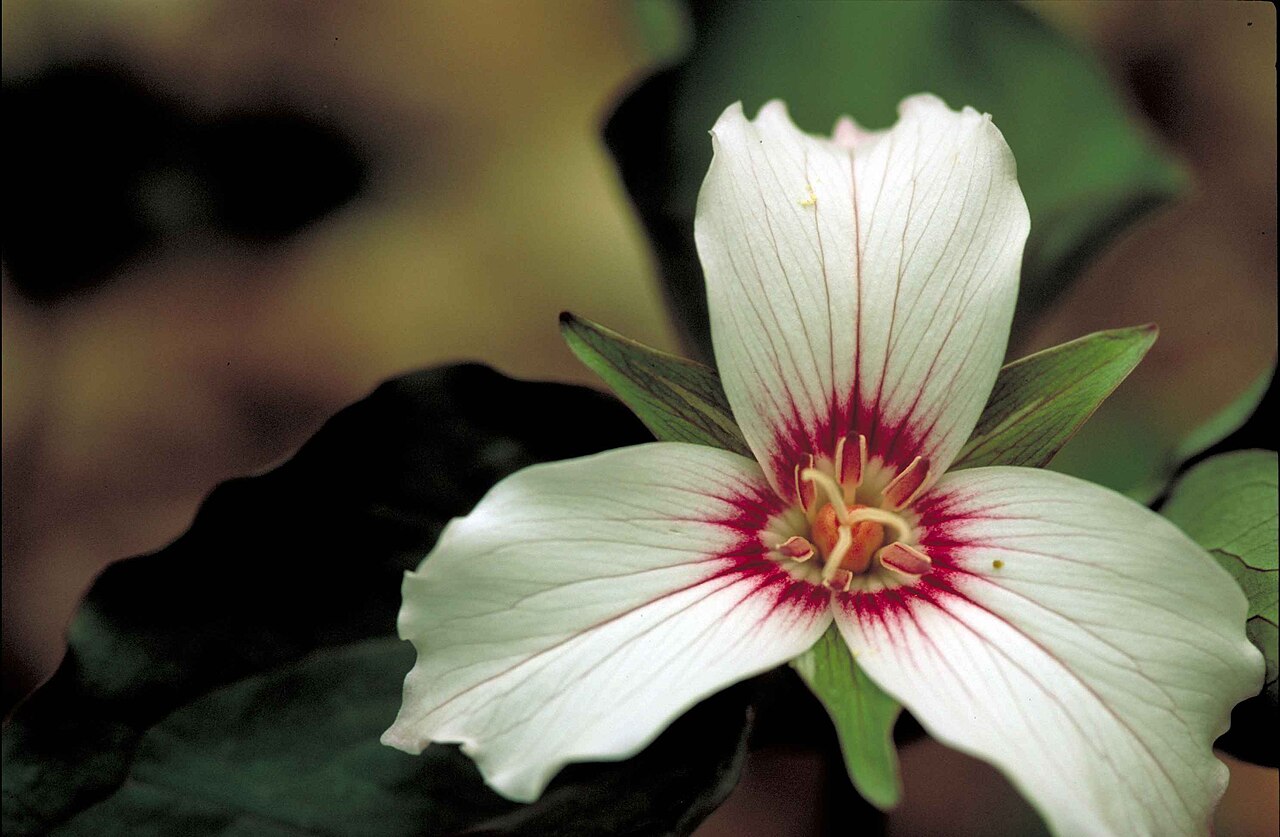
The single flower stands upright on a stalk 1 to 2 inches long above the leaves. It has three narrow green sepals, often edged with red, and three white petals about 1 to 1½ inches long with wavy edges and a crimson to magenta V-shaped blaze at the base. The center has six stamens and a three-part stigma. Rarely the petals are all white or pink-tinged. Painted trillium blooms from April to June, depending on elevation and latitude, and it is often among the later trilliums to flower.
Fruit & Seeds
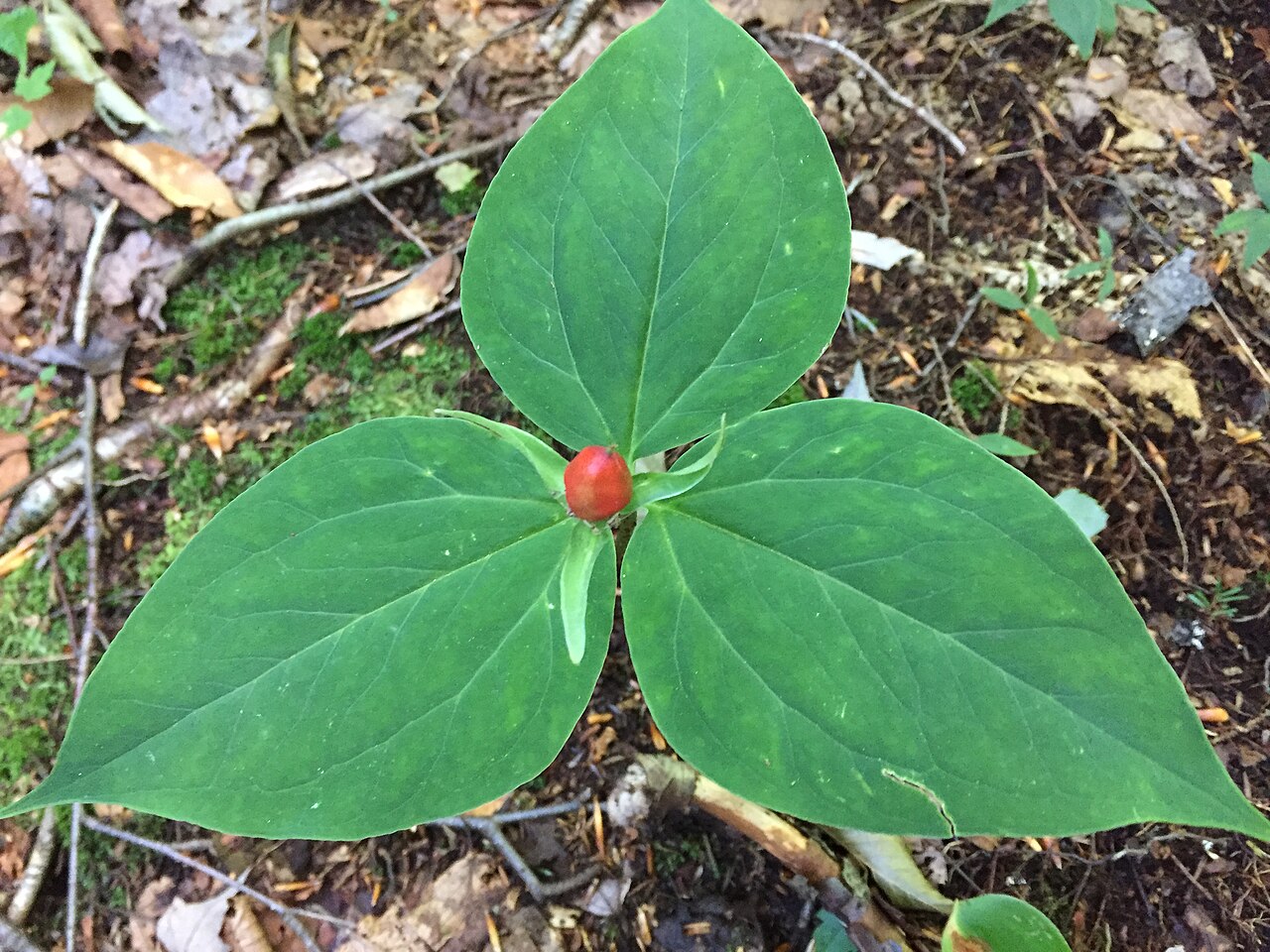
After flowering, the ovary swells into a glossy, bright red, somewhat three-angled berry about 3/4 inch long, which ripens in late summer or early fall. The seeds inside have small, oily appendages (elaiosomes) that attract ants. The ants carry the seeds to their nests, eat the appendages and leave the seeds to germinate.
Quick Facts
| Scientific Name | Trillium undulatum |
| Common Names | Painted trillium (USDA), painted wakerobin, painted lady |
| Family | Melanthiaceae (trillium family; formerly Liliaceae) |
| Plant Type | Herbaceous perennial from a rhizome; spring-blooming woodland wildflower |
| Mature Height | 8–20 in |
| Mature Spread | 6–12 in |
| Growth Rate | Very slow |
| Sun Exposure | Part shade to full shade |
| Water Needs | Medium to high; soil must stay cool and moist |
| Soil Type | Strongly acid, humus-rich, sandy or peaty forest soil |
| Soil pH | Acid (about 4.0–5.5) |
| Bloom Time | April–June |
| Flower Color | White with a crimson to magenta V at the base of each petal |
| Fall Color | Leaves yellow and wither in late summer |
| Fruit | Glossy, bright red berry, late summer–early fall |
| Deer Resistant | No; deer browse trilliums heavily |
| USDA Hardiness Zones | 3–7 |
Native Range
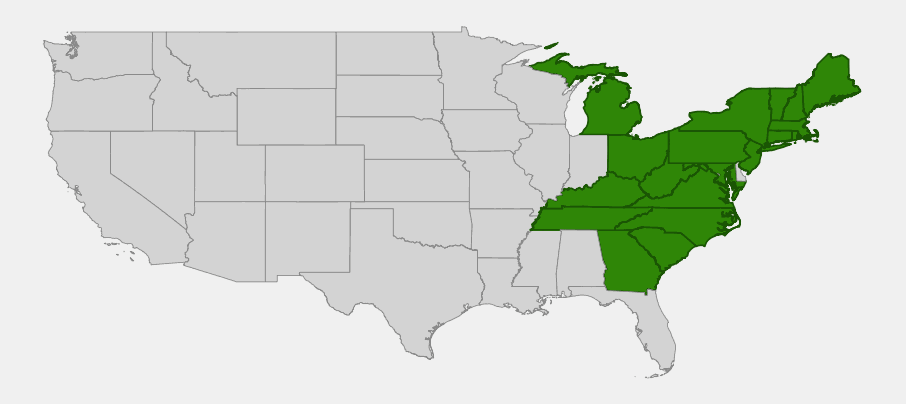
Painted trillium is native to northeastern North America and the Appalachian Mountains. USDA PLANTS records it from 19 states, from Maine, New Hampshire and Vermont south through New England, New York, New Jersey and Pennsylvania, and west to Michigan and Ohio. From there it follows the Appalachians south through Maryland, West Virginia, Virginia, Kentucky, Tennessee and the Carolinas to northern Georgia. In Canada it grows in Ontario, Quebec, New Brunswick, Nova Scotia and Prince Edward Island.
In the north it grows from near sea level to the mountains, but in the southern part of its range it is restricted to high elevations, mostly above about 3,000 feet. In the Great Smoky Mountains and other southern Appalachian ranges it grows in spruce-fir and northern hardwood forests and in rhododendron thickets up to about 6,000 feet. It is rare at the western and southern edges of its range, including in Ohio, Kentucky, Georgia and South Carolina.
Typical habitats are cool, moist, strongly acid woods: hemlock and white pine forests, spruce-fir forests, northern hardwood stands of beech, birch and maple, and the borders of sphagnum bogs and swamps. It is often found in the deep shade of rhododendron and mountain laurel.
📋 Regional plant lists featuring Painted Trillium: New York, Pennsylvania & Northern New Jersey · Ohio & Indiana · Michigan, Wisconsin & Eastern Minnesota · Kentucky & Tennessee · Connecticut, Massachusetts & Rhode Island · New Hampshire, Maine & Vermont · Maryland, Virginia & West Virginia · Delaware, Southern New Jersey & Long Island · Alabama, Georgia & Mississippi
Growing & Care Guide
Painted trillium is a choice plant for experienced woodland gardeners in cool, acid-soil regions. It is slow and demanding, and it should come only from nurseries that propagate it from seed. Never dig it from the wild, and avoid plants offered cheaply or in large numbers, which are often wild-collected. Where your soil is not strongly acid, other trilliums such as white trillium are much easier.
Light
Give it part to full shade under deciduous or mixed trees, ideally with some evergreen cover such as hemlock or rhododendron nearby. It needs protection from hot afternoon sun and does best in cool, humid sites.
Soil & Water
Soil is the key to success. Painted trillium needs strongly acid soil (pH about 4 to 5.5) that is rich in organic matter, loose, and evenly moist but not waterlogged. A mix of acid leaf mold, pine needles, rotted wood and sand works well. It will not tolerate lime, clay that bakes dry, or summer drought. Mulch with shredded oak leaves or pine needles, and water during dry spells.
Planting Tips
Plant nursery-grown rhizomes in late summer or early fall, about 2 to 4 inches deep with the bud pointing upward. Potted plants can be planted in spring. Grow it with other acid-loving woodland plants such as bluebead lily, goldthread, Canada mayflower, partridgeberry and ferns. Protect plants from deer, which can eat them down to the ground, and from slugs. Expect plants to take several years to settle in.
Pruning & Maintenance
No pruning is needed. Leave the leaves until they wither on their own, since the rhizome depends on them for food. Never pick the flowers with the leaves: removing the leaves can weaken or kill the plant for years. Let fallen leaves stay in place as mulch.
Propagation
Trillium seed should be sown fresh, as soon as the berries ripen, in pots of acid, humus-rich mix left outdoors. Germination usually takes two winters, and seedlings then grow for several years before flowering. Mature clumps can be divided carefully when dormant, but they increase slowly. This slow propagation is why legitimately nursery-grown painted trilliums are scarce and expensive.
Landscape Uses
- Acid woodland gardens: under hemlocks, oaks and pines, with rhododendrons and ferns
- Shade gardens in cool climates: striking spring flowers in moist, acid soil
- Native wildflower collections: one of the most distinctive eastern trilliums
- Habitat stewardship: protecting existing wild colonies from deer, trampling and collection
Wildlife & Ecological Value
Painted trillium is part of the spring flora of the cool, acid forests of the Northeast and Appalachians, and it relies on insects and ants to reproduce.
For Pollinators
The flowers have little or no nectar but offer pollen. They are visited by small bees, flies and beetles. Many trilliums can also self-pollinate, which helps them set seed when pollinators are scarce.
For Birds
Ground-feeding birds may eat some of the red berries, though they are not a major food. The forests where painted trillium grows are important nesting habitat for warblers, thrushes and other songbirds.
For Mammals
White-tailed deer eat trilliums readily, and heavy deer browsing has reduced trillium populations in many eastern forests. Because the leaves are the plant’s only source of food for the year, repeated browsing can weaken or kill plants. Small mammals may also eat the fruit.
Ecosystem Role
Painted trillium is a classic ant-dispersed plant. Ants carry its seeds to their nests, eat the fatty appendages, and leave the seeds in nutrient-rich soil. Because ants move seeds only short distances, trillium colonies spread very slowly, and old, large populations usually indicate long-undisturbed forest.
Cultural & Historical Uses
The species was described by the German botanist Carl Ludwig Willdenow in 1801. In older books it sometimes appears as Trillium erythrocarpum, “red-fruited trillium”, a name that refers to its bright red berries. Common names such as painted lady and painted wakerobin refer to the crimson markings on the petals and to the plant’s spring blooming time.
Trilliums have a long history in traditional medicine. Several eastern Native American peoples used trillium roots in remedies, and some species were known as “birthroot” for their use in childbirth. Medical use of wild plants is not recommended today, and digging the rhizomes kills the plants.
Painted trillium has become a symbol of the cool, mossy forests of the Northeast and Appalachian highlands, and it is a favorite of hikers and wildflower photographers on spring trails. It is listed as rare in some states at the edges of its range, and in all states the guidance is the same: enjoy the flowers, leave the plants where they grow, and buy only propagated plants for the garden.
Frequently Asked Questions
Can I grow painted trillium in my garden?
Yes, but only in cool, shady sites with strongly acid, humus-rich, evenly moist soil. It is one of the harder trilliums to grow. Buy plants from nurseries that propagate them from seed, and never dig plants from the wild.
Why should I never pick a trillium?
A trillium’s three leaves are its only source of food for the year. Picking the flower usually removes the leaves too, and the plant may take years to recover or may die. Collecting also harms wild populations that grow back very slowly.
How long does painted trillium take to bloom from seed?
Usually five to seven years or more. Seeds often take two winters to germinate, and seedlings grow a single small leaf for the first year or two before slowly building up a rhizome large enough to flower.
How can I tell painted trillium from white trillium?
Painted trillium has wavy white petals with a crimson V at the base and leaves on short stalks with long, tapering tips. White trillium (Trillium grandiflorum) has larger, plain white petals that turn pink with age and stalkless leaves. White trillium also grows in richer, less acid soils.
Is painted trillium endangered?
It is widespread and secure across much of its range, but it is rare in some states at the edges of its range, and local populations suffer from deer browsing, logging, development and collecting. Leave wild plants undisturbed everywhere.

Looking for a nursery that carries Painted Trillium?
Browse our native plant nursery directory: Connecticut & Georgia · Kentucky, Maine, Maryland, Massachusetts & Michigan · New Hampshire, New Jersey, New York, North Carolina & Ohio · Pennsylvania, Rhode Island, South Carolina, Tennessee, Vermont & Virginia · West Virginia