
Pink Sundew (Drosera capillaris)
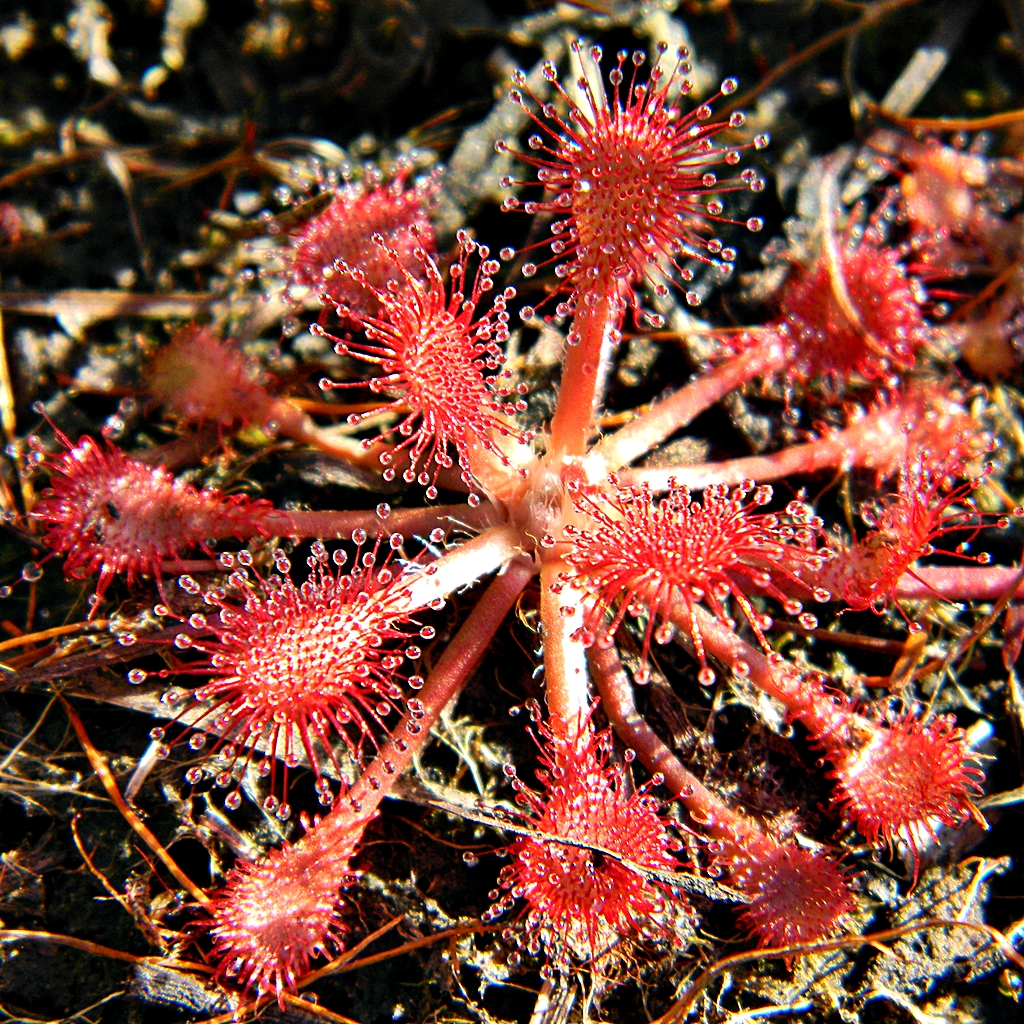
Drosera capillaris, known as Pink Sundew, is a small carnivorous wildflower of the sundew family (Droseraceae) native to the wet, sandy, sunny places of the southeastern Coastal Plain. Each plant is a flat rosette only 1 to 2 inches across, made of little spoon-shaped leaves that are covered in reddish hairs. Each hair is tipped with a drop of clear, sticky fluid that sparkles like dew in the sun, the source of the name “sundew.” From spring into summer it sends up slender stalks of pink to white flowers about half an inch across.
The glistening drops are a trap. Small insects such as gnats, mosquitoes, springtails and ants land on the leaves or brush against them and are caught in the sticky mucilage. The surrounding hairs slowly bend toward the prey, and the leaf releases enzymes that digest it. This lets the plant gather nitrogen and other nutrients that are scarce in the waterlogged, acidic sands where it grows.
Pink sundew grows in wet pine savannas and flatwoods, seepage bogs, pond margins and ditches from Delaware and Maryland south to Florida and west to Texas and Arkansas, as well as in Puerto Rico and much of tropical America. It is the most widespread sundew of the Southeast and one of the easiest to grow in a sunny bog garden. This guide covers identification, range, growing it from nursery or seed-grown stock, its role in the ecosystem and its history.
Identification
Pink sundew is tiny, but once you notice one in a wet savanna you will often find hundreds. Several sundews share its range, and leaf shape, flower color and the hairs on the flower stalk are the best clues to telling them apart.
Rosette & Leaves
The leaves lie in a flat or slightly raised rosette, usually 1 to 2 inches across, though plants in shade or deep moss can be larger and more upright. Each leaf has a slender, mostly hairless stalk and a rounded to spoon-shaped (spatulate) blade about ¼ inch wide. The upper surface and edges of the blade are covered with glandular hairs (tentacles), each tipped with a glistening drop of mucilage. In full sun the whole plant turns deep red. In shade it stays greener.
Flowers
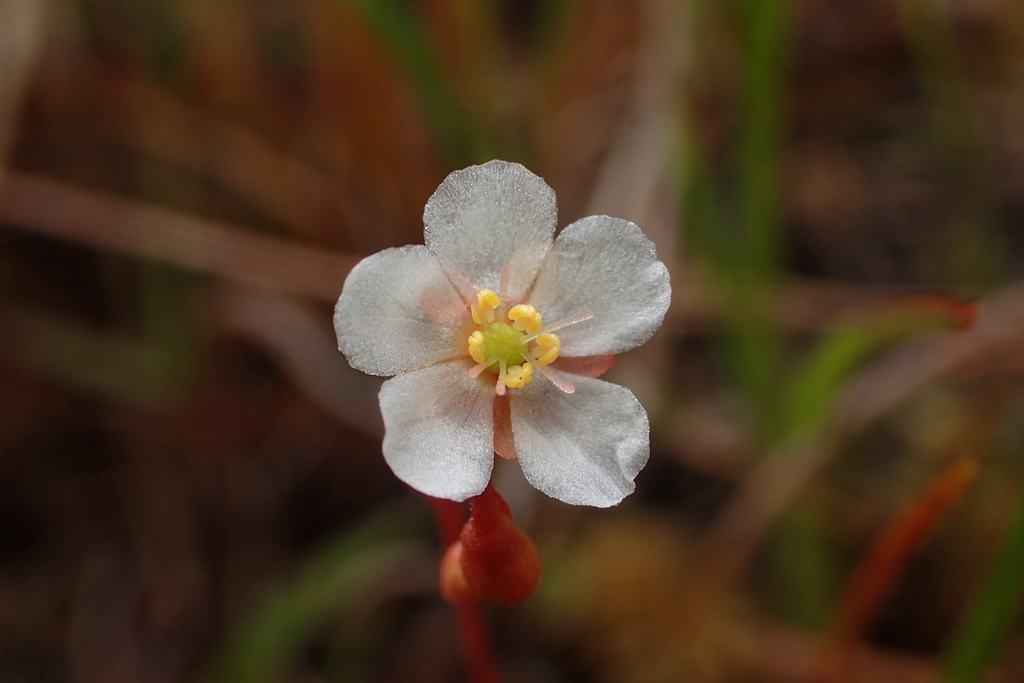
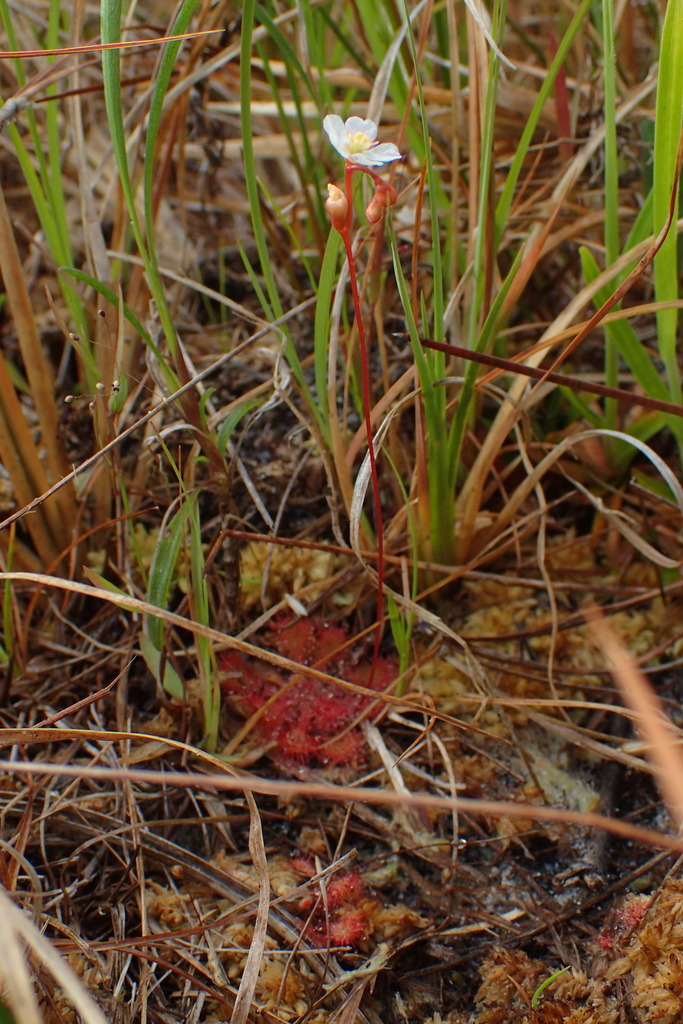
One to several smooth, reddish flower stalks rise from the center of the rosette, usually 2 to 8 inches tall. The flowers are arranged in a one-sided, coiled cluster that unrolls as it grows, opening one or a few at a time from the bottom up. Each flower has five rounded petals, pale to rosy pink or sometimes white, and is about ⅓ to ½ inch across. Flowers open in the morning sun and close by afternoon. Bloom time is long, mostly from spring into late summer, beginning in late winter in southern Florida.
Fruit & Seeds
Each flower forms a small capsule that splits to release numerous tiny dark seeds. They fall close to the parent plant or wash a short distance in rain, which is why pink sundews often grow in dense patches.
Life Cycle
Pink sundew can behave as a perennial, an annual or a short-lived perennial depending on conditions. Plants in seasonally flooded sites or dry winters may die after flowering and return from seed. In the Deep South the rosettes remain active through the winter, while plants at the northern edge of the range may go partly dormant.
Similar Species
Dwarf sundew (Drosera brevifolia) is smaller, with wedge-shaped leaves, glandular hairs on its flower stalk, and an earlier, shorter bloom. Spoonleaf sundew (Drosera intermedia) has longer, upright leaves along a short stem and white flowers. Thread-leaved sundews (Drosera filiformis and D. tracyi) have long, threadlike leaves. Roundleaf sundew (Drosera rotundifolia) has round, long-stalked leaves and grows mostly to the north and in the mountains.
Quick Facts
| Scientific Name | Drosera capillaris |
| Family | Droseraceae (sundew family) |
| Plant Type | Carnivorous herbaceous perennial, sometimes annual |
| Mature Height | Rosette under 1 in tall; flower stalks 2–8 in |
| Mature Spread | 1–2 in per rosette |
| Growth Rate | Fast; may flower in its first year from seed |
| Sun Exposure | Full sun to light shade |
| Water Needs | High; soil must stay wet to saturated |
| Soil Type | Wet, nutrient-poor sand, peaty sand or sphagnum |
| Soil pH | About 4.0–6.0 (acidic) |
| Bloom Time | Spring–summer (from late winter in south Florida) |
| Flower Color | Pink to white |
| Fall Color | Rosettes are red in full sun year-round |
| Fruit | Small capsule with many tiny dark seeds |
| Deer Resistant | Yes; too small and sticky to be browsed |
| USDA Hardiness Zones | 7–11 |
Native Range
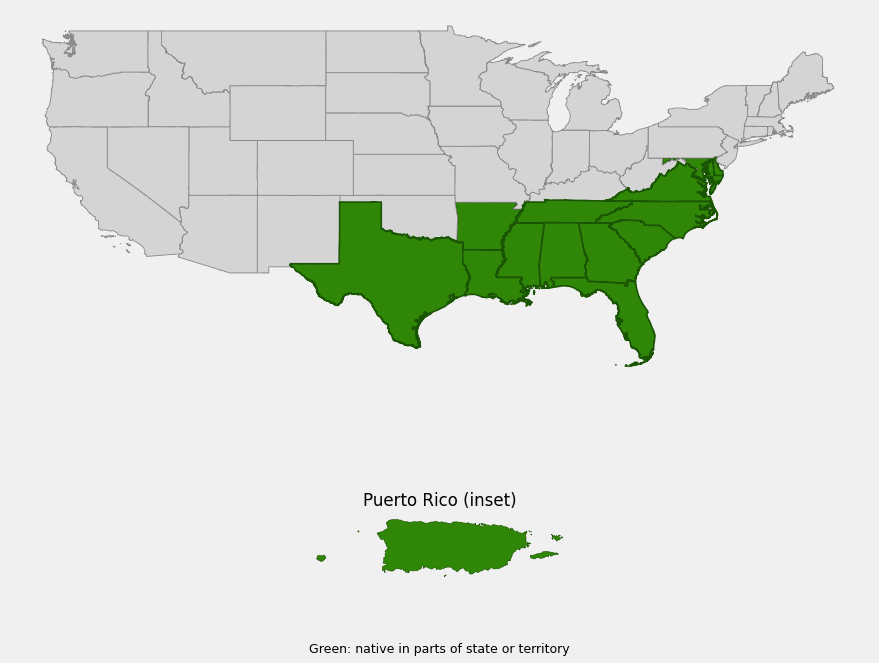
Pink sundew is native to the Atlantic and Gulf Coastal Plain of the southeastern United States. USDA PLANTS records it from Delaware, Maryland, Virginia, North Carolina, South Carolina, Georgia, Florida, Alabama, Mississippi, Louisiana, Texas, Arkansas and Tennessee, and from Puerto Rico. It is most abundant in Florida and in the pine savannas and bogs of the Carolinas and the Gulf Coast, from the Florida panhandle west to southeastern Texas.
Beyond the United States it ranges widely through the Caribbean, Mexico, Central America and northern and eastern South America, where it grows in wet savannas and on sandy lake shores at a range of elevations. In Puerto Rico it grows in wet, open, nutrient-poor sites.
Within its range it favors sunny, constantly moist to wet sandy or peaty soils with little competition. Typical habitats are wet pine flatwoods and savannas, seepage slopes and pitcher plant bogs, the margins of ponds, cypress domes and depression marshes, and disturbed open places such as wet roadside ditches and firebreaks. Like many savanna plants, it depends on periodic fire or other disturbance to keep its habitat open, and it declines as shrubs close in.
📋 Regional plant lists featuring Pink Sundew: Kentucky & Tennessee · Maryland, Virginia & West Virginia · Delaware, Southern New Jersey & Long Island · Alabama, Georgia & Mississippi · North & South Florida · Puerto Rico
Growing & Care Guide
Pink sundew is one of the easiest native carnivorous plants to grow, provided its basic needs are met: sun, constantly wet acidic soil, and water low in minerals. Grow it from nursery-propagated plants or seed. Never dig plants from the wild; pink sundew grows readily from seed, and collecting harms habitats that are already shrinking.
Light
Give it full sun or very bright light. In full sun the rosettes turn deep red and produce the most dew. In shade they become pale, leggy and weak, and they catch fewer insects.
Soil & Water
Use a nutrient-poor medium such as sphagnum peat mixed with roughly equal parts coarse, lime-free sand or perlite. Keep it wet at all times. In a pot, stand the container in a tray of water. Water only with rainwater, distilled water or reverse-osmosis water. Hard tap water and fertilizers build up minerals that will kill sundews. Do not fertilize; the plant feeds itself from insects.
Planting Tips
Plant in spring in a sunny bog garden, a lined container bog or a pot sitting in water. Pink sundews look best in groups and pair naturally with pitcher plants, which provide some shelter without casting heavy shade. In cold areas beyond its native range, grow it in pots that can be brought into an unheated, bright place in hard freezes.
Pruning & Maintenance
Remove taller grasses and sedges that shade the rosettes, and pull weeds by hand. Spent flower stalks can be cut or left to drop seed. Plants that die after flowering are usually replaced by seedlings if the soil surface stays wet and open.
Propagation
Seed is the easiest method. Sow it on the surface of wet peat and sand, without covering, in bright light. It germinates within a few weeks without cold treatment. Leaf cuttings laid on wet sphagnum also form new plantlets. Some plants produce side rosettes that can be separated.
Landscape Uses
- Bog gardens: a red groundcover under pitcher plants and among native orchids
- Container bogs and windowsill bogs: an easy introduction to carnivorous plants for children and beginners
- Wet savanna and pond-edge restoration: within its native range, using seed or nursery-propagated stock
- Rain gardens with acidic sand: in the wettest, sunniest, nutrient-poor spots
- Teaching collections: a classic, easily observed example of plant carnivory
Wildlife & Ecological Value
Pink sundew is both a predator and a provider. It catches small insects with its leaves while relying on others to pollinate its flowers, and it is a characteristic member of the remarkably diverse wet savanna flora.
For Pollinators
The pink flowers are visited by small bees, including sweat bees, and by small flies such as hover flies. The flowers stand on stalks well above the sticky leaves, which helps keep pollinators separate from prey. When insects do not visit, the flowers can self-pollinate, so plants set plenty of seed.
For Birds
Pink sundew is not a food source for birds. It grows in the open, fire-maintained savannas and bogs that support birds such as Bachman’s sparrows, Henslow’s sparrows and sandhill cranes.
For Mammals
Mammals rarely eat sundews. The plants live where grazing animals seldom forage, and their sticky leaves are unappetizing.
Ecosystem Role
Sundews are carnivores in the plant world. By catching gnats, mosquitoes, springtails, small flies and ants, they obtain nitrogen and phosphorus that are scarce in leached, waterlogged sands. This lets them thrive where few other plants can. Spiders and some insects steal prey from the sticky leaves. Pink sundew is a good indicator of high-quality, open wetlands with intact water levels and regular fire.
Cultural & Historical Uses
The genus name Drosera comes from the Greek droseros, “dewy,” and capillaris means “hair-like,” referring to the glandular hairs. The species was described in the early nineteenth century by the French botanist Jean Louis Marie Poiret.
Sundews have fascinated naturalists for centuries. Charles Darwin spent years experimenting with them and described their slow-moving tentacles and digestive powers in his book Insectivorous Plants (1875), which helped establish that plants could truly digest animal prey. In Europe, sundews were long used in herbal remedies for coughs, though that history concerns other species.
Today pink sundew is a favorite of carnivorous plant growers and educators. Many states protect carnivorous plants and their bog habitats, and poaching of wild plants for sale has been a real problem with some species. Buying seed-grown or nursery-propagated sundews and supporting the protection and prescribed burning of southeastern savannas are the best ways to help them.
Frequently Asked Questions
Is pink sundew really carnivorous?
Yes. Its leaves are covered in sticky, glandular hairs that trap small insects. The hairs and leaf slowly curl around the prey, and the leaf secretes enzymes that digest it and absorbs the nutrients.
Is pink sundew dangerous to pets or people?
No. It can only catch tiny insects, and the sticky fluid is harmless to touch. It is not a food plant, though, so do not eat it.
How do I grow pink sundew?
Grow it in full sun in a mix of peat and lime-free sand kept constantly wet with rainwater or distilled water. Never fertilize it. It is easy from seed sown on the surface of wet peat and often flowers in its first year.
Do I need to feed my sundew?
Outdoors, sundews catch plenty of prey on their own. Indoors, an occasional small insect helps, but a sundew in bright light and clean water will survive without feeding. Never feed it meat or use fertilizer.
Can I collect pink sundews from the wild?
No. Collecting harms wild populations and their fragile habitats, and many states protect carnivorous plants. Pink sundew is easy to grow from seed and is widely sold as nursery-propagated plants.

Looking for a nursery that carries Pink Sundew?
Browse our native plant nursery directory: Alabama & Arkansas · Delaware, Florida & Georgia · Louisiana, Maryland & Mississippi · North Carolina · South Carolina, Tennessee, Texas & Virginia