
Hooded Pitcher Plant (Sarracenia minor)
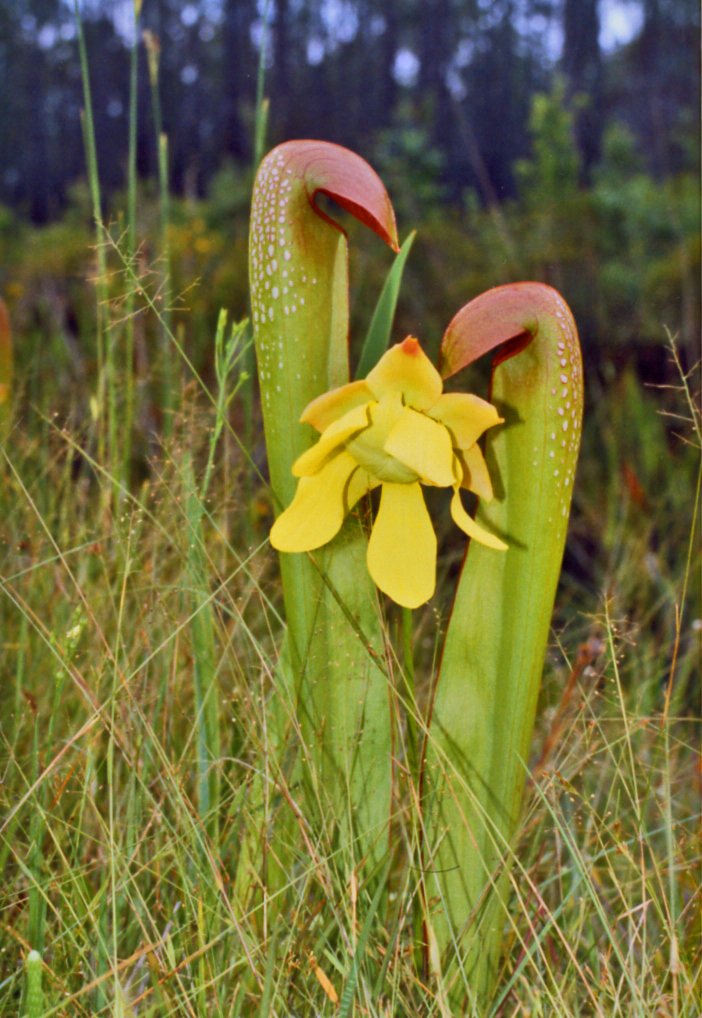
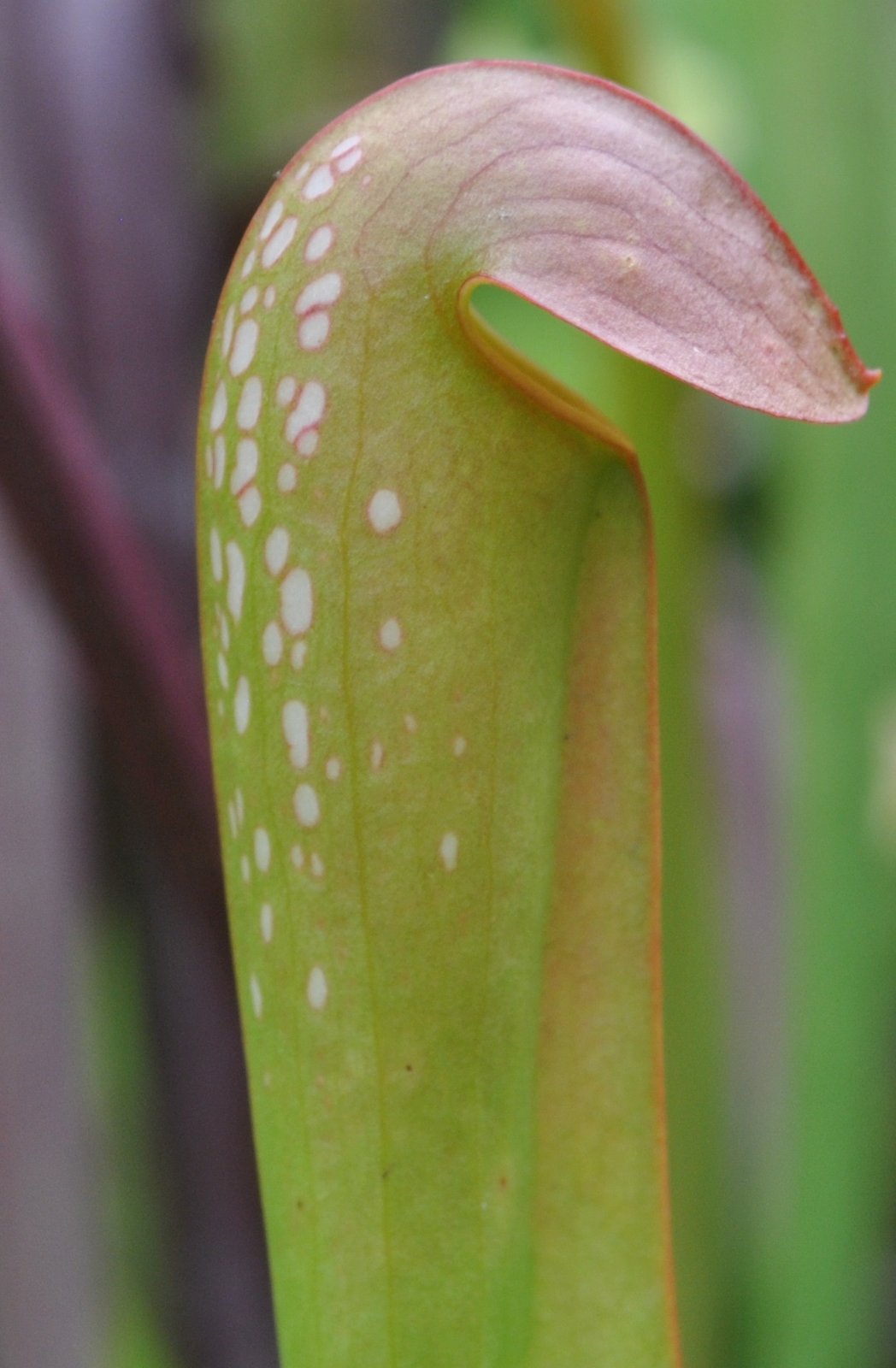
Sarracenia minor, the Hooded Pitcher Plant, is a carnivorous perennial of the southeastern Coastal Plain whose leaves are rolled into slender, upright tubes topped by a hood that curves forward over the opening like a cowl. Across the back of each hood is a scatter of translucent white spots. Insects that climb a nectar trail into the tube find the dark interior lit by those false windows, fly toward them instead of the real exit, and fall into the fluid below.
The hood does something practical as well: because it arches right over the mouth, rain cannot get in and dilute the digestive fluid, which is why this species does not hold the pool of rainwater that an open pitcher plant does. Hooded pitcher plants are famous for catching ants, and a single pitcher opened late in the season is often packed with them.
This is the only pitcher plant that reaches down into the Florida peninsula, and it is listed as Threatened by the State of Florida (FDACS) because of habitat loss and drainage. Collecting wild plants is both illegal and pointless, since nursery-grown stock is widely available. Buy nursery-propagated plants and never dig plants or collect seed from the wild.
Identification
Pitcher plants are unmistakable as a group, and hooded pitcher plant is one of the easiest to name once you see the top of a pitcher. Only this species combines an arched, hood-covered mouth with white translucent spots on the back of the tube.
Pitchers
The pitchers are the leaves. They are green at the base, usually flushed red or coppery toward the top, hollow, narrowly funnel-shaped, and held upright in a clump from a shallow rhizome. Most Florida plants carry pitchers 6 to 18 inches tall; the Florida Natural Areas Inventory distinguishes typical plants by pitchers under about 35 cm (14 inches). The hood is the key: it leans forward over the opening so that the mouth faces sideways and down rather than up.
Windows
The scatter of pale, translucent spots across the upper back of each pitcher, called areoles or fenestrations, is diagnostic. They act as false skylights. An insect that has walked in and then tries to escape is drawn to the brightest part of the chamber, which is the window rather than the opening, and it keeps battering against the wall until it drops. No other eastern pitcher plant shows this pattern so strongly.
Flowers
A single nodding flower is carried on a leafless stalk, usually at about the same height as the pitchers or slightly below, and it opens in spring. The Lady Bird Johnson Wildflower Center records flowering in March, April and May. The five drooping petals are yellow to greenish-yellow, and they hang over an umbrella-shaped style that catches pollen falling from the stamens. The flower stalk is short relative to the pitchers, which is itself a useful identification clue in this genus.
The Okefenokee Giant
Plants in and around the Okefenokee Swamp of southeastern Georgia and adjacent northeastern Florida grow far larger, with pitchers that can approach three to four feet, and they are often treated as a separate variety, Sarracenia minor var. okefenokeensis. Apart from size they look much like ordinary hooded pitcher plants and they share the same hood and window pattern.
Quick Facts
| Scientific Name | Sarracenia minor |
| Family | Sarraceniaceae (pitcher plant family) |
| Plant Type | Carnivorous herbaceous perennial with a rhizome |
| Mature Height | 6–18 in typically; Okefenokee plants to 3–4 ft |
| Mature Spread | 1–2 ft as clumps widen by rhizome |
| Growth Rate | Slow |
| Sun Exposure | Full sun |
| Water Needs | High; constantly moist to saturated, never dry |
| Soil Type | Acidic, nutrient-poor sand or peat; no fertilizer |
| Soil pH | Acidic |
| Bloom Time | March–May |
| Flower Color | Yellow to greenish yellow |
| Fall Color | Pitchers often deepen to red or copper before dying back |
| Fruit | Brown capsule that forms beneath the old umbrella-shaped style |
| Deer Resistant | Generally; rarely browsed |
| USDA Hardiness Zones | 7A–9B |
Native Range
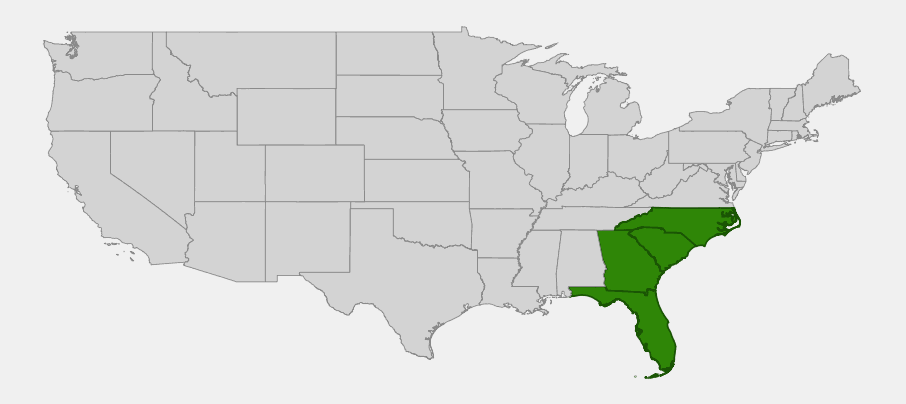
Hooded pitcher plant is native to the southeastern Coastal Plain in four states: Florida, Georgia, South Carolina and North Carolina. The U.S. Forest Service describes its range as running from central and western Florida north to southeastern North Carolina and inland to northeastern Georgia, and notes that it is the only Sarracenia species that extends into the Florida peninsula. USDA PLANTS lists it as native to the lower 48 states.
It grows in open, seasonally wet, fire-maintained habitats: wet and mesic pine flatwoods, pine savannas, seepage slopes, bogs and the edges of cypress depressions. The 2022 National Wetland Plant List rates it OBL, meaning it almost always occurs in wetlands. The Florida Native Plant Society lists its habitats as savannas, bogs, wet flatwoods and seepage slopes, and adds that it benefits from fire. Regular low-intensity burning removes the shrubs and grasses that would otherwise shade it out.
Because of habitat loss, drainage and fire suppression, hooded pitcher plant is listed as Threatened by the State of Florida (FDACS). The same pressures affect its populations elsewhere in the Coastal Plain, and poaching for the carnivorous plant trade is an added problem. Gardeners should buy nursery-propagated plants only, and should never dig plants or take seed from wild populations.
📋 Regional plant lists featuring Hooded Pitcher Plant: North & South Florida · Alabama, Georgia & Mississippi · North & South Carolina
Growing & Care Guide
Hooded pitcher plant is one of the easier Sarracenia species to grow, provided you accept two non-negotiable rules: wet, acidic, nutrient-poor soil, and full sun. It is sold by carnivorous plant nurseries and by some Florida native nurseries, and the Florida Native Plant Society recommends it for bog gardens. Because it is state-listed in Florida, buy nursery-propagated plants and never collect from the wild.
Light
Full sun, all day if possible. Sun is what produces the red pigments in the hood and the strongest, most upright pitchers. In shade the pitchers stay pale green, lean over and trap less. In the wild, fire keeps the canopy open; in a garden, you have to choose an open site and keep it that way.
Soil & Water
Use a nutrient-poor, acidic mix: roughly equal parts peat and clean coarse sand or perlite, with no fertilizer, no lime and no potting compost. Keep it constantly wet. The standard method is a bog container or lined bog bed sitting in a tray of water for most of the year. Water only with rainwater, distilled water or reverse-osmosis water, because the dissolved minerals in most tap water will kill these plants over a season or two. The Florida Native Plant Society rates the species as having no tolerance for salt spray or brackish flooding.
Planting Tips
The simplest approach is a half-barrel or similar container lined and filled with the peat-sand mix, topped up with rainwater and set in full sun. In the ground, excavate a basin, line it with pond liner punched with a few small drainage holes near the top, and fill with the same mix. Plant rhizomes just at the surface with the growth point exposed. It is hardy through roughly zones 7A to 9B and needs a cool winter rest, so do not bring it indoors to a warm room.
Pruning & Maintenance
Trim off pitchers only once they have browned completely, since even a fading pitcher is still feeding the plant. Cut back the dead growth in late winter before new pitchers emerge. Never fertilize: these plants get their nitrogen from insects, and fertilizer salts burn the roots. Do not feed captured insects by hand either; a plant in the open catches all it needs. Keep competing grasses and seedlings weeded out of the bog, which is the garden equivalent of fire.
Propagation
The Florida Native Plant Society lists seed as the propagation method. Sow fresh seed on the surface of a wet peat-sand mix and give it one to two months of cold, moist stratification before moving it to warmth and light; seedlings grow slowly and take several years to reach flowering size. Established clumps can also be divided in late winter, cutting the rhizome so each piece has a growth point and roots.
Landscape Uses
- Bog gardens: the Florida Native Plant Society recommends it specifically for bog gardens
- Container bogs: a half-barrel bog on a sunny patio is the easiest way to grow it well
- Pond and rain garden margins: on the saturated, acidic, unfertilized edge
- Conservation and education plantings: a striking way to show how a carnivorous plant works
- Pine flatwoods restoration: within its natural range, using nursery-propagated stock only
Wildlife & Ecological Value
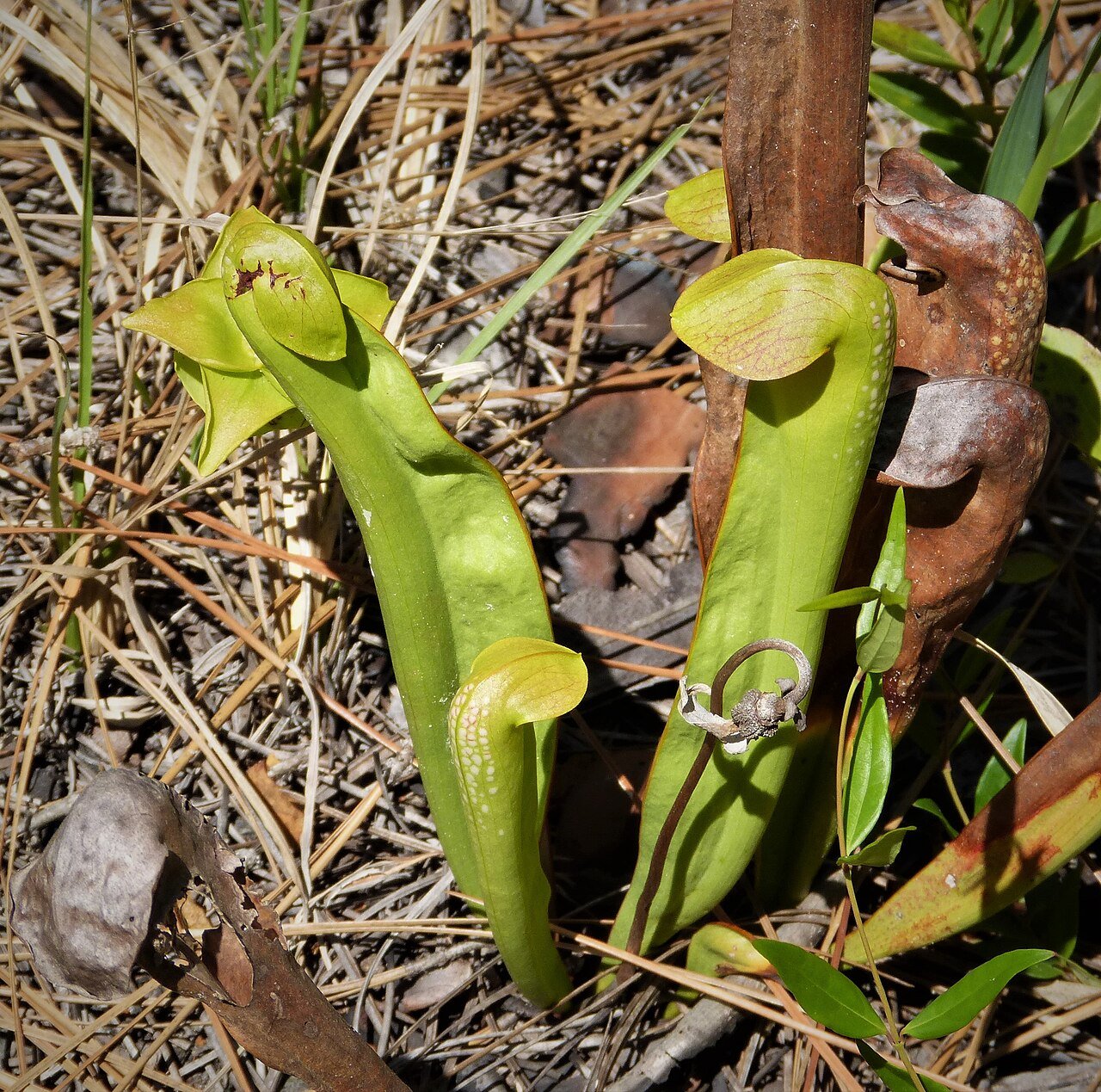
A pitcher plant is an unusual garden citizen: it eats some of the insects that visit it, but it also feeds and shelters others, and a mature clump turns out to be a small ecosystem in its own right.
For Pollinators
Spring flowers are visited by a range of insects. The Florida Native Plant Society notes that although several insect groups visit the flowers, their actual role in pollination is not well documented, with small bees the most likely pollinators. The nodding flower with its umbrella-shaped style is built to dust visitors with pollen as they crawl in and out. Flowering happens before the new season’s pitchers are fully developed, which reduces the chance that the plant traps its own pollinators.
For Birds
Hooded pitcher plant is not a bird food plant. In an open savanna the standing pitchers and flower stalks offer small perches, and birds occasionally pick insects from around the pitcher mouths.
For Mammals
Mammals largely ignore it. The pitchers are tough and fibrous, and the plant grows in wet ground that most browsers avoid.
Ecosystem Role
Ants make up a large share of this species’ prey, and the nitrogen it extracts from them is what allows it to live on soils far too poor for most plants. At the same time, pitcher plants host their own specialized community: moth larvae that bore into the pitchers, mites, and the larvae of flies and midges that live in the fluid and feed on the drowned insects. Hooded pitcher plant is also an indicator species. Where it still grows, the savanna is still wet, still open and still burning; when drainage or fire suppression change those conditions, it disappears along with the sundews, orchids and other specialists that share its ground.
Cultural & Historical Uses
The genus Sarracenia was named for Michel Sarrazin, a French physician and naturalist in Quebec who sent North American pitcher plants to European botanists in the early eighteenth century. Sarracenia minor was described by Thomas Walter in his 1788 Flora Caroliniana, one of the first floras written from the American South.
Pitcher plants fascinated nineteenth-century naturalists, and Charles Darwin’s work on insectivorous plants helped turn them from curiosities into serious subjects of study. The hooded pitcher plant’s false windows became a standard textbook example of how a plant can manipulate insect behaviour using light alone.
Today the main cultural issue surrounding this species is conservation. Carnivorous plants are heavily collected, and the combination of drainage, development, fire suppression and poaching is why Florida lists the hooded pitcher plant as Threatened. Nursery propagation is well established and inexpensive, so there is no reason to take plants from the wild; growers and bog garden societies have made the species easy to obtain legally.
Frequently Asked Questions
Why does it have a hood over the opening?
The hood keeps rain out so the digestive fluid is not diluted, and it makes the trap dark except for the translucent white spots at the back. Insects inside head for those false windows instead of the real exit and fall into the fluid.
What does a hooded pitcher plant eat?
Mostly ants, along with other crawling and flying insects. It absorbs nitrogen and other nutrients from the prey, which is what lets it grow in bog soils that are far too poor for ordinary plants.
Is it protected?
Yes. Hooded pitcher plant is listed as Threatened by the State of Florida (FDACS), largely because of habitat loss, drainage and fire suppression. Buy nursery-propagated plants and never dig plants or collect seed in the wild.
Can I grow it in regular potting soil?
No. Potting soil, compost and fertilizer will kill it. Use a nutrient-poor mix of peat and coarse sand or perlite, keep it constantly wet with rainwater or distilled water, and never fertilize.
Do I need to feed it insects?
No. A plant growing outdoors in the sun catches everything it needs. Hand-feeding usually does more harm than good, and feeding it meat or fertilizer will rot the pitchers.

Looking for a nursery that carries Hooded Pitcher Plant?
Browse our native plant nursery directory: Florida & Georgia · North Carolina · South Carolina