
False Rosemary (Conradina canescens)
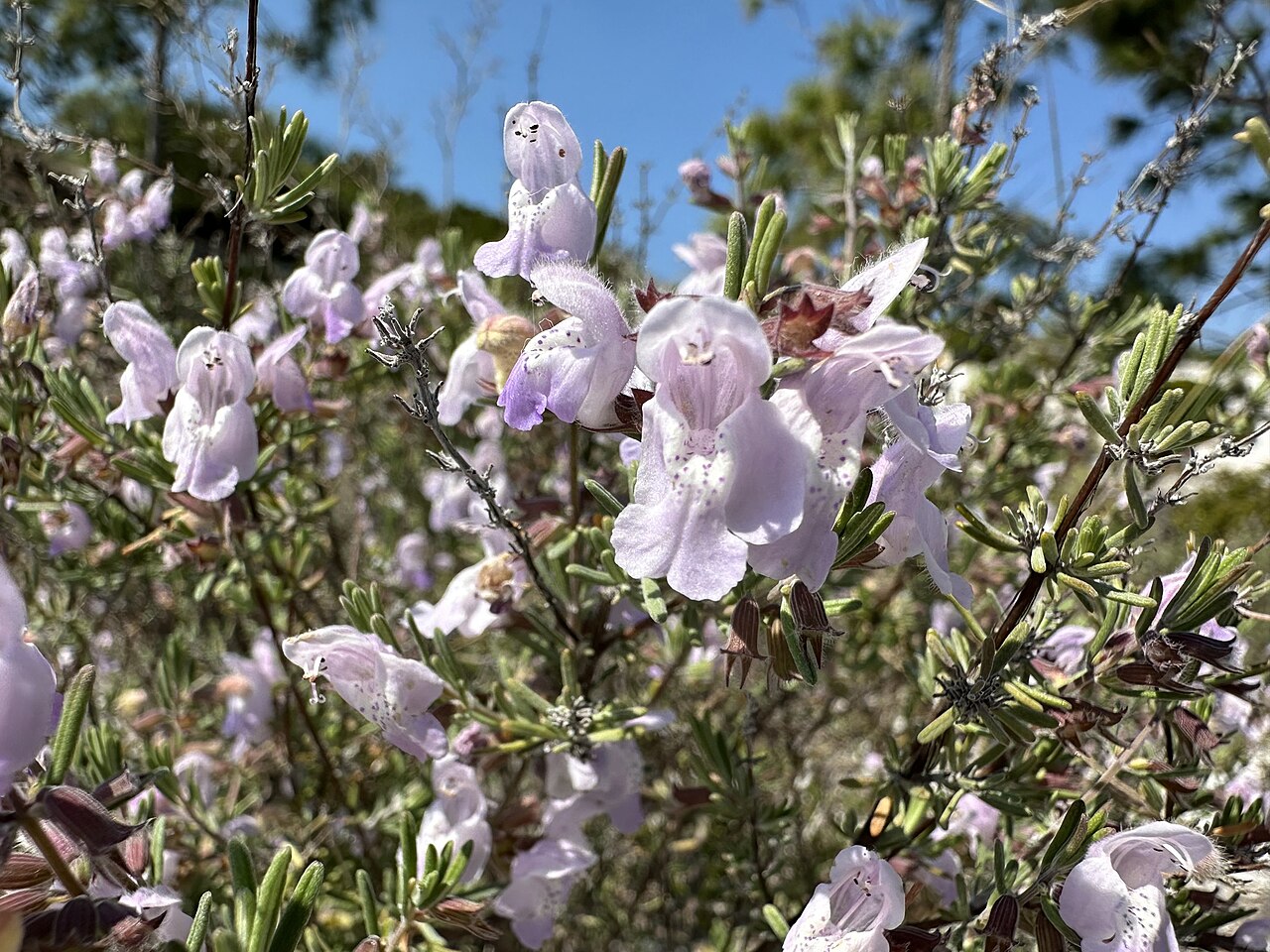
Conradina canescens, known as False Rosemary, gray-leaved conradina or wild rosemary, is a small, aromatic, evergreen shrub of the white sand scrub and dunes along the northern Gulf Coast. Its needle-like, gray-green leaves look and smell remarkably like culinary rosemary, and in spring it is covered with pale lavender to nearly white, two-lipped flowers marked with purple spots. It belongs to the mint family (Lamiaceae).
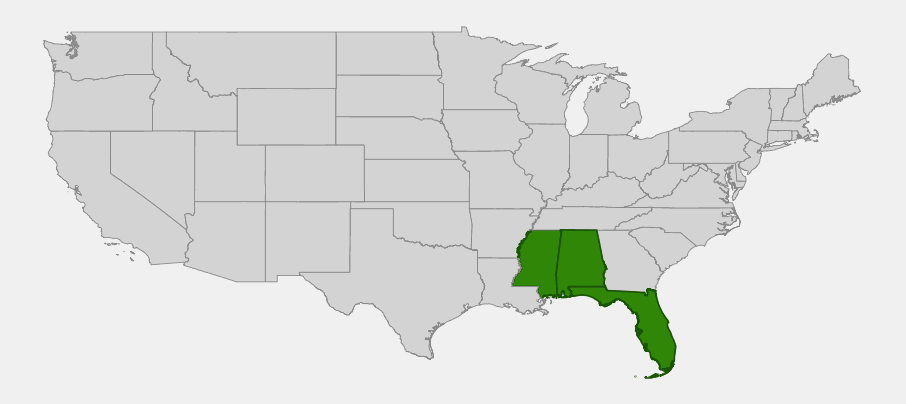
False rosemary has one of the smaller native ranges among Gulf Coast shrubs: the Florida Panhandle and the coasts of Alabama and Mississippi. It thrives in deep, dry, nutrient-poor sand where summer heat, salt wind and drought eliminate most other plants. That toughness makes it one of the best native shrubs for sunny, sandy, coastal gardens in its region.
It is not related to the true rosemary of the Mediterranean (Salvia rosmarinus), although both are mints, and it is also different from Florida rosemary (Ceratiola ericoides), an unrelated shrub of the same sandy habitats. This guide covers how to recognize false rosemary, where it grows, and how to grow it from nursery-propagated plants.
Identification
False rosemary is easy to recognize: a low, rounded, gray-green shrub with needle-like leaves that smell of rosemary when crushed and, in spring, many lavender, spotted flowers. Several other Conradina species grow in Florida and the Southeast, most of them rare, and they differ in leaf length and hairiness, flower details and range.
Stems & Habit
It is a small, much-branched evergreen shrub, usually 1 to 3 feet tall and about as wide. Stems are woody, with grayish bark on older branches. Young shoots are covered with fine, short gray hairs and are square in cross-section, like other mints. In exposed dune sites it stays low and compact. In more sheltered sites it becomes taller and more open.
Leaves
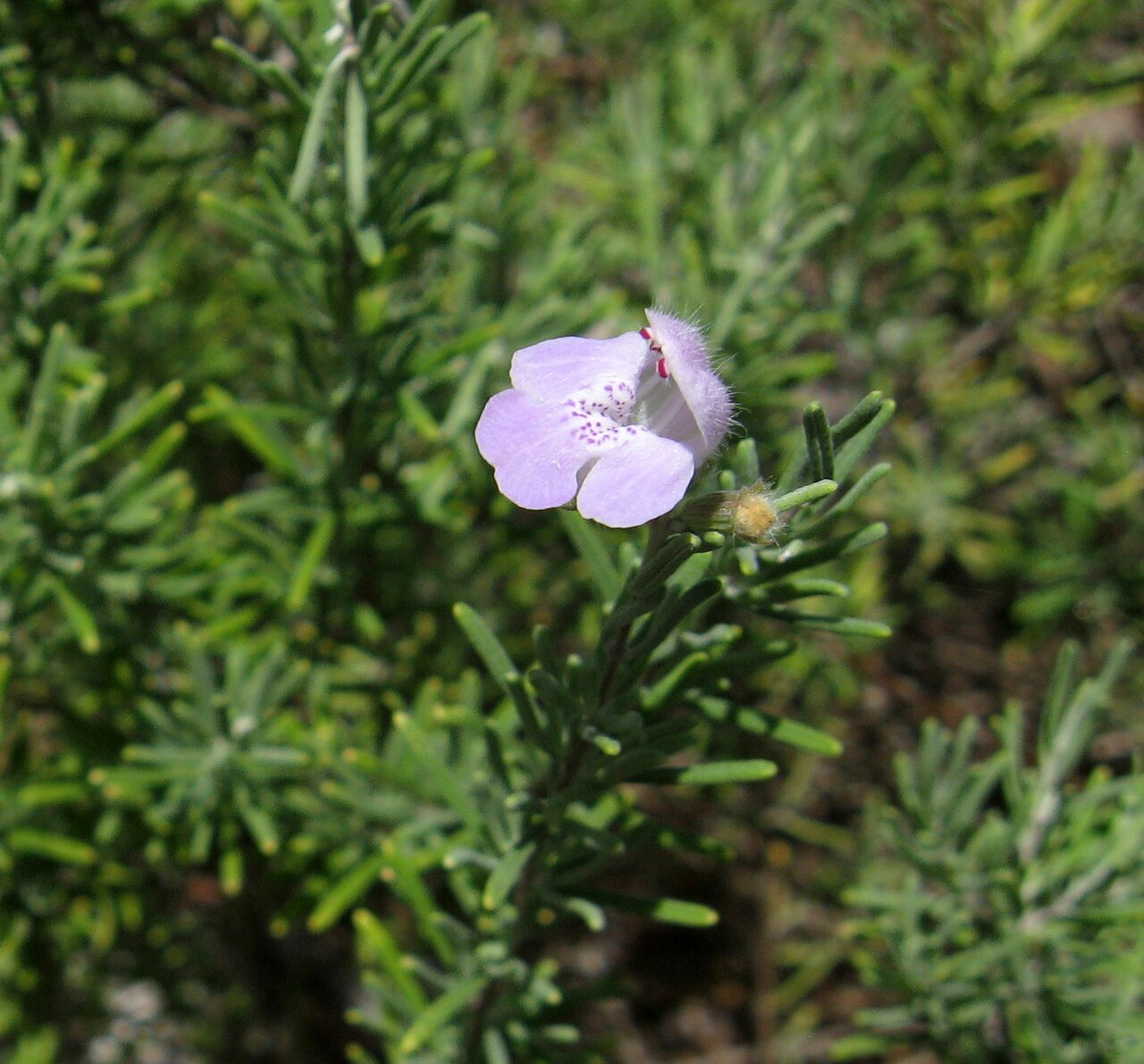
The leaves are opposite but appear clustered, because short leafy shoots grow in their axils. Each leaf is linear and needle-like, usually about ¼ to ¾ inch long, with edges rolled under. Both surfaces are covered with dense, fine gray hairs, which give the plant its gray-green color. This dense gray hair is the main feature that separates it from other Conradina, and the species name canescens means “becoming gray”. The leaves have a strong, pleasant rosemary-like scent when crushed.
Flowers
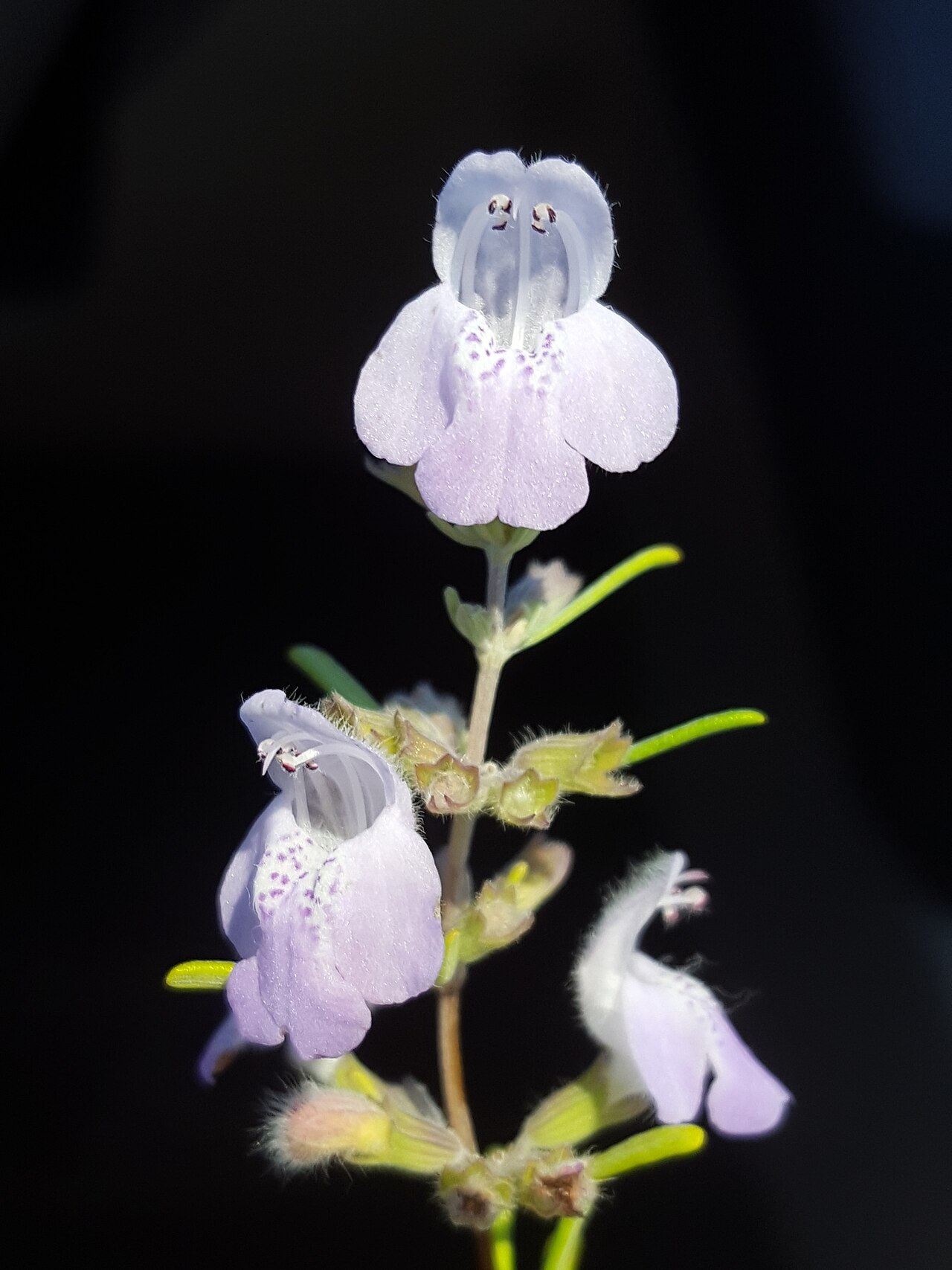
Flowers appear mainly from late winter to spring, from about February to May, with scattered flowers at other times of the year. They grow in small clusters in the leaf axils near the ends of the branches. Each flower is about ½ inch long, two-lipped, and pale lavender to nearly white. The lower lip has three lobes and is marked with dark purple spots, and the tube is bent near the base.
Fruit
Each flower produces up to four tiny, dark nutlets enclosed in the persistent calyx. They ripen in late spring and early summer and fall near the parent plant.
Quick Facts
| Scientific Name | Conradina canescens |
| Family | Lamiaceae (mint family) |
| Plant Type | Small evergreen aromatic shrub |
| Mature Height | 1–3 ft |
| Mature Spread | 1–3 ft |
| Growth Rate | Moderate |
| Sun Exposure | Full sun |
| Water Needs | Low; very drought tolerant once established |
| Soil Type | Deep, dry, well-drained sand |
| Soil pH | About 4.5–7.0 |
| Bloom Time | February–May, with scattered flowers at other times |
| Flower Color | Pale lavender to nearly white, spotted with purple |
| Fall Color | None; evergreen |
| Fruit | Tiny nutlets |
| Deer Resistant | Yes; aromatic foliage is rarely browsed |
| USDA Hardiness Zones | 8–9 |
Native Range
False rosemary is native to a narrow band along the northern Gulf Coast. USDA PLANTS records it from Florida, Alabama and Mississippi. In Florida it grows in the western and central Panhandle, especially in coastal counties, and in Alabama and Mississippi it occurs mainly in the coastal counties. Within this range it can be locally common, sometimes forming extensive patches on open sand.
It grows in coastal scrub, on stabilized and back dunes, in sand pine and oak scrub, in sandhills and in scrubby flatwoods. It also colonizes open, sandy road edges and clearings. All of these habitats have deep, very well-drained, nutrient-poor sand and high exposure to sun and heat.
Some recent botanical treatments include the central Florida plant known as short-leaved rosemary (C. brevifolia), from the Lake Wales Ridge, in C. canescens. USDA PLANTS treats the two separately. This page describes the Gulf Coast plant, and the map follows USDA. Coastal development has destroyed much of its habitat, and the remaining scrub depends on occasional fire or other disturbance to stay open.
📋 Regional plant lists featuring False Rosemary: North & South Florida · Alabama, Georgia & Mississippi
Growing & Care Guide
False rosemary is easy to grow in full sun and sharply drained sand, and it is available from native plant nurseries in its range. Buy nursery-propagated plants rather than digging wild ones, which rarely survive transplanting.
Light
Plant it in full sun. In shade it becomes sparse and leggy, flowers poorly and often declines.
Soil & Water
Excellent drainage is essential. It thrives in deep, dry sand, including coastal sand. In heavy, rich or wet soil it usually rots. Water young plants regularly through their first growing season, then only in extended droughts. Do not fertilize.
Planting Tips
Plant in fall or spring, spacing plants 2 to 3 feet apart. In heavier soils, plant on a mound or slope of sand. Use little or no mulch, or use a mineral mulch such as coarse sand, because organic mulch holds moisture around the stem.
Pruning & Maintenance
Lightly trim after spring flowering to keep plants compact. Avoid cutting into old, leafless wood, which may not resprout. Plants can become woody and sparse after several years, so it helps to root a few cuttings as replacements.
Propagation
Softwood or semi-hardwood cuttings root readily in a sandy mix under mist or high humidity, and this is the usual nursery method. Seeds can be sown in fall or spring, but germination may be low. Propagate only from legally obtained, nursery-grown plants.
Landscape Uses
- Coastal and dune gardens: tolerates salt wind, heat, drought and deep sand
- Xeriscapes and rock gardens: a compact evergreen shrub that needs no irrigation once established
- Pollinator gardens: spring flowers for bees and other pollinators
- Scrub and dune restoration: a characteristic Gulf Coast scrub shrub, using propagated stock
- Fragrance and herb gardens: an aromatic native alternative to culinary rosemary in the landscape
Wildlife & Ecological Value
False rosemary adds flowers and cover to sandy coastal habitats where few other shrubs grow.
For Pollinators
The spring flowers attract native bees, especially bumblebees and other medium-sized bees, as well as bee flies and butterflies. The purple spots on the lower lip guide visitors to the nectar, and the shape of the flower places pollen on their backs.
For Birds
Birds do not eat much of the plant, but low, dense shrubs provide cover in open scrub and dunes, and birds forage for the insects it attracts.
For Mammals
The aromatic foliage is rarely eaten by deer. Its dense branches can provide cover for small mammals of Gulf Coast dunes and scrub.
Ecosystem Role
False rosemary is one of the shrubs that stabilize sand in back dunes and coastal scrub. It is part of a scrub community that supports many specialized plants and animals. Like other Conradina, it is adapted to open, sunny conditions and declines when scrub becomes overgrown.
Cultural & Historical Uses
The genus Conradina was named by Asa Gray in honor of Solomon White Conrad, a 19th-century Philadelphia botanist and mineralogist. The species was first published in the mid-19th century in another genus, and Gray moved it into Conradina when he established the genus. The genus is small and entirely southeastern, and several of its species are rare and protected.
The common names false rosemary and wild rosemary reflect the strong resemblance to culinary rosemary in both appearance and scent. Although the leaves are aromatic, false rosemary is not a substitute for culinary rosemary, and there is little information on its safety as a food or tea.
Today false rosemary is valued by native plant gardeners on the Gulf Coast as a tough, fragrant, attractive shrub for sandy coastal sites, and by conservationists as part of the disappearing coastal scrub of the Florida Panhandle, Alabama and Mississippi.
Frequently Asked Questions
Can I use false rosemary like culinary rosemary?
It is not recommended. Although the leaves smell like rosemary, false rosemary is a different plant, and there is little information on its safety as food. Grow true rosemary for cooking and enjoy false rosemary as an ornamental.
Is false rosemary the same as Florida rosemary?
No. Florida rosemary (Ceratiola ericoides) is an unrelated shrub in the crowberry subfamily of the heath family, with green needle-like leaves and tiny flowers. False rosemary is a mint with gray, hairy leaves and showy lavender flowers.
Why did my false rosemary die?
The most common cause is poor drainage or too much water. It needs deep, sharply drained sand and full sun, and it usually rots in heavy, rich or wet soils.
Does false rosemary attract pollinators?
Yes. Its spring flowers attract bees, bee flies and butterflies, and it is a good addition to coastal pollinator gardens.
Where can I see false rosemary in the wild?
It grows in coastal scrub and dunes along the Florida Panhandle and the coasts of Alabama and Mississippi. Parks such as St. Joseph Peninsula State Park in Gulf County, Florida, are good places to see it. Never dig or collect plants.

Looking for a nursery that carries False Rosemary?
Browse our native plant nursery directory: Alabama · Florida · Mississippi