
California Blackberry (Rubus ursinus)
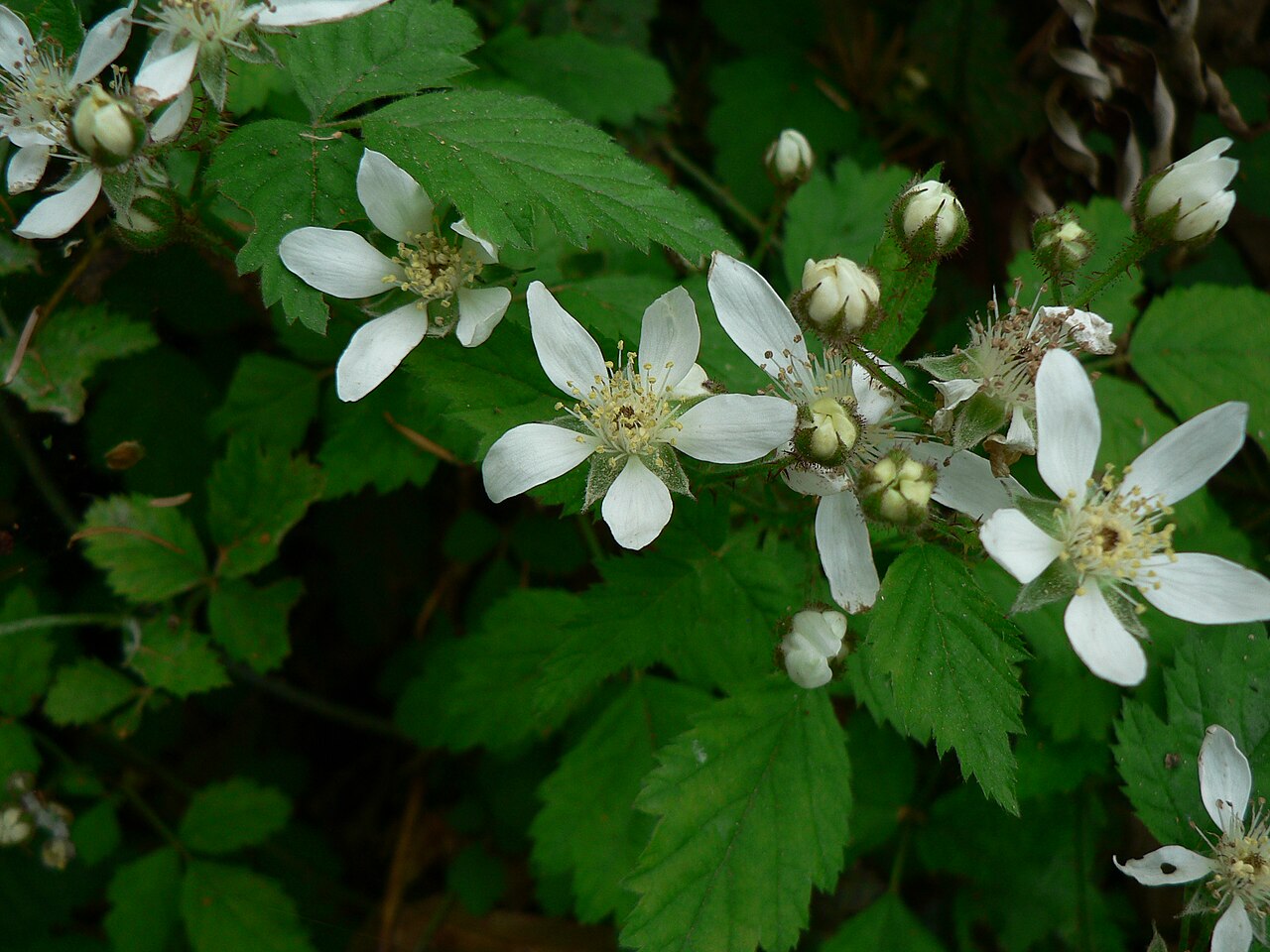
Rubus ursinus, known as California Blackberry, trailing blackberry, Pacific blackberry or Pacific dewberry, is the native blackberry of the Pacific Coast. It is a low, sprawling, prickly plant with long, slender stems that trail across the ground or scramble over shrubs and logs, rooting where their tips touch soil. In spring it bears white flowers with narrow petals, and in summer it produces small, glossy black berries that many foragers consider the best-flavored blackberry in the West.
It belongs to the rose family (Rosaceae), along with raspberries, thimbleberry and salmonberry. Unlike most blackberries, California blackberry is functionally dioecious: individual plants bear either male flowers or female flowers. That is why some patches flower heavily but never set fruit. It is also one of the parents of several famous cultivated berries, including the loganberry, boysenberry and marionberry.
Gardeners in the West often confuse it with the far more aggressive Himalayan blackberry, an introduced species that now dominates roadsides and stream banks from British Columbia to California. Learning to tell them apart lets you keep and encourage the native while removing the invader. This guide covers identification, range, care, wildlife value and the cultural history of this native berry.
Identification
California blackberry is best recognized by its thin, round, trailing stems, its usually three-parted leaves, and its small, elongated fruit. Introduced Himalayan blackberry and cutleaf blackberry have thick, arching, strongly angled canes, larger, broader berries, and leaves with five leaflets on first-year canes.
Stems
The stems (canes) are slender, round in cross-section, and often covered with a whitish, waxy bloom. They are armed with many small, straight to slightly curved prickles. First-year canes trail along the ground or climb over other plants for 10 to 20 feet, rooting at the tips. The following year they produce short side shoots that carry flowers and fruit, and then the canes die back. Plants usually form low mounds or tangles about 2 to 5 feet tall, much lower than the head-high walls of Himalayan blackberry.
Leaves
The leaves are alternate and usually divided into three toothed leaflets, though leaves on new canes may be simple and three-lobed. The terminal leaflet is the largest, ovate, and 1½ to 4 inches long. The upper surfaces are green and the undersides are paler and somewhat hairy, and prickles often run along the leaf stalks and midribs. Leaves persist into winter in mild coastal climates.
Flowers
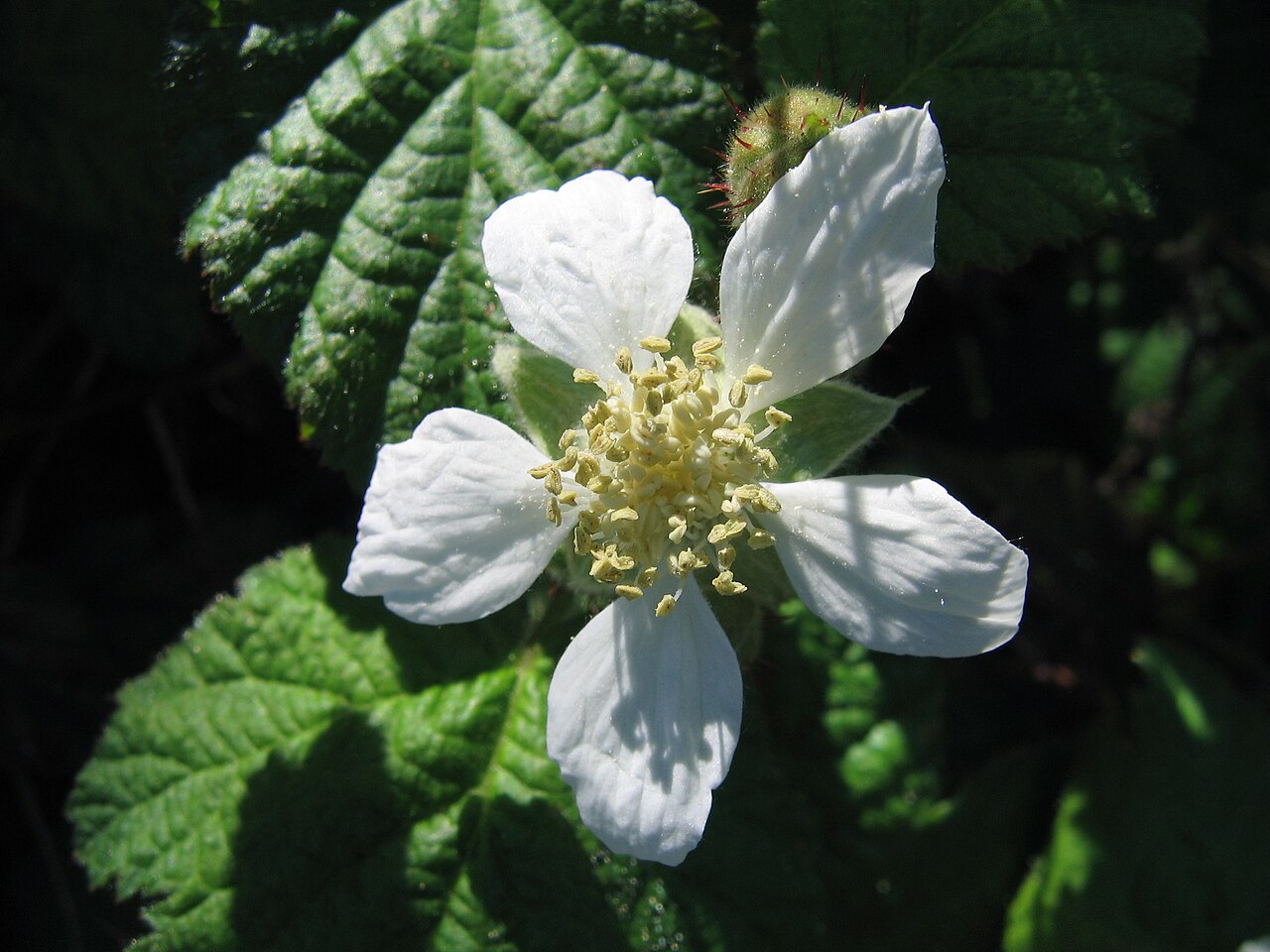
Flowers appear from about March to July in small clusters at the ends of short side branches. They are white and have five petals that are narrow and spaced apart rather than overlapping. Male flowers are larger, with petals up to about ¾ inch long and many stamens, while female flowers are smaller and have a dome of green pistils with shrunken stamens.
Fruit & Seeds
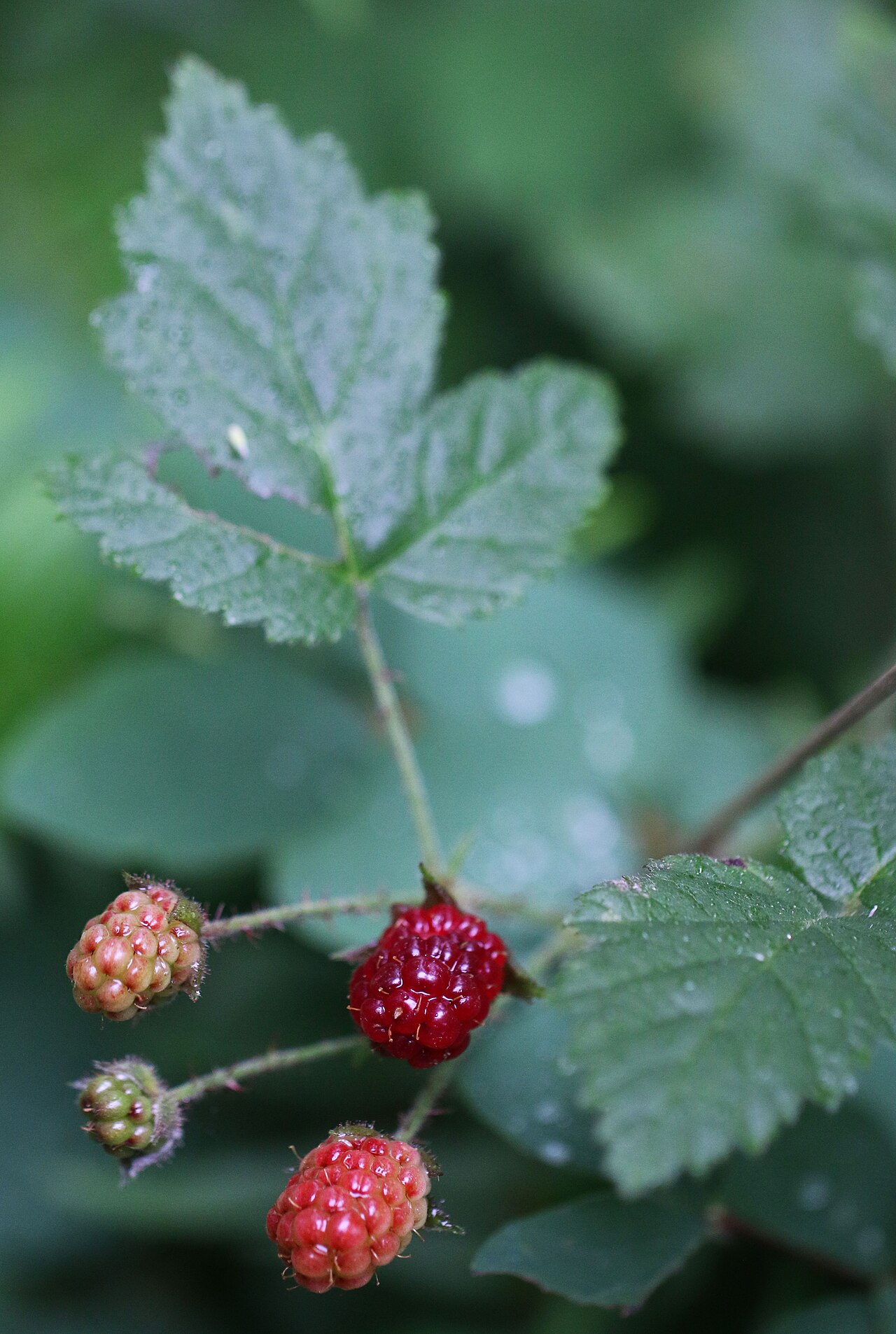
Female plants produce small aggregate fruits made of many one-seeded drupelets that cling to a core, as in all blackberries. They are often slightly elongated, up to about ¾ inch long, and ripen from green to red to glossy black from about June to August. They are sweet, aromatic and juicy, with a richer flavor than the introduced blackberries.
Quick Facts
| Scientific Name | Rubus ursinus Cham. & Schltdl. |
| Family | Rosaceae (rose family) |
| Plant Type | Trailing, prickly subshrub (bramble) |
| Mature Height | 2–5 ft mounds; canes trail or climb 10–20 ft |
| Mature Spread | 6 ft or more; spreads by tip-rooting canes |
| Growth Rate | Fast |
| Sun Exposure | Full sun to part shade; tolerates shade |
| Water Needs | Moderate; best with some moisture, tolerates summer dryness once established |
| Soil Type | Loam, sand, clay or gravel; adaptable |
| Soil pH | About 5.0–7.5 |
| Bloom Time | March–July |
| Flower Color | White |
| Fall Color | Leaves sometimes redden in fall; partly evergreen in mild climates |
| Fruit | Small, elongated black blackberry, June–August, on female plants only |
| Deer Resistant | No; deer browse the leaves and canes |
| USDA Hardiness Zones | 6–10 |
Native Range
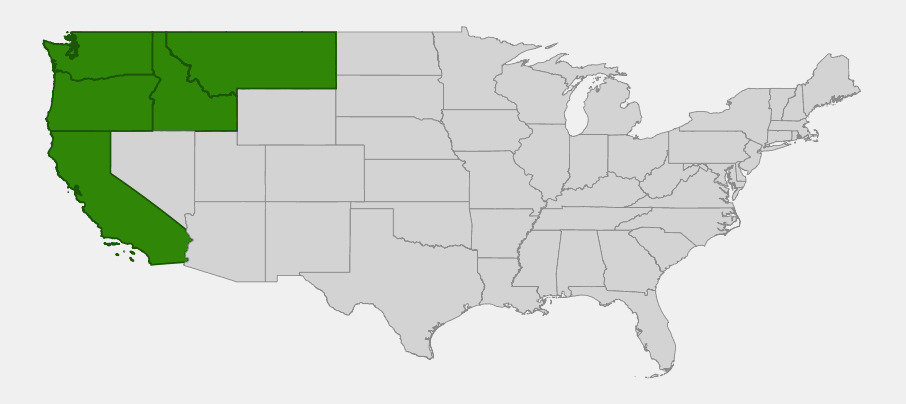
California blackberry is native to western North America. USDA PLANTS records it in California, Oregon, Washington, Idaho and Montana, and in Canada in southwestern British Columbia, including Vancouver Island. Its range continues south into northern Baja California. It is the only native blackberry across much of this region.
It is most common west of the Cascades and the Sierra Nevada: on the coast, in the Coast Ranges, and through the foothills and valleys of California, western Oregon and western Washington. East of the Cascades it is more local, reaching northern Idaho and northwestern Montana (Sanders County) in moister valleys. It grows mainly at lower elevations, rarely above about 3,000 to 4,000 feet in the north, but it reaches higher in California’s mountains.
It grows in a wide range of habitats: open forests and forest edges, clearings, burns and logged areas, chaparral and coastal scrub, riparian thickets, meadows and fencerows. It quickly colonizes disturbed ground after fire or logging, then fades as the forest canopy closes. Botanists recognize regional variation, and plants of the Pacific Northwest are sometimes separated as subsp. macropetalus.
📋 Regional plant lists featuring California Blackberry: Idaho, Eastern Oregon & Eastern Washington · Montana & Wyoming
Growing & Care Guide
California blackberry is easy to grow, fast and adaptable. It is too sprawling and prickly for a tidy flower bed, but it is valuable in wildlife gardens, hedgerows, restoration sites and edible landscapes. If you want berries, plant several plants or make sure both male and female plants are present, because only female plants fruit.
Light
It grows in full sun to fairly deep shade. It flowers and fruits best with at least half a day of sun. In shade it makes long, sparse canes with few berries.
Soil & Water
It tolerates most soils, from sand to clay, and fairly acidic to near-neutral conditions. It does best in soil that stays at least slightly moist, but established plants survive California’s dry summers, often going partly dormant. An occasional deep watering in summer improves fruit size in dry areas. It needs no fertilizer.
Planting Tips
Plant in fall or winter in mild-winter areas and in early spring elsewhere. Space plants about 3 to 6 feet apart for a hedgerow or ground cover. Choose a site where the canes can roam, or provide a low fence or trellis to train them. Buy from native plant nurseries and confirm the plant is Rubus ursinus, since some “blackberry” plants sold for gardens are hybrids or introduced species.
Pruning & Maintenance
Like other brambles, each cane fruits in its second year and then dies. In late winter, cut out the old, gray canes that fruited last summer and shorten or thin new canes. Redirect or cut back canes that root where you do not want them. Wear gloves. Remove any Himalayan blackberry that appears nearby, because it will overgrow and smother the native.
Propagation
The easiest method is tip layering: bend a cane tip to the soil in late summer, pin it down, and dig the rooted tip the following spring. Rooted suckers and divisions also transplant easily. It can be grown from seed, but seeds need cold stratification and germinate slowly, and seedlings will be a mix of male and female plants.
Landscape Uses
- Wildlife gardens and hedgerows: prickly cover and summer berries for birds and mammals
- Edible landscaping: one of the best-flavored wild berries, for fresh eating, jam and pies
- Restoration and revegetation: fast cover on burns, logged land and disturbed slopes within its range
- Erosion control: tip-rooting canes help hold soil on banks and slopes
- Replacing invasive blackberries: a native alternative where Himalayan blackberry has been removed
Wildlife & Ecological Value
California blackberry is one of the most important wildlife plants of western lowlands. It provides nectar in spring, fruit in summer, and cover all year.
For Pollinators
The flowers attract many native bees, including bumble bees, mason bees, sweat bees and small carpenter bees, as well as honey bees, flies and butterflies. Because plants are either male or female, insects that move between them are essential for fruit set. Several moths, including some leafroller species, feed on Rubus foliage.
For Birds
The berries are eaten by many birds, including band-tailed pigeons, quail, grouse, American robins, thrushes, towhees, jays, cedar waxwings and western tanagers. Its tangles provide nesting and escape cover for spotted towhees, song sparrows, wrens and other birds of the shrub layer.
For Mammals
Black bears, coyotes, foxes, raccoons, squirrels, chipmunks and other mammals eat the fruit. Deer and elk browse the leaves and stems, and rabbits and woodrats shelter in thickets.
Ecosystem Role
California blackberry is an early colonizer of burned and logged forest, open edges and stream banks. Its tip-rooting canes quickly cover bare soil, reducing erosion and providing food and cover while trees regrow. As the forest closes over, it gradually declines but persists in openings, waiting for the next disturbance.
Cultural & Historical Uses
The berries were an important food for many Native peoples of California and the Pacific Northwest. They were eaten fresh or mashed and dried into cakes for winter, and the leaves and roots were used for teas and medicines. Traditional burning of meadows and forest openings also favored the young canes that bear the most fruit.
The species was described in 1827 by Adelbert von Chamisso and Diederich von Schlechtendal from specimens collected in California. The name ursinus means “of bears”, a nod to how much bears relish the fruit.
California blackberry is one of the parents of some of the best-known cultivated berries. The loganberry arose in Santa Cruz, California, in the 1880s from a cross involving Rubus ursinus and a red raspberry. The boysenberry, youngberry and Oregon’s marionberry all descend in part from the species, and breeders still use it for its flavor. Many westerners pick the wild berries in summer, and they are prized for jam and pie.
Frequently Asked Questions
How do I tell California blackberry from Himalayan blackberry?
California blackberry has thin, round, trailing stems often covered in a whitish bloom, usually three leaflets per leaf, and small, elongated berries. Himalayan blackberry (Rubus armeniacus) has thick, angled, arching canes up to 10 feet tall with large, hooked prickles, five leaflets on most first-year cane leaves, and larger, rounder berries.
Why doesn’t my California blackberry produce fruit?
The plant is probably male. California blackberry is functionally dioecious, so only female plants fruit, and they need a male plant nearby for pollination. Too much shade and drought can also reduce fruiting.
Are California blackberries edible?
Yes. The berries are sweet and highly flavorful, and many people think they are the best wild blackberries in the West. They are smaller and softer than cultivated blackberries, so they are best eaten fresh or cooked into jam and pies.
Is California blackberry invasive?
No. It is native from British Columbia to Baja California. It can spread vigorously in a garden by tip-rooting canes, but it does not form the towering monocultures that the introduced Himalayan and cutleaf blackberries do.
Is it the same plant as trailing blackberry or Pacific blackberry?
Yes. California blackberry, trailing blackberry, Pacific blackberry and Pacific dewberry are all common names for Rubus ursinus. USDA PLANTS lists it as California blackberry.

Looking for a nursery that carries California Blackberry?
Browse our native plant nursery directory: California · Idaho · Montana · Oregon · Washington