
Ball Moss (Tillandsia recurvata)
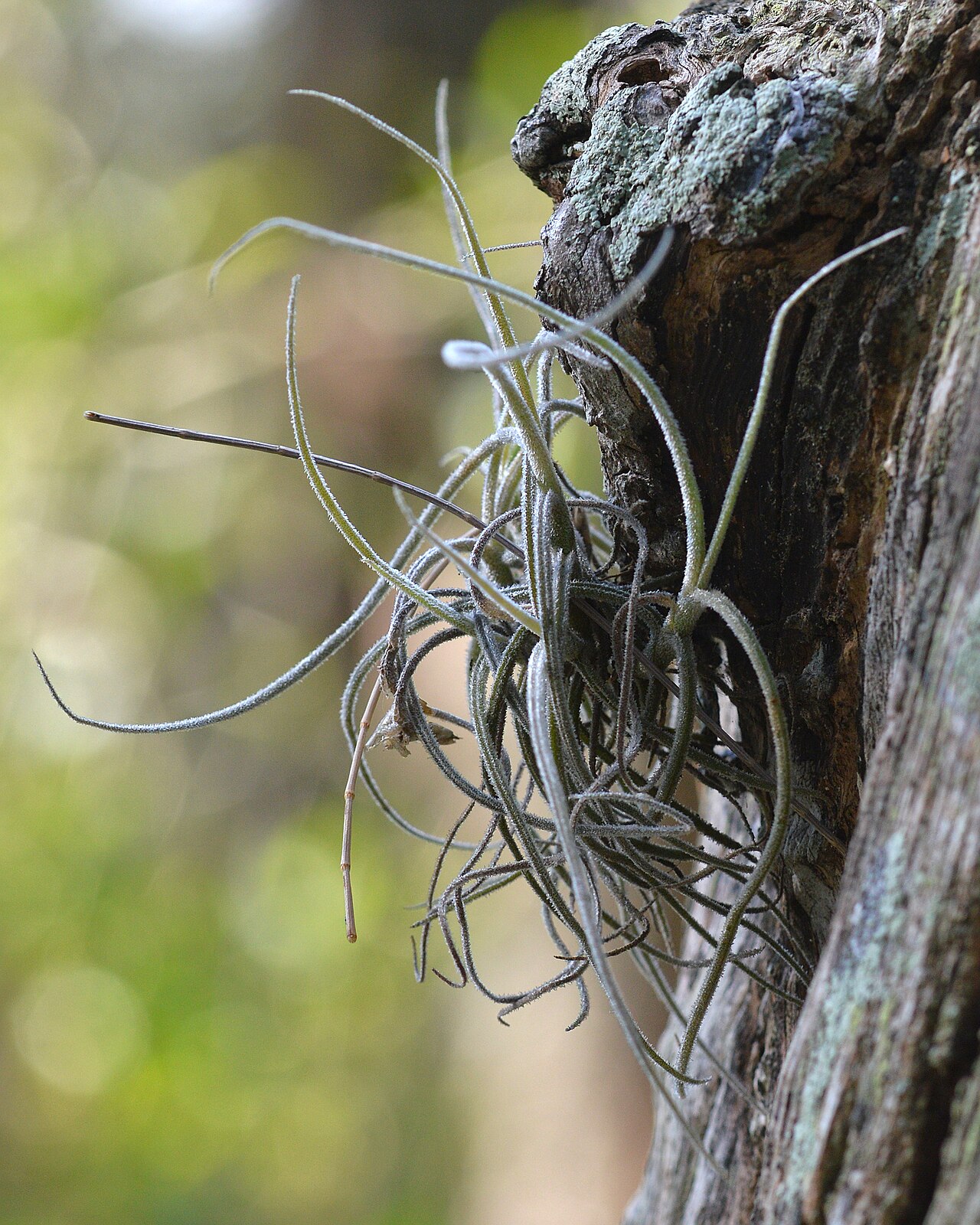
Tillandsia recurvata, known as Ball Moss or small ballmoss, is a small native air plant that forms gray, bristly balls on the branches of trees, shrubs, fences and even power lines across the warm southern edge of the United States. Despite its name it is not a moss. It is a flowering plant in the pineapple family (Bromeliaceae) and a close relative of Spanish moss. Each clump, from golf-ball to softball size, is a colony of many small plants with thin, curving, silvery leaves 1 to 6 inches long.
Ball moss is an epiphyte, not a parasite. It uses trees only as a place to sit. It does not tap into the tree’s sap; it makes its own food by photosynthesis and takes water and minerals from rain, fog, dew and windblown dust through the scales on its leaves. Its few wiry roots work as anchors only. This is why ball moss can grow just as happily on a telephone wire as on a live oak.
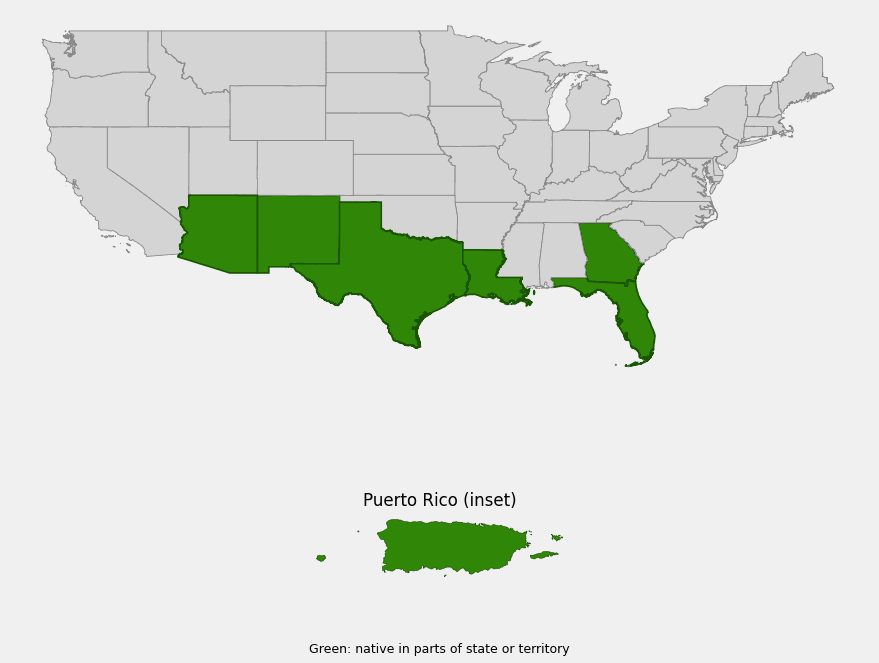
In the United States it grows from Florida and coastal Georgia west through Louisiana and Texas to southern New Mexico and Arizona, and it is native in Puerto Rico and the Virgin Islands. Many homeowners see it as a pest, but it is a native plant that does little harm to healthy trees. This guide explains how to identify it, why it appears on stressed trees, and why removing it is usually unnecessary.
Identification
Ball moss is easy to recognize once you have seen it: a rounded tuft of gray, curling leaves on a twig, often with thin flower stalks sticking out. The main confusion is with Spanish moss and other native Tillandsia species.
Growth Form
Each plant is a small rosette of leaves on a short stem. New plants form as offshoots (pups) at the base and from seeds that land nearby, so a single seedling grows into a dense, rounded clump of dozens of rosettes. Clumps usually sit on the upper side of small branches and twigs, where they are anchored by a few tough, wiry roots that wrap around the bark. Large old trees may carry hundreds of clumps.
Leaves
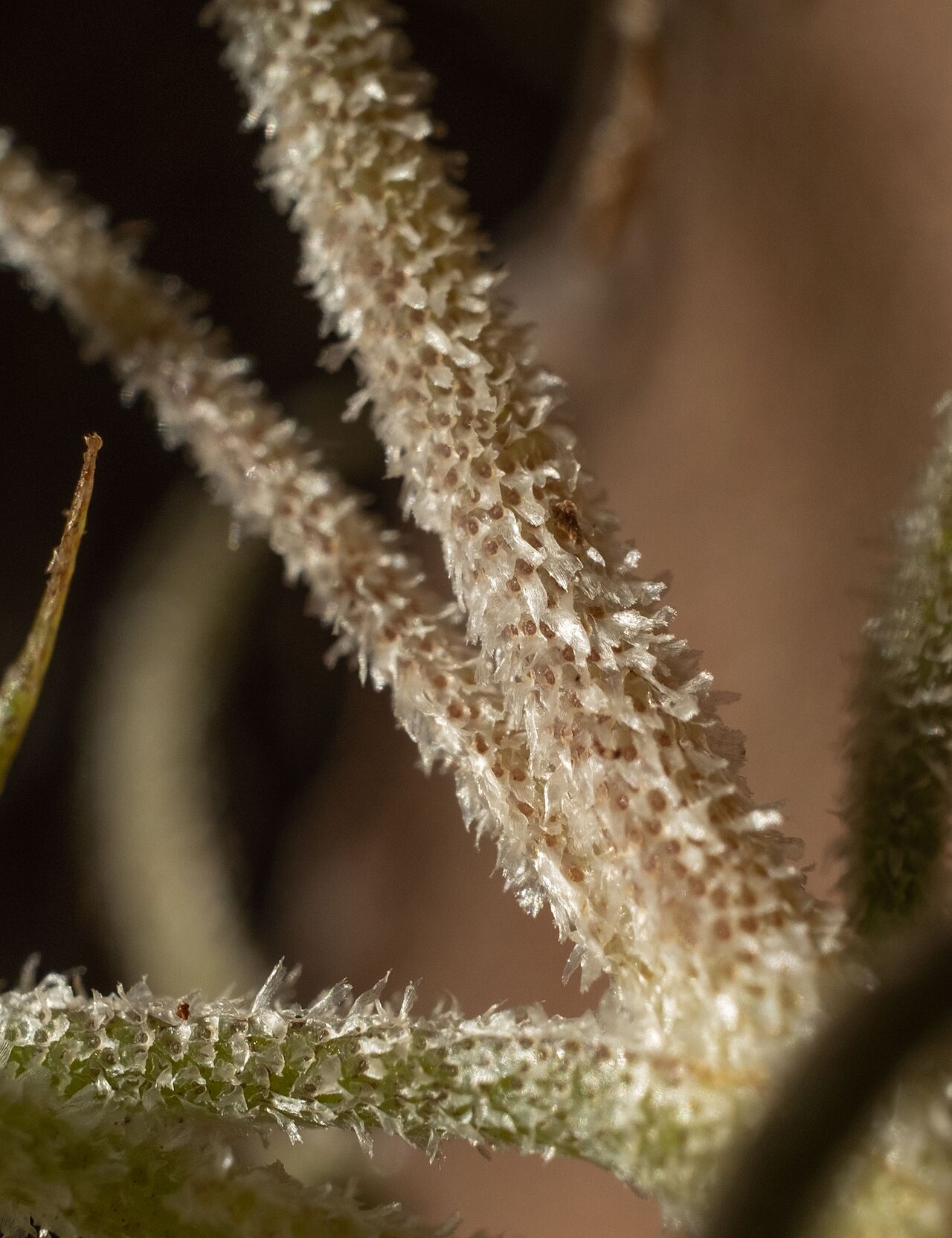
The leaves are narrow and almost cylindrical, about 1 to 6 inches long, and often curve or twist back (the meaning of recurvata). They are densely covered in silvery-gray scales called trichomes, which give the plant its dusty look. When wet, the leaves turn noticeably greener because water fills the scales and lets the green tissue show through.
Flowers
A thin, wiry stalk 1 to 9 inches long rises above the leaves and carries one or a few small tubular flowers. The petals are pale violet to blue and only about ¼ inch long, so the flowers are easy to miss. Flowering can happen in much of the year in the tropics; in the southern United States it is mainly in spring and summer.
Fruit & Seeds
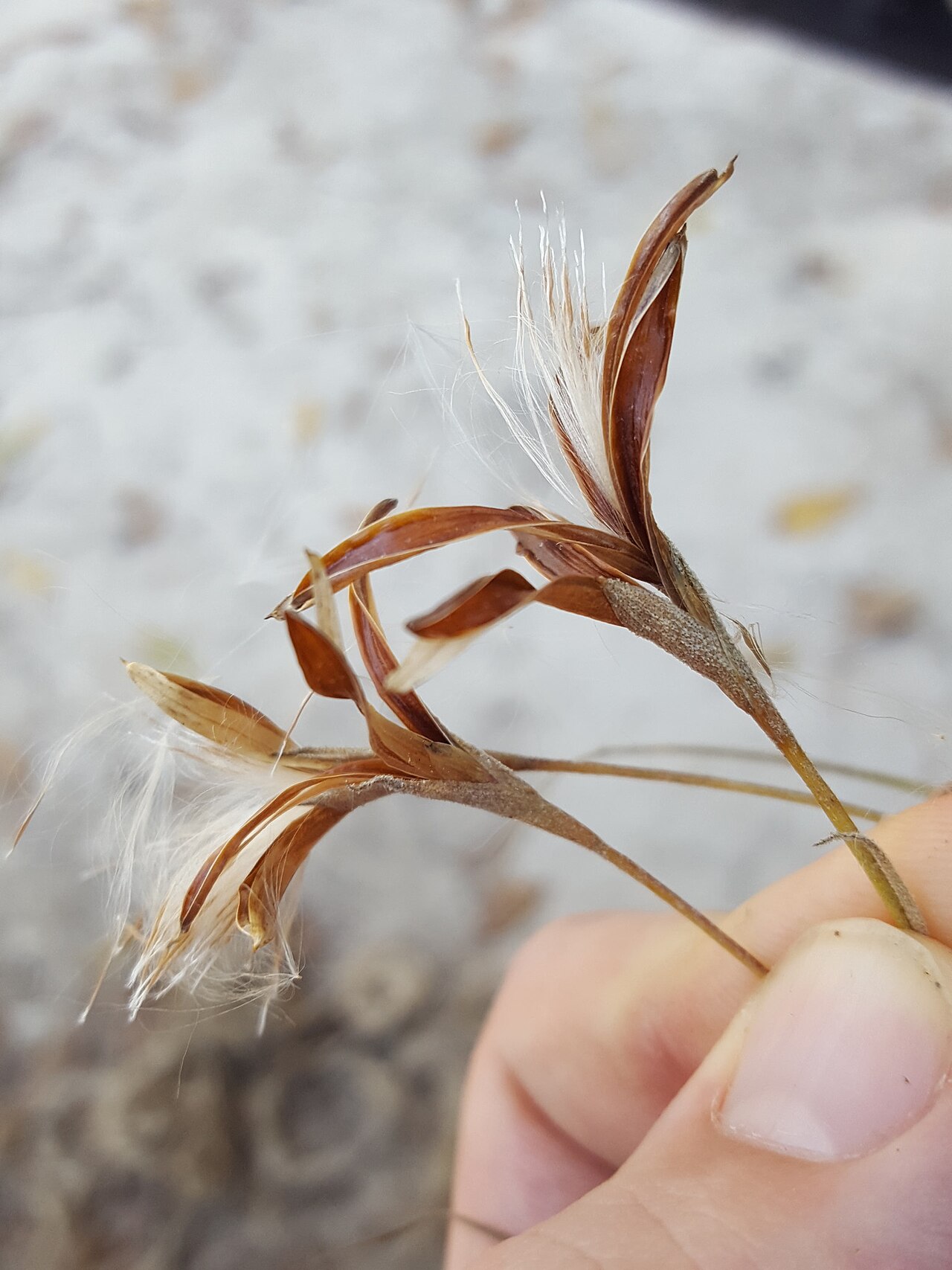
Each flower becomes a narrow capsule about an inch long that splits into three parts when ripe. Inside are many small seeds, each with a tuft of fine, silky hairs. The hairs carry the seeds on the wind and help them catch on rough bark, where they germinate and anchor themselves.
Look-alikes
Spanish Moss hangs in long, stringy festoons instead of forming compact balls. Larger airplants such as Cardinal Airplant and Spreading Airplant have broad, stiff, vase-like rosettes and showy flower spikes. Lichens can form gray tufts on twigs too, but they have no leaves, flowers or seeds.
Quick Facts
| Scientific Name | Tillandsia recurvata (syn. Renealmia recurvata, Diaphoranthema recurvata) |
| Family | Bromeliaceae (bromeliad or pineapple family) |
| Plant Type | Epiphytic perennial (air plant) |
| Mature Height | Clumps 2–6 in across; flower stalks to about 9 in |
| Mature Spread | Clumps golf-ball to softball size |
| Growth Rate | Slow to moderate |
| Sun Exposure | Part shade to sun |
| Water Needs | Low to moderate; absorbs rain, dew and humidity through its leaves |
| Soil Type | None; grows on bark, branches, rocks, fences and wires |
| Soil pH | Not applicable (no soil) |
| Bloom Time | Mainly spring and summer in the U.S. |
| Flower Color | Pale violet to blue |
| Fall Color | None; evergreen silvery-gray |
| Fruit | Narrow capsule; seeds with silky hairs |
| Deer Resistant | Yes; grows on branches out of reach |
| USDA Hardiness Zones | 8b–11 (sensitive to hard freezes, especially when wet) |
Native Range
Ball moss is a plant of the warm Americas. USDA PLANTS lists it as native in Arizona, Florida, Georgia, Louisiana, New Mexico and Texas, and in Puerto Rico and the U.S. Virgin Islands. Beyond the United States it ranges through Mexico, Central America and the West Indies to South America as far south as Argentina and Chile, which makes it one of the most widespread bromeliads in the world.
In the Southeast it is common over much of peninsular Florida and reaches its northern natural limit in coastal Georgia, where it is uncommon. In Texas it is abundant in the Hill Country and south Texas on live oaks, cedar elms, hackberries and mesquites. Farther west it is found in scattered, drier sites in southern New Mexico and Arizona, often on oaks and shrubs in canyons. In Puerto Rico it grows on trees, shrubs and wires in dry coastal and lowland areas.
Because the seeds blow on the wind and stick to any rough surface, ball moss is quick to colonize new trees, utility lines and fences within its range. Its northern spread is limited by cold: hard freezes, especially when the plants are wet, kill exposed clumps.
📋 Regional plant lists featuring Ball Moss: North & South Florida · Alabama, Georgia & Mississippi · Arizona & New Mexico · Puerto Rico
Growing & Care Guide
Most people meet ball moss because it shows up on their trees, not because they planted it. Within its native range it needs no help at all. It can also be grown as a small, tough air plant on a piece of bark or driftwood. If you want to grow it, use clumps that have fallen naturally or come from pruned branches on your own property; do not strip it from trees in parks or natural areas.
Light
Ball moss grows best in bright, filtered light or part sun. It is often most abundant in the lower, inner branches of trees, where light is dappled and humidity is higher. Too much deep shade or harsh full sun in dry air slows it down.
Soil & Water
It needs no soil. Outdoors in its range, rain, dew and humidity supply all the water it needs. Mounted indoors or on a porch, mist it or dunk it briefly in rainwater a few times a week and let it dry within a few hours. Constant wetness causes rot. Avoid copper containers or copper-based sprays, which are toxic to Tillandsia.
Planting Tips
Tie or wedge a clump onto a branch, a piece of rough bark or a cork mount with cotton string or fishing line. Do not use glue that covers the base, and never bury it in potting soil. Within a season or two the plant will grip the surface with its own roots.
Pruning & Maintenance
On trees, ball moss rarely needs control. It is not a parasite, and heavy growth usually shows up on branches that are already shaded out, slow-growing or dying, not the cause of the decline. If clumps bother you, remove them by hand or with a pole pruner along with dead twigs. Many extension services advise against chemical sprays, which can harm the tree and other wildlife and do not stop new seeds from arriving.
Propagation
Separate offshoots from a large clump and tie them onto a new mount. Ball moss also spreads by its wind-borne seeds, which germinate on rough bark within its range without any help.
Landscape Uses
- Mounted air plant: a tough, low-care native air plant for bark, driftwood or porch displays
- Wildlife-friendly yards: leave it on trees as a source of nesting material and insect habitat
- Nature study: an easy example of an epiphyte for teaching about plants that grow without soil
- Holiday and craft displays: fallen clumps make natural decorations and wreath accents
- Native landscapes: part of the natural character of southern live oak, elm and hackberry canopies
Wildlife & Ecological Value
Ball moss is a small plant, but on a big oak its hundreds of clumps add a lot of shelter and material to the canopy.
For Pollinators
Ball moss can pollinate itself, and its tiny flowers are not a major source of nectar. Small insects visit them occasionally, and the clumps shelter insects, spiders and other small invertebrates.
For Birds
Birds use ball moss as nesting material and pick through clumps for insects and spiders. In the South, many small songbirds weave air plants like ball moss and Spanish moss into their nests.
For Mammals
It has little food value for mammals, but squirrels and other small animals may use fallen clumps as nest material.
Ecosystem Role
Ball moss supplies its own food and takes nitrogen with the help of bacteria living on its surfaces, so it adds plant material and nutrients to the tree canopy. Clumps trap dust and rain and become microhabitats for tiny invertebrates. Research suggests it may slightly shade new buds on heavily covered branches, but it is not known to kill healthy trees.
Cultural & Historical Uses
Linnaeus described ball moss in 1762 as Renealmia recurvata and later moved it to Tillandsia, the genus named for the seventeenth-century Swedish-Finnish physician and botanist Elias Tillandz. The species name refers to the curving leaves.
In Texas and Florida ball moss is the subject of frequent questions to extension offices, and many homeowners spray or strip it from their trees. Botanists and arborists have long pointed out that it is not a parasite and that heavy growth is mostly a sign of shade and slow growth inside the canopy. In Mexico, gray Tillandsia clumps known as heno or paixtle have traditionally decorated Christmas nativity scenes, and ball moss is sometimes gathered as animal fodder.
In the United States ball moss has become a symbol of the old live oaks of the South. It is one of the few bromeliads whose native range reaches into the deserts of Arizona and New Mexico, and it shows how bromeliads have adapted to life with almost no soil and very little water.
Frequently Asked Questions
Is ball moss killing my tree?
Almost certainly not. Ball moss is an epiphyte, not a parasite: it does not take sap from the tree. It grows best on shaded, slow-growing inner branches, which often die naturally, so it tends to be blamed for dieback that has other causes. A healthy tree can carry a lot of ball moss without harm.
Should I remove ball moss?
Usually there is no need. If you want to remove it for looks, pull it off by hand or prune out dead twigs during normal pruning. Avoid chemical sprays: they don’t prevent new seeds from arriving and can harm the tree, beneficial insects and nearby plants.
Is ball moss the same as Spanish moss?
No, although they are close relatives in the same genus. Spanish moss forms long hanging strands; ball moss forms compact, rounded clumps. Both are native air plants that make their own food.
Can I grow ball moss as a houseplant?
Yes. Tie a clump to bark or wood, give it bright indirect light, and soak or mist it with rainwater a few times a week, letting it dry quickly. Collect clumps only from your own trees or fallen branches.
How does ball moss spread?
Mostly by wind. Its seeds have silky hairs that carry them through the air and help them stick to rough bark, fences and wires. Clumps also grow larger by producing offshoots.

Looking for a nursery that carries Ball Moss?
Browse our native plant nursery directory: Arizona · Florida & Georgia · Louisiana · New Mexico · Texas