
California Pitcher Sage (Lepechinia calycina)
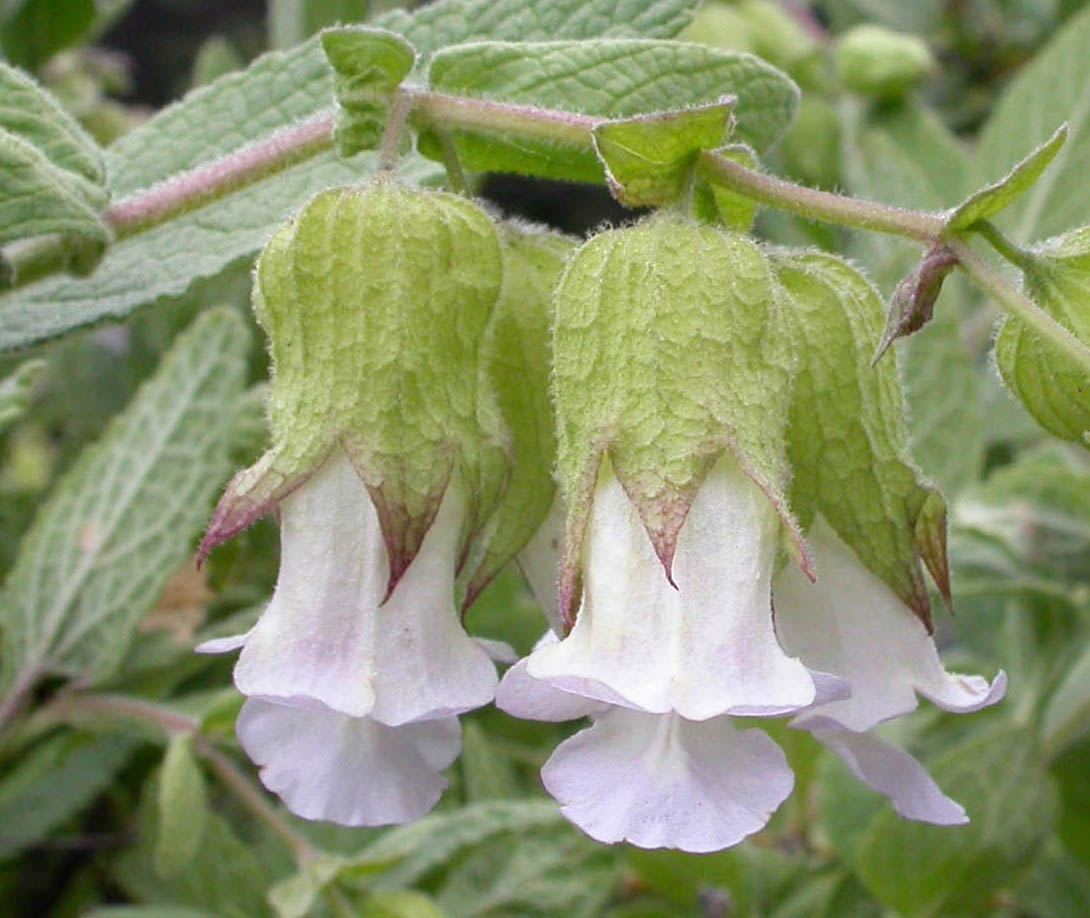
Lepechinia calycina, known as California Pitcher Sage (USDA: woodbalm; also white pitcher sage or pitchersage), is an aromatic evergreen shrub in the mint family (Lamiaceae) found only in California. It grows on rocky slopes, canyons and ridges in chaparral and foothill oak woodland, mainly in the Coast Ranges and the Sierra Nevada foothills. Plants are usually 3 to 6 feet tall, sometimes up to 8 feet, with soft, wrinkled, gray-green leaves that release a strong, resinous scent when brushed.
From spring into early summer it bears white to pale lavender, tubular flowers about an inch long that hang from the branches. Each flower sits in a cup-shaped calyx that swells after flowering into a papery, inflated “pitcher,” green at first and later tinged reddish purple. These lantern-like calyces stay on the shrub for weeks and give the plant its common name and its species name, calycina, which refers to the calyx.
It is not a true sage (Salvia), though it belongs to the same family. In gardens it is a tough, drought-tolerant shrub for dry slopes and native plantings in California, where it feeds native bumble bees and other bees. Its fragrance is strong: some people love it, while others find it musky or even unpleasant.
Identification
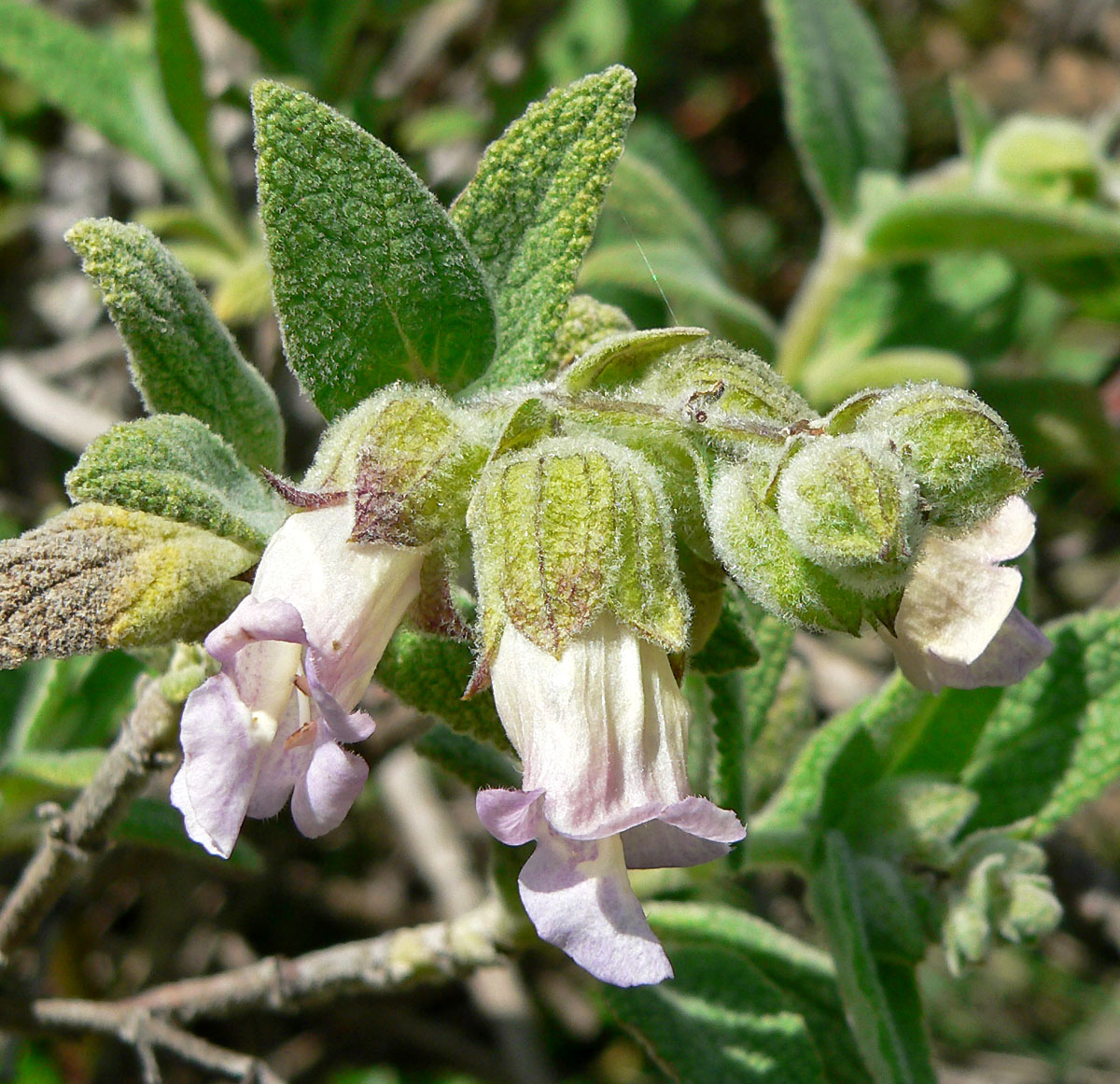
California pitcher sage is easiest to recognize in spring and early summer, when its hanging white flowers and swollen, pitcher-shaped calyces cover the branches. At other times, look for the soft, wrinkled, strongly scented leaves in opposite pairs on square young stems.
Growth Habit
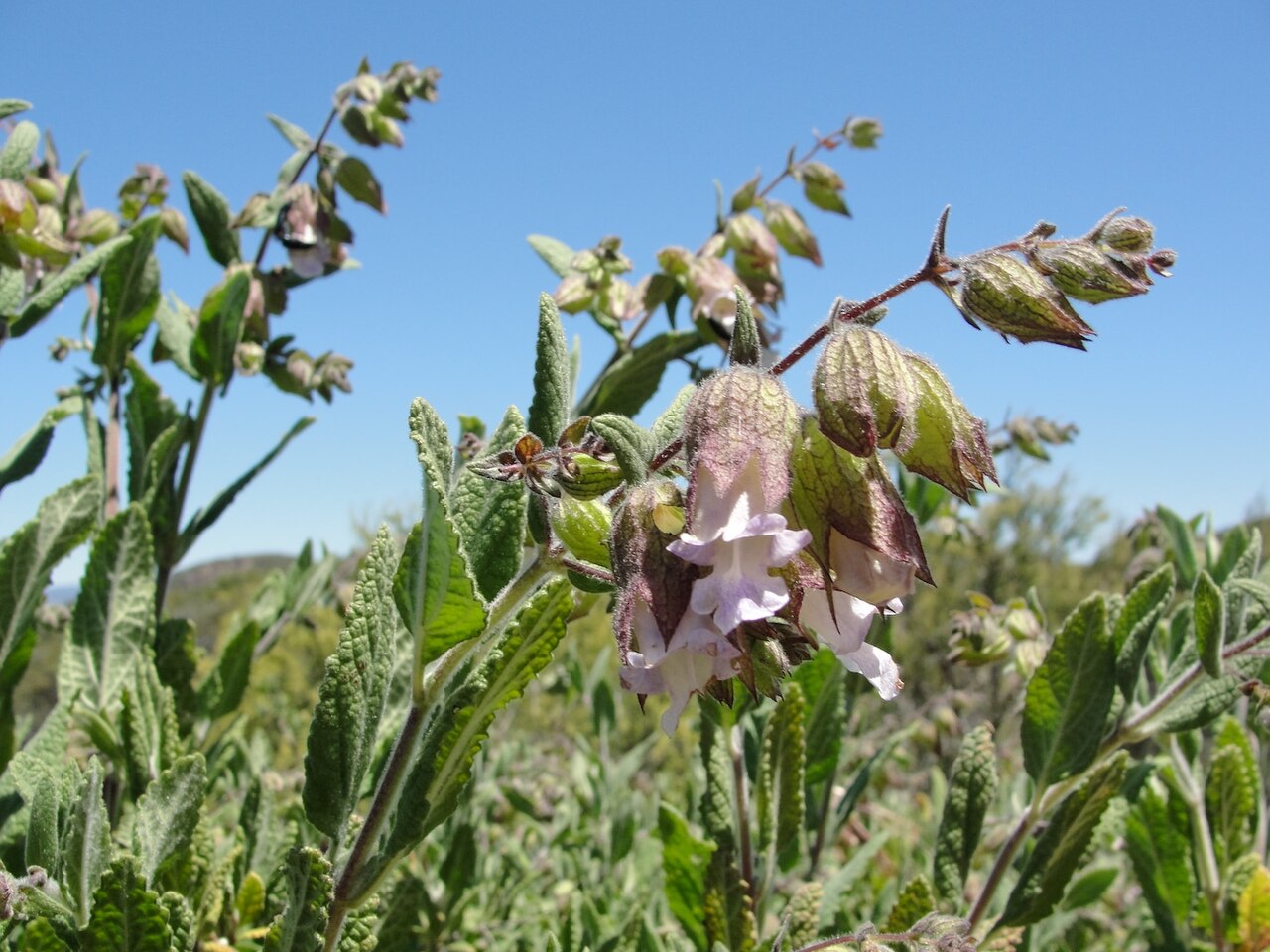
A rounded, open, evergreen shrub 3 to 6 feet tall and wide, occasionally up to 8 feet. The young stems are four-sided, as in most mints, and covered with long hairs, some of them glandular and sticky. Older stems are woody with shreddy bark. In very dry summers some leaves may drop, and the plant looks sparse until the winter rains.
Leaves
The leaves are opposite, lance-shaped to oval, about 1.5 to 4 inches long, and gray-green. They have a wrinkled, puckered surface with net-like veins, and the edges may be smooth or shallowly toothed. Both surfaces are hairy and glandular, giving them a soft, slightly sticky feel and a strong, pungent, resinous fragrance.
Flowers
The flowers appear from about April to June in loose clusters near the branch tips. The corolla is a broad, two-lipped tube about 1 to 1.5 inches long, white to pale lavender or pinkish, often with faint purple lines inside. The tip is rolled back into four small lobes and one longer lower lip. The flowers hang or nod, which suits the bumble bees that visit them.
Calyx & Fruit
The calyx is the plant’s most distinctive feature. It is bell-shaped and hairy, with five short, pointed teeth, and it keeps growing after the flower falls, becoming inflated, papery and up to about an inch long. Inside, four small, rounded, dark nutlets develop. The swollen calyces turn from pale green to reddish purple and then tan as they dry.
Look-alikes
Fragrant pitcher sage (Lepechinia fragrans) of the Transverse Ranges and Channel Islands has flowers that are more distinctly lavender and leaves with a sweeter scent. True sages such as Cleveland Sage and White Sage have smaller, more strongly two-lipped flowers in whorled clusters and no swollen calyx. Yerba Santa has sticky, alternate leaves and clusters of small funnel-shaped flowers.
Safety
Pitcher sage is not known to be poisonous to people or pets, but it is not a culinary herb. The glandular hairs and aromatic oils can irritate sensitive skin, and the scent can be overpowering in a small space. Do not use it as a medicine; the Miwok traditional uses described below are history, not advice.
Quick Facts
| Scientific Name | Lepechinia calycina |
| Family | Lamiaceae (mint family) |
| Plant Type | Aromatic evergreen shrub |
| Mature Height | 3–6 ft (occasionally to 8 ft) |
| Mature Spread | 3–6 ft |
| Growth Rate | Moderate to fast |
| Sun Exposure | Full sun to part shade |
| Water Needs | Low; occasional summer water once established |
| Soil Type | Fast-draining, rocky or sandy loam |
| Soil pH | Slightly acidic to neutral (about 6.0–7.5) |
| Bloom Time | April–June |
| Flower Color | White to pale lavender or pinkish |
| Fall Color | None; evergreen gray-green foliage |
| Fruit | Four small dark nutlets inside an inflated, papery calyx |
| Deer Resistant | Yes; the aromatic, hairy leaves are rarely browsed |
| USDA Hardiness Zones | 8–10 |
Native Range
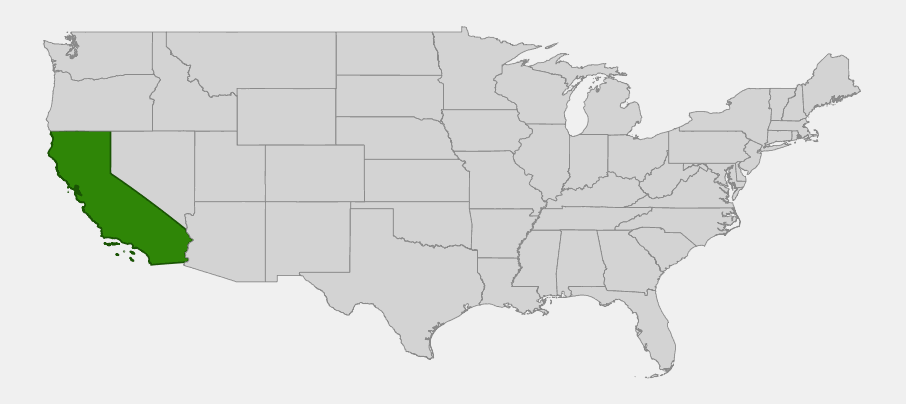
California pitcher sage is endemic to California. USDA PLANTS lists it as native only in California, and it is not known in the wild from Oregon, Nevada or Baja California. It is a common shrub within its range.
It grows mainly in the Coast Ranges, from the North Coast Ranges and San Francisco Bay Area south through the Santa Cruz Mountains and the inner and outer South Coast Ranges, and in the foothills of the Sierra Nevada. Well-known places to see it include the hills of the East Bay, Mount Diablo, Pinnacles National Park and Fort Ord National Monument near Monterey Bay.
Its habitat is dry, rocky or gravelly slopes, canyons and ridges in chaparral, the edges of coastal sage scrub, and openings in foothill oak woodland, generally below about 3,300 feet. It is often among the first shrubs to return after disturbance or fire on open slopes.
📋 Regional plant lists featuring California Pitcher Sage: California & Nevada
Growing & Care Guide
California pitcher sage is a reliable, low-water shrub for California gardens with good drainage. The California Native Plant Society’s Calscape rates it as moderately easy, and it is sold at many native plant nurseries. It is happiest on a dry slope, among rocks or at the edge of a chaparral-style planting where it will not get regular summer water.
Light
Plant it in full sun near the coast and in part shade, such as afternoon shade or the edge of oak canopy, in hot inland gardens. In deep shade it becomes leggy and flowers poorly.
Soil & Water
It needs fast-draining soil: rocky, gravelly or sandy loam, or clay on a slope where water runs off. Water regularly during its first year to establish it. After that it needs little summer water; Calscape suggests no more than about three waterings a month in summer, and less is often better in heavy soils. Too much summer water in poorly drained soil leads to root rot.
Planting Tips
Plant in fall or early winter so the roots can grow with the winter rains. Space plants 4 to 6 feet apart. Use it on slopes, in dry borders, in informal hedges or among other chaparral shrubs. Place it where you can enjoy the flowers and calyces up close but where the strong scent will not be overwhelming, for example away from windows and patios if you dislike it.
Pruning & Maintenance
Cut back lightly after flowering, or after the decorative calyces fade, to keep the shrub dense and remove spent stems. Older plants can become woody and open; a harder pruning in late fall or winter can renew them. No fertilizer is needed. Plants may be fairly short-lived in rich, watered gardens and longer-lived on lean, dry sites.
Propagation
Grow it from seed or cuttings. Calscape notes that a hot-water treatment followed by about three months of cold stratification may improve seed germination. Softwood or semi-hardwood cuttings taken in spring or early summer root fairly easily. Plants sometimes self-sow on open, disturbed ground.
Landscape Uses
- Chaparral and dry slope gardens: a fragrant, low-water evergreen for hillsides
- Pollinator gardens: spring flowers for native bumble bees and other bees
- Informal hedges and screens: loose, rounded shrubs 3 to 6 ft tall
- Fire-adapted native landscapes: with other chaparral shrubs, kept lean and well spaced
- Erosion control: on dry, rocky banks and road cuts
Wildlife & Ecological Value
California pitcher sage is a valuable spring nectar and pollen plant in chaparral and woodland, and its leaves host a few specialized insects.
For Pollinators
The hanging, tubular flowers are well suited to bumble bees, which push into them to reach nectar and pollen. Calscape lists 19 native bee species that visit it, including the black-tailed bumble bee (Bombus melanopygus) and small carpenter bees (Ceratina). Other bees, flies and occasionally hummingbirds also visit.
For Birds
The dense, twiggy shrubs give cover and nesting sites to chaparral birds such as wrentits, California towhees and bushtits. Seed-eating birds may pick nutlets from the dried calyces.
For Mammals
The aromatic, hairy leaves are rarely eaten by deer or rabbits, which makes it a good choice where browsing is heavy. Small mammals shelter under the shrubs.
Ecosystem Role
It is part of the diverse shrub layer of California chaparral and oak woodland, holding soil on steep, rocky slopes. Calscape records native moths that use it, including Anoncia sphacelina, whose name recalls pitcher sage’s old genus, Sphacele. Like many chaparral shrubs, it can establish quickly on open ground after disturbance or fire.
Cultural & Historical Uses
Several California Native American peoples used pitcher sage. The Miwok used an extract of the leaves to treat fever and headache, a use recorded in ethnobotanical studies of California tribes. These are historical cultural uses and are not a recommendation to use the plant as medicine.
The plant was first described by the English botanist George Bentham as Sphacele calycina, from specimens collected in California in the early 19th century. The botanist Carl Epling later moved it to Lepechinia, a genus of the Americas named for the Russian naturalist Ivan Lepechin. The old name Sphacele still appears in some older California references.
Today pitcher sage is a common sight on trails through the hills of the Bay Area and the Central Coast, and it is a familiar shrub in California native plant gardens and botanic gardens, where its lantern-like calyces and strong scent make it a conversation piece.
Frequently Asked Questions
Is California pitcher sage a true sage?
No. It is in the mint family with true sages (Salvia), but it belongs to a different genus, Lepechinia. It is not a culinary herb.
What does pitcher sage smell like?
The leaves have a strong, resinous, somewhat musky scent. Some gardeners find it pleasant and others find it unpleasant, so smell a plant before you buy it.
How much water does it need?
Water regularly the first year. Once established it needs little summer water: occasional deep watering at most, especially in heavy soil.
Can I grow it outside California?
It is native only to California and is best suited to mild, Mediterranean-climate gardens in about USDA zones 8 to 10 with dry summers and good drainage.
Does it attract pollinators?
Yes. Its spring flowers are visited by many native bees, especially bumble bees, which fit neatly into the hanging, tubular flowers.

Looking for a nursery that carries California Pitcher Sage?
Browse our native plant nursery directory: California