
Rattlebush (Sesbania drummondii)
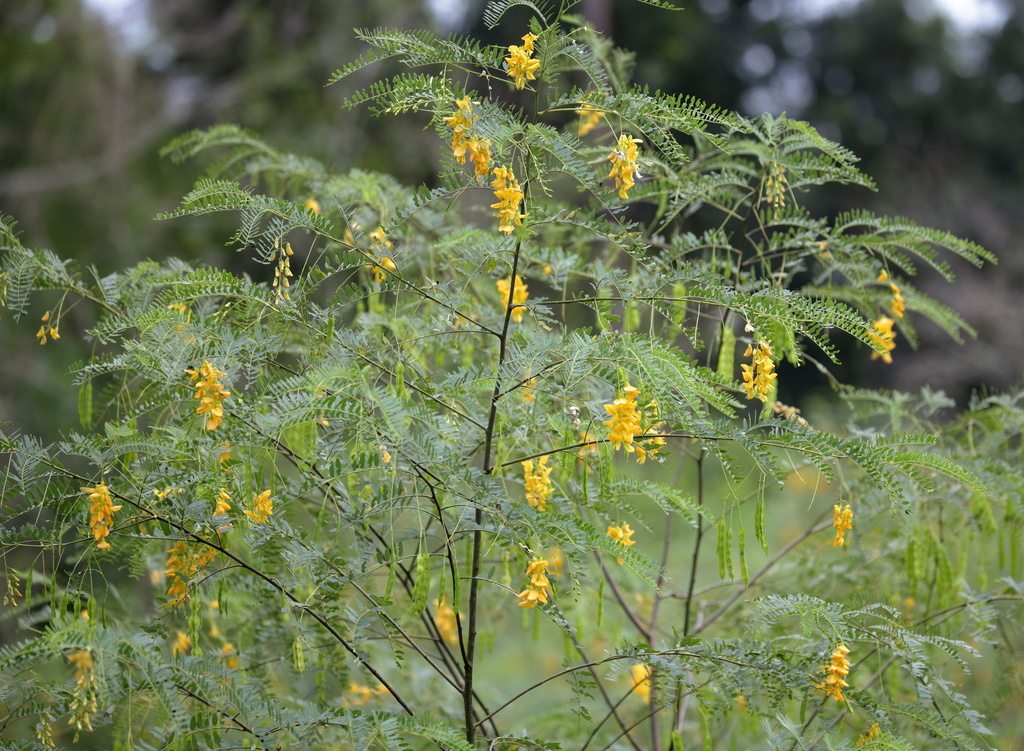
Sesbania drummondii, known as Rattlebush (USDA: poisonbean), is a fast-growing native shrub of the legume family (Fabaceae) found in wet, open places across the Gulf Coast and southeastern United States. It grows 3 to 10 feet tall from a woody base, with slender, widely spreading upper branches and feathery, pinnately compound leaves. From late spring into fall it bears drooping clusters of yellow to orange-yellow pea flowers, often streaked with red, followed by unusual four-winged pods. When the pods dry, the loose seeds rattle inside them, which gives the plant its best-known name. It was formerly called Daubentonia drummondii, and other names include rattlebox, sennabean and Drummond sesbania.
Rattlebush is a plant of ditches, wet meadows, marsh edges, pond and lake shores, river banks and other frequently flooded ground. It grows quickly from seed after disturbance and often forms thickets on newly exposed mud. Its nectar-rich flowers attract bees and butterflies, and it fixes nitrogen in poor, wet soils.
Safety note: rattlebush is seriously poisonous. The seeds contain sesbanimide and related toxins and are highly toxic to people, pets and livestock; eating even a small number of seeds can be fatal to animals. Cattle, sheep and goats are most often poisoned when hungry animals graze dry plants and pods in late fall and winter. Do not plant it near pastures, play areas or where pets or children may eat the seeds.
Identification
Rattlebush is easiest to recognize in late summer and fall, when its branches carry both yellow flowers and the hanging, four-winged pods that give it its name.
Growth Habit
A short-lived, woody-based perennial shrub, usually 3 to 10 feet tall, with an open, sparse look. It is much branched in the upper part, with thin, well-separated branches. The bark is smooth, green to light brown. In the northern part of its range, stems may die back to the ground in hard freezes and resprout or regrow from seed.
Leaves
The leaves are alternate, deciduous and pinnately compound, 4 to 8 inches long, with 12 to about 50 narrow, oblong leaflets, each about 1/2 to 1 1/4 inches long. There is no single leaflet at the tip. The foliage is medium green and gives the shrub a light, ferny texture.
Flowers
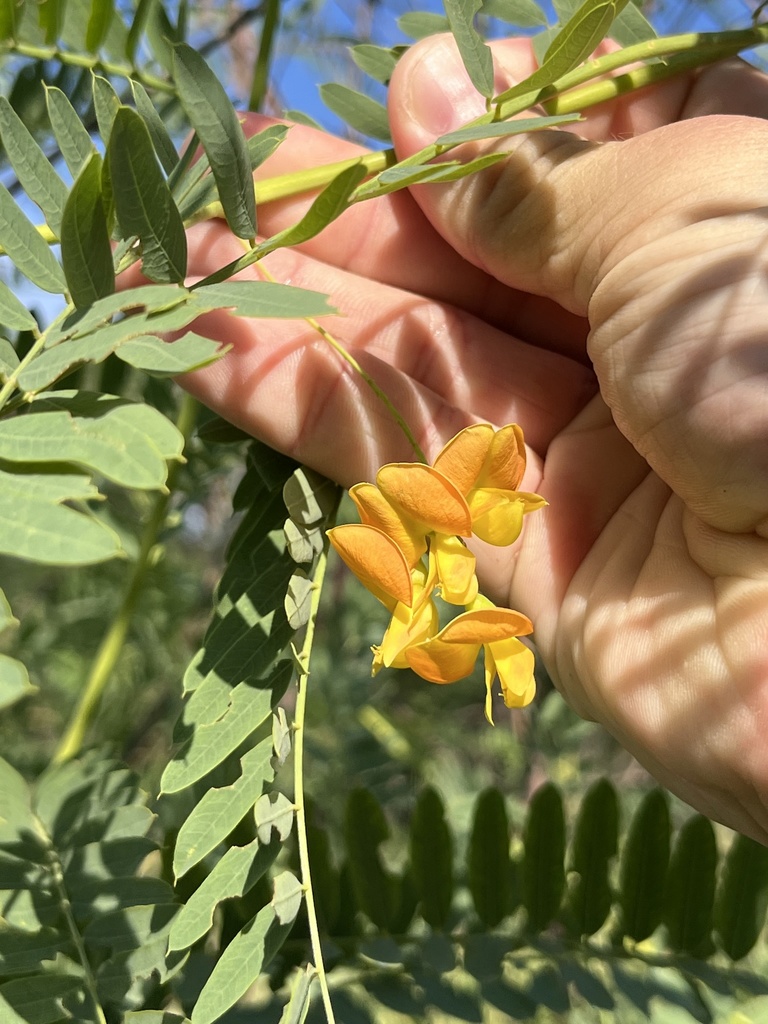
From about May or June to October, loose, drooping clusters of pea-shaped flowers appear on stalks from the leaf axils. Each flower is about 1/2 inch long, yellow to orange-yellow, often with red streaks or a reddish tinge on the back of the upper petal (the banner).
Fruit
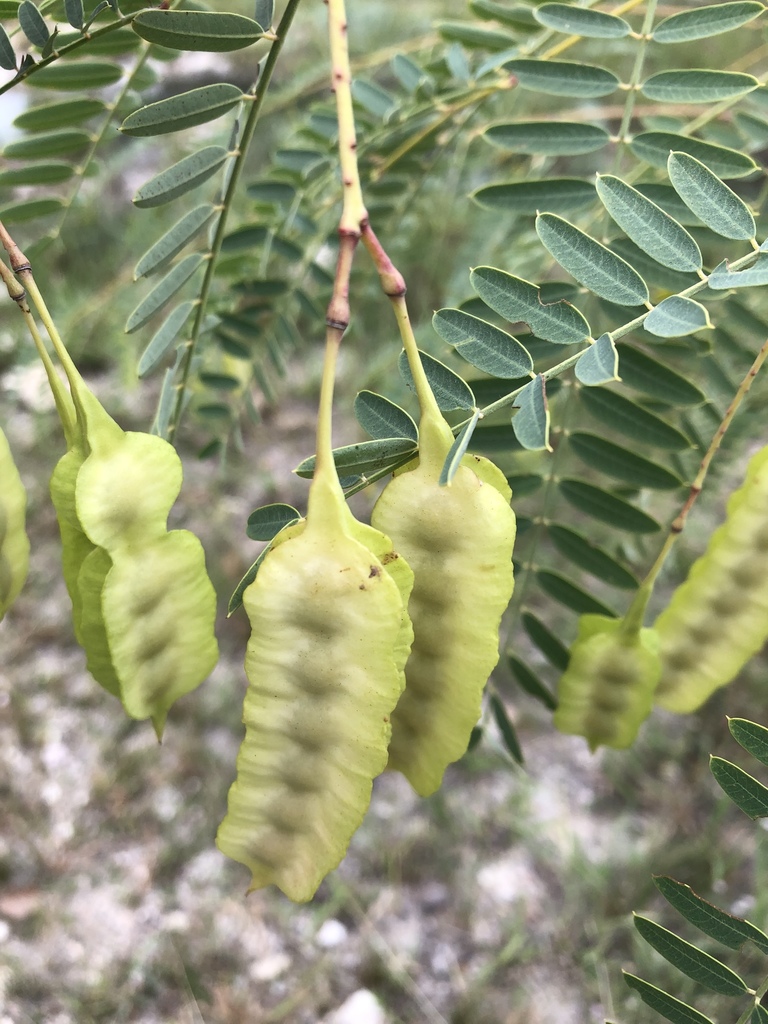
The pods are 2 to 4 inches long, pointed at the tip and have four papery, lengthwise wings, making them square in cross-section. Inside, the seeds are separated by cross partitions. The pods ripen from green to brown and often stay on the plant into winter, where the loose seeds rattle when the wind blows.
Look-alikes
Scarlet wisteria or rattlebox (Sesbania punicea) is a South American shrub that has become invasive in the Southeast; it has larger, bright orange-red flowers. Bagpod (S. vesicaria) is a native annual with flat, inflated, bladder-like pods holding one or two seeds. Bigpod Sesbania (S. herbacea) is a tall annual with very long, narrow pods.
Safety
All parts of the plant should be treated as poisonous, but the seeds are the most dangerous. They contain sesbanimide, a potent toxin that causes severe digestive upset, weakness, diarrhea and rapid death in livestock. Animals raised with the plant usually avoid the bitter green plants, but cattle, goats and sheep moved onto pastures with dried rattlebush in fall and winter are frequently poisoned, and sick animals may die within a day. Keep children and pets from handling or eating the pods and seeds, and do not grow it in or next to pastures or poultry yards.
Quick Facts
| Scientific Name | Sesbania drummondii |
| Family | Fabaceae (legume family) |
| Plant Type | Deciduous, woody-based perennial shrub |
| Mature Height | 3–10 ft |
| Mature Spread | 3–6 ft |
| Growth Rate | Fast |
| Sun Exposure | Full sun |
| Water Needs | High; moist to wet soil, tolerates periodic flooding |
| Soil Type | Wet clay, loam, sand or mud |
| Soil pH | About 5.5–8.0 |
| Bloom Time | May–October |
| Flower Color | Yellow to orange-yellow, often streaked red |
| Fall Color | Not significant |
| Fruit | Four-winged pod, 2–4 in long, with rattling seeds (very poisonous) |
| Deer Resistant | Generally; foliage is bitter and toxic |
| USDA Hardiness Zones | 8–11 |
Native Range
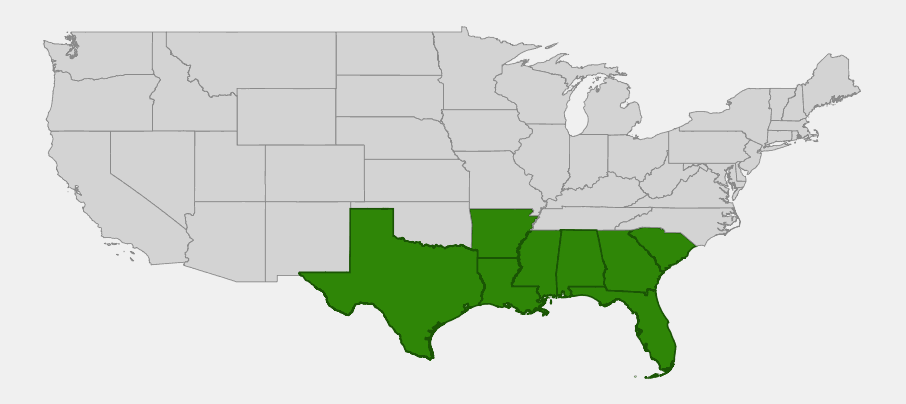
Rattlebush is native to the coastal plain of the southeastern United States. USDA PLANTS lists it as native in the lower 48 states and records it from Alabama, Arkansas, Florida, Georgia, Louisiana, Mississippi, South Carolina and Texas. It is most common along the Gulf Coast, from Texas and Louisiana east to the Florida Panhandle and peninsula.
In Texas it is widespread in the eastern half of the state and along the coast, and it extends inland along rivers and creeks to the Edwards Plateau and Hill Country (for example, along the Pedernales and Guadalupe rivers) and south toward the Rio Grande. In Arkansas it is found mainly in the southern lowlands, and on the Atlantic side it reaches coastal Georgia and southern South Carolina, where it is less common.
Typical habitats are open, wet places: roadside ditches, wet prairies and meadows, freshwater and brackish marsh edges, shores of lakes and ponds, river and creek banks, and disturbed low ground that floods periodically. It colonizes bare mud quickly and often grows in dense stands.
📋 Regional plant lists featuring Rattlebush: Alabama, Georgia & Mississippi · North & South Florida · North & South Carolina · Arkansas, Louisiana, Eastern Oklahoma & Eastern Texas · South & West Texas
Growing & Care Guide
Rattlebush is easy to grow in wet, sunny ground and is useful for quickly covering bare, flood-prone soil. Because its seeds are highly poisonous, it is best used in wetland restorations, detention basins and wild areas rather than in home gardens, especially where children, pets or livestock are present.
Light
Full sun. It becomes thin and leggy and flowers poorly in shade.
Soil & Water
It thrives in moist to wet soils of almost any texture, from heavy clay to sand, and tolerates periodic flooding and brief drought once established. It does not need fertilizer: like most legumes, it partners with root bacteria that fix nitrogen.
Planting Tips
Sow seed or set out young plants in spring in ditches, pond margins, rain gardens or wet meadows. It grows several feet in its first season. Give it room, and plant it away from pastures, paddocks, poultry yards, play areas and paths.
Pruning & Maintenance
Rattlebush is short-lived and naturally open in form. Cut old stems back in late winter to encourage fresh growth. To reduce the risk to animals and limit self-seeding, remove pods before they dry and drop their seeds; wear gloves and dispose of them where animals cannot reach them.
Propagation
Grow from seed. The hard seed coats germinate better after scarification (nicking or a brief soak in hot water) and soaking overnight. Sow in warm soil in spring; seedlings grow quickly. Plants also self-sow readily on bare, wet ground.
Landscape Uses
- Wetland restoration: quick cover for bare, flood-prone soil along ponds, ditches and marshes
- Stormwater and detention basins: tolerates repeated flooding in sunny, wet sites
- Pollinator habitat: long bloom season feeds bees and butterflies
- Soil improvement: nitrogen-fixing legume for poor, wet soils
- Naturalistic water edges: airy, ferny texture; plant only away from livestock and play areas
Wildlife & Ecological Value
Despite its toxicity, rattlebush plays a useful role in wet coastal plain habitats, feeding pollinators and quickly stabilizing disturbed ground.
For Pollinators
The pea flowers are pollinated mainly by bees, including bumble bees and large carpenter bees strong enough to open the petals. Butterflies also visit for nectar, and its long bloom season from late spring to fall makes it a dependable nectar source in wet habitats.
For Birds
Thickets of rattlebush provide cover and perches for marsh and wetland birds. The seeds are toxic, and birds are not known to rely on them as food.
For Mammals
Most mammals avoid the bitter foliage. Livestock poisoning is the main concern: naive cattle, sheep and goats can be fatally poisoned by eating the seeds and dry plants.
Ecosystem Role
As a fast-growing nitrogen-fixing legume, rattlebush colonizes bare mud after floods, storms and soil disturbance, adding nitrogen and organic matter and helping stabilize the soil until longer-lived wetland plants take over.
Cultural & Historical Uses
The species is named for Thomas Drummond (about 1793–1835), a Scottish naturalist who collected plants in Texas in the early 1830s and sent hundreds of new species back to European botanists. Many Texas plants carry his name.
The name poisonbean, used by USDA, reflects rattlebush’s reputation among ranchers along the Gulf Coast. Extension services and livestock guides have long warned that dry pods and seeds in late fall and winter pastures are dangerous to cattle, sheep and goats, and that hungry animals moved to new pastures are most at risk.
The compound sesbanimide, isolated from Sesbania seeds, drew scientific interest in the 1980s for its strong effects on cells. Its toxicity is the reason this attractive, easy-to-grow shrub is seldom sold for gardens, even though it is a valuable native for wetland restoration.
Frequently Asked Questions
Is rattlebush poisonous?
Yes. The seeds are highly poisonous to people, pets and livestock, and the rest of the plant should be treated as toxic too. Livestock poisoning is most common when animals eat dry pods and seeds in late fall and winter.
Why is it called rattlebush?
When the four-winged pods dry, the loose seeds inside rattle in the wind or when the branches are shaken.
Is rattlebush the same as the invasive red sesbania?
No. Scarlet wisteria (Sesbania punicea) is a South American shrub with larger, bright orange-red flowers and is invasive in the Southeast. Rattlebush is native and has yellow to orange-yellow flowers.
Where does rattlebush grow?
In wet, open places on the coastal plain from Texas east to Florida and north to Arkansas and southern South Carolina: ditches, marsh edges, pond shores, stream banks and wet meadows.
Should I plant rattlebush in my garden?
Only with care. It is useful in wetland restoration and stormwater basins, but its poisonous seeds make it a poor choice near pastures, play areas, pets or small children.

Looking for a nursery that carries Rattlebush?
Browse our native plant nursery directory: Alabama & Arkansas · Florida & Georgia · Louisiana & Mississippi · South Carolina & Texas