
Bashful Wakerobin (Trillium catesbaei)
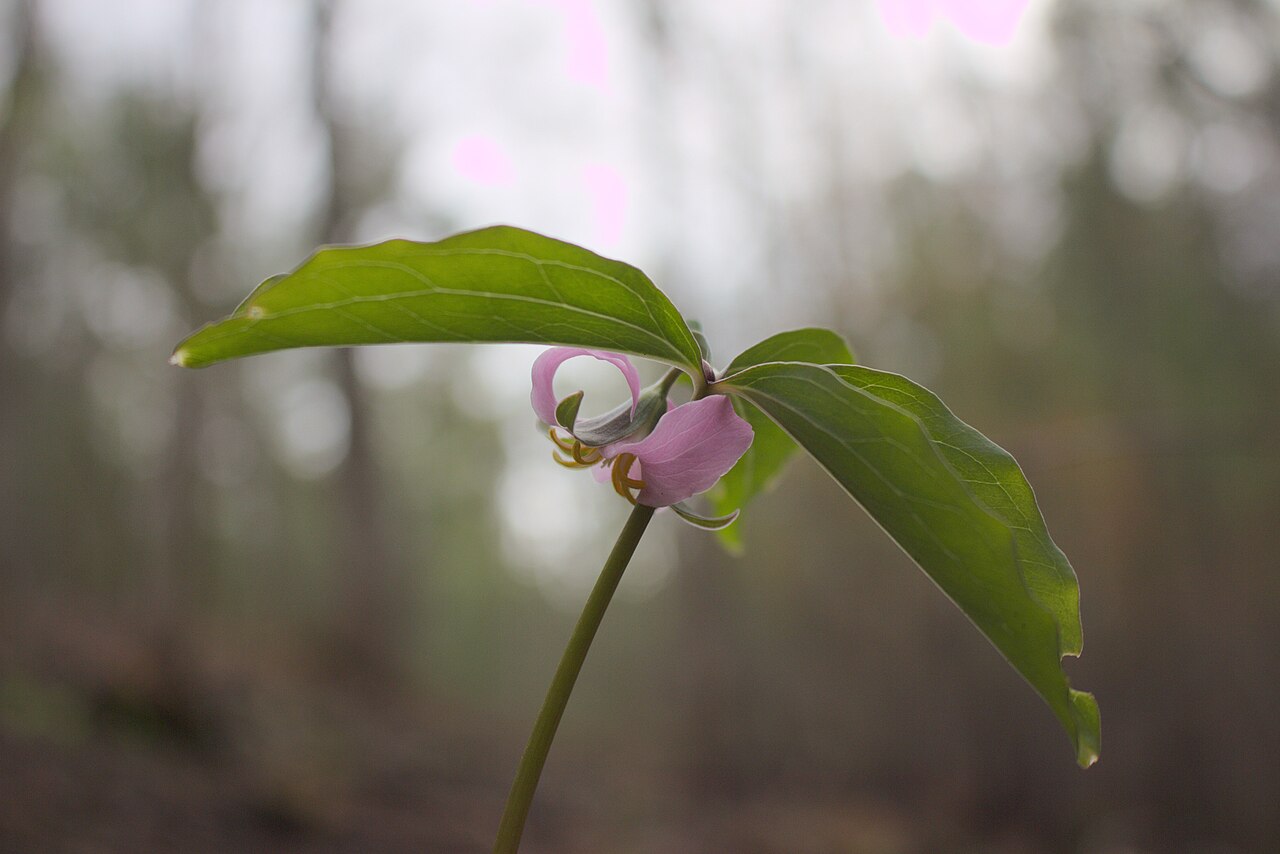
Trillium catesbaei, known as Bashful Wakerobin, and also called Catesby’s trillium or rosy wake-robin, is a spring-blooming woodland wildflower of the bunchflower family (Melanthiaceae). It is native to the southeastern United States, mainly the Piedmont and lower mountain slopes from North Carolina and Tennessee south through South Carolina and Georgia to Alabama.
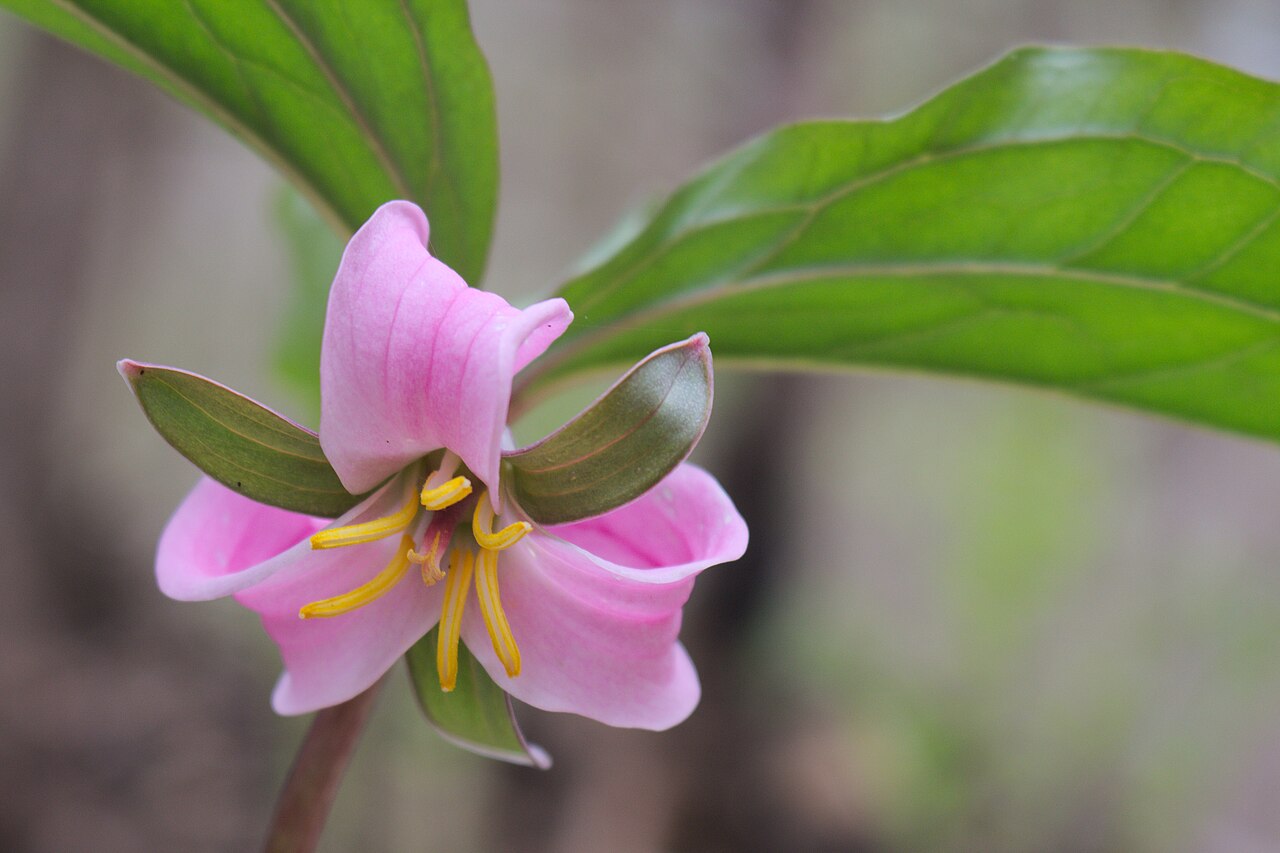
Like all trilliums, it has a single stem with a whorl of three leaves and one flower with parts in threes. Its flower is distinctive: pink to white, with wavy petals that sweep sharply backward and a ring of long yellow anthers, and it hangs on a curved stalk so that it nods below or beside the leaves. That shy, downward-facing habit gives it the name “bashful.”
It grows in deciduous and mixed woods, often on slopes, and it tolerates drier and more acidic soils than many trilliums. It is a lovely plant for southeastern shade gardens, but like all trilliums it must never be dug from the wild. Buy only nursery-propagated plants from reputable native plant growers.
Identification
Bashful wakerobin is the trillium of the southeastern Piedmont with a nodding pink or white flower whose petals curl strongly backward, held on a stalk that bends down below or between the three leaves.
Growth Form
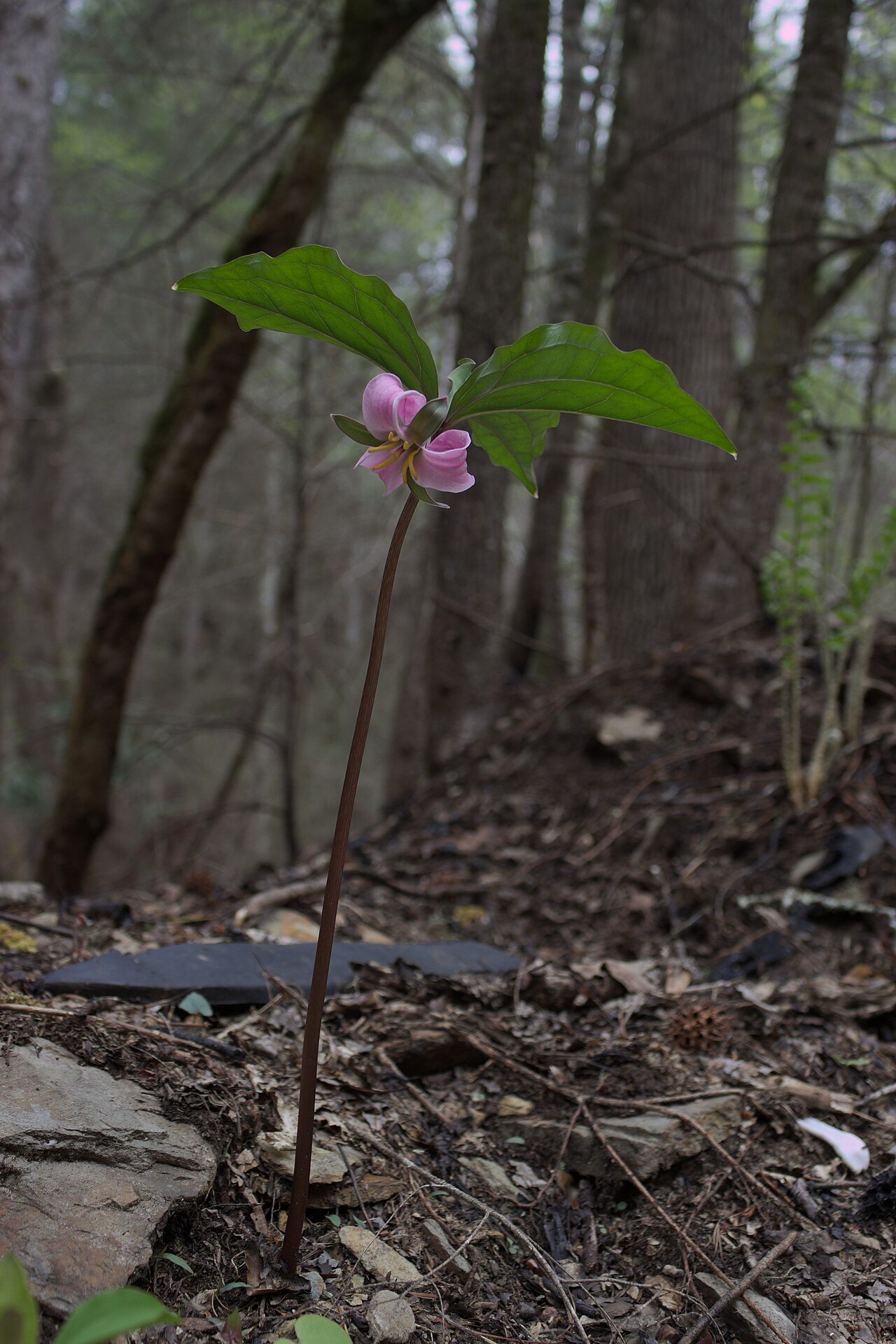
A perennial herb growing from a short underground rhizome. Each plant sends up a single unbranched stem, usually 8 to 18 inches tall, bearing a whorl of three leaves and a single flower. Established plants may form small clumps of several stems.
Leaves
The three leaves are broadly elliptic to egg-shaped, about 3 to 6 inches long, with pointed tips and a short, distinct stalk at the base. They are plain green, not mottled, which separates it from the sessile trilliums of the region whose leaves are often mottled and have no stalks.
Flowers
The single flower appears from about late March to May. It hangs on a curved stalk 1 to 2 inches long, nodding below or beside the leaves. The three petals are pink, rose or white, about 1 to 2 inches long, wavy-edged and strongly curved backward. The three green sepals are narrow and often curved backward too. The six stamens have long, bright yellow anthers that surround the small ovary. White-flowered plants often turn pinker as they age.
Fruit
After flowering, the ovary develops into a fleshy, egg-shaped, pale green to whitish berry-like capsule that hangs below the leaves in summer. Its seeds have fatty attachments (elaiosomes) that ants carry away, which helps spread the plant.
Look-alikes
White Trillium (Trillium grandiflorum) has larger white flowers held upright above the leaves, turning pink with age. Nodding trillium (T. cernuum) and Rugel’s trillium (T. rugelii) also have nodding flowers, but their petals are not strongly swept back, and their anthers are shorter or purplish. Sessile trilliums, such as toadshade, have stalkless, often mottled leaves and upright, closed flowers.
Safety
Trilliums are not considered seriously poisonous, but they are not food plants, and some people may find the berries and roots irritating if eaten. Keep them away from children and pets. Above all, do not pick trilliums: removing the leaves can weaken or kill the plant for years.
Quick Facts
| Scientific Name | Trillium catesbaei |
| Family | Melanthiaceae (bunchflower family) |
| Plant Type | Herbaceous perennial; spring wildflower |
| Mature Height | 8–18 in |
| Mature Spread | 6–12 in; slowly forms small clumps |
| Growth Rate | Slow |
| Sun Exposure | Part shade to full shade |
| Water Needs | Moderate; moist to somewhat dry woodland soil |
| Soil Type | Humus-rich, well-drained loam; tolerates acidic soils |
| Soil pH | About 5.0–7.0 |
| Bloom Time | Late March–May |
| Flower Color | Pink, rose or white |
| Fall Color | None; leaves die back by summer |
| Fruit | Pale green to whitish fleshy capsule; ant-dispersed seeds |
| Deer Resistant | No; heavily browsed by deer |
| USDA Hardiness Zones | 6–8 |
Native Range
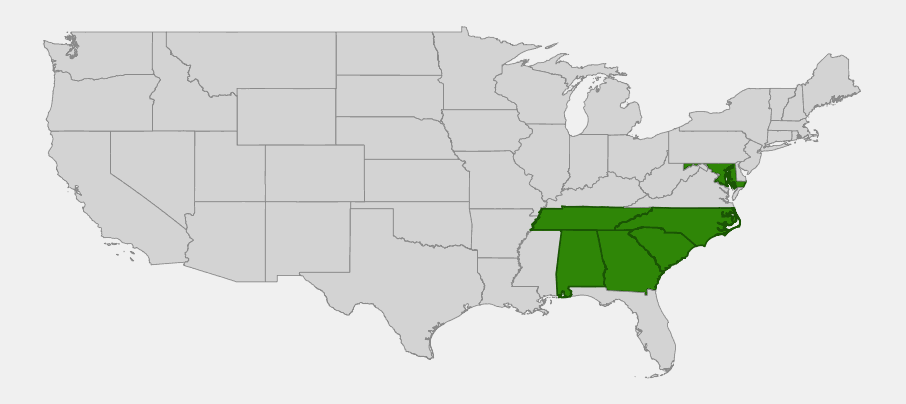
Bashful wakerobin is a southeastern U.S. endemic. Most of its populations are in the Piedmont from central North Carolina through South Carolina and Georgia to Alabama, with others on the lower slopes of the Blue Ridge and southern Appalachians, reaching its northern limit in the mountains of western North Carolina and eastern Tennessee, including the Great Smoky Mountains. Its southernmost natural populations are in southern Alabama. USDA PLANTS also lists an outlying record from Maryland, far north of the main range.
It grows in deciduous and mixed hardwood forests under American beech, oaks, hickories and tulip poplar, on slopes, ravines and bluffs, and along streams. Compared with many trilliums, it tolerates relatively dry, rocky and acidic sites, and it is often found in oak–hickory woods on Piedmont hillsides and near mountain laurel and rhododendron thickets.
Although it is not considered rare across its range, it is a slow-growing plant whose populations can be damaged by heavy deer browsing, development and illegal digging. Because trilliums take many years to grow from seed, plants offered cheaply in large numbers may have been dug from the wild.
📋 Regional plant lists featuring Bashful Wakerobin: Kentucky & Tennessee · Maryland, Virginia & West Virginia · Alabama, Georgia & Mississippi · North & South Carolina
Growing & Care Guide
Bashful wakerobin is a rewarding plant for southeastern woodland gardens. It is offered by a few specialist native plant nurseries; buy only plants clearly labeled as nursery-propagated, never wild-collected.
Light
Grow it in part shade to full shade under deciduous trees, where it gets spring sun before the canopy leafs out and shade in summer. Avoid hot afternoon sun.
Soil & Water
It prefers humus-rich, well-drained, slightly to moderately acidic woodland soil, and it tolerates drier conditions than many trilliums once established. Add leaf mold or compost when planting, keep the soil evenly moist in spring, and let it be drier in summer when the plant is dormant. Avoid heavy, waterlogged soil, which can rot the rhizome.
Planting Tips
Plant dormant rhizomes in late summer or fall, about 2 to 4 inches deep, or potted plants in early spring. Space them 6 to 12 inches apart in small groups. Mark their location, because the leaves disappear by midsummer. It combines well with ferns, foamflower, wild ginger, mayapple and spring ephemerals.
Pruning & Maintenance
Do not cut the leaves; the plant needs them to store energy for the next year. Let the foliage die back naturally and leave fallen leaves in place as mulch. Protect plants from deer, which can eat the whole stem, and keep slugs in check in wet springs.
Propagation
Propagate by dividing established clumps in late summer or fall, or from fresh seed sown outdoors as soon as it is ripe. Seed needs two winters to germinate fully, and seedlings may take five years or more to flower, which is why nursery-grown trilliums are slow and costly to produce.
Landscape Uses
- Woodland and shade gardens: spring flowers under deciduous trees
- Southeastern native gardens: a Piedmont trillium suited to warm, acidic woods
- Ephemeral and spring wildflower beds: pairs with ferns and spring ephemerals
- Naturalized woodland plantings: slowly forms colonies where undisturbed
- Conservation plantings: grow nursery-propagated plants to reduce pressure on wild populations
Wildlife & Ecological Value
Bashful wakerobin is part of the spring flowering layer of southeastern hardwood forests and has close relationships with ants and early-season insects.
For Pollinators
Its nodding flowers are visited by bees, including early-season bumble bees and small native bees, which reach the pollen from below, as well as by flies and beetles.
For Birds
The plant is of minor importance to birds, though ground-foraging birds may take insects among the foliage.
For Mammals
White-tailed deer browse trilliums heavily, often eating the leaves and flower, and can eliminate them from overbrowsed woods. Small mammals may eat the fruits.
Ecosystem Role
Its seeds carry fatty elaiosomes that attract ants, which carry the seeds to their nests, eat the elaiosomes and discard the seeds in nutrient-rich soil. This slow, short-distance dispersal is one reason trillium colonies spread slowly and recover slowly from disturbance.
Cultural & Historical Uses
The species name catesbaei honors the English naturalist Mark Catesby, who traveled in the Carolinas in the 1720s and published an illustration of this trillium in his famous Natural History of Carolina, Florida and the Bahama Islands. The botanist Stephen Elliott formally named the species in 1817.
The name “wakerobin” is an old English name for trilliums and other spring flowers that bloom about the time the American robins return north in spring. “Bashful” refers to the way the flower hangs down and is often half-hidden by the leaves.
Trilliums have long been dug from the wild for sale, and conservation groups encourage gardeners to ask nurseries how their trilliums were produced. Buying only plants grown from seed or division in a nursery helps protect wild populations of species like bashful wakerobin.
Frequently Asked Questions
Why is it called bashful wakerobin?
Its flower nods on a curved stalk so that it often hangs below or beside the leaves, as if shy. “Wakerobin” is an old name for trilliums that bloom when robins return in spring.
Can I dig it from the woods for my garden?
No. Wild trilliums should never be dug: transplanted plants often die, it is illegal on public land and without permission on private land, and wild populations recover very slowly. Buy nursery-propagated plants instead.
Where does it grow naturally?
Mainly in the Piedmont and lower mountains of North Carolina, South Carolina, Georgia, Alabama and eastern Tennessee, in deciduous and mixed hardwood forests.
Is it pink or white?
Both. Flowers range from white to rose pink, and white flowers often turn pinker as they age. All have backward-curving petals and long yellow anthers.
How long does it take to grow from seed?
Several years. Seeds usually need two winters before they germinate fully, and plants may take five or more years to reach flowering size.

Looking for a nursery that carries Bashful Wakerobin?
Browse our native plant nursery directory: Alabama · Georgia · Maryland · North Carolina · South Carolina & Tennessee