Canyon Live Oak (Quercus chrysolepis)
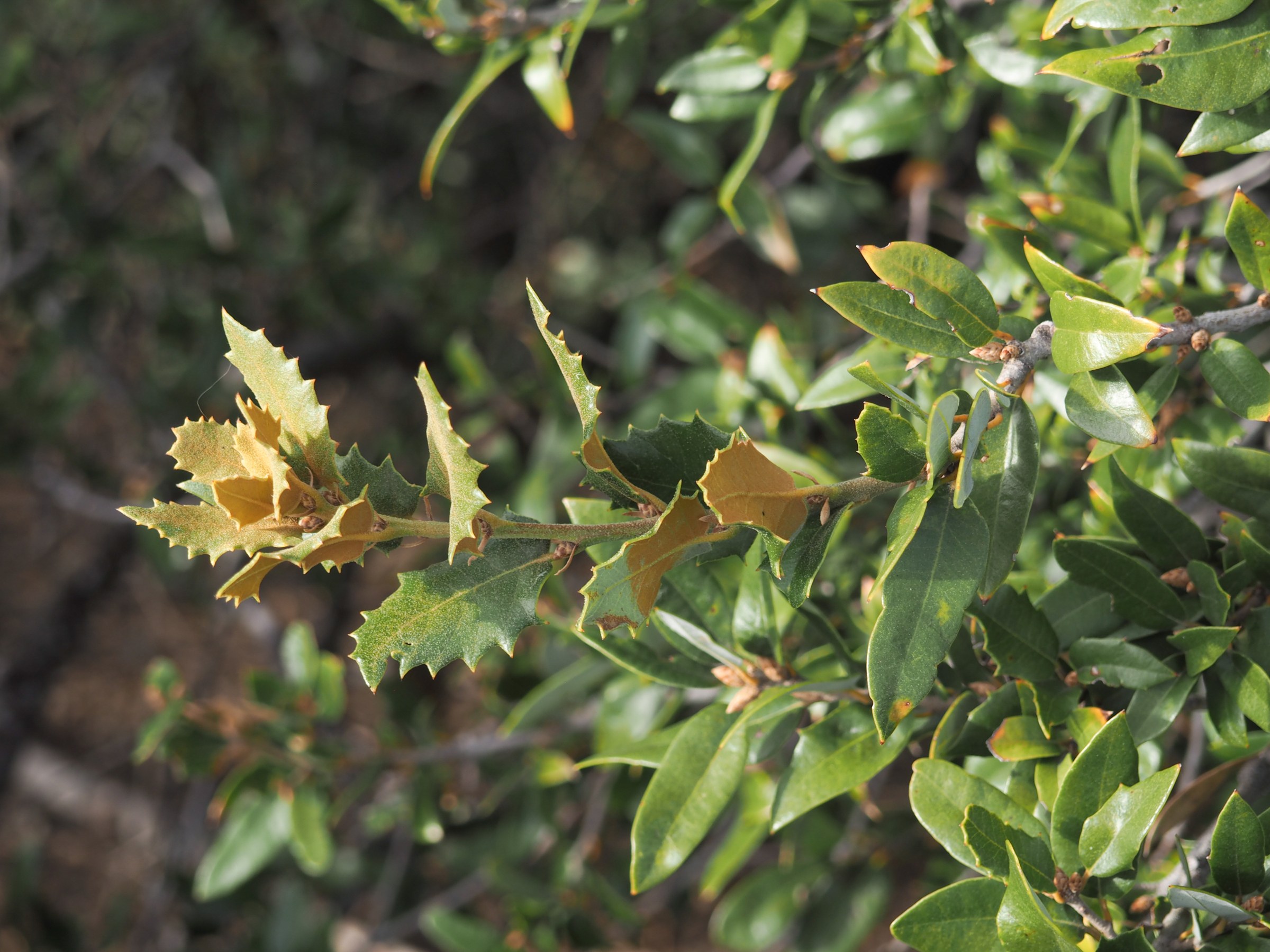
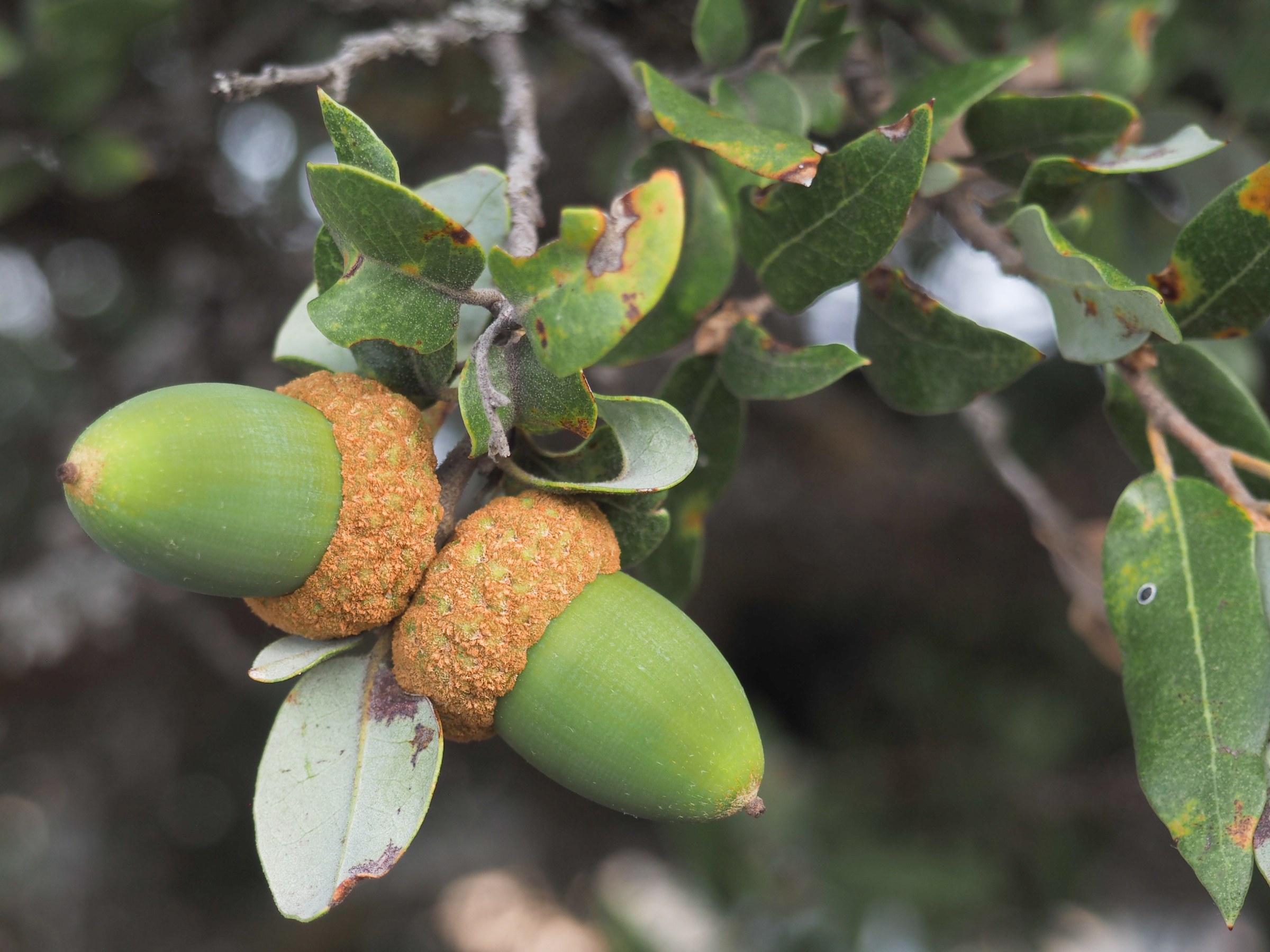
Quercus chrysolepis, the Canyon Live Oak (also called Maul Oak or Golden Cup Oak), is one of the most widespread and ecologically important evergreen oaks of the mountainous American West. Its species name, chrysolepis, means “golden scale,” a reference to the fine golden-yellow fuzz that covers the acorn cups and often the undersides of young leaves — one of the easiest field marks for identifying the tree.
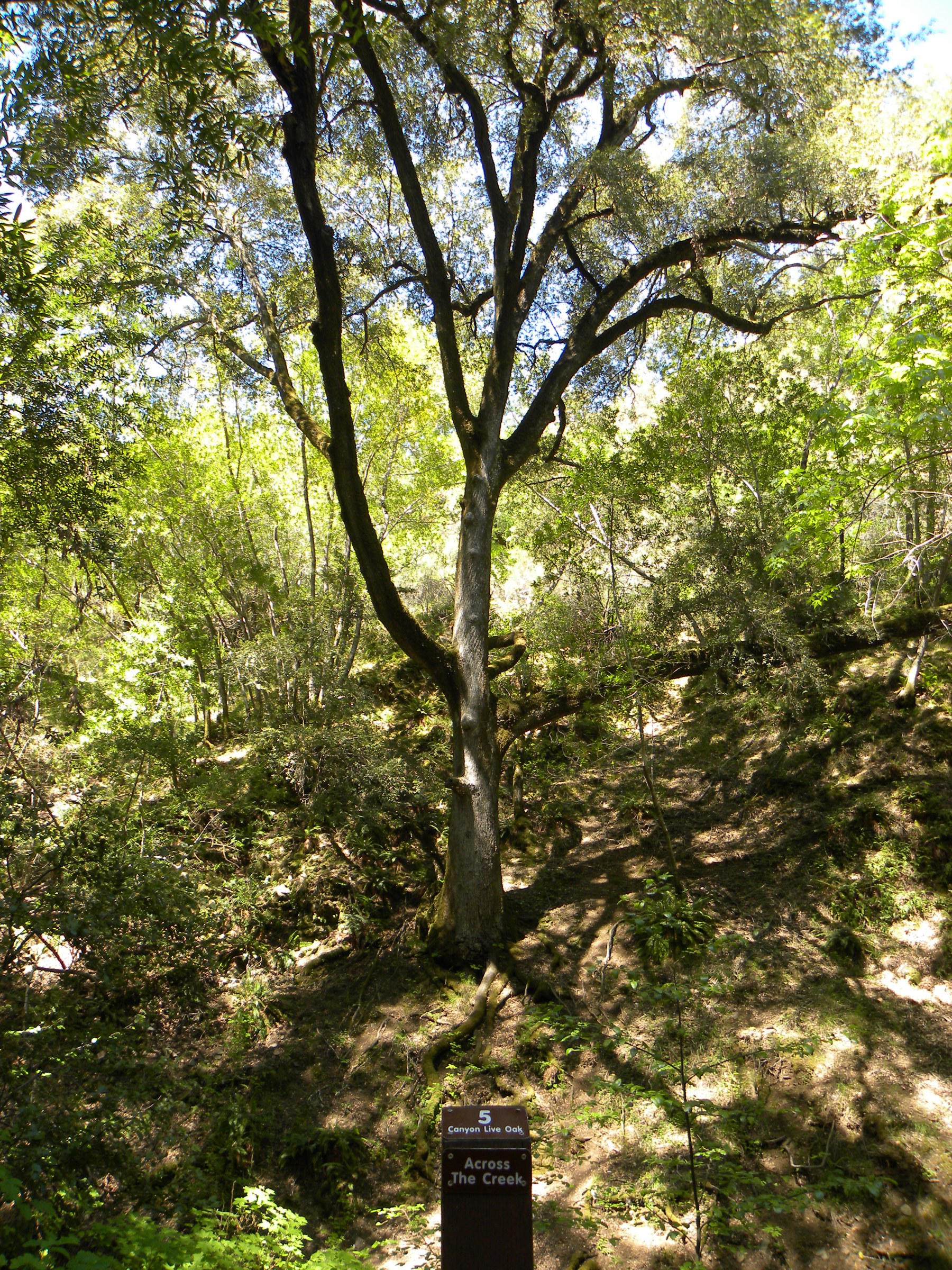
Canyon live oak is remarkably variable in form, which is part of what makes it so successful across such a wide range of elevations and conditions. In sheltered canyons and along streams it grows into a tall, single-trunked tree 60 to 80 feet high with a dense, rounded crown. On exposed ridgetops, rocky outcrops and high mountain slopes, the same species may grow as a gnarled, multi-stemmed shrub only a few feet tall — the two extremes can look like different plants entirely, but both are Quercus chrysolepis.
True to its common name, canyon live oak is most at home in rocky canyons and steep, rugged terrain from near sea level in the Coast Ranges to over 8,000 feet in the southern Sierra Nevada and the mountains of Arizona. It is exceptionally drought tolerant, long-lived, and produces some of the hardest, heaviest wood of any oak in North America — hence its old nickname, maul oak, for the wooden mauls once split from its wood.
Identification
Growth form ranges from a single-trunked tree 60 to 80 feet tall with a broad, rounded crown in favorable canyon sites, down to a dense shrub only 3 to 10 feet tall on dry, exposed ridges — often within sight of each other on the same mountainside.
Bark
Bark is gray to grayish-brown, smooth on young trees and becoming shallowly furrowed into small plates with age, but never developing the deep, rugged furrows seen in many deciduous oaks.
Leaves
Leaves are evergreen, leathery, and notably variable on the same tree — one of the species’ most distinctive identification traits. Young or lower-growing leaves, especially on vigorous sprouts or browsed growth, have sharp, holly-like spiny teeth along the margins; older leaves higher in the canopy are often smooth-edged or nearly so. Leaves are 1 to 3 inches long, elliptical to oblong, glossy dark green above. The underside is where the “golden” in the species name shows clearest: new leaves are covered in fine golden-yellow hairs (tomentum) that often wear away to gray or pale green with age, though some populations retain a gold cast longer than others.
Flowers & Acorns
Male flowers hang in slender yellow-green catkins in spring as new growth emerges; female flowers are small and inconspicuous in the leaf axils. Canyon live oak occupies its own section of the oak genus (Protobalanus) with an acorn maturation schedule intermediate between the one-year white oaks and two-year red oaks, typically ripening over about 18 months. The acorns are large, ¾ to 1½ inches long, with a thick, deep, bowl-like cup covered in the same fine golden fuzz as the young leaves — the “golden cup” that gives the species its other common name.
Quick Facts
| Scientific Name | Quercus chrysolepis |
| Family | Fagaceae (Beech/Oak) |
| Plant Type | Evergreen tree or shrub (highly variable) |
| Mature Height | 3–10 ft as a shrub on exposed sites; 60–80 ft as a tree in canyons |
| Mature Spread | Roughly equal to height as a tree; wider than tall as a shrub |
| Growth Rate | Slow |
| Sun Exposure | Full Sun to Part Shade |
| Water Needs | Low once established; excellent drought tolerance |
| Soil Type | Rocky, well-drained; tolerates thin or poor soils |
| Soil pH | Slightly acidic to neutral (5.5–7.0) |
| Bloom Time | April – June |
| Flower Color | Yellow-green catkins (inconspicuous) |
| Fall Color | None (evergreen) |
| Fruit | Large golden-cupped acorns, maturing over about 18 months |
| Deer Resistant | Moderate (foliage browsed, especially young growth) |
| USDA Hardiness Zones | 7–10 |
Native Range
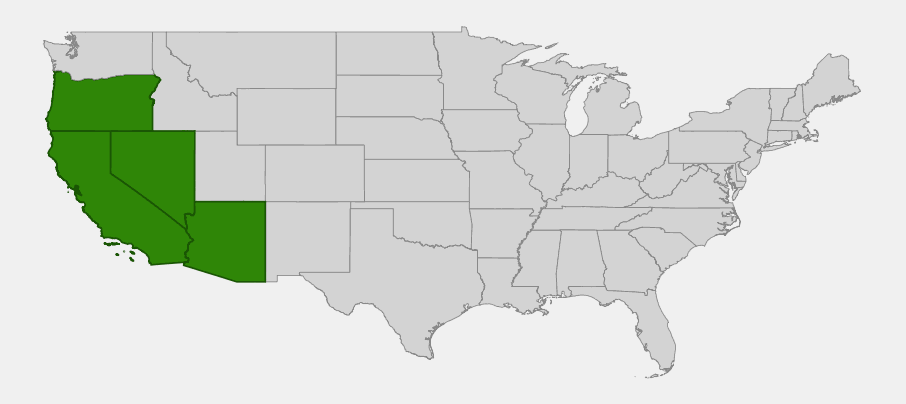
Canyon live oak has one of the broadest ranges of any western American oak. It runs from southwestern Oregon’s Siskiyou region south through essentially the entire length of California — coast ranges, Sierra Nevada foothills and mid-elevation forests, and the Transverse and Peninsular Ranges of southern California — and east into Nevada, Arizona, and northern Mexico (Baja California and northern Sonora).
It is very much a plant of rugged terrain, true to its common name: steep canyon walls, rocky slopes, cliff faces and ridgelines, often where few other trees can get a foothold. Elevation range is enormous, from near sea level in coastal canyons of central California up to roughly 8,500 feet in the southern Sierra Nevada and the sky island mountains of Arizona. It is a major component of mixed evergreen forest and oak woodland, growing alongside bigcone Douglas-fir, Coulter pine, and other oaks, and it is often the dominant tree in the narrowest, steepest canyons where moisture collects even in otherwise dry chaparral country.
Canyon live oak is genuinely drought-adapted and fire-adapted, resprouting vigorously from root crowns and basal burls after fire — an important trait in the fire-prone landscapes that make up most of its range.
📋 Regional plant lists featuring Canyon Live Oak: Arizona & New Mexico · Western Oregon & Western Washington
Growing & Care Guide
Canyon live oak is a patient, long-lived tree for gardeners willing to let it grow at its own pace. It rewards that patience with one of the toughest, longest-lived evergreen oaks for dry western landscapes.
Light
Full sun to part shade both work well. In its native canyons it often grows with some afternoon shade from canyon walls or neighboring trees, but it tolerates full, exposed sun once established, especially near the coast.
Soil & Water
Rocky, well-drained soil is ideal, and this species is notably tolerant of thin, poor or even serpentine soils that stunt many other trees. It is deeply drought tolerant once established and, like most California native oaks, resents summer irrigation near the trunk once mature — overwatering established canyon live oaks is a common cause of root rot. Water regularly only during the first one to two years to establish roots.
Planting Tips
Plant small container stock in fall so winter rains can help establish the root system; oaks planted from small containers generally outperform larger, more root-bound specimens over time. Choose a well-drained slope or rocky site if possible, and keep irrigation away from the root crown as the tree matures. Expect slow early growth — this is a long game, not a quick shade tree.
Pruning & Maintenance
Minimal pruning is needed. Remove dead or crossing branches in the dormant season. Canyon live oak tolerates hard pruning and resprouts readily, which is part of why it was historically valued as a coppice and firewood tree, but a natural, lightly shaped form suits most landscapes best. Avoid summer irrigation and soil disturbance near the root zone, which can increase susceptibility to oak root fungus.
Landscape Uses
Canyon live oak’s toughness and variable habit make it useful across a range of dry-climate garden situations:
- Large evergreen shade tree on well-drained sites with room to grow
- Screening hedge or windbreak when planted in groups and lightly pruned
- Slope and canyon restoration where erosion control and fire resilience both matter
- Wildlife garden anchor tree for acorn-dependent birds and mammals
- Low-water landscaping once established, especially in oak woodland-adjacent gardens
Wildlife & Ecological Value
Few western trees match canyon live oak’s value as a wildlife food and shelter source across such a wide elevation range.
For Birds
Acorn woodpeckers depend heavily on canyon live oak and other oaks for both food and granary trees, where they drill thousands of holes to store acorns for winter. Band-tailed pigeons, Steller’s jays, and a wide range of other birds feed on the large acorn crops, and the dense evergreen canopy provides year-round nesting and roosting cover unusual among deciduous western trees.
For Mammals
Mule deer browse the foliage, especially young spiny growth, and acorns are a critical fall and winter food source for black bears building fat reserves before winter, along with gray squirrels, chipmunks, and other rodents that in turn cache and disperse the seed.
Ecosystem Role
In the steep, fire-prone canyons and slopes where it dominates, canyon live oak’s dense root system helps stabilize otherwise erosion-prone terrain, and its ability to resprout vigorously after fire makes it one of the first trees to recover canopy cover in burned chaparral and mixed evergreen forest. Its long-lived acorn crop underpins the food web for an unusually wide range of elevations, from coastal canyons to high mountain slopes.
Cultural & Historical Uses
Canyon live oak produces some of the hardest, heaviest wood of any oak in North America, and 19th-century settlers prized it for tool handles, wagon parts, and especially wooden mauls and wedges used for splitting other wood — the source of its old common name, “maul oak.” The wood’s density also made it useful for fuel, burning hot and long.
Indigenous peoples throughout California and the Southwest relied on canyon live oak acorns as a staple food for countless generations, processing them through extensive leaching — pounding the kernels into meal, then repeatedly rinsing or soaking the meal in water to remove bitter tannins — before cooking it into breads, mush or cakes. This was skilled, labor-intensive work passed down through generations, not something acorns can be eaten as, and raw or unleached acorns remain unpalatable and can be harmful if eaten in quantity, particularly by livestock.
Today the species is valued mainly for its ecological role, its drought tolerance in increasingly water-conscious western landscapes, and its sheer longevity — old canyon live oaks in undisturbed canyons can live for many centuries.
Frequently Asked Questions
Why do some canyon live oak leaves have spines and others don’t?
The spiny, holly-like leaves typically occur on young growth, vigorous sprouts, or lower branches within reach of browsing animals, while leaves higher in the canopy or on older growth are often smooth-edged. This is thought to be a defense against browsing, similar to the pattern seen in some hollies.
Is canyon live oak the same as coast live oak?
No. Coast live oak (Quercus agrifolia) has a different native range centered on coastal California, smoother bark, and leaves that cup downward; canyon live oak has a much broader range into the interior mountains, rougher bark with age, and the distinctive golden-fuzzy acorn cups that give it its name.
Why is canyon live oak sometimes a shrub and sometimes a tree?
Growth form depends heavily on site conditions. On sheltered, moist canyon bottoms it grows into a full-sized single-trunked tree, while on exposed, dry ridgetops and rocky outcrops with thin soil, it stays a dense, multi-stemmed shrub — both are the same species responding to very different growing conditions.
Are canyon live oak acorns edible?
Not raw. Like all oak acorns, they are high in bitter tannins and require extensive leaching before they are safe and palatable to eat. Indigenous peoples across California historically processed them this way as a staple food, but this is a demanding traditional practice, not a modern foraging shortcut, and unleached acorns and foliage can be toxic to livestock if consumed in quantity.
How long do canyon live oaks live?
Very long. Specimens in undisturbed canyon habitat are believed to live several hundred years, and the species’ slow growth rate and dense wood both contribute to its exceptional longevity compared to faster-growing trees.

Looking for a nursery that carries Canyon Live Oak?
Browse our native plant nursery directory: California · Oregon · Nevada · Arizona