
Clamshell Orchid (Prosthechea cochleata)
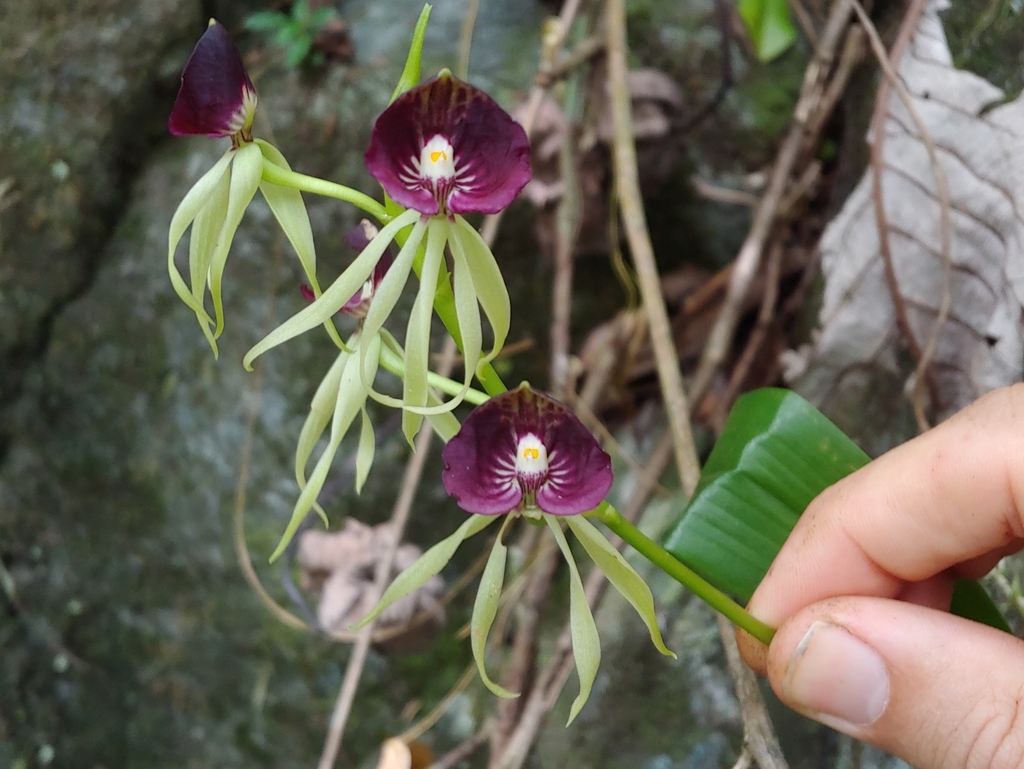
Prosthechea cochleata, the Clamshell Orchid, is one of the most recognizable orchids of the American tropics. In Puerto Rico it is known as orquídea negra (“black orchid”) and cañuela. Its flowers seem to hang upside down: a dark purple, shell-shaped lip striped with pale lines sits at the top like a little hood, and long, twisted, yellow-green sepals and petals dangle beneath it like tentacles, which has earned it the name “octopus orchid” as well. It belongs to the orchid family (Orchidaceae) and was long known as Encyclia cochleata and, before that, Epidendrum cochleatum.
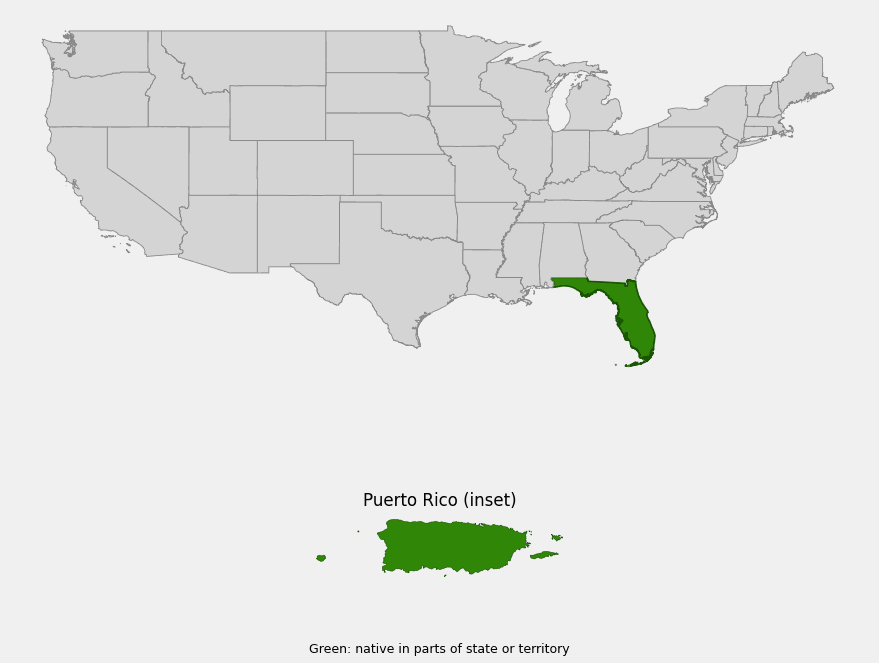
Clamshell orchid grows on tree trunks and branches and, in Puerto Rico, often on rocks. It is widespread from southern Mexico through Central America to northern South America and across the West Indies, including Puerto Rico, Vieques, St. Croix, Cuba, Jamaica, Hispaniola and the Bahamas, and it reaches the United States mainland only in southern Florida. Florida’s plants belong to a distinct variety, var. triandra, which pollinates itself.
In Florida it is listed as Endangered by the state, and in both Florida and Puerto Rico wild plants have been reduced by habitat loss and collecting. This guide covers how to identify it, where it grows, how to grow nursery-propagated plants, and why it should never be taken from the wild.
Identification
No other native orchid in Puerto Rico or Florida has flowers quite like the clamshell orchid’s. When not in bloom, it looks like many other epiphytic orchids: a cluster of flattened, pear-shaped pseudobulbs topped by strap-shaped leaves.
Pseudobulbs & Leaves
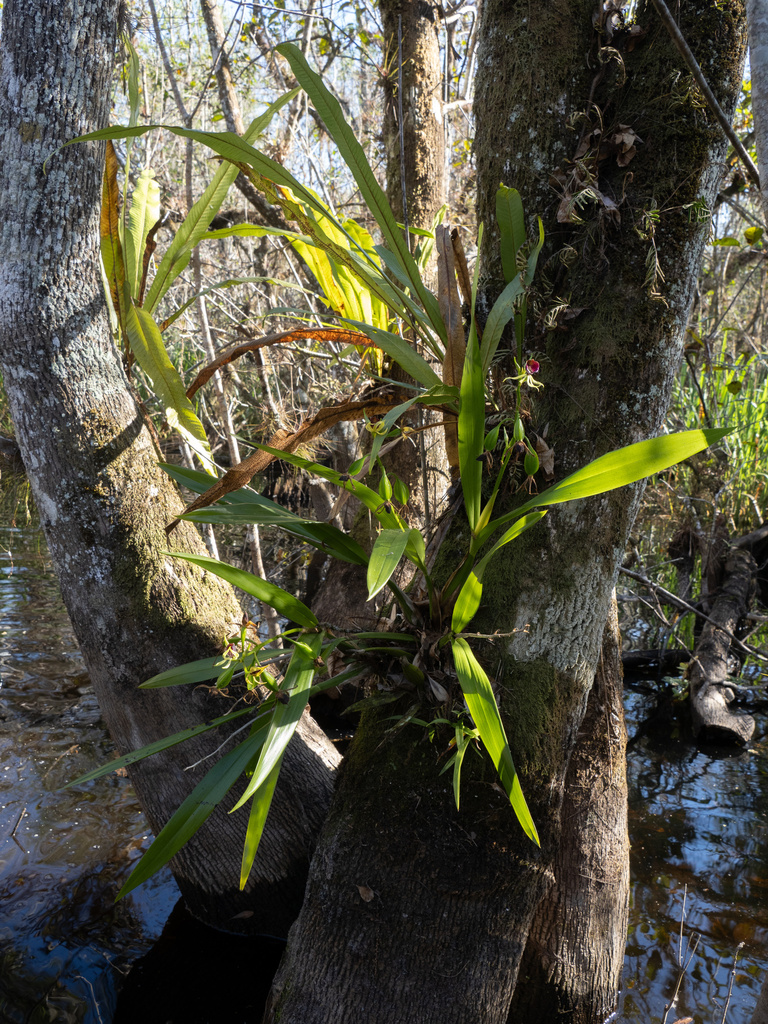
The plant grows in clumps of flattened, pear- to spindle-shaped pseudobulbs, each a few inches long, which store water during dry spells. Each pseudobulb bears one to three (usually two) narrow, strap-shaped to lance-shaped leaves, about 6 to 12 inches long, bright to yellowish green, and slightly leathery. Wiry white roots anchor the plant to bark or rock.
Flowers
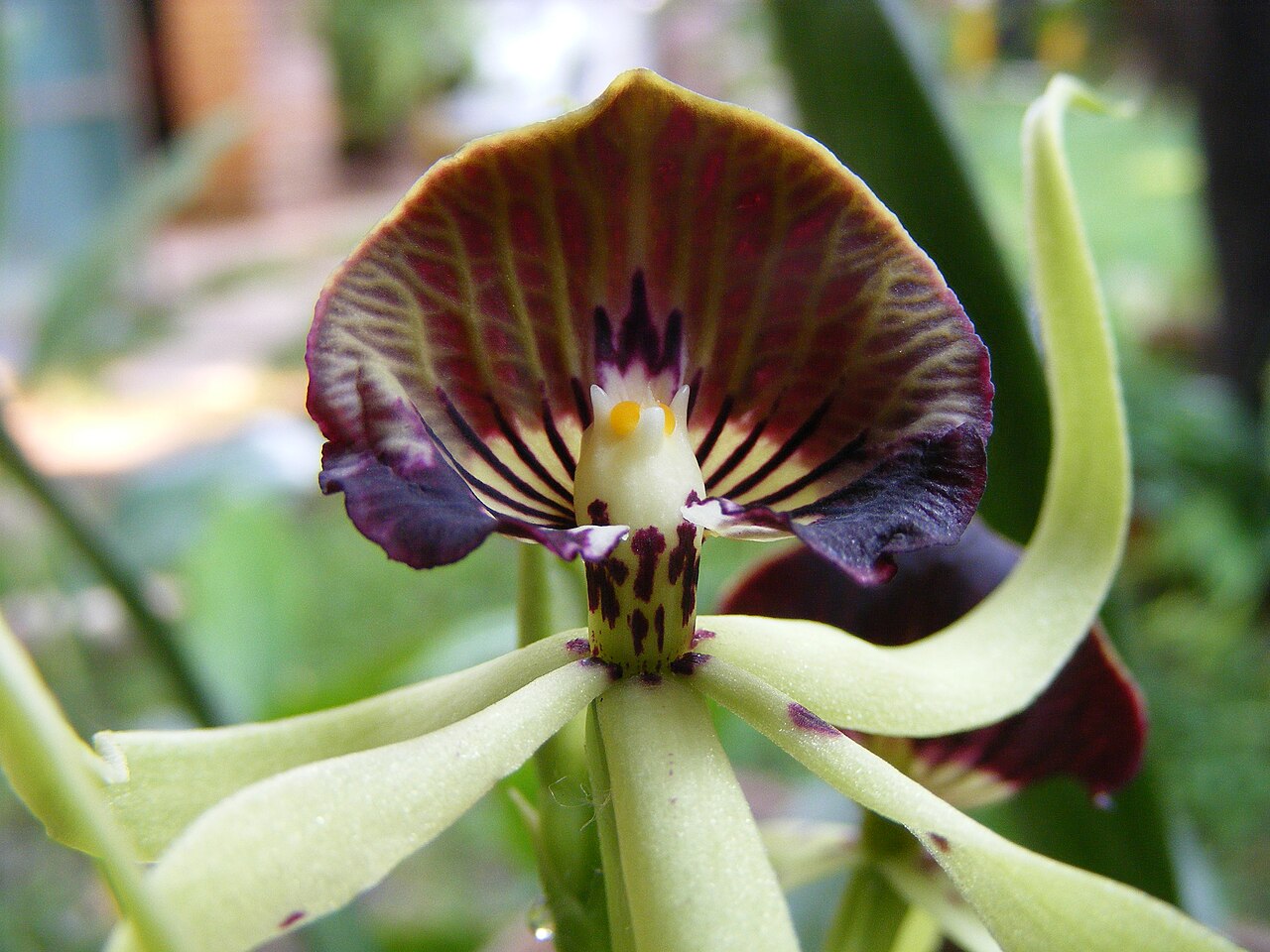
A slender, upright flower stalk arises from the top of each new pseudobulb and can grow a foot or more tall. Flowers open one or a few at a time over many weeks or months, so a single stalk may bloom for a long time. Each flower is about 2 to 4 inches long. The lip is held at the top of the flower: it is broad, rounded and cupped like a clamshell or cockleshell, deep purple to nearly black with pale stripes, with a pale area at the base. The sepals and petals are narrow, ribbon-like, pale yellow-green and twisted, hanging down below the lip. Some flowers are lightly fragrant.
The name cochleata means “shell-shaped,” referring to the lip. Florida’s var. triandra has three fertile anthers instead of the usual one and is self-pollinating, so its flowers often set fruit without insect visits.
Fruit & Seeds
Pollinated flowers develop into green, ribbed, oval capsules about an inch long. When ripe they split to release thousands of dust-fine seeds, which drift on the wind. Like other orchid seeds, they need a compatible fungus to germinate on bark or rock.
Quick Facts
| Scientific Name | Prosthechea cochleata (L.) W.E. Higgins (syn. Encyclia cochleata, Epidendrum cochleatum) |
| Family | Orchidaceae (orchid family) |
| Plant Type | Evergreen epiphytic or rock-dwelling orchid with pseudobulbs; USDA common name “clamshell orchid” |
| Mature Height | About 1–2 ft in flower |
| Mature Spread | About 6–18 in; clumps slowly |
| Growth Rate | Slow to moderate |
| Sun Exposure | Bright filtered light to part shade |
| Water Needs | Moderate; water freely in growth, drier in winter |
| Soil Type | None (epiphyte); mounted on bark or in coarse bark mix |
| Soil pH | Slightly acid (bark) |
| Bloom Time | Mainly winter to summer; individual stalks bloom for months |
| Flower Color | Dark purple to blackish lip; pale yellow-green sepals and petals |
| Fall Color | None; evergreen |
| Fruit | Ribbed oval capsule with dust-like seeds |
| Deer Resistant | Not applicable; grows on trees and rocks |
| USDA Hardiness Zones | 10b–12 (frost-free); indoors or greenhouse elsewhere |
Native Range
Clamshell orchid has a broad range in the American tropics. The Smithsonian’s Flora of the West Indies records it as native in the Lesser Antilles, Jamaica, Cuba, the Cayman Islands, Hispaniola, Puerto Rico (including Vieques), the U.S. Virgin Islands (St. Croix), the Bahamas, Florida and Mexico, and it continues through Central America to northern South America. USDA PLANTS lists it as native in Florida, Puerto Rico and the U.S. Virgin Islands.
In Florida it is confined to the southern tip of the peninsula, in Miami-Dade, Collier and Monroe counties. Herbarium specimens come from hammocks in and around Everglades National Park (such as Royal Palm Hammock and Long Pine Key), from the Cape Sable region, and from cypress swamps and wet hammocks of the Big Cypress Swamp and Fakahatchee Strand, where it grows on pond apple, pop ash, live oak, cypress and other trees. The Atlas of Florida Plants lists it as state Endangered.
In Puerto Rico it is scattered across the island, especially in the west and north. Collections come from the serpentine forests of Maricao, Sabana Grande and San Germán, from the limestone hills of the northern karst (Isabela, Quebradillas, Arecibo, Barceloneta, Bayamón), from the Cordillera Central around Adjuntas, Aibonito and Monte Montoso, and from dry rocky hills. Habitat notes describe low forest on serpentine rock, moist forest remnants on karst hills, dry and semi-evergreen forest, and windswept, shrubby mountaintops where it grows among rocks.
📋 Regional plant lists featuring Clamshell Orchid: Puerto Rico · North & South Florida
Growing & Care Guide
Clamshell orchid is one of the easiest and most rewarding orchids to grow, and nursery-propagated plants (including seed-grown Florida var. triandra) are widely available. Buy only nursery-propagated plants and never collect from the wild: it is listed as Endangered by the State of Florida, and wild collection has depleted populations in both Florida and Puerto Rico. In Puerto Rico and frost-free South Florida it can be grown outdoors on trees; elsewhere in the U.S. it is a good orchid for a bright windowsill, sunroom or greenhouse, and it can summer outdoors in light shade.
Light
Give it bright, filtered light, like that under a high tree canopy: morning sun or about 50 to 70 percent shade. Too much direct sun yellows and burns the leaves; too little light and it will not bloom.
Soil & Water
Mount it on a piece of cork, rough bark or a branch, or pot it in a coarse, fast-draining orchid mix of bark and perlite in a small pot. Water freely while new growths are developing and roots are active, letting the mix dry slightly between waterings; water less in the cooler, drier months, but do not let the pseudobulbs shrivel. Mounted plants need daily watering or misting in hot, dry weather. It likes humidity and good air movement.
Planting Tips
In Puerto Rico or South Florida, tie a plant to the trunk or a sturdy branch of a rough-barked tree such as a live oak, pond apple or citrus, on the shaded side, with cotton string or fishing line until the roots attach. Indoors, a south- or east-facing window works well. Feed lightly with a balanced orchid fertilizer every two to four weeks during active growth.
Pruning & Maintenance
Do not cut flower stalks while they still have buds; they keep producing new flowers for months. Remove them only when completely dry. Repot or remount every few years, just as new roots begin to grow. Watch for scale insects on the leaves.
Propagation
Divide large clumps into pieces of three or more pseudobulbs when new roots appear. Seed propagation is done by orchid laboratories on sterile media; Florida var. triandra sets abundant seed by self-pollination, which makes laboratory seed propagation practical.
Landscape Uses
- Tree-mounted orchids: on trees in shaded gardens in Puerto Rico and frost-free South Florida
- Windowsill and greenhouse orchid: an easy, long-blooming orchid for beginners
- Conservation collections: botanic gardens and growers maintaining native Florida and Caribbean orchids
- Native epiphyte gardens: part of a natural epiphyte layer with bromeliads and ferns
Wildlife & Ecological Value
Clamshell orchid is part of the epiphyte community of tropical forests and swamps, sharing trunks and branches with bromeliads, ferns, lichens and mosses.
For Pollinators
In much of its range the flowers are thought to be pollinated by bees, which land on the hooded lip and contact the column beneath it. Florida’s var. triandra is self-pollinating and does not depend on insects to set seed.
For Birds
It offers no fruit or nectar of importance to birds, but clumps of orchids and other epiphytes on trunks shelter insects and spiders that warblers and other small birds pick from the bark.
For Mammals
No mammals are known to depend on this orchid.
Ecosystem Role
Like other epiphytes, clamshell orchid adds to the diversity and structure of the forest canopy and trunk layer, trapping moisture and debris and providing microhabitats for insects, spiders and small tree frogs. Its dust-like seeds depend on specific fungi to germinate, linking it to the fungal community of bark and rock.
Cultural & Historical Uses
Linnaeus named this orchid Epidendrum cochleatum in 1763, based on earlier descriptions from the Caribbean, making it one of the first tropical American orchids known to European botanists. It was grown in England by the late 1700s, and it is often said to be one of the first tropical orchids to flower in cultivation there. It was later placed in Encyclia and, in the late 1990s, moved to Prosthechea by the orchid botanist Wesley Higgins.
The clamshell orchid, there called the black orchid, is the national flower of Belize. In Puerto Rico its names orquídea negra and cañuela are used for it, and it is one of the island’s best-known native orchids.
In Florida, var. triandra has become a symbol of orchid conservation. Its self-pollinating flowers produce abundant seed, which makes it well suited to laboratory seed propagation, and South Florida botanic gardens and conservation groups have worked to propagate native orchids like it and return them to protected areas where collecting and habitat destruction thinned their numbers.
Frequently Asked Questions
Why does the flower look upside down?
In most orchids the flower bud twists as it develops so that the lip ends up at the bottom. In clamshell orchid the flower does not twist this way, so the shell-shaped lip remains at the top, with the narrow sepals and petals hanging below.
Is it protected?
It is listed as Endangered by the State of Florida (Atlas of Florida Plants), which makes it illegal to collect from the wild without permission. It is not listed under the U.S. Endangered Species Act. Buy only nursery-propagated plants.
Where can I see it in the wild?
In Florida, look in protected areas of the Big Cypress and Everglades region, such as Fakahatchee Strand Preserve State Park. In Puerto Rico it grows in forests of the west and north, including the serpentine hills of Maricao and Susúa and the northern karst.
Is it hard to grow?
No. It is one of the easiest orchids for beginners. Give it bright, filtered light, good drainage, regular watering in growth and humidity. Indoors it often blooms for months.
What is the difference between the Florida and Caribbean plants?
Florida plants belong to var. triandra, which has three anthers and pollinates itself. Plants in Puerto Rico and most of the range are the typical variety, which relies on insects for pollination.

Looking for a nursery that carries Clamshell Orchid?
Our nursery directory does not yet include Puerto Rico. Browse the native plant nursery directory by state: Alabama–Arkansas · California · Colorado–Hawaii · Idaho–Kansas · Kentucky–Montana · Nebraska–Oklahoma · Oregon · Pennsylvania–Virginia · Washington · West Virginia–Wyoming