Clasping Coneflower (Rudbeckia amplexicaulis)
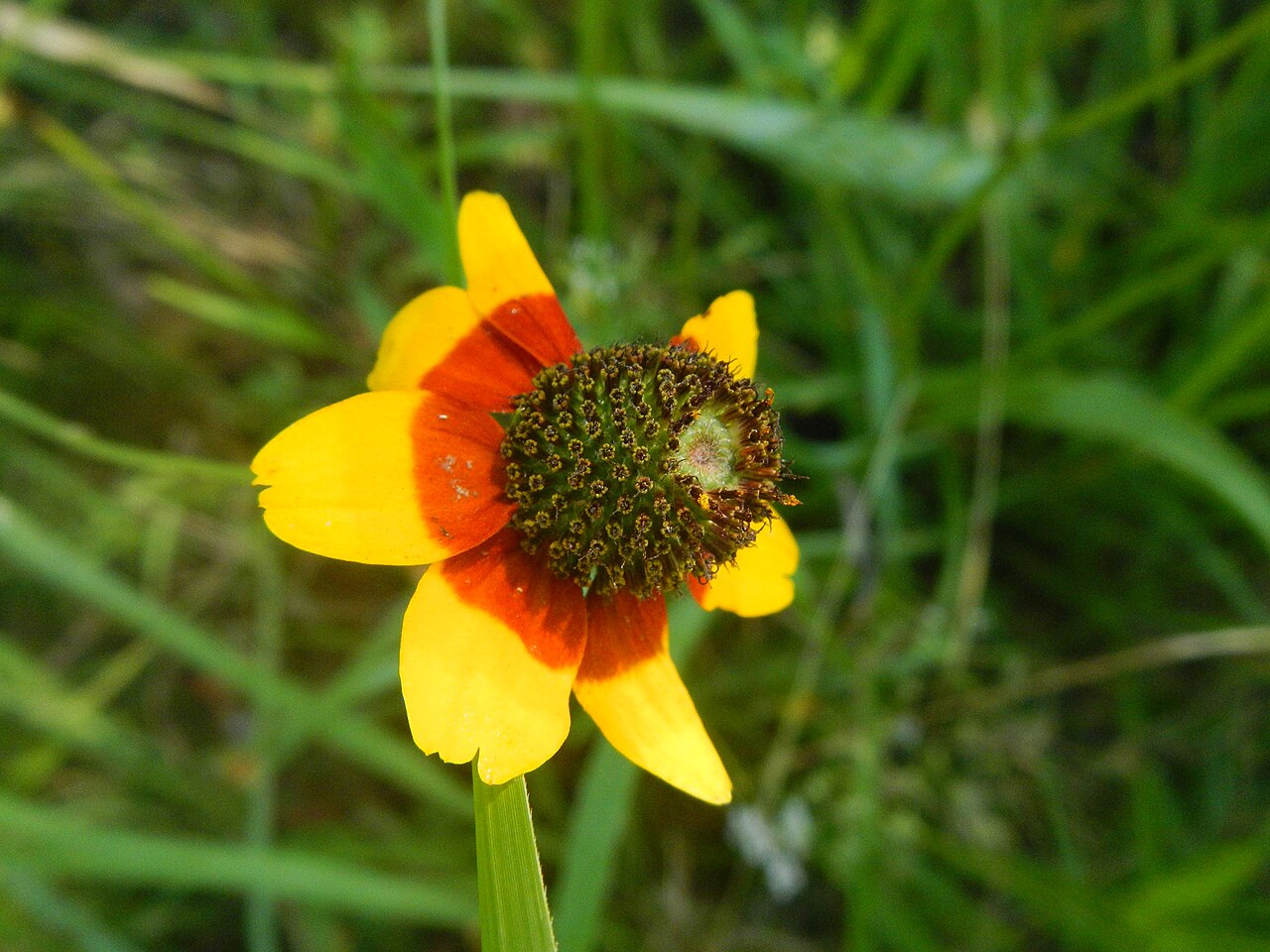
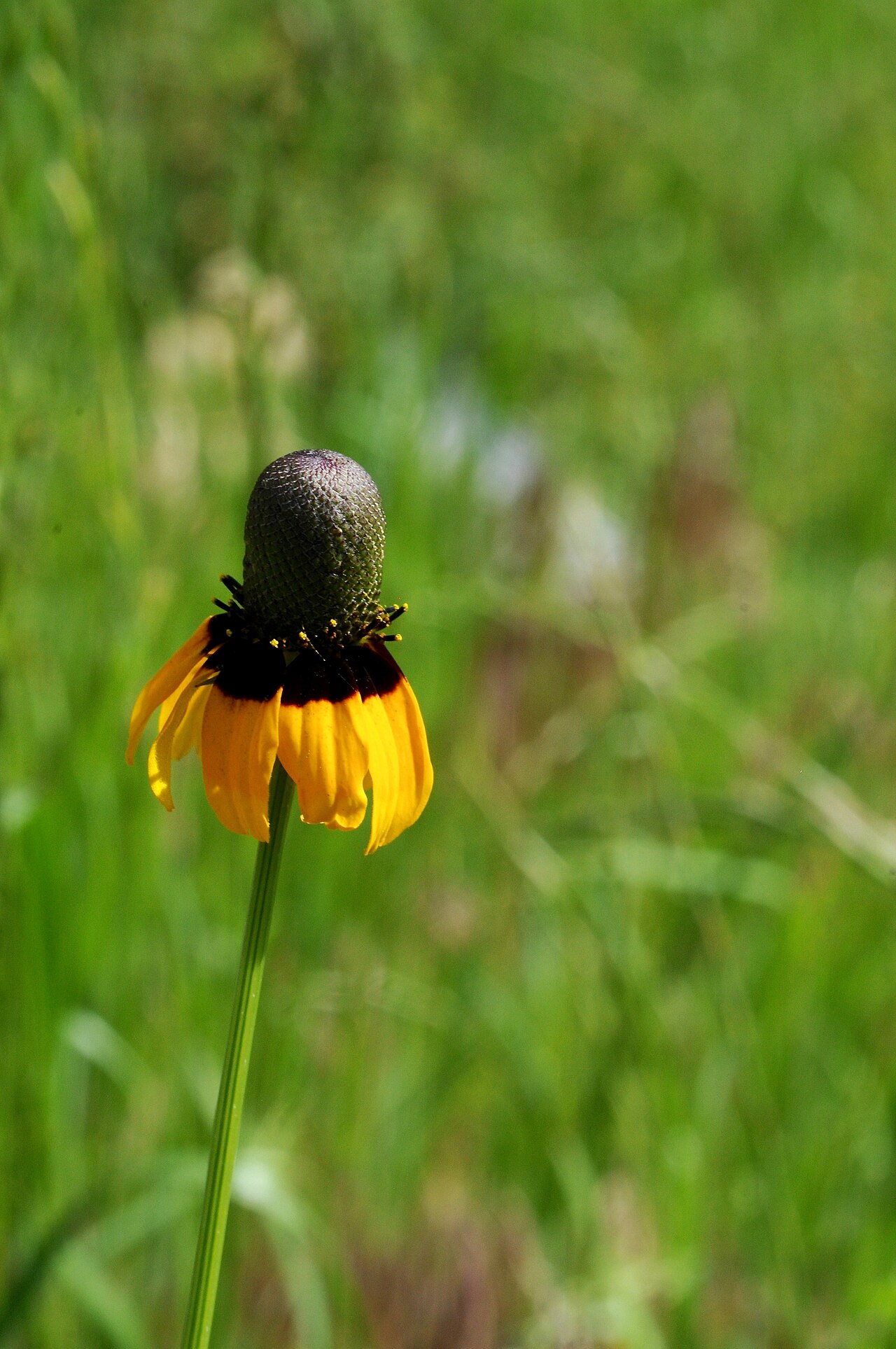
Clasping coneflower is a cheerful native annual with a surprisingly architectural flower: drooping yellow rays surround a tall, dark central cone. The broad leaf bases wrap around the stem, providing the clue behind both its common name and the epithet amplexicaulis. Kew and Flora of North America place it in Rudbeckia as Rudbeckia amplexicaulis; USDA and many seed suppliers use the synonym Dracopis amplexicaulis. Both names should be checked when buying seed or comparing regional lists.
Unlike the perennial coneflowers many gardeners know, each plant completes its life as an annual. The population persists through seed, not through an enduring clump of crowns. This makes it useful for filling sunny openings and establishing a lively early wildflower display, but it also changes the maintenance plan: removing every seed head can mean removing next year’s plants. A patch can shift from one year to the next as bare ground, rainfall and competition change.
Across Arkansas, Louisiana, eastern Oklahoma and eastern Texas, clasping coneflower fits sunny, well-drained native plantings where a reseeding annual is welcome. It is not a substitute for a long-lived perennial backbone, nor should it be scattered indiscriminately outside its local range. Mix it thoughtfully with other appropriate species, give emerging seedlings room, and use a clearly identified seed source rather than an unnamed “native coneflower” packet.
Identification
Stems & Habit
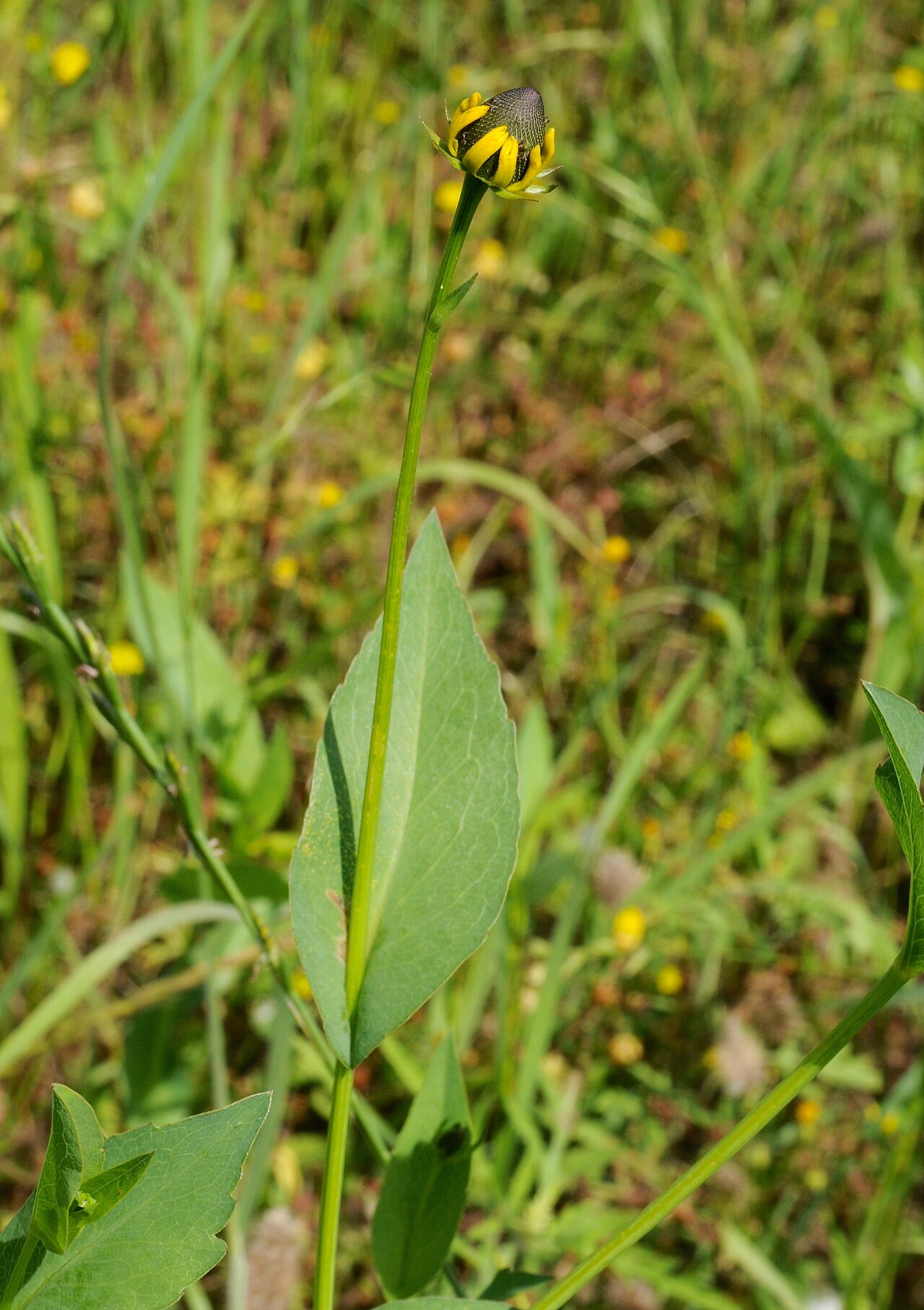
Plants commonly reach about 1–2½ feet, with branching above a relatively simple lower stem. The stems and leaves are generally smooth and can look bluish green. A young plant may look much less distinctive than a flowering one. Before weeding a seeded bed, compare the seedlings with a marked reference plant so that intended annuals are not removed with unrelated weeds. This species does not form the persistent woody framework of a shrub or the robust spreading crown of a perennial Rudbeckia.
Leaves
The leaves are simple rather than finely divided. The stem leaves have widened bases that clasp the stem, often with a heart-shaped outline at the attachment. This is more reliable than flower color alone for separating the plant from superficially similar yellow daisies. Look at several healthy middle leaves. Leaves can vary in outline and margin, and the lowest leaves may be gone by flowering, so a detached upper leaf or a distant picture is not always sufficient for identification.
Flower Heads
The central disk becomes an elongated dark cone, with yellow rays hanging away from it. Some plants have reddish or brownish patches near the ray bases; others appear more uniformly yellow. As a head ages, its proportions and the angle of the rays change. The display often comes in late spring to early summer in the southern part of the range, with later flowering possible elsewhere. A nursery calendar is therefore a guide, not a promise of the same month in every climate.
Fruit & Seeds
Small dry fruits develop in the maturing head. The dark cone eventually becomes dry enough to release seed. Collect a few ripe heads into a paper bag, label them with species and origin, and allow them to dry in an airy place. Seed that remains tightly attached may not yet be ready. Harvest only a portion of a garden patch if you want natural reseeding, and never assume a ripe-looking roadside plant is free to collect or suitable for your own locality.
Quick Facts
| Scientific Name | Rudbeckia amplexicaulis; synonym Dracopis amplexicaulis |
| Family | Asteraceae (aster family) |
| Plant Type | Annual wildflower, not a perennial |
| Mature Height | Usually 1–2½ ft |
| Mature Spread | About 1–1½ ft per plant; seedlings can form broader patches |
| Growth Rate | Fast seasonal growth under suitable conditions |
| Sun Exposure | Full sun preferred; light shade tolerated |
| Water Needs | Average moisture for establishment; some drought tolerance later |
| Soil Type | Well-drained sandy or clay loam; avoid stagnant wet soil |
| Soil pH | Adaptable; acid to calcareous soils reported |
| Bloom Time | Late spring–summer, varying with region and sowing time |
| Flower Color | Yellow rays, sometimes reddish at bases; dark central cone |
| Fall Color | No dependable ornamental fall color |
| Fruit | Small dry achenes |
| Deer Resistant | Do not rely on it as a deer barrier |
| USDA Hardiness Zones | Grown as an annual across roughly zones 2–11; nativity is more restricted |
Native Range
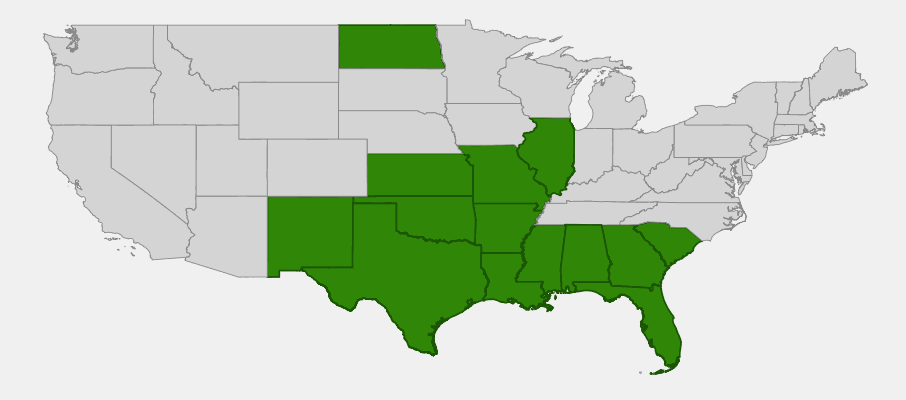
The core native range lies in south-central and southeastern North America. USDA’s plant guide describes the range from the Georgia–Texas belt northward toward Missouri and Kansas. That broad statement is particularly relevant to the Arkansas–Louisiana–eastern Oklahoma–eastern Texas regional list. The map shown here follows the state-level native entries in Kew’s Rudbeckia amplexicaulis account, which is broader than that simplified core-range description.
Range boundaries deserve care. Some southeastern records have been interpreted differently by regional floras, with introductions mixed among apparently native occurrences. Kew includes South Carolina, while regional literature has questioned the origin of at least some populations there. A state shaded on this map should not be read as proof that a particular roadside patch is indigenous. Use a local flora and specimen records when the planting is intended as ecological restoration rather than an ornamental garden.
The plant can occupy prairies, swales, floodplain openings and disturbed sunny places. Occurrence in a floodplain does not mean it needs permanent standing water. Its annual strategy depends on opportunities for seed to contact suitable soil and receive enough light. Dense turf and deep mulch remove those opportunities. In a designed planting, small managed openings can support renewal without disturbing an entire established meadow every year.
📋 Regional plant list: Arkansas, Louisiana, Eastern Oklahoma and Eastern Texas
Growing & Care Guide
Light
Choose full sun for the clearest flowering display. Light shade may be tolerated, but a dense canopy or a bed crowded by taller plants can reduce the usable space for this relatively short annual. If you sow into an existing perennial bed, place seed where spring foliage will not immediately cover it. A sunny spot in winter is not necessarily sunny enough after shrubs and trees leaf out.
Soil & Water
A well-drained seedbed is more important than exceptionally rich soil. Keep the surface from drying completely during germination, then shift toward deeper, less frequent watering as roots develop. Avoid creating a permanently saturated pocket. Established plants can tolerate dry spells, but severe drought during establishment can still destroy a sowing. Check actual soil moisture rather than using a fixed daily watering schedule, especially in heavier Louisiana or Arkansas soils.
Planting from Seed
Prepare a small, weed-controlled area and firm the surface. Broadcast the tiny seed evenly, press it into contact with the soil, and avoid burying it under a thick layer. USDA’s southern seed-production guidance uses late-summer to early-fall sowing; spring sowing can also be useful in garden settings, with timing adjusted to climate. For a first attempt, divide the packet into two trial sowings rather than risking it all on one untested date or location.
Starting Transplants
If growing plugs, use clean containers and a freely draining seed-starting medium. Give seedlings strong light and avoid keeping them crowded and wet. Move them into the garden while young enough that roots have not formed tight coils, and harden them gradually to outdoor conditions. Transplants still need establishment water. Because this is an annual, replacing failed plants from saved seed is usually more practical than trying to divide a spent specimen.
Pruning & Maintenance
Deadhead selected flowers to prolong a tidy display and reduce seed production where necessary. Leave other heads if you want the patch to renew itself. Remove unwanted seedlings early, before their roots enlarge and mingle with desired plants. Do not label a disappearing parent plant as a failed perennial: its annual life cycle naturally ends after reproduction. Track the next generation instead, looking for seedlings in the following favorable season.
Managing Competition
A reseeding population often thins as perennial neighbors occupy the ground. That can be desirable in a maturing meadow. If you want an annual display to persist, maintain limited open patches rather than scraping the entire planting bare. Excessively dense stands may need thinning to keep air moving. Watch for powdery mildew and other foliar problems, but begin with spacing, watering practice and accurate diagnosis rather than assuming every blemish needs treatment.
Landscape Uses
- Use as a sunny native annual in a mixed wildflower bed within its appropriate regional range.
- Fill temporary gaps while slower perennial plants establish, then allow their balance to change naturally.
- Place near a path where the clasping leaves and dark cones can be examined closely.
- Keep a small seed-saving patch with labeled provenance instead of depending entirely on purchased seed each year.
Wildlife & Ecological Value
For Pollinators
USDA’s plant guide records use by native bees and butterflies. Flowering patches can add accessible food to a broader planting, but they should be part of a season-long sequence rather than the sole pollinator resource. Avoid applying insecticides to open flowers and leave nearby nesting habitat where appropriate.
For Birds
Retaining dry heads preserves seed and structure in the planting instead of removing everything immediately after the yellow display ends. Specific bird use varies with the site and season; this is not a promise that a named bird will appear. A diverse garden with shelter and other food sources is more useful than a large annual flower patch in isolation.
For Mammals
Clasping coneflower is not presented here as forage or an edible garden crop. Young annuals can still be disturbed or browsed, regardless of how tough established plants appear. If repeated damage prevents seed production, protect a small part of the patch long enough to replenish your seed supply rather than treating the entire area as animal-proof.
Ecosystem Role
Annuals occupy openings and contribute seasonal turnover. Their role differs from that of deep-rooted, long-lived perennials, and both can belong in a diverse planting. Dense reseeding is useful where intended and a management problem where it suppresses smaller desired species. Keep observing the balance; native status alone does not guarantee a plant will remain within a neat border.
Cultural & Historical Uses
The two generic names reflect different taxonomic treatments, not a difference between a native and nonnative version of the plant. Flora of North America treats it in Rudbeckia, whereas the USDA plant guide uses Dracopis. When recording a planting, retain both names so that older records and current labels remain searchable.
The species epithet describes the encircling leaf bases. This is a useful example of a botanical name that points to a visible character. A closer look at foliage can resolve a confusion that a flower-only photograph cannot, particularly among yellow-flowered members of the aster family.
Its modern horticultural appeal is as a readily renewed wildflower for sunny ground. Historical medicinal references are not planting or treatment instructions, and no medicinal use is recommended here. Responsible seed production, regional provenance and management of reseeding are the practical concerns for a native garden today.
Frequently Asked Questions
Is clasping coneflower perennial?
No. It is an annual. A patch may return for years because seedlings replace the original plants, not because each parent crown survives.
Are Dracopis amplexicaulis and Rudbeckia amplexicaulis different plants?
They are names for the same species in the cited treatments. This page follows Kew and Flora of North America in using Rudbeckia and retains Dracopis as a synonym.
Why did my patch disappear after two seasons?
Annual renewal needs seed and suitable germination space. Complete deadheading, deep mulch, heavy competition or poor establishment weather can interrupt the cycle.
Can I scatter it into a lawn?
Dense turf is a poor seedbed. A small prepared opening gives seed-to-soil contact and reduces competition; simply broadcasting over intact grass is unreliable.
Does a wide hardiness-zone range mean it is native everywhere?
No. An annual can grow ornamentally in climates outside its native range. Check local distribution separately before using it in a restoration or a strictly local-native planting.
Sources & Further Reading
- USDA NRCS — clasping coneflower plant guide
- Kew Plants of the World Online — Rudbeckia amplexicaulis
- Flora of North America — Rudbeckia section Dracopis
- Missouri Botanical Garden — clasping coneflower
- Missouri Department of Conservation — Rudbeckia field guide and local nativity
Find Native Plants
Ask growers about nursery propagation and regional provenance. Browse our Arkansas native plant nurseries, Louisiana native plant nurseries, Oklahoma native plant nurseries, Texas native plant nurseries directory for suppliers.