Colorado Blue Columbine (Aquilegia coerulea)
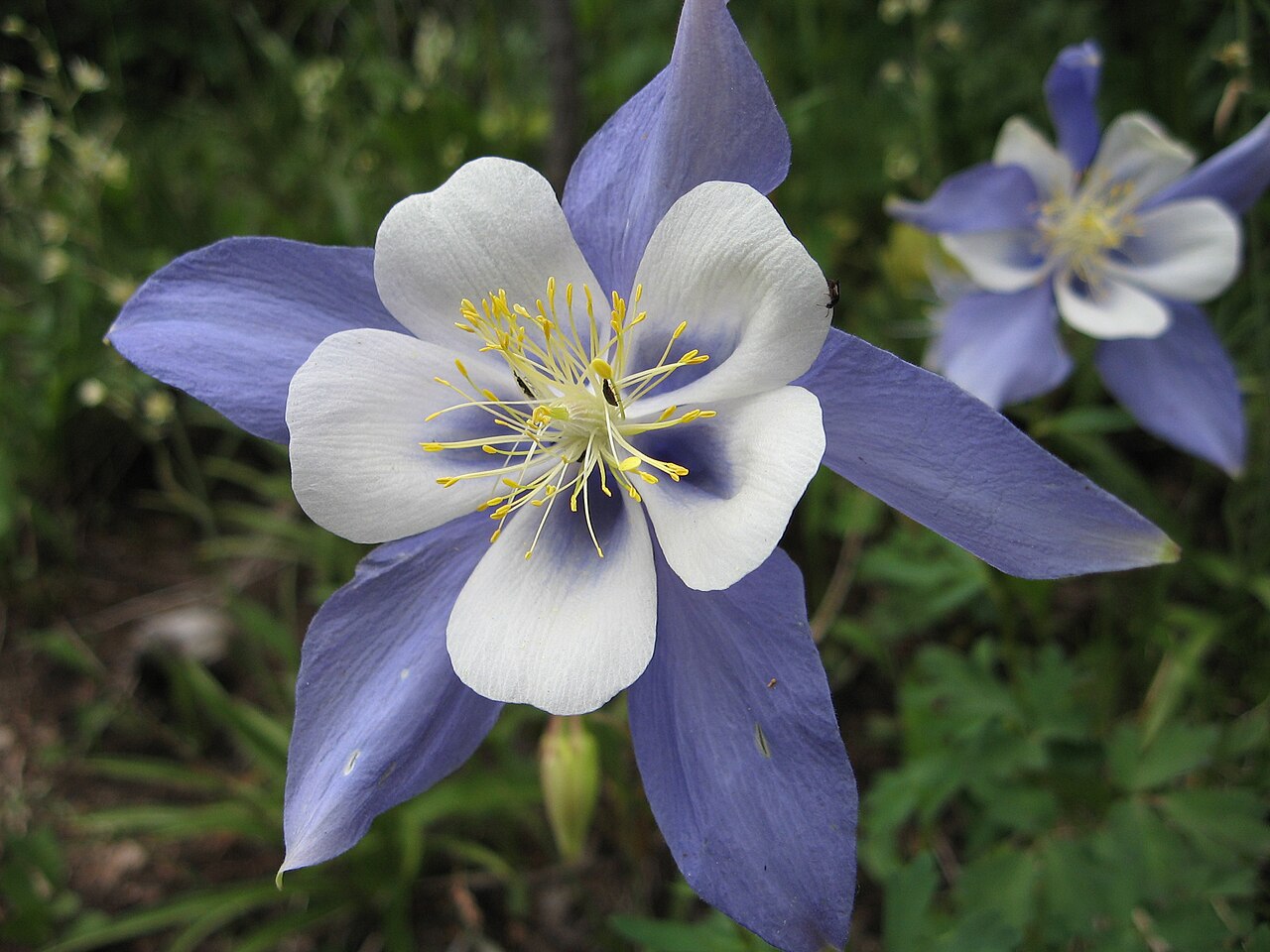
Colorado Blue Columbine (<em>Aquilegia coerulea</em>) is a mountain wildflower with an unmistakably sculptural bloom: broad outer sepals, inner petals and long backward-projecting spurs surround a cluster of yellow stamens. Blue and white is the familiar combination, but wild populations include paler and nearly white flowers. Color alone is therefore not a reliable way to separate a native plant from a garden hybrid.
The species is native to parts of the Rocky Mountains and neighboring interior western states. It is not eastern red columbine, <em>Aquilegia canadensis</em>, and a page or nursery label for that eastern species is not an interchangeable destination. Colorado blue columbine belongs to cool mountain woods, meadows and rocky openings, where moisture and drainage occur together rather than as opposing requirements.
In gardens, it is best approached as a relatively short-lived perennial that can renew itself from seed. Choose correctly identified nursery material, give roots a cool and well-drained setting, and allow some follicles to mature if a continuing population is wanted. Its delicate appearance can be misleading: successful care is less about pampering the flowers than about selecting an appropriate site.
Identification
Overall form
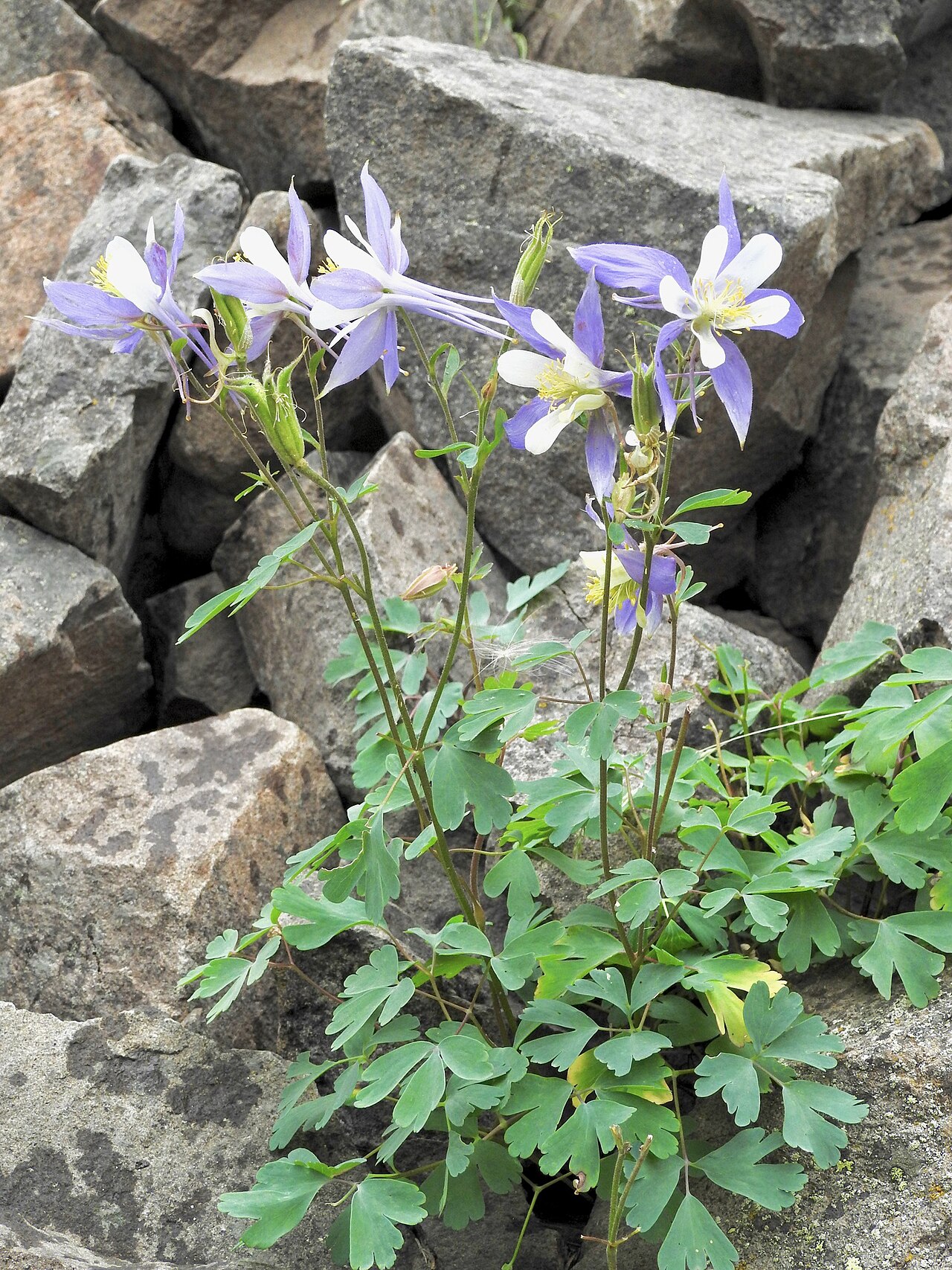
Flowering stems rise above a lower mound of divided leaves, commonly reaching roughly one to two and a half feet. Plants on exposed rocky sites may be more compact than those in sheltered woodland openings. The foliage and flower stems have different visual roles, so allow room for the airy stems rather than measuring only the basal clump.
Leaves
Leaves are divided into groups of rounded, lobed leaflets. Their soft outline contrasts with the pointed sepals and long spurs of the flowers. Similar-looking foliage occurs in other members of the buttercup family, so a nonflowering plant should not be identified solely from a general resemblance to columbine. Keep the original nursery label or photograph the plant through flowering.
Flowers
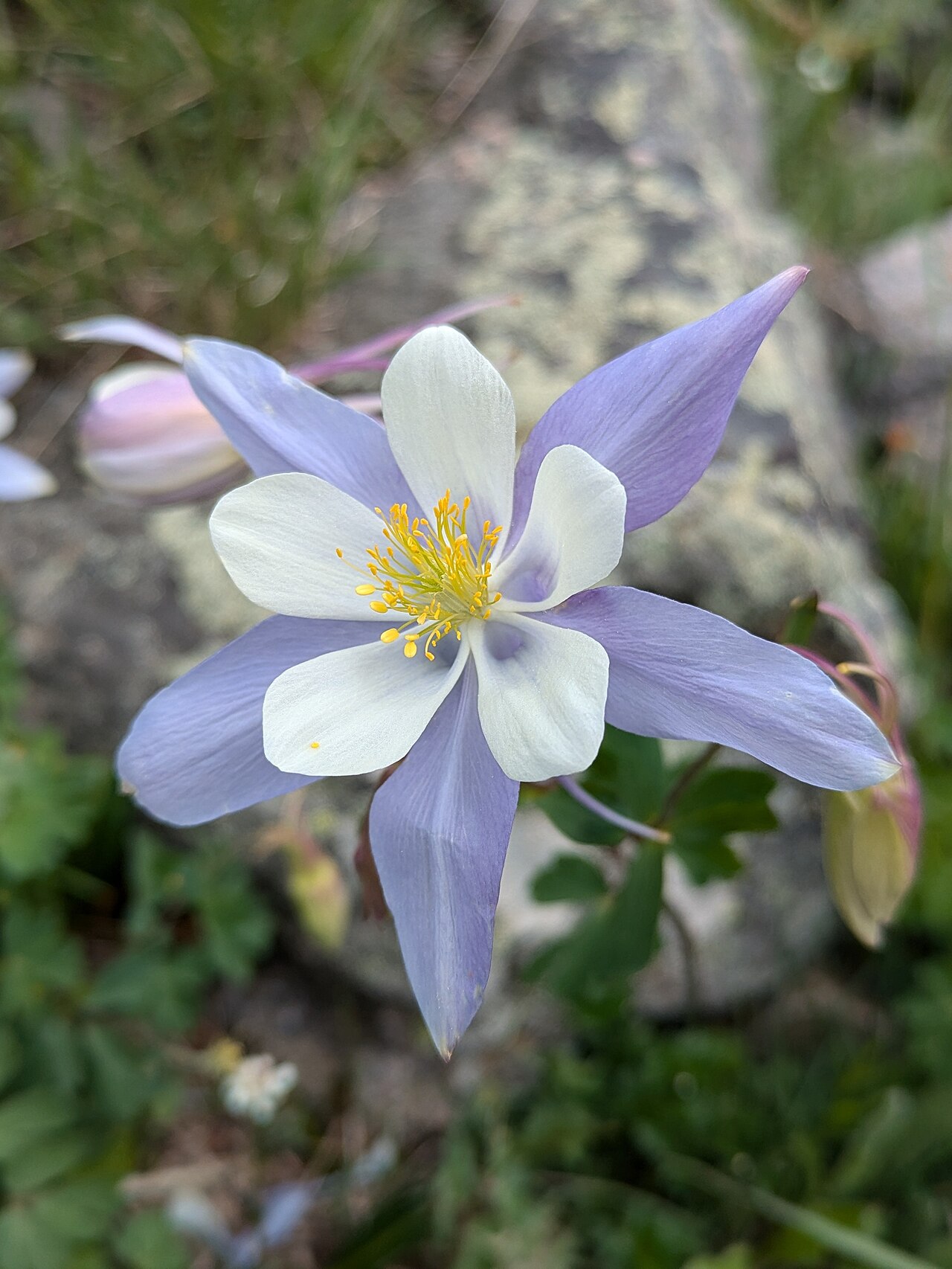
Five showy sepals surround five petals, each extended backward into a spur. In familiar blue-and-white forms the outer sepals are blue to lavender and the inner petal blades are white. Yellow stamens occupy the center. Flowers are generally held outward or upward rather than hanging like the red-and-yellow flowers of eastern columbine.
Variation
White or cream flowers occur naturally within the broader species, especially in some northern and western populations. Named varieties also differ. A pale flower is not automatically a hybrid, but an unusual garden color does not prove a wild form either. Provenance and structural characters are the most useful context for interpreting variation.
Fruits and seed
After bloom, a group of upright follicles develops, eventually opening to release small dark seeds. Seed can be ready before the whole fruiting structure is uniformly brown. If seed collection is appropriate, observe maturity closely and collect only from plants you own or have permission to use. Leave wild plants and their reproductive structures intact.
Quick Facts
| Scientific Name | Aquilegia coerulea E.James |
| Family | Ranunculaceae (buttercup family) |
| Plant Type | Herbaceous perennial; often short-lived |
| Mature Height | About 12–30 inches |
| Mature Spread | A modest basal clump; allow roughly 1–2 feet |
| Growth Rate | Moderate |
| Sun Exposure | Partial shade; more sun in cool moist mountain conditions |
| Water Needs | Moderate; moist but well-drained root zone |
| Soil Type | Rocky or loamy soil with good drainage |
| Soil pH | Match local soil and provenance; no narrow universal target |
| Bloom Time | June–August, varying with elevation |
| Flower Color | Blue and white; naturally paler or white forms occur |
| Fall Color | Foliage declines seasonally |
| Fruit | Follicles containing small dark seeds |
| Deer Resistant | Often less favored, but browsing is still possible |
| USDA Hardiness Zones | Cold-adapted mountain perennial; summer heat and drainage also matter |
Native Range
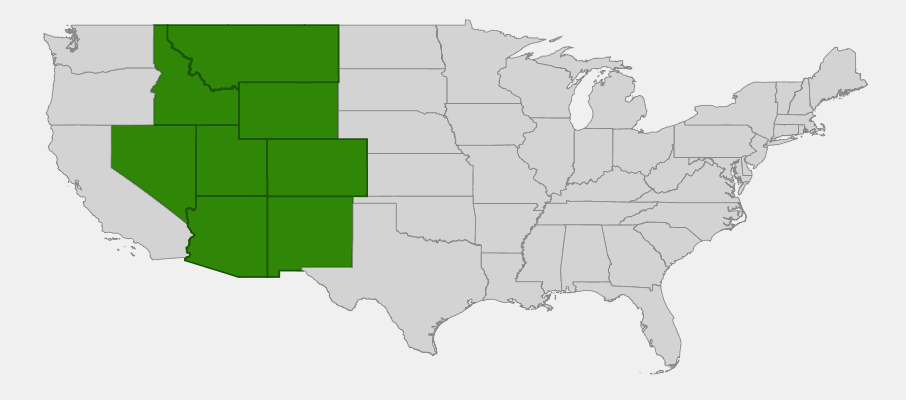
Kew lists Arizona, Colorado, Idaho, Montana, Nevada, New Mexico, Utah and Wyoming within the native range of the species as a whole. The map uses those eight states. Individual varieties occupy smaller areas, so a broad species map should not be used to justify moving any seed source anywhere within the highlighted region.
Rocky Mountain National Park describes the plant from shaded montane and subalpine forest as well as rocky alpine settings. Other regional accounts include mountain meadows and aspen-associated understories. Those habitats share a cooler seasonal environment than a hot exposed lowland bed, even when some wild plants receive considerable direct sun.
The name Colorado blue columbine is not a statement that the species occurs only in Colorado. Conversely, its popularity in gardens does not make it native to every state where it is sold. For restoration or a strictly local native garden, verify the appropriate variety and seed source with a regional nursery or flora.
📋 Regional plant list: Intermountain West
Growing & Care Guide
Finding a cool root zone
Morning sun with afternoon protection is a useful garden starting point in warmer settings. At higher elevations, more sun may be tolerated if soil moisture remains adequate. Avoid equating a mountain photograph in open sun with tolerance of a heat-reflecting wall at low elevation. Air temperature, soil temperature and moisture all change the practical meaning of “full sun.”
Drainage
The plant benefits from moisture without stagnant water around the crown. A raised or gently sloping position may help where the surrounding soil drains poorly. Do not create a small potting-soil basin inside heavy clay that holds water differently from the surrounding ground. Improve the site as a whole or choose another location.
Planting
Set nursery plants at their existing crown level and water carefully after planting. Avoid deeply burying the basal foliage. Young plants with healthy roots are generally easier to establish than old crowded containers. Place a durable marker nearby, because seasonal foliage decline can make the planting difficult to recognize during cleanup.
Watering
Check moisture beneath the surface, particularly during the first season and during dry spells. Water the root zone when needed and allow excess water to drain. A plant that wilts in afternoon heat may recover as conditions cool, so inspect soil before repeatedly adding water. Constant saturation can create a different problem from drought.
Soil and feeding
A moderate, well-drained soil is preferable to aggressive fertilization. If the plant is weak, first examine heat exposure, root condition and moisture. Fertilizer cannot compensate for an unsuitable site. Use compost sparingly where it improves structure, and keep a heavy mulch away from the crown and emerging shoots.
Starting seed
The Wildflower Center recommends fall sowing and notes that moist chilling can speed germination. Seeds need light, so avoid deep burial. Use the seed supplier’s instructions for the particular lot and climate, and keep the surface from drying during germination. Label sowing dates and provenance so successful results can be repeated.
Raising seedlings
Give seedlings enough light to grow steadily without exposing tiny containers to severe heat. Water gently so small roots are not washed out. When moving plants into the garden, handle the root ball carefully and acclimate them to outdoor conditions. A small healthy seedling is not improved by rushing it into the hottest part of the bed.
Renewing a planting
Individual plants may persist for several years but should not be assumed permanent. Allow some seed to mature if you want younger plants to replace older ones. Thin volunteers where they crowd paths or other plants. In a garden containing several columbine species or hybrids, seedling identity may be less predictable than that of the original labeled plant.
Pruning after bloom
Remove spent flowering stems if preventing seed production is the goal; retain selected stems if renewal is wanted. Keep useful foliage as long as it remains healthy. Avoid cutting indiscriminately into new basal growth. A tidy edge can coexist with a few seed-bearing stems farther inside the planting.
Leaf problems
Aphids and leaf-mining damage can occur in columbines. Assess whether the plant is merely marked or actually declining before intervening. A few damaged leaves do not automatically justify spraying a flowering plant. Improve airflow and site conditions, remove severely damaged material selectively, and seek local advice if a persistent problem threatens the planting.
Landscape Uses
- Colorado blue columbine makes a strong focal point in a cool native woodland edge or mountain-style garden. Place it where the flowers can be seen at close range and from the side, so the spurs are visible. It is less effective when hidden behind dense tall foliage or crowded into a hot, dry border.
- Its divided basal foliage combines well with plants of contrasting leaf shape, provided they share the same moisture conditions. Use longer-lived companions to maintain structure after flowering. This avoids expecting a short-lived columbine to provide all-season bulk.
- In an educational planting, compare the sepals, petals and spurs rather than calling all colored parts petals. A photograph from the side is particularly useful. The plant also illustrates why a popular ornamental species and a locally sourced wild population are not automatically the same conservation choice.
Wildlife & Ecological Value
Nectar visitors
The Wildflower Center describes nectar use by long-tongued insects and hummingbirds. The long spurs are part of that floral architecture. Keep the flowering area free of routine insecticide applications and provide other native blooms before and after the columbine season.
Habitat context
A cool, layered planting with nearby cover and varied flowers is more useful than a single isolated specimen. The columbine contributes one seasonal resource, while surrounding native vegetation supplies other food and structure. Preserve that diversity rather than expanding only the showiest species.
Seed and genetic identity
Where conservation is the goal, avoid allowing garden hybrids to replace a documented local population through repeated seed saving. Keep provenance records and obtain new seed from a reliable source when identity matters. In an ornamental garden, varied seedlings can be attractive, but they should be labeled as such.
Cultural & Historical Uses
Colorado blue columbine is celebrated as Colorado’s state flower. Its association with mountain landscapes is well deserved, yet the species extends into neighboring states. The familiar state-flower image represents one part of a variable western species.
The spelling <em>Aquilegia caerulea</em> is common in older references and remains visible in historical plant lists. The accepted spelling used here is <em>Aquilegia coerulea</em>. Correcting that spelling does not turn the plant into eastern columbine or another species.
Colorado blue columbine has contributed to cultivated hybrid columbines. That horticultural history makes source documentation especially valuable when the aim is a native-species planting. A beautiful garden flower can be enjoyed without presenting it as an unmodified wild population.
Frequently Asked Questions
Is it the same as eastern red columbine?
No. Aquilegia canadensis is a different species with a different native range and usually red-and-yellow nodding flowers.
Can flowers be white naturally?
Yes. Pale and white flowers occur within the broader species. Identity still depends on more than color, especially in gardens with hybrids.
Does it need shade?
Partial shade is a useful choice in warmer gardens. In cool mountain settings it can grow in more open conditions when moisture and drainage are suitable.
Why has my old plant disappeared?
Columbines can be relatively short-lived. A continuing patch often includes new seedlings, so allow some seed production if renewal is desired.
Should I dig a wild plant for my garden?
No. Obtain nursery-propagated plants or responsibly sourced seed. Leave wild populations intact and follow local collection protections.
Sources & Further Reading
- Kew: accepted species and varieties
- Lady Bird Johnson Wildflower Center: AQCO
- Rocky Mountain National Park: blue and purple wildflowers
- US Forest Service: regional plant identification
- NC State Extension: general columbine cultivation
Find Native Plants
Ask growers about nursery propagation and regional provenance. Browse our CO native plant nurseries, UT native plant nurseries, ID native plant nurseries directory for suppliers. Explore the native nursery finder.