Common Snowberry (Symphoricarpos albus)
Symphoricarpos albus, commonly known as Common Snowberry, is a resilient and adaptable native shrub that stands out in Pacific Northwest landscapes with its clusters of pristine white berries that persist well into winter. This hardy member of the Caprifoliaceae (honeysuckle) family has earned its place as one of the most versatile native shrubs in North America, thriving in conditions ranging from full sun to deep shade and from dry slopes to wet meadows.
Growing naturally across much of Canada and the northern and western United States, Common Snowberry forms dense colonies through its spreading rhizome system, making it an excellent choice for erosion control, wildlife habitat, and naturalized landscaping. The shrub typically reaches 3-6 feet in height, producing stiff, branching stems that create an informal, somewhat open growth habit perfect for both formal landscapes and wild spaces.
What makes Common Snowberry truly distinctive is its remarkable seasonal display: small, bell-shaped pink flowers in spring and early summer give way to clusters of bright white, berry-like drupes that provide striking winter interest and serve as critical food for birds and small mammals during the harsh winter months. This combination of adaptability, wildlife value, and year-round appeal has made Common Snowberry a favorite among native plant enthusiasts and restoration professionals throughout its range.
Quick Facts
| Scientific Name | Symphoricarpos albus |
| Family | Caprifoliaceae (Honeysuckle) |
| Plant Type | Deciduous Shrub |
| Mature Height | 8–20 ft |
| Spread | 4–8 feet (spreads by rhizomes) |
| Growth Rate | Moderate to Fast |
| Sun Exposure | Full Sun to Part Shade |
| Water Needs | Low to High |
| Soil Type | Adaptable; prefers well-drained |
| Soil pH | 6.0–8.5 (slightly acidic to alkaline) |
| Bloom Time | May – August |
| Flower Color | Bright pink, bell-shaped |
| Fruit | White drupes (berry-like) |
| Fruit Persistence | October through March |
| Deer Resistant | No (browsed by many animals) |
| Toxicity | Berries poisonous to humans |
| USDA Hardiness Zones | 2–7 |
Identification
Common Snowberry is easily recognized throughout the year by its distinctive growth habit, foliage characteristics, and especially its prominent white fruit display. This colonial shrub forms dense thickets through underground rhizomes, creating extensive colonies that can persist for decades.
Leaves
The leaves are one of the most reliable identification features of Common Snowberry. They are oppositely arranged on the stems, a characteristic that distinguishes them from many other native shrubs. Individual leaves are oval-shaped and highly variable in size, typically measuring 1-2 inches long but occasionally reaching up to 3 inches on vigorous shoots. The leaves have smooth margins (entire) and are blue-green to gray-green in color with a somewhat thick, almost succulent texture.
The foliage has a distinctive appearance that remains consistent throughout the growing season — the leaves maintain their blue-green color from spring through fall, then drop cleanly in autumn without significant color change. This consistency makes the plant easily recognizable even when not in flower or fruit.
Bark & Stems
The stems of Common Snowberry are stiff and upright, creating an erect, somewhat irregular branching pattern. Young stems are smooth and reddish-brown to gray-brown in color, while older wood develops a slightly fibrous, peeling bark. The overall growth habit is dense and somewhat bushy, with multiple stems arising from the spreading rhizome system.
One notable characteristic is the plant’s ability to produce numerous shoots from its underground rhizome system, creating the dense thickets for which the species is known. These shoots can emerge several feet away from the parent plant, gradually expanding the colony over time.
Flowers
The flowers of Common Snowberry are small but charming — bright pink, bell-shaped blooms that appear in terminal racemes (clusters) of up to 16 individual flowers. Each flower is about ¼ inch long with a rounded, bell-shaped corolla that has pointed lobes at the opening. The inside of the flower is filled with white hairs, which is a unique identifying characteristic visible with close examination.
The flowers have a small, five-toothed calyx of sepals beneath the colorful corolla. Blooming occurs over an extended period from late spring through summer (May through August), with individual plants often producing flowers continuously throughout this period rather than in one concentrated flush.
Fruit & Seeds
The fruit is Common Snowberry’s most distinctive and valuable feature — clusters of bright white, berry-like drupes that appear in late summer and persist well into winter. Each fruit is approximately ⅜ inch in diameter and contains two seeds within the white, somewhat spongy flesh. The berries are produced in tight clusters at the branch tips and along the stems, creating a striking display against the blue-green foliage.
These white berries are what give the plant both its common name and its greatest ornamental value. They typically begin forming in late summer and reach full size by early fall, maintaining their bright white appearance through winter until they are consumed by wildlife or naturally deteriorate in spring. The persistence of the fruit makes this one of the most valuable shrubs for winter wildlife food and garden interest.
Native Range
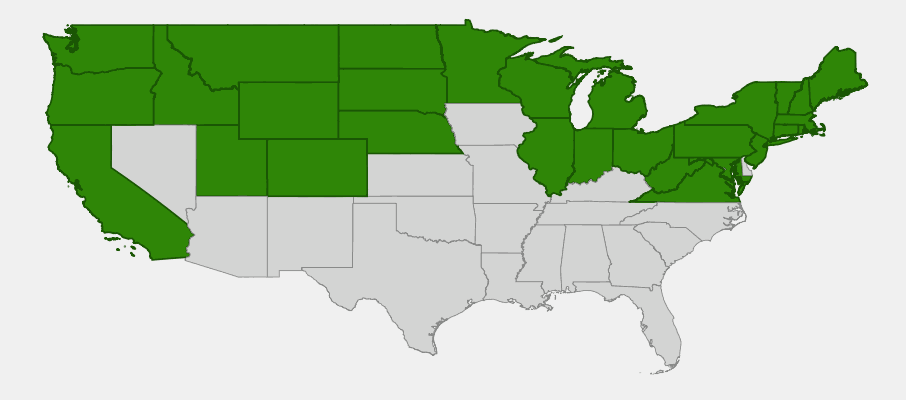
Native range of Common Snowberry. USDA (County-Level Data)
Common Snowberry has one of the broadest native distributions of any North American shrub, occurring across much of Canada and throughout the northern and western United States. The species ranges from Alaska and across Canada from British Columbia to Newfoundland, extending south in the western United States through Washington, Oregon, Idaho, and Montana, and in scattered populations through the Great Lakes region and northeastern states.
Within the Pacific Northwest, Common Snowberry is found from sea level to moderate elevations in the mountains, growing in a remarkable variety of habitats. It thrives in moist mountain forests, dry open slopes, streamside areas, forest edges, and even in relatively exposed, rocky sites where few other shrubs can establish.
The species shows remarkable ecological flexibility, growing in everything from dense forest understories to open meadows and disturbed sites. It’s commonly found along roadsides, in clearcuts, and in other areas where the original vegetation has been disturbed, demonstrating its value as a colonizing species that helps stabilize soils and provide habitat during ecological succession.
There are two recognized varieties: the typical variety (S. albus var. albus) native to eastern North America, and the western variety (S. albus var. laevigatus) native to the Pacific coast. The western variety is generally larger, reaching up to 6-8 feet tall, and has slightly larger fruit. Some botanists treat the western variety as a separate species, Symphoricarpos rivularis.
📋 Regional plant lists featuring Common Snowberry: Western Oregon & Western Washington · Idaho, Montana & Eastern Washington
Growing & Care Guide
Common Snowberry is one of the most adaptable and low-maintenance native shrubs available to Pacific Northwest gardeners. Its ability to thrive in almost any condition makes it an excellent choice for challenging sites where other plants struggle, while its wildlife value and attractive appearance make it suitable for more formal landscape applications as well.
Light Requirements
One of Common Snowberry’s greatest assets is its remarkable tolerance for a wide range of light conditions. The plant thrives in full sun, where it produces the most flowers and fruit, but it’s equally at home in partial shade and can even survive in quite deep shade conditions. This flexibility makes it one of the few flowering shrubs that can provide reliable performance in challenging shade situations, such as under mature trees or on the north side of buildings.
Soil & Water Adaptability
Common Snowberry demonstrates exceptional soil tolerance, growing successfully in everything from sandy, well-drained soils to heavy clay and even periodically wet conditions. The plant prefers slightly acidic to alkaline conditions (pH 6.0-8.5) but adapts to most soil types as long as there’s adequate drainage during the wettest periods.
Water requirements are similarly flexible. Once established, Common Snowberry can tolerate significant drought conditions, making it excellent for xeriscape applications and areas with limited irrigation. However, it also tolerates seasonal flooding and can be planted in rain gardens and bioswales where periodic standing water occurs. This adaptability makes it particularly valuable for restoration projects and challenging landscape sites.
Planting & Establishment
Plant Common Snowberry in fall or early spring for best results. The species transplants easily due to its fibrous, shallow root system, and container-grown plants establish quickly when planted properly. Space plants 4-6 feet apart if creating a hedge or mass planting, keeping in mind that the rhizomatous growth habit will eventually fill in gaps between plants.
Because of its spreading nature, Common Snowberry is best used where you want it to naturalize and form colonies. If you need to contain its spread, regular removal of new shoots or installation of root barriers may be necessary.
Pruning & Maintenance
Common Snowberry requires minimal pruning and maintenance once established. The plant benefits from occasional rejuvenation pruning every 4-6 years, where older stems can be cut back to ground level in late winter or early spring. This encourages vigorous new growth and helps maintain a dense, attractive form.
Because the plant reproduces primarily vegetatively through its rhizome system, it will often form dense thickets over time. This can be managed by selectively removing unwanted shoots or by mowing around the colony edges to maintain desired boundaries.
Pest & Disease Issues
Common Snowberry is remarkably resistant to pests and diseases, which contributes to its reputation as a low-maintenance landscape plant. Occasional aphid infestations may occur but rarely cause significant damage. The plant’s natural hardiness and adaptability mean it rarely experiences stress conditions that make it susceptible to disease problems.
Wildlife & Ecological Value
Common Snowberry serves as one of the most important wildlife shrubs in North American ecosystems, providing critical food and habitat resources for an enormous variety of species. Its ecological value extends far beyond what might be expected from such a common and adaptable plant.
Birds
The white berries of Common Snowberry are consumed by at least 40 species of birds, making it one of the most valuable native plants for avian wildlife. Important bird species that rely on snowberry include grouse, quail, pheasants, mourning doves, robins, thrushes, waxwings, finches, and sparrows. The berries are particularly crucial during winter months when other food sources are scarce.
The persistent fruit provides sustenance from fall through early spring, exactly when birds need high-energy food sources most. The timing of fruit availability fills a critical gap in the natural food cycle, as snowberry berries remain fresh and nutritious well into the winter when most other fruits have been consumed or deteriorated.
Beyond food value, the dense, thorny growth habit provides excellent nesting habitat for small songbirds. The shrub’s tendency to form thickets creates secure nesting sites protected from predators, while the extended flowering period provides nectar for hummingbirds throughout the summer months.
Mammals
Large mammals including bighorn sheep, white-tailed deer, mule deer, and elk readily browse Common Snowberry foliage, particularly during winter when other food sources are limited. The plant’s ability to withstand heavy browsing pressure while continuing to resprout makes it particularly valuable in areas with high ungulate populations.
Bears, both black bears and grizzlies, consume the berries as part of their fall diet, helping them build fat reserves before hibernation. Small mammals including chipmunks, squirrels, and various mice species also rely on the berries, while pocket gophers create extensive burrow systems beneath snowberry thickets during winter, taking advantage of the protective cover and root zone habitat.
Pollinators
The small pink flowers are valuable nectar sources for native bees, beneficial wasps, and other small pollinators. The extended blooming period from late spring through summer provides consistent nectar availability when many native plants have finished flowering. Hummingbirds also visit the flowers, though the small size means individual flowers provide limited nectar per visit.
Ecosystem Functions
Common Snowberry plays several critical roles in ecosystem health and stability. Its extensive rhizome system makes it excellent for erosion control on slopes and streambanks, while its ability to colonize disturbed sites helps accelerate natural succession processes. The plant serves as a “nurse crop” for tree seedlings, providing protection and improved growing conditions for slower-establishing species.
In riparian areas, snowberry thickets help filter runoff, reduce stream bank erosion, and provide critical winter habitat for wildlife when other cover is limited. The plant’s tolerance for periodic flooding makes it particularly valuable for watershed management and flood control applications.
Cultural & Historical Uses
Common Snowberry has a rich history of use by Indigenous peoples throughout its range. Various tribes utilized different parts of the plant for medicinal, practical, and ceremonial purposes, demonstrating the deep cultural connections between native peoples and native plants.
Medicinally, Indigenous peoples used snowberry preparations to treat a variety of ailments. The roots and bark were used to make treatments for stomach problems, colds, and other internal conditions, while crushed berries were applied externally for various skin conditions. However, it’s important to note that the berries are toxic to humans and can cause vomiting and other serious symptoms — these traditional uses required specific preparation methods and should not be attempted today.
The straight, flexible stems were highly valued for making arrows, with many tribes specifically seeking out snowberry wood for this purpose. The wood’s combination of strength, flexibility, and straight growth made it ideal for arrow shafts, and snowberry arrows were often preferred over those made from other materials.
Some tribes used the plant as a soap substitute — the berries could be crushed and used for cleaning, though again, care was required due to their toxic properties. The plant also had ceremonial uses in some cultures, where the persistent white berries were seen as symbols of purity and endurance through harsh conditions.
In European-American settlement history, Common Snowberry became popular as an ornamental shrub during the late 1800s and early 1900s. It was commonly planted around homesteads and farmhouses, particularly in the 1890s through 1920s, alongside other popular shrubs like Vanhoutte Spirea (Bridal Wreath). The combination of attractive white berries, blue-green foliage, and extreme hardiness made it a favorite for frontier gardens.
Today, Common Snowberry has found new relevance in ecological restoration and native plant gardening movements. Its proven ability to establish quickly on disturbed sites, provide immediate wildlife habitat, and thrive with minimal maintenance makes it invaluable for restoration projects on former mining sites, clearcuts, and other degraded lands.
Modern Landscape Uses
Common Snowberry offers tremendous versatility for contemporary landscapes, serving functions from ornamental accent to large-scale erosion control. Its adaptability and low maintenance requirements make it suitable for a wide range of applications:
Wildlife Gardens: Perhaps the best single shrub choice for attracting birds and providing year-round wildlife habitat. Plant in informal groupings to allow natural colony formation.
Erosion Control: Excellent for stabilizing slopes, streambanks, and other areas prone to erosion. The extensive rhizome system holds soil effectively while the dense growth provides immediate visual screening.
Restoration Projects: Invaluable for re-establishing native plant communities on disturbed sites. Quick establishment and ability to improve growing conditions for other plants make it an ideal “pioneer” species.
Rain Gardens & Bioswales: Tolerates both drought and periodic flooding, making it perfect for stormwater management applications.
Difficult Sites: Thrives where other shrubs fail — deep shade, poor soils, exposed conditions, and areas with limited maintenance access.
Winter Interest Gardens: The persistent white berries provide outstanding winter color when most other plants are dormant.
One consideration for landscape use is the plant’s toxicity to humans. While the berries are beautiful and attract wildlife, they should not be planted where small children might be tempted to eat them. However, cases of serious poisoning are rare, and the wildlife value typically outweighs this concern in most landscape situations.

Looking for a nursery that carries Common Snowberry?
Browse our native plant nursery directory: Oregon · Washington
Frequently Asked Questions
Are Common Snowberry berries poisonous?
The white berries contain saponins and are mildly toxic to humans if consumed in large quantities, causing stomach upset. However, they are an important food source for many bird species. Keep this in mind if you have young children who might be tempted to eat the attractive white berries.
How fast does Common Snowberry spread?
Common Snowberry spreads moderately through underground rhizomes, typically extending 1-3 feet per year under good conditions. This spreading habit makes it excellent for erosion control and naturalizing, but it can be managed with regular pruning if you want to contain it to a specific area.
When is the best time to prune Common Snowberry?
Prune in late winter or early spring before new growth begins. Since the plant flowers on new wood, spring pruning won’t affect berry production. You can cut it back severely (even to 6 inches from the ground) for rejuvenation, as it will quickly regrow from the root system.
Can Common Snowberry grow in full shade?
Yes! Common Snowberry is one of the few native shrubs that tolerates deep shade well, though it will be less dense and produce fewer berries than plants grown in more light. In full shade, expect a more open growth habit and lighter berry production, but the plant will still thrive.
Why are my snowberry leaves turning yellow?
Yellow leaves can indicate several issues: overwatering (especially in clay soils), drought stress, or natural fall senescence. Common Snowberry prefers well-drained soils and can be sensitive to constantly wet conditions. Ensure proper drainage and adjust watering based on your soil type and climate.