Twinberry (Lonicera involucrata)
Lonicera involucrata, commonly known as Twinberry, Black Twinberry, or Bearberry Honeysuckle, is a versatile and ecologically valuable native shrub that brings year-round beauty and wildlife habitat to Pacific Northwest landscapes. This remarkable member of the Caprifoliaceae (honeysuckle) family stands out with its bright yellow tubular flowers paired with distinctive red bracts, followed by glossy black berries that give the plant its common name.
Growing naturally from Alaska to northern Mexico, Twinberry demonstrates exceptional adaptability, thriving in everything from coastal wetlands to mountain meadows up to 9,500 feet elevation. Its ability to flourish in both wetland and upland conditions, combined with its tolerance for various soil types and moisture levels, makes it one of the most versatile native shrubs for Pacific Northwest gardens and restoration projects.
What makes Twinberry particularly special is its exceptional value to wildlife throughout the seasons. The tubular yellow flowers provide critical nectar for hummingbirds, butterflies, and native bees during the spring and early summer blooming period, while the black berries that follow serve as important food for bears, birds, and small mammals through fall and winter months.
Quick Facts
| Scientific Name | Lonicera involucrata |
| Family | Caprifoliaceae (Honeysuckle) |
| Plant Type | Deciduous Shrub |
| Mature Height | 4–8 ft |
| Spread | 4–10 feet |
| Growth Rate | Moderate to Fast |
| Sun Exposure | Full Sun to Partial Shade |
| Water Needs | Moist to Wet (very adaptable) |
| Soil Type | Highly adaptable; prefers moist |
| Soil pH | 5.0–8.0 (acidic to alkaline) |
| Bloom Time | May – July |
| Flower Color | Yellow with red bracts |
| Fruit | Paired black berries |
| Wetland Status | FAC+ (equally likely wet or dry) |
| Deer Resistant | No (browsed by deer) |
| USDA Hardiness Zones | 2–8 |
Identification
When identifying Twinberry in the field, pay close attention to the combination of characteristics rather than relying on any single feature. Seasonal changes can significantly alter the plant’s appearance, with different identification markers being most prominent during different times of year. Spring emergence patterns, summer foliage characteristics, fall color changes, and winter structure all provide valuable identification clues.
The habitat context is also crucial for accurate identification. Twinberry typically grows in specific ecological niches that provide important clues about its identity. Understanding the plant’s preferred growing conditions, associated species, and elevation preferences can help distinguish it from similar-looking relatives or introduced species that might occur in the same region.
Twinberry is easily recognized by its distinctive flowers, paired berries, and characteristic growth habit that make it unmistakable among Pacific Northwest native shrubs.
Leaves
The leaves are opposite, oval to elliptical, and measure 2-6 inches long by 1-3 inches wide. They have a distinctive abruptly pointed tip and are covered with fine hairs along the margins and undersides. The leaves are bright green during the growing season, turning yellow before dropping in fall.
Flowers
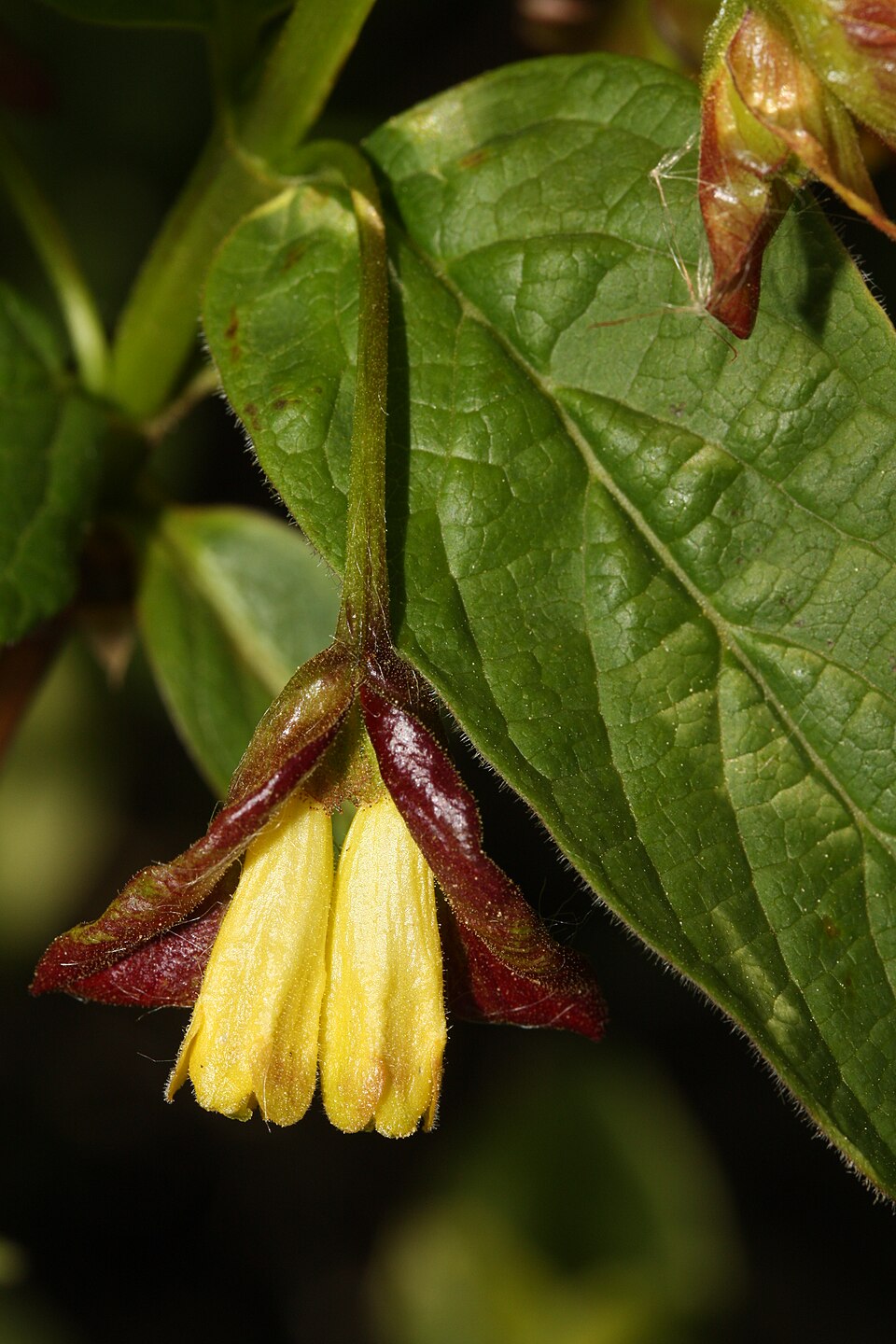
The flowers are perhaps Twinberry’s most distinctive feature — bright yellow, tubular blooms about 0.5-0.75 inches long that appear in pairs from the leaf axils. What makes them truly special is the pair of large, heart-shaped red to reddish-purple bracts that surround each flower pair, creating a striking color contrast that makes the flowers visible from considerable distance.
Fruit
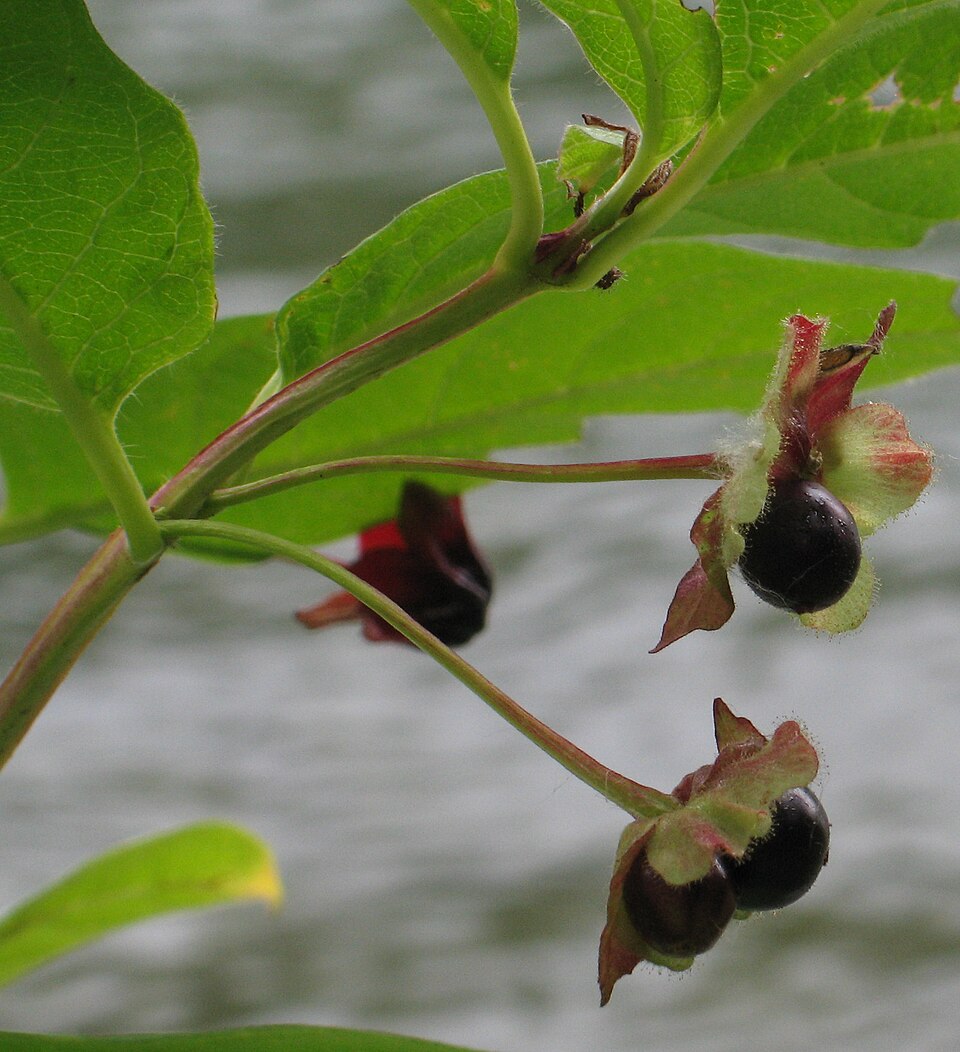
The paired black berries that give Twinberry its name develop within the persistent red bracts, creating an attractive display of glossy black fruits surrounded by bright red. The berries ripen from mid to late summer and are about 0.25-0.5 inches wide. While important for wildlife, the berries are unpalatable and possibly toxic to humans.
Native Range
Native range of Twinberry. USDA (County-Level Data)
Twinberry has one of the broadest distributions of any North American native shrub, ranging from Alaska across boreal Canada to Quebec, and south through the western United States to California and northwestern Mexico. This enormous range reflects the species’ remarkable adaptability to diverse climatic and habitat conditions.
📋 Regional plant lists featuring Twinberry: Western Oregon & Western Washington
Growing & Care Guide
Twinberry’s adaptability makes it one of the easiest native shrubs to grow successfully in Pacific Northwest gardens. It tolerates a remarkable range of conditions while providing consistent beauty and wildlife value.
Site Selection
Twinberry thrives in full sun to partial shade and adapts to virtually any soil type from sandy to heavy clay. It’s equally at home in dry upland sites and consistently moist or even wet locations, making it perfect for challenging sites where other shrubs struggle.
Planting & Care
Plant in fall or spring, spacing plants 6-8 feet apart for screening or mass plantings. Water regularly the first year, then reduce as the plant becomes established. Mature plants require minimal care and are drought tolerant once established, though they perform best with consistent moisture.
Pruning & Maintenance
Twinberry requires minimal pruning. Remove dead or damaged wood in late winter, and lightly shape if desired after flowering. The plant naturally develops an attractive, somewhat open form that rarely needs corrective pruning.
Seasonal Care
Understanding the seasonal needs of Twinberry is essential for successful cultivation. Spring is typically the most active growth period, when the plant benefits from adequate moisture and nutrients. Summer care focuses on maintaining consistent soil moisture while avoiding waterlogged conditions. Fall preparation involves allowing the plant to naturally enter dormancy, while winter protection may be needed in exposed locations or at the edges of the plant’s hardiness range.
Propagation
Twinberry can be propagated through several methods, each with its own advantages and appropriate timing. Understanding the natural reproductive strategies of this species helps inform the most successful propagation approaches for home gardeners and restoration projects. Seed collection timing, storage requirements, and germination treatments all play important roles in successful propagation efforts.
Common Issues
While Twinberry is generally a resilient native plant, certain environmental stresses or cultural problems can affect its health and appearance. Recognizing early signs of stress, understanding common pest and disease issues, and knowing when intervention is necessary versus when to allow natural processes to occur are all important aspects of successful cultivation.
Wildlife & Ecological Value
Few native shrubs provide more comprehensive wildlife value than Twinberry. The tubular flowers are specially adapted for hummingbird pollination, with their bright yellow color and red bracts creating a “hummingbird beacon” that attracts these important pollinators from considerable distances.
For Hummingbirds & Pollinators
The extended blooming period from May through July provides consistent nectar when hummingbirds are most active. Native bees, butterflies, and moths also visit the flowers, making Twinberry valuable for supporting diverse pollinator communities.
For Birds & Mammals
The paired black berries are consumed by numerous wildlife species including bears (hence “bearberry honeysuckle”), various songbirds, and small mammals. The berries persist into fall and early winter, providing food when other sources may be scarce.
Habitat Structure
The dense, multi-stemmed growth habit provides excellent nesting sites and cover for small birds and mammals. Deer browse the foliage and twigs, especially during winter months.
Seasonal Wildlife Value
The ecological value of Twinberry varies throughout the year, with different wildlife species taking advantage of the resources it provides during different seasons. Understanding these seasonal patterns helps appreciate the full ecological impact of including this species in native plant gardens and restoration projects.
Habitat Relationships
Beyond direct food and shelter provision, Twinberry participates in complex ecological relationships that benefit entire plant and animal communities. These indirect ecological services often exceed the obvious direct benefits and contribute to overall ecosystem health and resilience.
Cultural & Historical Uses
Indigenous peoples throughout Twinberry’s vast range found multiple uses for this versatile plant, despite the berries being inedible for humans.
Pacific Northwest Coast peoples, including the Quileute, Kwakwaka’wakw, and Haida, used the berries to create black pigment for painting and as hair dye. The dark juice provided a reliable source of black coloring for various cultural and practical applications.
Medicinally, various tribes prepared teas and poultices from the bark, berries, and leaves to treat different ailments. The bark was sometimes woven together with willow bark to create clothing and other textiles.
The berries were known by various names that reflected their inedible nature — “monster food,” “crow berry,” and similar terms that warned against human consumption while acknowledging their value to wildlife.
Modern Landscape Uses
Twinberry’s exceptional adaptability and wildlife value make it ideal for numerous modern landscape applications:
Rain Gardens & Bioswales: The plant’s tolerance for both wet and dry conditions makes it perfect for stormwater management landscapes.
Wildlife Gardens: Few plants provide more comprehensive wildlife support, attracting hummingbirds, butterflies, and berry-eating birds.
Restoration Projects: Widely used for riparian restoration and bank stabilization due to its adaptability and rapid establishment.
Urban Landscapes: Tolerance for air pollution and challenging urban growing conditions makes it suitable for city plantings.
Natural Screening: The dense growth habit provides effective visual and noise screening while supporting wildlife.
Frequently Asked Questions
How fast does Twinberry grow?
Twinberry has a moderate growth rate under optimal conditions. Growth varies depending on soil moisture, light levels, and climate conditions. In favorable sites with adequate water and appropriate light, you can expect steady annual growth that will establish a mature specimen within several years.
Is Twinberry deer resistant?
Like most native plants, Twinberry may be browsed by deer, especially during winter months when other food sources are scarce. However, established plants are generally resilient to occasional browsing. Consider using physical barriers for young plants in areas with heavy deer pressure.
When is the best time to plant Twinberry?
Fall planting is ideal for Twinberry, as it allows the root system to establish during the cool, moist winter months before the stress of summer heat. Early spring planting is also successful if you can provide consistent watering through the first growing season.
Does Twinberry need special soil conditions?
Twinberry performs best in conditions that mimic its natural habitat. While adaptable to various soil types, it thrives in well-drained soil with adequate organic matter. Match the moisture and pH conditions of its native range for optimal health and growth.
Can Twinberry be grown in containers?
Young Twinberry plants can be successfully grown in containers for a time, making them suitable for patios, decks, or as temporary plantings. However, for long-term health and full development, transplanting to the ground is recommended once the plant reaches maturity.

Looking for a nursery that carries Twinberry?
Browse our native plant nursery directory: Oregon · Washington