
Cylindrical Blazing Star (Liatris cylindracea)
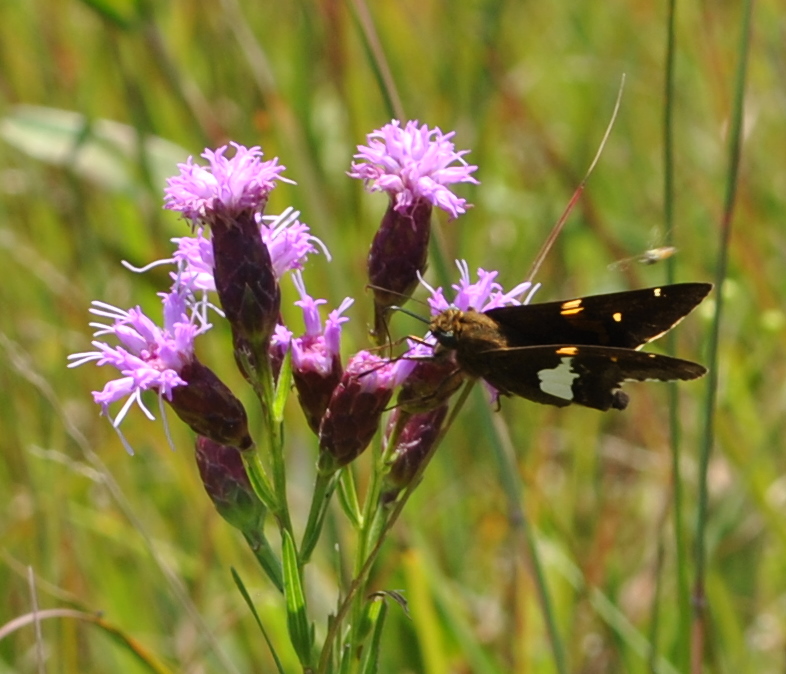
Liatris cylindracea, known as Cylindrical Blazing Star, Ontario blazing star, barrelhead blazing star or dwarf blazing star, is a compact native wildflower of dry prairies, limestone glades and rocky bluffs in the Midwest and the Great Lakes region. It is one of the shortest blazing stars, usually 8 inches to 2 feet tall, and instead of the dense bottlebrush spike of the familiar garden Liatris it carries a loose cluster of rose-purple flower heads, each set on a smooth, barrel-shaped base. It belongs to the aster family (Asteraceae).
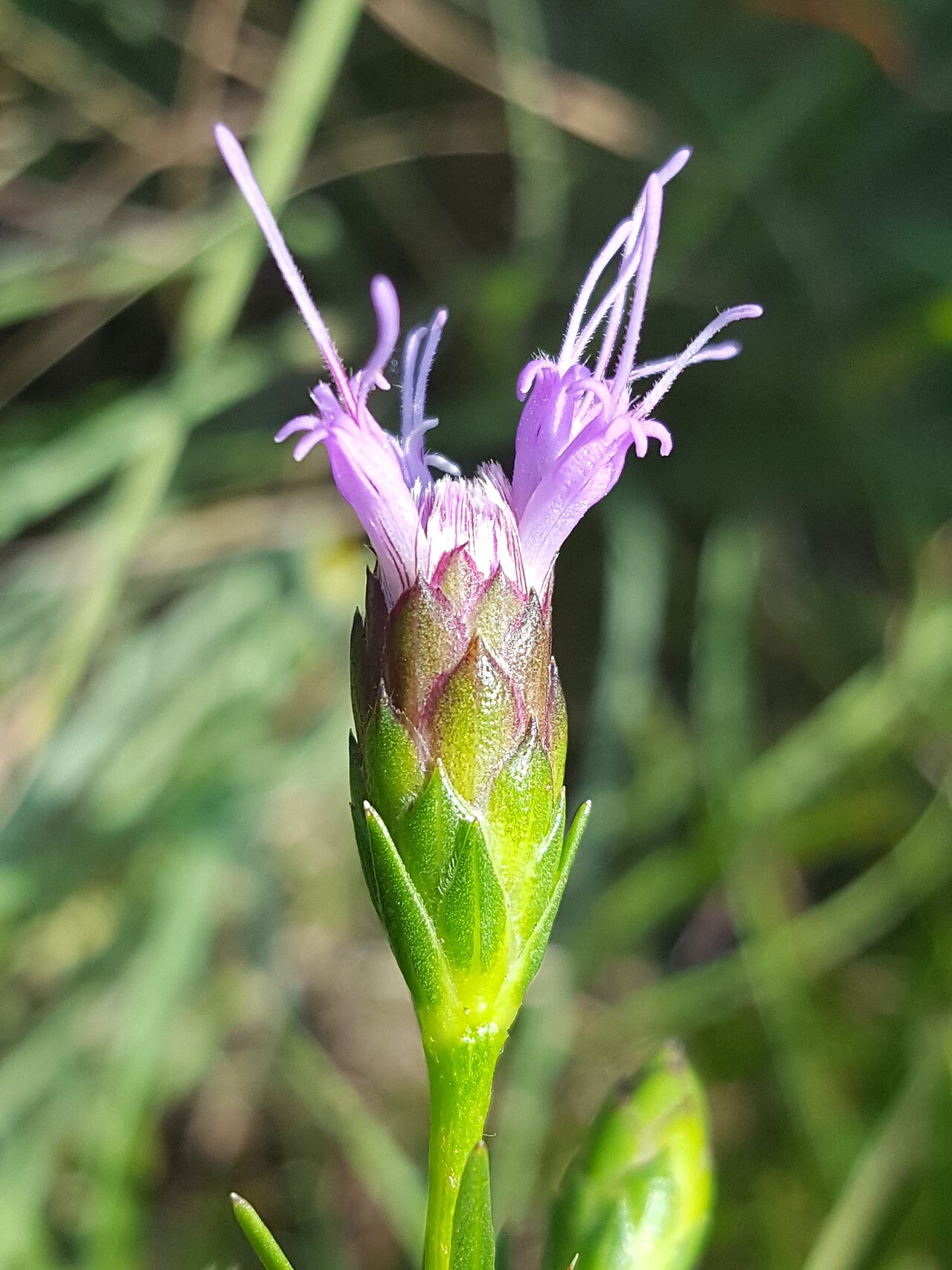
The common and scientific names both describe those bases. Each flower head sits in a cylinder of smooth, rounded, tightly overlapping green bracts, often tinged with purple, that looks like a tiny pine cone or barrel. Out of the top bursts a tuft of 10 to 35 lavender to magenta florets with long, curling, thread-like styles that give the head its feathery look. Plants bloom from mid to late summer, opening from the top of the stem downward like other blazing stars.
Cylindrical blazing star is a plant of poor, thin soils. It thrives in exactly the hot, dry, rocky places where taller prairie flowers struggle, and it is well suited to rock gardens, green roofs and the front of sunny native borders. Its compact size and long bloom also make it a dependable nectar plant for bumblebees, skippers and butterflies. This guide explains how to identify it, where it grows wild, how to grow it from seed or plants, and how it supports pollinators.
Identification
There are more than 35 species of Liatris in North America, and several share the Midwest prairies. Cylindrical blazing star is easiest to separate by its few, fairly large, cylindrical heads with smooth, rounded bracts, combined with its short stature and narrow, grass-like leaves.
Corm & Stems
Each plant grows from a rounded, sometimes elongated corm, and older plants produce one to several stems. The stems are unbranched, usually hairless, and 8 to 24 inches tall. Below ground the plant has a deep root system that helps it survive drought on thin, rocky soil.
Leaves
The leaves are long, narrow and grass-like, 3 to 10 inches long and less than ¼ inch wide, with usually three visible veins. They are smooth or have a few hairs along the margins and are often dotted with tiny glands. The largest leaves sit a little above the base of the stem and the leaves become gradually shorter toward the top. Some plants in Kentucky and Missouri have hairier leaves, which may reflect hybridization with other blazing stars.
Flowers
The stem ends in a single flower head or a loose spike or cluster of 2 to about 28 heads. Each head is held upright on a very short stalk or none. The involucre, the bract-covered base of the head, is cylindrical and about ½ to nearly 1 inch long, with smooth, broadly rounded bracts that lie flat against one another and may have a purplish edge. The heads carry 10 to 35 tubular florets in shades of rose-purple and lavender, rarely white, each with a long, two-branched style. Bloom runs from July into September, varying with latitude and moisture.
Fruit & Seeds
After flowering, each floret produces a small ribbed seed (a cypsela) about ¼ inch long, topped by a pappus of feathery bristles. Mature heads turn fluffy and tan in early fall, and the seeds drift short distances on the wind. Compare the bracts with rough blazing star (L. aspera), which has rounded, papery-edged bracts on much larger, globe-like heads, and scaly blazing star (L. squarrosa), which has pointed bract tips that spread outward.
Quick Facts
| Scientific Name | Liatris cylindracea Michx. |
| Family | Asteraceae (aster family) |
| Plant Type | Herbaceous perennial wildflower from a corm |
| Mature Height | 8–24 in |
| Mature Spread | 6–12 in |
| Growth Rate | Slow to moderate; flowers in the second or third year from seed |
| Sun Exposure | Full sun |
| Water Needs | Low; very drought tolerant once established |
| Soil Type | Dry, thin, rocky, gravelly or sandy soils; often over limestone |
| Soil pH | About 6.0–8.0; tolerates limy soils |
| Bloom Time | July–September |
| Flower Color | Rose-purple to lavender; rarely white |
| Fall Color | Foliage turns tan to bronze; fluffy tan seed heads |
| Fruit | Small ribbed seed (cypsela) with a feathery pappus |
| Deer Resistant | Moderate; rabbits and deer occasionally browse the stems |
| USDA Hardiness Zones | 3–8 |
Native Range
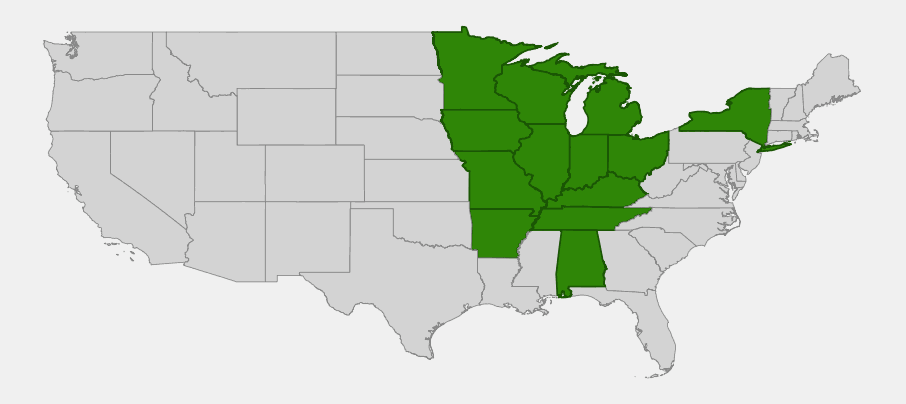
Cylindrical blazing star is native to eastern North America, with most of its populations in the Midwest and the Great Lakes region. The Lady Bird Johnson Wildflower Center describes its range as western New York to Ohio and southeastern Minnesota, south to Alabama and Arkansas. In the United States it is recorded from Alabama, Arkansas, Illinois, Indiana, Iowa, Kentucky, Michigan, Minnesota, Missouri, New York, Ohio, Tennessee and Wisconsin, and USDA PLANTS also lists scattered records for Kansas and Delaware. In Canada it grows only in southern Ontario, which is the source of the name Ontario blazing star.
It is most frequent in the prairie and savanna country of Wisconsin, Illinois, Iowa and Missouri, where it grows on dry hill prairies, goat prairies on south-facing bluffs, and sand prairies. Farther east and south it becomes a plant of special rock habitats: limestone and dolomite glades and barrens in Ohio, Kentucky, Tennessee and Alabama, alvars and limestone pavements around the Great Lakes, and dry sandy openings and dunes along the shores of Lake Michigan.
At the eastern and southern edges of its range it is uncommon. It is considered threatened in Ohio and is rare in New York and Ontario, where its alvar and glade habitats have been lost to quarrying, development and the spread of red cedar and other woody plants. Where these open habitats are maintained by fire or cutting, it can still be locally abundant.
📋 Regional plant lists featuring Cylindrical Blazing Star: Alabama, Georgia & Mississippi · Arkansas, Louisiana, Eastern Oklahoma & Eastern Texas · Illinois, Iowa & Missouri · Ohio & Indiana · Kentucky & Tennessee · Michigan, Wisconsin & Eastern Minnesota · New York, Pennsylvania & Northern New Jersey
Growing & Care Guide
Cylindrical blazing star is a low-maintenance plant as long as it gets sun and sharp drainage. It is better behaved than taller blazing stars: it does not flop, it stays in its spot, and it tolerates heat and drought that would stress most garden perennials. Its main enemies are wet winter soil, shade and crowding by taller plants.
Light
Give it full sun, at least six hours a day. In the wild it grows on open, south- and west-facing slopes, glades and prairies, and in partial shade it produces fewer heads and weaker stems.
Soil & Water
Plant it in lean, well-drained soil: gravelly, rocky or sandy loam, including limestone-based soils. It does well in rock gardens, gravel gardens and on green roofs with a deep enough substrate. Avoid heavy clay that stays wet, especially in winter, because the corms rot in soggy soil. Water new plants during their first summer; after that they rarely need watering except in severe drought.
Planting Tips
Set out plants or corms in spring or early fall, about 8 to 12 inches apart, with the top of the corm just below the soil surface. Group several together, since single plants are easy to lose among taller neighbors. Place them at the front of a border or among short grasses such as little bluestem, prairie dropseed and sideoats grama rather than next to tall, spreading perennials.
Pruning & Maintenance
No pruning is needed. Leave the seed heads standing into fall and winter for birds and to let the plant self-sow; cut stems back in late winter or early spring. Do not fertilize or mulch heavily, as rich soil and thick mulch encourage rot and competition. In prairie plantings, a spring burn or mowing every few years helps keep the open conditions it needs.
Propagation
Cylindrical blazing star grows readily from seed. Collect the heads when the whole stalk has turned fluffy and tan, air-dry them, and rub out the seeds. Sow outdoors in late fall, or give the seed 60 days of cold, moist stratification and sow in spring. Seedlings form small corms in their first year and usually bloom in the second or third. Established clumps can also be divided carefully in early spring, but plants from seed are more reliable.
Landscape Uses
- Rock and gravel gardens: compact size and drought tolerance suit hot, rocky, well-drained sites
- Prairie and glade restoration: a characteristic forb of dry hill prairies, sand prairies, alvars and limestone glades
- Front of the border: a short, upright accent for sunny native perennial beds
- Pollinator gardens: summer nectar for bumblebees, skippers and butterflies
- Green roofs: tolerates heat, wind and thin, fast-draining media
Wildlife & Ecological Value
Like other blazing stars, this species is a magnet for pollinators in late summer. Because it grows in open, rocky places with few other flowers, it can be an important food source in its native habitats.
For Pollinators
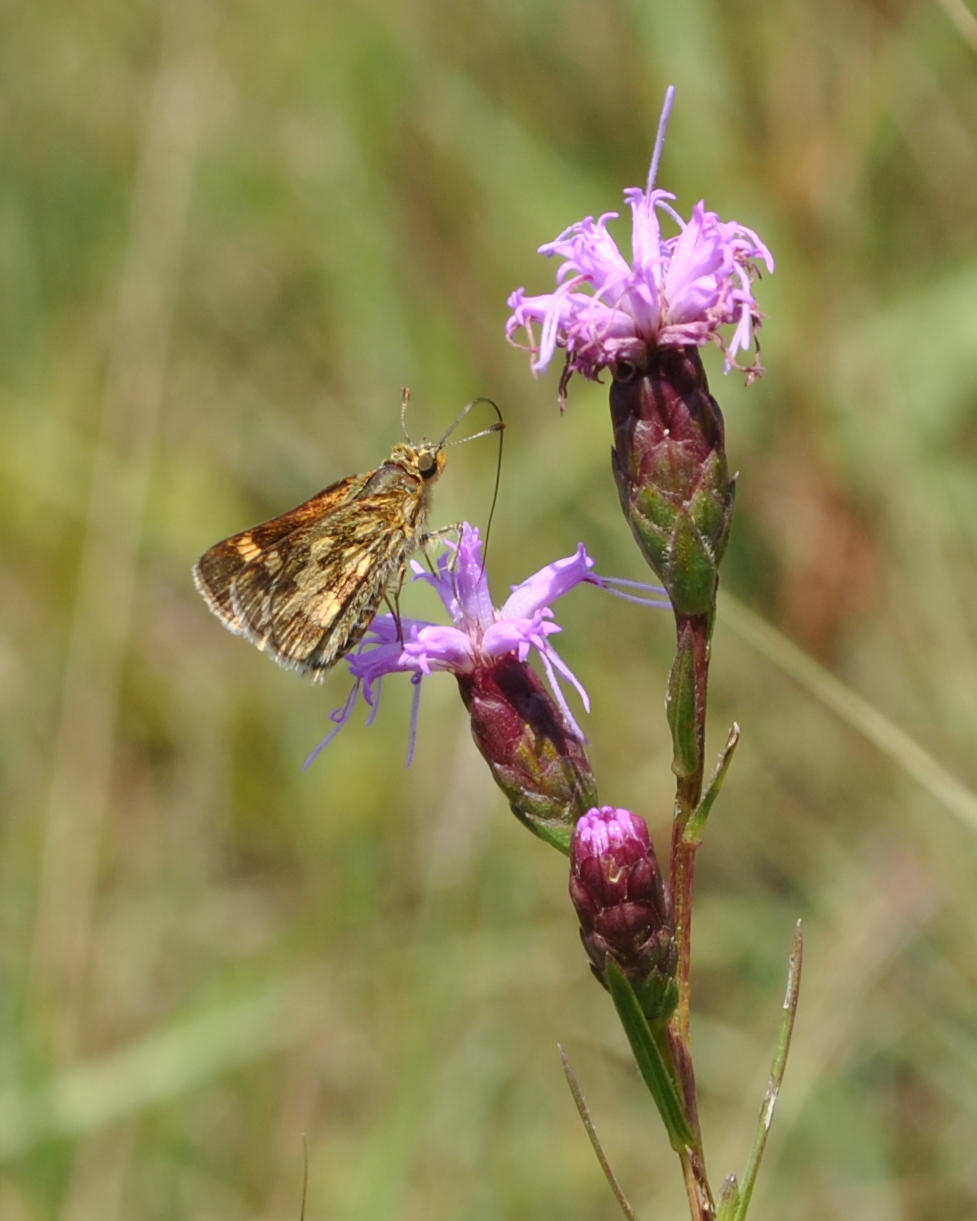
The flowers produce plenty of nectar and pollen and attract bumblebees, other long-tongued native bees, skippers and butterflies such as monarchs, fritillaries and swallowtails. Silver-spotted skippers and Peck’s skippers are frequent visitors in Wisconsin prairies. The Xerces Society notes that the species has special value to native bees and bumblebees. Blazing stars are also food plants for the caterpillars of several moths, including the bleeding flower moth (Schinia sanguinea), which feeds on Liatris flower heads.
For Birds
Small seed-eating birds pick at the fluffy seed heads in fall and winter, and the low, open prairies and glades where this plant grows provide foraging habitat for sparrows and other grassland birds. Leaving the stems standing through winter makes the seeds available longer.
For Mammals
Rabbits and deer occasionally browse the young stems, and voles and other rodents may eat the corms. Small mammals also eat fallen seeds.
Ecosystem Role
Cylindrical blazing star is a typical forb of fire-maintained dry prairies, glades and alvars. These are often open, rocky habitats that depend on periodic fire or other disturbance to keep red cedar and shrubs out. Its deep roots help hold thin soils on slopes, and its presence often indicates a high-quality prairie or glade remnant.
Cultural & Historical Uses
André Michaux described Liatris cylindracea in his Flora Boreali-Americana (1803), based on plants he saw during his travels in eastern North America. The species name refers to the cylindrical shape of the flower heads, a feature that still separates it from most of its relatives. The origin of the genus name Liatris is obscure.
Native peoples of the prairie region used several blazing stars as food and medicine. The corms of some species were eaten or used in remedies for sore throats, swelling and other ailments. Records specific to this small, scattered species are few, and most documented uses refer to more common prairie blazing stars such as dotted gayfeather.
Today cylindrical blazing star is valued mostly by prairie restorationists and native plant gardeners who want a blazing star for dry, rocky sites. It is less common in the nursery trade than tall blazing star or dense blazing star, but native seed companies in the Midwest offer it, and its compact form makes it a good choice for small gardens.
Frequently Asked Questions
How tall does cylindrical blazing star get?
Usually 8 inches to 2 feet tall. It is one of the shortest blazing stars, which makes it useful in rock gardens and at the front of borders where taller Liatris would flop.
How is it different from dense blazing star?
Dense blazing star (Liatris spicata) has many small, stalkless heads packed into a long, tight spike and grows in moist soils. Cylindrical blazing star has a few larger, barrel-shaped heads with smooth, rounded bracts, and it grows in dry, rocky or sandy soil.
Does it need dry soil?
It needs well-drained soil, and it is best in dry, lean, rocky or sandy ground. It tolerates average garden soil if drainage is good, but it will rot in heavy clay that stays wet in winter.
When does it bloom?
From July into September, depending on location. The heads open from the top of the stem downward, so each plant blooms for several weeks.
Is it deer resistant?
Moderately. Deer and rabbits sometimes nibble the stems, especially in spring, but the plant is not a preferred food. Protecting young plants in their first season helps them establish.

Looking for a nursery that carries Cylindrical Blazing Star?
Browse our native plant nursery directory: Alabama & Arkansas · Illinois, Indiana & Iowa · Kentucky, Michigan, Minnesota & Missouri · New York & Ohio · Tennessee · Wisconsin