
Horsetail Milkweed (Asclepias subverticillata)
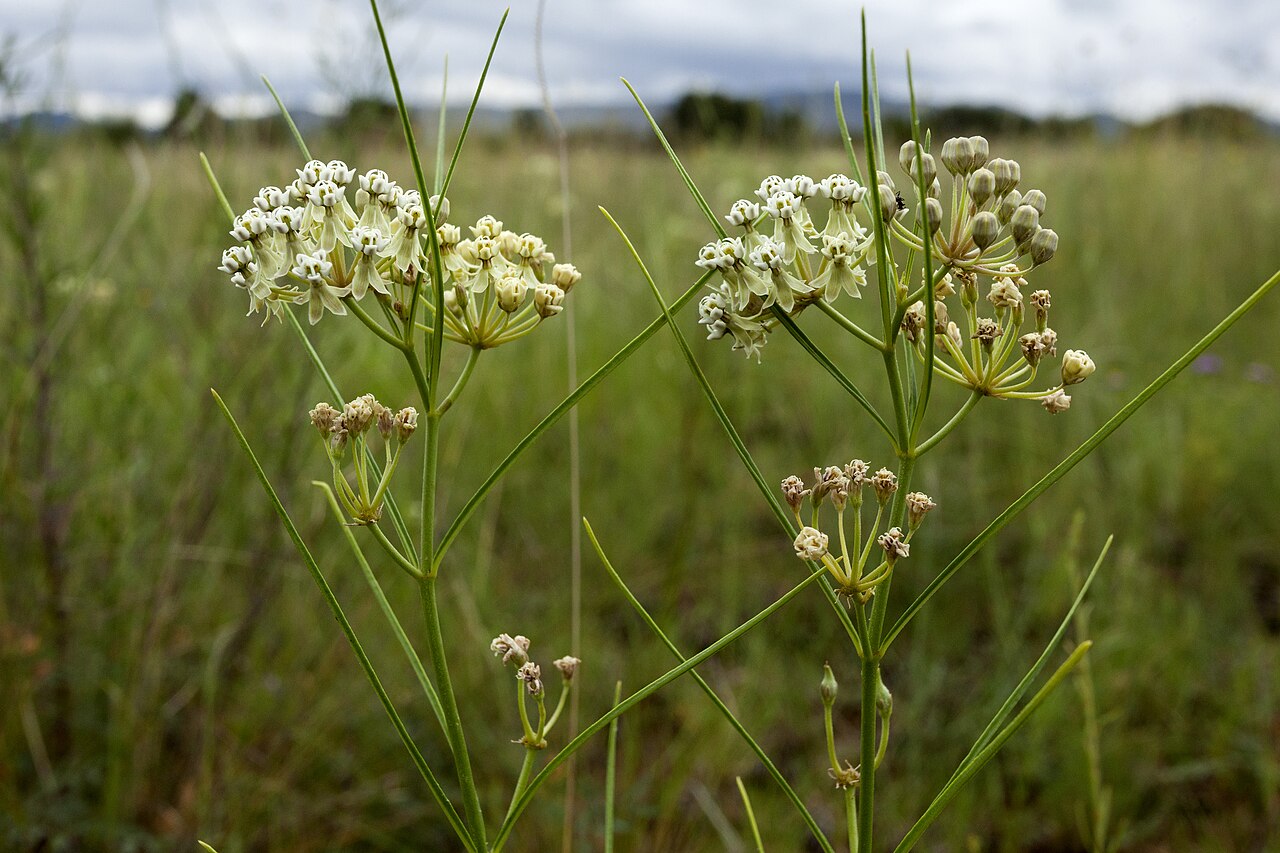
Asclepias subverticillata, known as Horsetail Milkweed, whorled milkweed or poison milkweed, is a native milkweed of the American Southwest and the southern Great Plains. It forms airy, bushy colonies of upright stems clothed in whorls of thread-like leaves, which give the plant a feathery, horsetail-like look, and from late spring to early fall it carries rounded clusters of small white flowers. It is a member of the dogbane family (Apocynaceae), which now includes all the milkweeds.
This is one of the toughest and longest-blooming milkweeds in the West. It grows in desert grassland, pinyon-juniper country, sandy plains and washes, and it thrives along roadsides, ditches and other disturbed ground where runoff collects. Its flowers draw a remarkable variety of insects, from native bees and butterflies to large wasps, and its leaves feed the caterpillars of monarch and queen butterflies.
Horsetail milkweed has a darker side too. It is one of the most toxic milkweeds to livestock, and it spreads readily by underground rhizomes, so it is best placed where it has room to roam and where grazing animals are not present. This guide covers identification, native range, growing tips, wildlife value and the plant’s long history of use in the Southwest.
Identification
Among western milkweeds, horsetail milkweed is distinctive for its very narrow, linear leaves arranged in whorls of three to five, combined with white flowers. Its close relative, the eastern whorled milkweed (Asclepias verticillata), is very similar and the two are sometimes difficult to separate where their ranges meet on the Great Plains.
Stems & Roots
The plant grows from a deep, creeping rhizome that sends up many stems, so a single plant soon becomes a colony. Stems are slender, upright, usually unbranched or branched near the top, and 1 to 3 feet tall, occasionally reaching 4 feet. Like other milkweeds, all parts contain a milky latex sap that oozes from any break.
Leaves
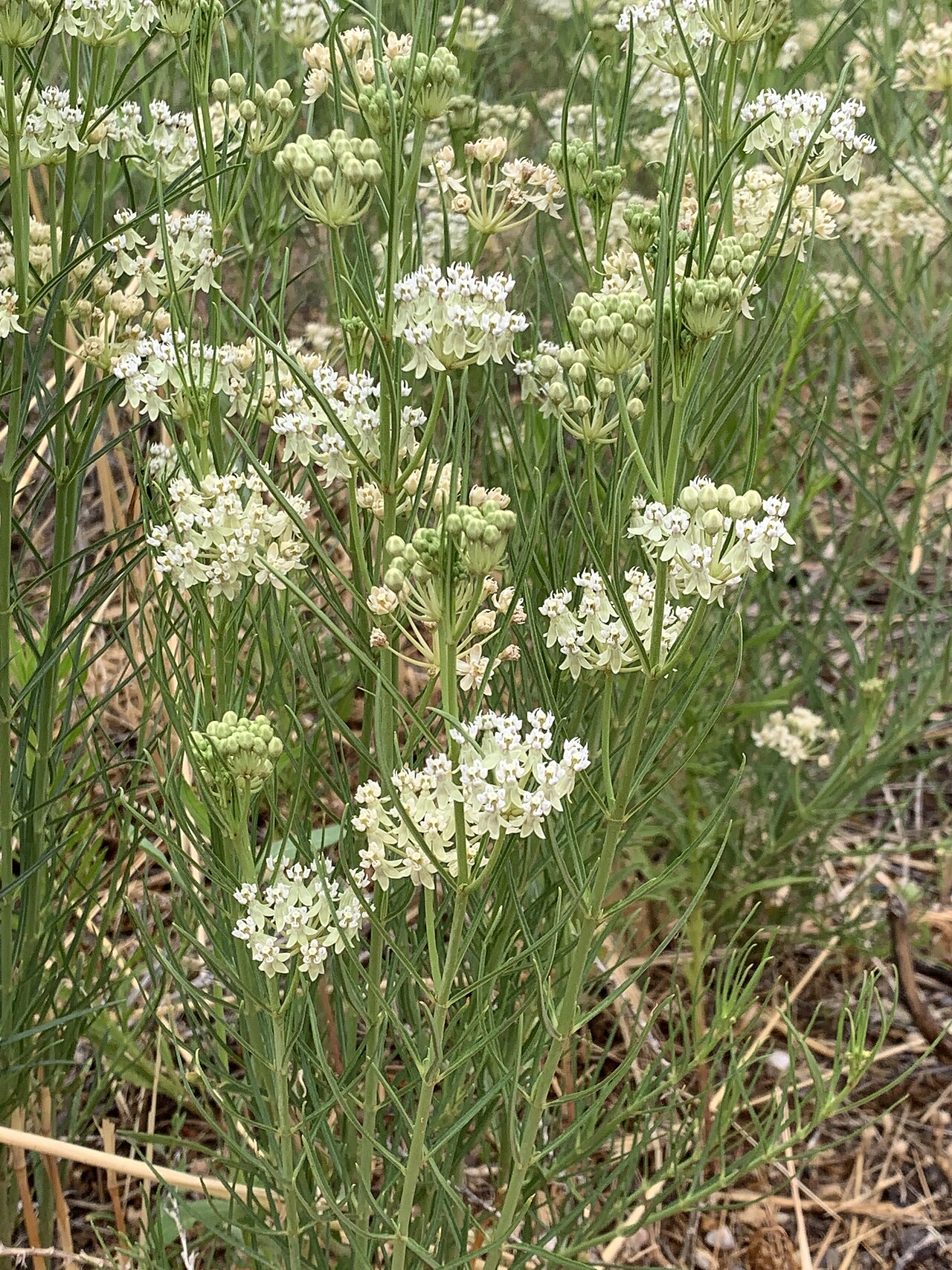
The leaves are linear and thread-like, 1 to 5 inches long and no more than about ⅛ inch wide, with margins that often roll under. They are arranged in whorls of three to five at each node, and short leafy shoots often grow from the leaf axils, giving the stems a dense, bushy, feathery appearance. The foliage is smooth and bright green to grayish green.
Flowers
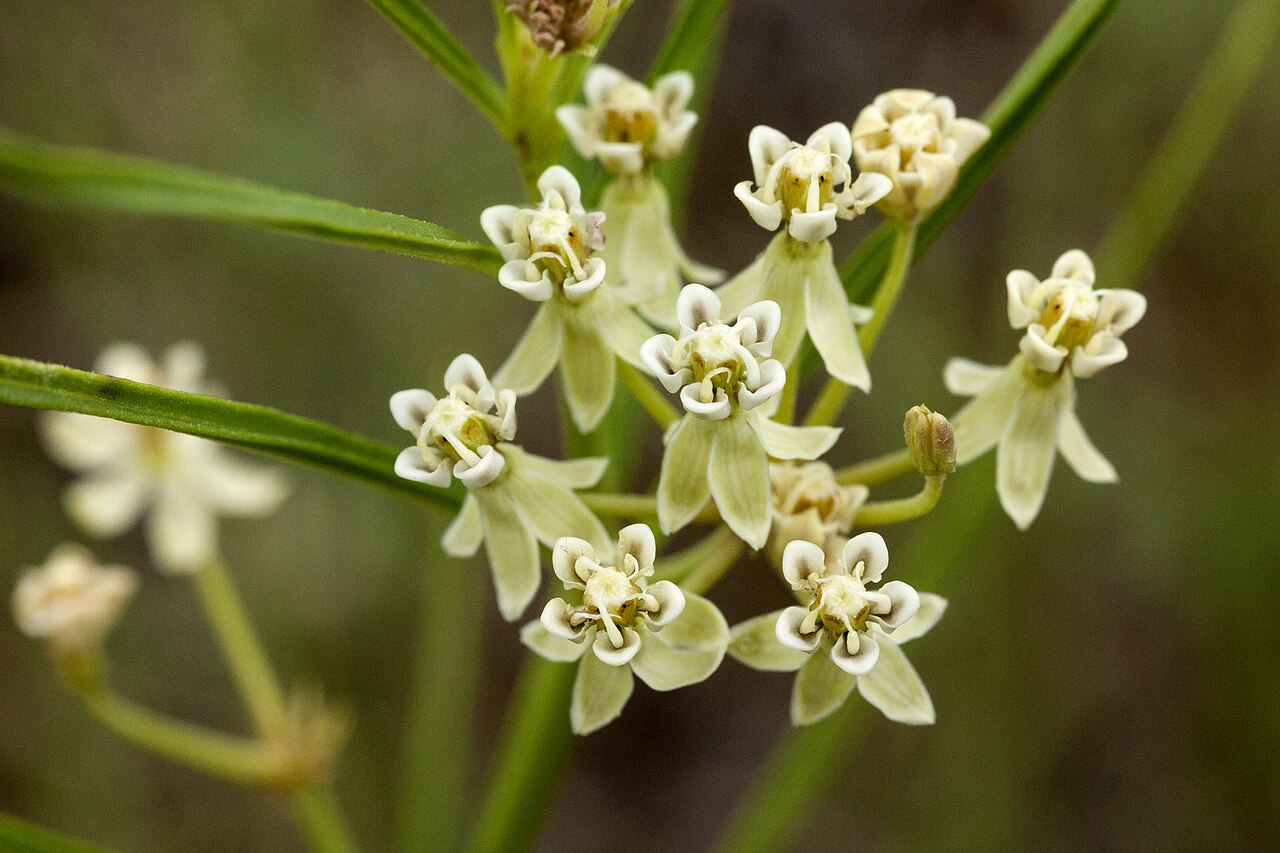
Flowers appear in rounded umbels about 1 to 1¼ inches across, at the upper nodes and stem tips. Each flower is about ¼ to ½ inch across, with five greenish-white petals bent sharply back and a central crown of five white hoods, each with a small curved horn. The bloom season is long, from May to September and often into October where rains continue, and a single colony may bear buds, flowers and pods at the same time.
Fruit & Seeds
The fruits are slender, smooth, upright pods (follicles) 2 to 4 inches long, tapering to a point. When ripe in late summer and fall they split along one side and release flat brown seeds, each carrying a tuft of long, silky white hairs (the coma) that carries it on the wind.
Quick Facts
| Scientific Name | Asclepias subverticillata (A. Gray) Vail |
| Family | Apocynaceae (dogbane family; milkweed subfamily) |
| Plant Type | Herbaceous perennial; colony-forming from rhizomes |
| Mature Height | 1–3 ft (occasionally to 4 ft) |
| Mature Spread | 2–3 ft per clump; spreads by rhizomes into larger colonies |
| Growth Rate | Fast |
| Sun Exposure | Full sun |
| Water Needs | Low to moderate; very drought tolerant, more lush where runoff collects |
| Soil Type | Sandy, gravelly, rocky or clay soils; tolerant of disturbed ground |
| Soil pH | About 6.5–8.5; tolerates alkaline soils |
| Bloom Time | May–September (often into October) |
| Flower Color | White to greenish-white |
| Fall Color | Foliage yellows before dying back |
| Fruit | Slender, smooth pod 2–4 in long with silk-tufted seeds |
| Deer Resistant | Yes; toxic and rarely browsed, but very poisonous to livestock |
| USDA Hardiness Zones | 4–9 |
Native Range
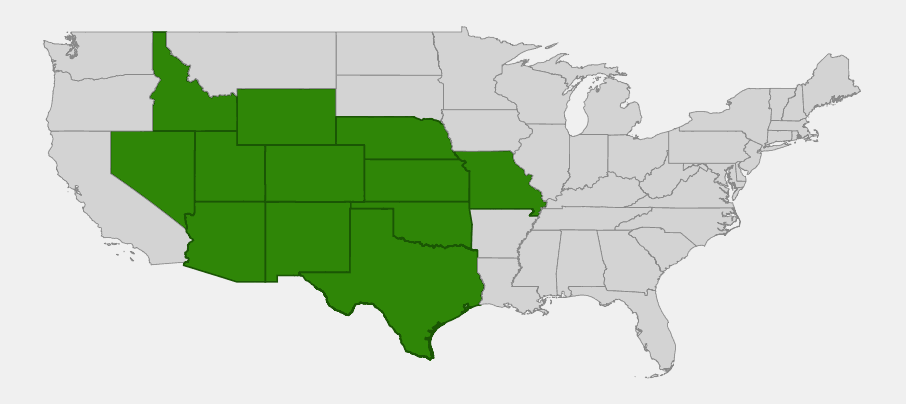
Horsetail milkweed is native to the southwestern United States and northern Mexico. According to the Lady Bird Johnson Wildflower Center and USDA PLANTS, its range runs from Idaho, Nevada and Arizona east to Missouri and south through Texas into Mexico. In the United States it is recorded from Arizona, Colorado, Idaho, Kansas, Missouri, Nebraska, Nevada, New Mexico, Oklahoma, Texas, Utah and Wyoming.
Its heartland is New Mexico, Arizona, southern Colorado, southern Utah and western Texas, where it is common in desert grassland, pinyon-juniper woodland, sandy plains, arroyos and canyon bottoms, from low desert edges into the foothills. It is especially frequent along roadsides, where runoff from the pavement gives it extra water. Toward the edges of its range, in Idaho, Wyoming, Nebraska, Kansas and Missouri, it is much more scattered, and some eastern occurrences are along railroads and roads.
In the southern and central Great Plains its range meets that of the eastern whorled milkweed (A. verticillata). Some botanists have treated horsetail milkweed as a variety of that species. They are now generally kept separate: horsetail milkweed is larger and bushier, with longer leaves and more numerous leafy shoots, and is the typical whorled-leaf milkweed of the Southwest.
📋 Regional plant lists featuring Horsetail Milkweed: Arizona & New Mexico · Utah & Western Colorado · South & West Texas · Nebraska, Kansas & Eastern Colorado · Montana & Wyoming · Idaho, Eastern Oregon & Eastern Washington · California & Nevada
Growing & Care Guide
Horsetail milkweed is easy to grow in the Southwest and the western Plains. It needs sun, tolerates poor soils and drought, and blooms for months. The main thing to plan for is its spreading habit: it runs by rhizomes and can fill a bed, so give it room or contain it.
Light
Plant it in full sun. In shade, stems become lanky and flowering drops off. It handles the intense sun, heat and wind of desert and plains gardens without trouble.
Soil & Water
It grows in almost any well-drained soil, including sand, gravel, caliche-influenced and alkaline soils, and it also tolerates heavier clay if water does not stand. Once established, it survives on natural rainfall across most of its range. Occasional deep watering in long dry spells keeps it blooming through summer, and plants near a downspout, swale or roadside drainage are noticeably lusher.
Planting Tips
Plant container-grown plants in spring after frost, or in late summer with the monsoon rains, about 2 feet apart. Because it spreads by rhizomes, put it where it can form a colony: in a pollinator meadow, along a fence line, in a rain basin or a wildlife garden. In a small bed, plant it in a large bottomless container sunk into the ground or surround it with a deep edging.
Pruning & Maintenance
Little care is needed. Cut stems to the ground in late winter. Pull up shoots that wander beyond where you want them. Wear gloves when handling the plant, as the milky sap can irritate skin and eyes. Aphids, especially the bright yellow oleander aphid, sometimes cover the stems; they rarely harm the plant and are food for lady beetles and other beneficial insects.
Propagation
Grow it from seed or from rhizome cuttings. Seeds germinate best after about 30 days of cold, moist stratification and sprout quickly in warm soil. Collect pods just as they begin to split, before the seeds blow away. Root sections taken in spring and planted horizontally a couple of inches deep will produce new plants.
Landscape Uses
- Monarch and pollinator gardens: a long-blooming milkweed host plant for monarchs and queens in arid regions
- Roadside and disturbed-site revegetation: colonizes bare, compacted and disturbed soils readily
- Rain gardens and water-harvesting basins: thrives where runoff collects but survives long droughts
- Naturalistic meadows: a fine-textured, white-flowered companion for native grasses
- Habitat restoration: in grassland and pinyon-juniper sites within its native range, away from livestock
Wildlife & Ecological Value
Horsetail milkweed is one of the most valuable plants for insects in the arid West. Because it blooms for so long, it provides nectar from late spring until frost, often when few other plants are flowering.
For Pollinators
Its flowers attract an exceptionally wide range of visitors: native bees and bumblebees, honey bees, butterflies, beetles, flies and many wasps, including the large tarantula hawk wasps of the Southwest. The Xerces Society notes it has special value to native bees, bumblebees and honey bees, and that it supports beneficial insects used in conservation biological control. Milkweed pollen is packaged in pairs of sacs called pollinia, which clip onto the legs of visiting insects and are carried to the next flower.
The leaves are eaten by monarch and queen caterpillars, and horsetail milkweed is one of the main host milkweeds for western monarchs in the Southwest. It also supports specialist milkweed insects such as milkweed bugs, milkweed beetles and milkweed tussock moths.
For Birds
Birds rarely eat the plant, but they feed on the many insects it attracts. Some songbirds use the silky seed fluff as nest lining.
For Mammals
Horsetail milkweed contains toxic cardiac glycosides. Wild mammals generally avoid it, and it is very poisonous to sheep, cattle and horses, which are most likely to eat it when better forage is scarce or when it is mixed into hay. It is considered one of the most dangerous milkweeds for livestock.
Ecosystem Role
As a colonizer of washes, roadsides and disturbed ground, horsetail milkweed helps stabilize bare soil and brings pollinators to otherwise flower-poor ground. Its toxins are taken up by monarch and queen caterpillars, which store them and become distasteful to birds, an important defense for these butterflies.
Cultural & Historical Uses
Horsetail milkweed has long been known in the Southwest. Among the Zuni, young boys ate the flower buds, and pods gathered when about two-thirds ripe provided fibers that were used in weaving clothing. The silky seed fluff was made into cords used for fastening feathers to prayer sticks. Other milkweeds were used similarly for fiber and food by peoples across the West.
In ranching country the plant is better known as poison milkweed. Its leaves contain cardiac glycosides and other toxins, and in the early twentieth century livestock losses led the U.S. Department of Agriculture to study its toxicity, then under the name Asclepias galioides. Ranchers still watch for it in overgrazed pastures, along roads and in hay, where it remains dangerous even when dried.
Today horsetail milkweed is valued by monarch conservation programs in the Southwest, where few milkweeds are adapted to heat and drought. Native seed companies and regional nurseries grow it for pollinator gardens and roadside plantings, and it is often one of the first milkweeds to colonize newly disturbed ground.
Frequently Asked Questions
Is horsetail milkweed good for monarchs?
Yes. It is one of the most important native host plants for monarch and queen caterpillars in the Southwest, and its long bloom season provides nectar for adult butterflies through summer and fall.
Is horsetail milkweed poisonous?
Yes. It is among the most toxic milkweeds, especially to sheep, cattle and horses. Do not plant it where livestock graze or near hayfields, and keep children and pets from chewing on it. Wear gloves when handling it, since the sap can irritate skin and eyes.
Does horsetail milkweed spread?
Yes. It spreads by creeping rhizomes and forms colonies, and it can also self-sow. In small gardens, contain it with a deep edging or bottomless pot, or plant it where spreading is welcome.
How is it different from whorled milkweed?
Eastern whorled milkweed (Asclepias verticillata) is very similar, with whorled thread-like leaves and white flowers. Horsetail milkweed is generally taller and bushier, with longer leaves and more leafy side shoots, and it is the species found in most of the Southwest.
When does horsetail milkweed bloom?
From May into September, and often into October in years with good monsoon rains. Plants frequently carry buds, flowers and pods at the same time.

Looking for a nursery that carries Horsetail Milkweed?
Browse our native plant nursery directory: Arizona · Colorado · Idaho & Kansas · Missouri · Nebraska, Nevada, New Mexico & Oklahoma · Texas & Utah · Wyoming