
Daddy Longlegs Orchid (Brassavola cucullata)
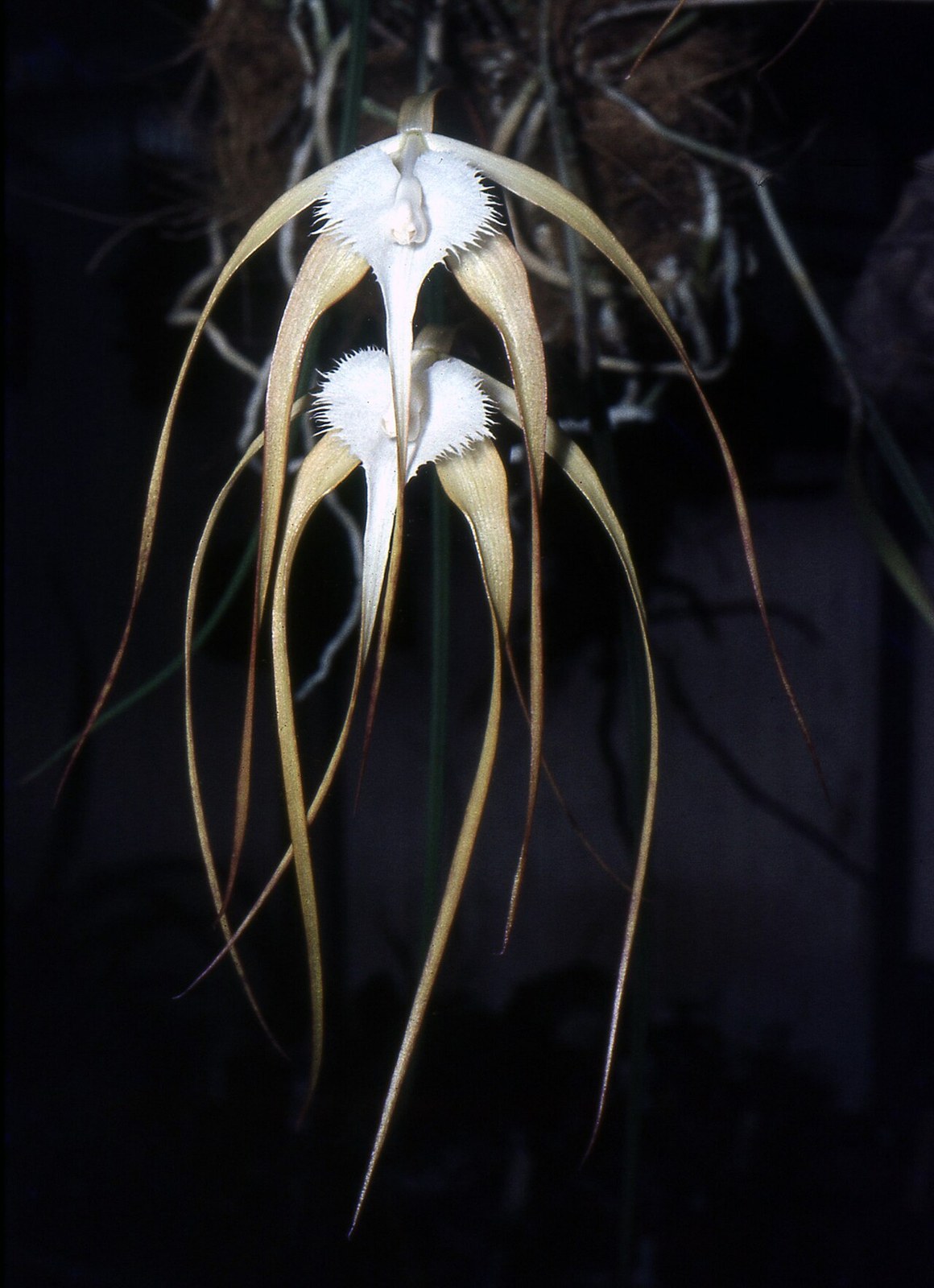
Brassavola cucullata, the Daddy Longlegs Orchid, is a native Puerto Rican orchid with flowers that look like a spider dangling on long, thin legs. USDA PLANTS uses the same common name, daddy longlegs orchid. It grows on trees and rocks across the West Indies and from Mexico through Central America to northern South America. Linnaeus first described it as Epidendrum cucullatum, and it is the type species of the genus Brassavola.
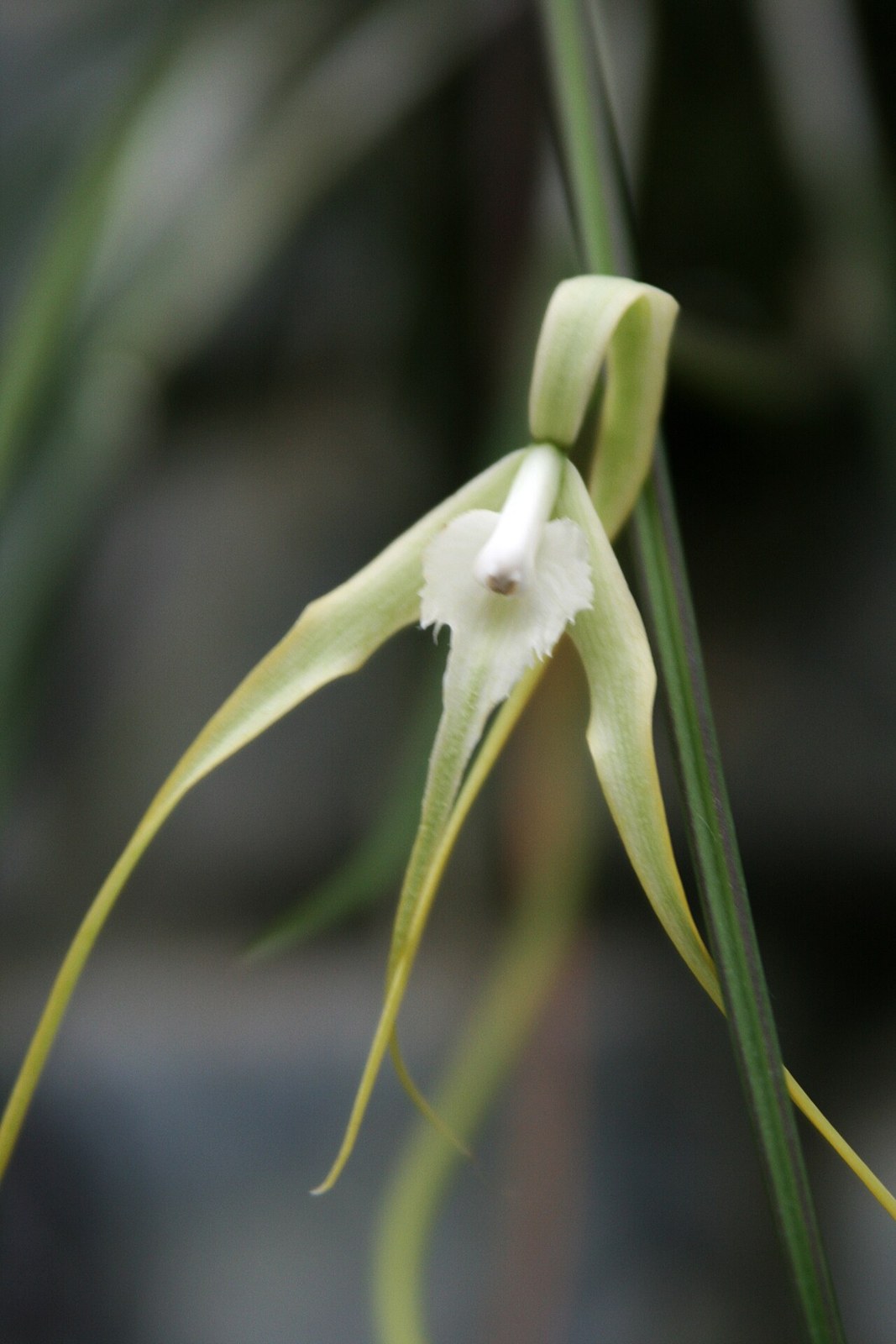
The plant is a clump of hanging, pencil-thin leaves, each topped by a tiny stem. The flowers have very long, narrow, drooping sepals and petals, pale greenish to cream at first and fading to tan, and a white lip that is hooded at the base and fringed along its edges. Like its relatives, it is fragrant at night.
This guide covers how to identify the daddy longlegs orchid, where it grows in Puerto Rico and the Caribbean, how to grow it mounted on a tree or slab, and how it is pollinated.
Identification
Brassavolas are easy to recognize as a group by their round, pencil-like leaves and white-lipped flowers. The daddy longlegs orchid is told apart by its extremely long, thread-like sepals and petals and its fringed, hooded lip.
Growth Form
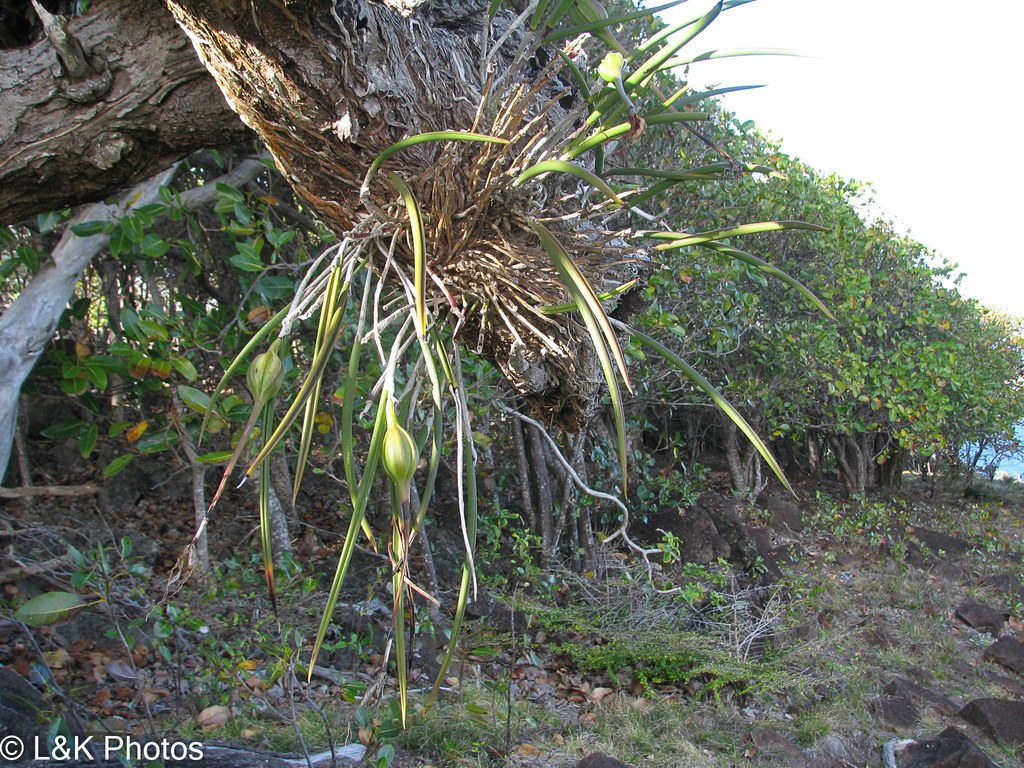
A small evergreen epiphyte or lithophyte that grows on tree branches and rocks, forming clumps of hanging leaves. Each leaf sits on a short, slender stem (pseudobulb) that grows from a creeping rhizome. Thick, white roots cling to the bark or rock.
Leaves
Each stem carries a single leaf that is fleshy and nearly round in cross-section (terete), with a groove along the upper side, like a thick pencil or green shoelace. The leaves usually hang down and are commonly about 6 to 12 inches (15 to 30 cm) long. Their thick, succulent texture helps the plant survive dry seasons.
Flowers
The flowers are borne one or a few at a time from the tip of the stem. The sepals and petals are very long and narrow, several inches long, tapering to thread-like tips, pale green to cream and turning tan or brownish with age; they hang down like the legs of a daddy longlegs. The lip is white, with a hooded (cucullate) base that wraps around the column, a fringed edge, and a long, narrow, pointed tip. The flowers are fragrant in the evening and at night.
Fruit
A pollinated flower develops into a spindle-shaped seed capsule that splits to release thousands of dust-like seeds carried by the wind.
Quick Facts
| Scientific Name | Brassavola cucullata (L.) R. Br. (syn. Epidendrum cucullatum L.); USDA common name: daddy longlegs orchid |
| Family | Orchidaceae (orchid family) |
| Plant Type | Evergreen epiphytic or lithophytic orchid |
| Mature Height | Leaves hang 6–12 in |
| Mature Spread | Clumps 6–12 in wide |
| Growth Rate | Slow |
| Sun Exposure | Bright filtered light to partial sun |
| Water Needs | Moderate; water often while growing, drier in the dry season |
| Soil Type | None; mounted on bark, a branch or a slab, or in coarse bark mix |
| Soil pH | Not applicable (epiphyte) |
| Bloom Time | Variable; flowers can appear at different times of year |
| Flower Color | Greenish cream to tan, white lip |
| Fall Color | None; evergreen |
| Fruit | Spindle-shaped capsule with dust-like seeds |
| Deer Resistant | Not applicable in Puerto Rico |
| USDA Hardiness Zones | 10b–12; frost tender |
Native Range
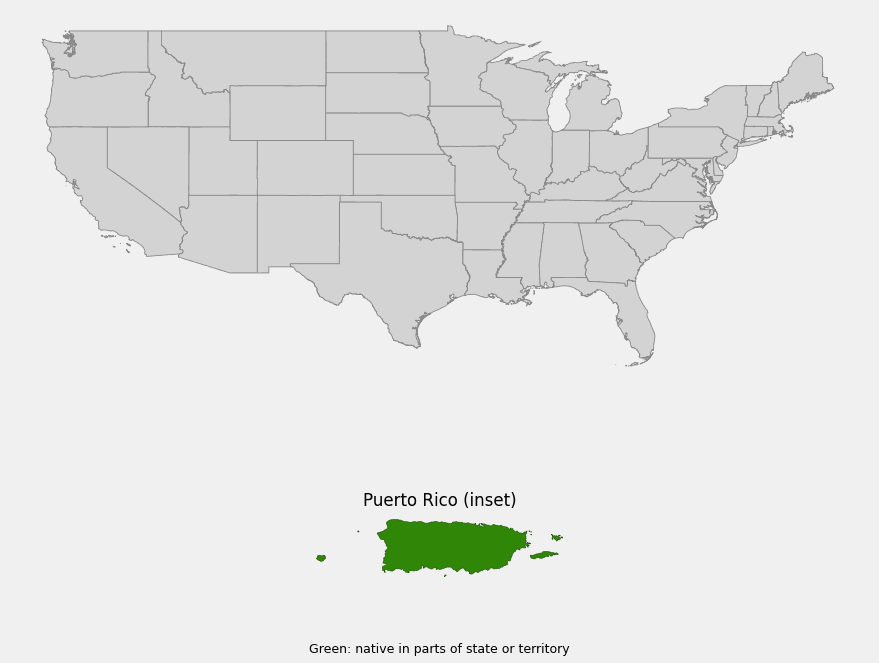
USDA PLANTS lists Brassavola cucullata as native to Puerto Rico and the U.S. Virgin Islands. The Smithsonian Flora of the West Indies records it from Puerto Rico, St. Thomas in the Virgin Islands and the Lesser Antilles (Antigua, Saba, St. Eustatius, St. Martin, Montserrat, Marie-Galante, Dominica, St. Vincent and Grenada). Outside the Caribbean it grows from Mexico, from Sinaloa and San Luis Potosí south to Chiapas and the Yucatán Peninsula, through Belize and Central America to Colombia, Venezuela and the Guianas.
It grows on tree trunks and branches and on rocks, usually in fairly open, bright places where it gets good air movement and a distinct dry season, such as lowland deciduous and semi-evergreen forest and coastal woodland. Its fleshy leaves let it survive months without rain. In the Virgin Islands it has been photographed growing on boulders as well as on trees.
It is not listed under the U.S. Endangered Species Act. All orchids are protected in international trade under CITES Appendix II. Buy only nursery-propagated plants, and never take orchids from the wild.
📋 Regional plant lists featuring Daddy Longlegs Orchid: Puerto Rico
Growing & Care Guide
Daddy longlegs orchid is one of the easier native orchids to grow, as long as it is mounted rather than potted in soil. In Puerto Rico it can be tied to a garden tree; on the mainland it does well outdoors in frost-free areas and as an indoor or greenhouse orchid elsewhere.
Light
Give it bright light: dappled sun through a tree canopy, or morning sun with afternoon shade. Brassavolas like more light than many orchids. Too little light gives soft, dark leaves and few flowers; too much direct midday sun can scorch the leaves.
Soil & Water
Grow it mounted on a piece of cork bark, a hardwood branch or a slab, so the hanging leaves can dangle naturally and the roots dry quickly after watering. It can also grow in a basket of very coarse bark. Water mounted plants frequently in the warm, rainy months, letting the roots dry between waterings, and give less water during the dry season.
Planting Tips
To mount it on a tree, choose a branch with rough bark, such as a calabash or gumbo limbo, in bright, filtered light. Tie the plant on with soft string or plant ties, with the rhizome pressed against the bark. The roots will attach within a season. Avoid trees with peeling bark.
Pruning & Maintenance
Leave old leaves in place as long as they are green; they store water and food. Remove only dead, shriveled leaves and spent flower stems. Feed with a dilute orchid fertilizer every week or two in the growing season.
Propagation
Divide large clumps when new roots are starting, keeping several leaves and stems with each division. Orchid seeds need special laboratory culture, so propagation from seed is left to specialist nurseries.
Landscape Uses
- Tree mounting: grows naturally on branches and trunks
- Moon gardens: fragrant flowers at night
- Hanging displays: pendent leaves and flowers suit slabs and baskets
- Low-water gardens: succulent leaves survive dry seasons
- Native orchid collections: a native orchid of Puerto Rico and the Virgin Islands
Wildlife & Ecological Value
The pale color, long thread-like parts and evening scent of the daddy longlegs orchid all point to pollination by night-flying moths.
For Pollinators
Like other brassavolas, it is fragrant at night, and its pale flowers stand out in the dark. These are traits of moth-pollinated flowers, and long-tongued moths such as sphinx moths are thought to be its main pollinators. As in many orchids, the pollen is packed into small masses (pollinia) that stick to a visiting insect and are carried to the next flower.
For Birds
The orchid offers little food for birds, but the clumps of hanging leaves are part of the epiphyte community on trees that shelters insects and other small animals birds feed on.
For Mammals
The daddy longlegs orchid is not an important food plant for mammals.
Ecosystem Role
Like all orchids, it depends on soil and bark fungi: its tiny seeds have almost no food reserves and need a fungal partner to germinate. As an epiphyte it takes no food from its host tree, using only the tree as a perch.
Cultural & Historical Uses
Linnaeus described this orchid in 1763 as Epidendrum cucullatum. In 1813 Robert Brown created the genus Brassavola with this species as its type, naming the genus after Antonio Musa Brassavola, a 16th-century Italian physician and botanist. The name cucullata means “hooded,” for the shape of the base of the lip.
The common name “daddy longlegs” refers to the long, thin, drooping sepals and petals, which make the flowers look like a hanging spider or harvestman. The related “lady of the night” orchid, Brassavola nodosa, has a broad, heart-shaped white lip and shorter sepals and petals.
Brassavolas are popular with orchid growers for their night fragrance and easy culture, and they have been widely used in hybrids. Old botanical works such as Curtis’s Botanical Magazine illustrated this species in the 1800s.
Frequently Asked Questions
Why is it called the daddy longlegs orchid?
The flowers have very long, thin sepals and petals that hang down like the legs of a daddy longlegs.
Is it the same as the lady of the night orchid?
No. Lady of the night is Brassavola nodosa, a related species with a broad, white, heart-shaped lip. The daddy longlegs orchid has a narrow, fringed lip and much longer, thread-like sepals and petals.
Do the flowers smell?
Yes. Like other brassavolas, the flowers are fragrant in the evening and at night, when moths are active.
How do I grow it?
Mount it on cork, a branch or a garden tree in bright, filtered light. Water often during warm, rainy months and let it dry out somewhat in the dry season.
Is it protected?
It is not federally listed, but all orchids are covered by CITES international trade controls. Buy only nursery-propagated plants and never collect orchids from the wild.

Looking for a nursery that carries Daddy Longlegs Orchid?
Our nursery directory does not yet include Puerto Rico. Browse the native plant nursery directory by state: Alabama–Arkansas · California · Colorado–Hawaii · Idaho–Kansas · Kentucky–Montana · Nebraska–Oklahoma · Oregon · Pennsylvania–Virginia · Washington · West Virginia–Wyoming