
Fremont Cottonwood (Populus fremontii)
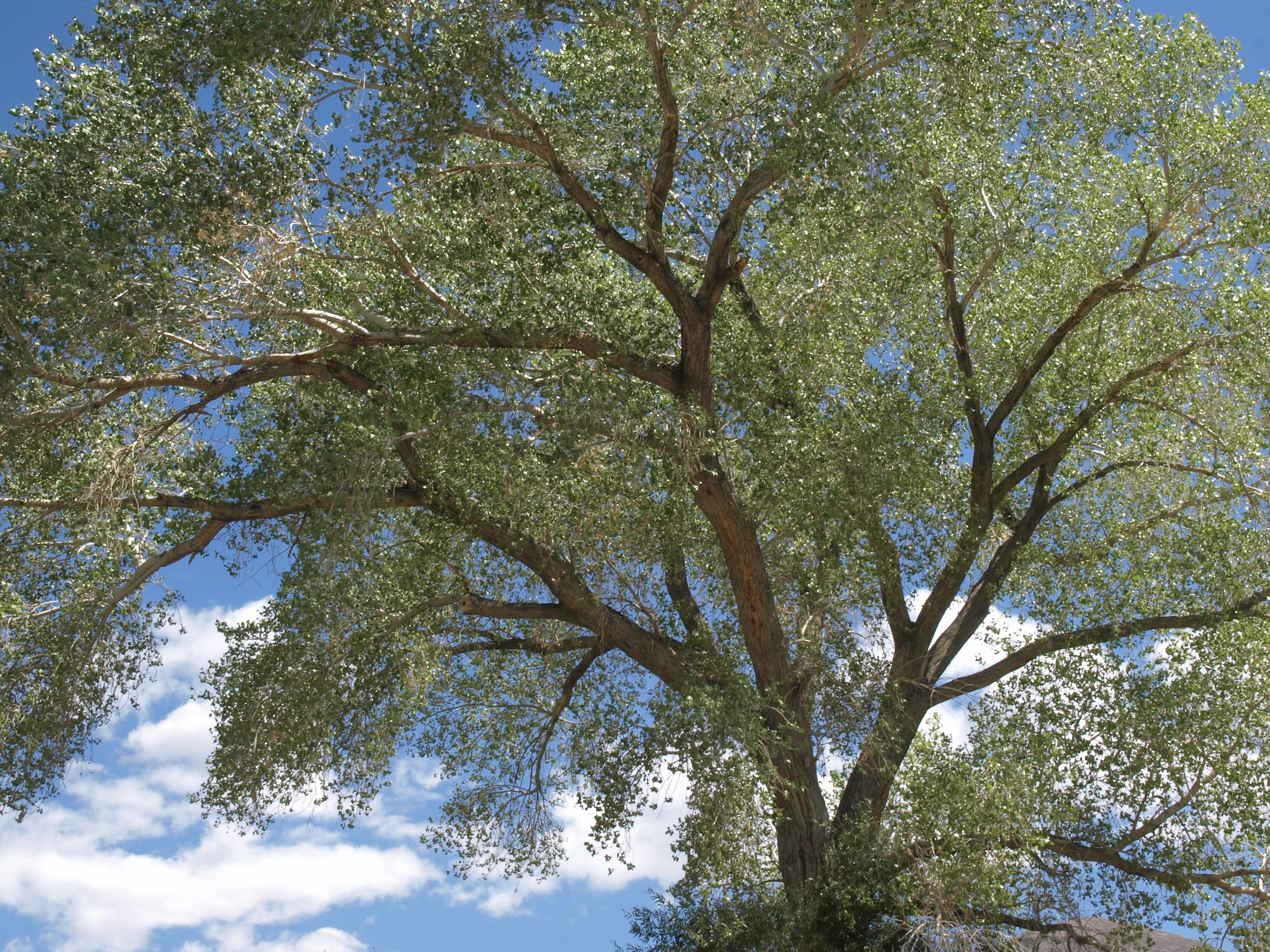
Populus fremontii, known as Fremont Cottonwood or Western Cottonwood, is one of the most ecologically dominant and visually iconic trees of the American Southwest. Named for the 19th-century explorer John C. Frémont, this massive deciduous tree defines the gallery forest communities along the Colorado River, Rio Grande, Gila River, and their tributaries — forming dense, cathedral-like groves that stand in brilliant contrast to the surrounding desert. Growing to 60 feet or more, with a broad, spreading crown and deeply furrowed silvery bark, Fremont Cottonwood is the largest native tree of Utah’s canyon country and one of the most productive wildlife habitats in the entire Southwest.
From an ecological standpoint, Fremont Cottonwood is a keystone riparian species. Its biology is perfectly synchronized with desert river dynamics: seeds are released in late spring and early summer just as river flows drop and expose moist sandbars — the precise conditions needed for germination and establishment. The trees grow rapidly in their youth, quickly shading out competing vegetation and stabilizing riverbanks with their dense, wide-spreading root systems. The soft wood decays easily once damaged, creating abundant natural cavities that are used by dozens of bird and mammal species for nesting and denning.
For gardeners in Utah and the broader Southwest, Fremont Cottonwood offers towering scale, incredible fall color (leaves turn brilliant gold in October–November), and exceptional wildlife value. It is best suited to large properties with reliable water access — the tree is not drought tolerant in its youth and requires deep, moist soil or regular irrigation to thrive. But for riparian restoration projects, large wildlife gardens, or properties bordering streams and rivers, there is no better native tree for creating a rich, productive habitat structure in a single generation.
Identification
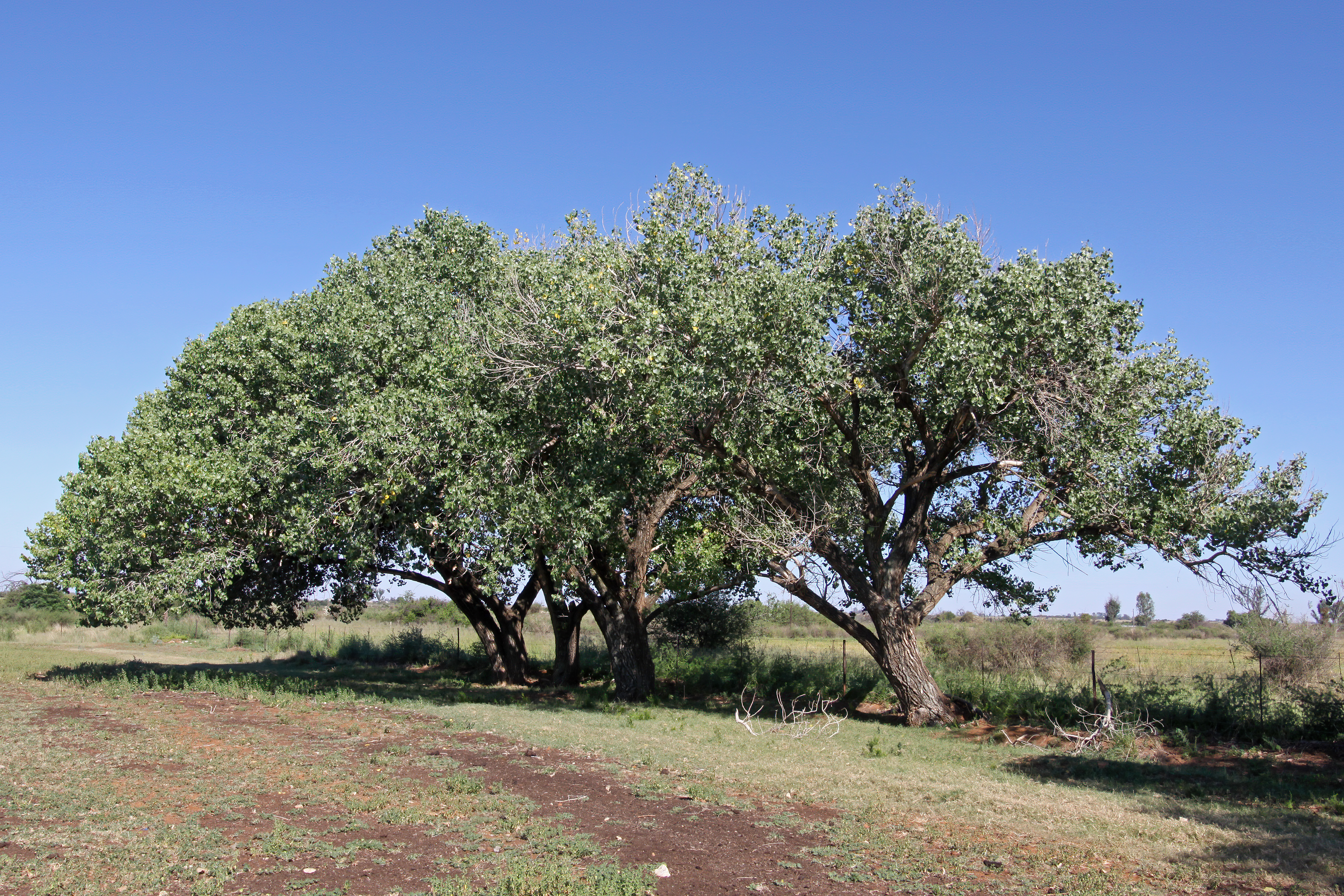
Fremont Cottonwood is a large deciduous tree typically reaching 40 to 60 feet tall in cultivation and up to 100 feet in optimal riparian conditions. The trunk is massive — often 2 to 4 feet in diameter on mature trees — with thick, deeply furrowed, grayish-white to silver bark that becomes increasingly rugged and textured with age. The crown is broad and spreading, creating a dense shade canopy that may extend 50–70 feet across on large specimens.
Bark
Young bark is smooth and whitish-gray; as the tree matures, it becomes deeply furrowed and ridged, with interlocking angular plates of grayish-white to silver-gray bark. The characteristic pale, almost white color of the upper trunk and major branches makes Fremont Cottonwood easy to identify from a distance, especially against the red-rock canyon walls of Utah’s canyon country. Broken branches reveal pale yellowish-green inner bark.
Leaves
The leaves are the most distinctive identification feature: broadly triangular to heart-shaped, 2 to 4 inches wide, with coarsely toothed margins and a flattened petiole (leaf stalk) that causes the leaves to flutter and “quake” in the slightest breeze — the same trait that gives Trembling Aspen its common name. Leaves are bright green above, paler beneath, and turn brilliant golden-yellow in fall, creating one of the most spectacular fall color displays of any Southwestern tree. In desert canyons, golden cottonwood groves are visible from miles away.
Flowers & Fruit
Fremont Cottonwood is dioecious — male and female flowers occur on separate trees. Both sexes produce elongated catkins in early spring before leaf-out. Female trees (as noted in the batch data) produce the characteristic cottony seeds after pollination — dense masses of white, cottony fibers attached to tiny seeds, released in late spring and early summer and carried by wind and water. The “cotton” can be impressive in productive years, drifting like snowflakes and accumulating in corners and crevices. Male trees produce no cotton, which may be preferable for landscape plantings where the cotton is unwanted.
Quick Facts
| Scientific Name | Populus fremontii |
| Family | Salicaceae (Willow) |
| Plant Type | Deciduous Tree |
| Mature Height | 60 ft (up to 100 ft in optimal conditions) |
| Sun Exposure | Full Sun |
| Water Needs | Moderate to High (riparian) |
| Bloom Time | February – April (catkins before leaf-out) |
| Flower Type | Wind-pollinated catkins (dioecious) |
| Fall Color | Brilliant golden-yellow (October–November) |
| Wildlife Value | Cavity nesters, bark harvesters, insect feeders |
| USDA Hardiness Zones | 3–9 |
Native Range
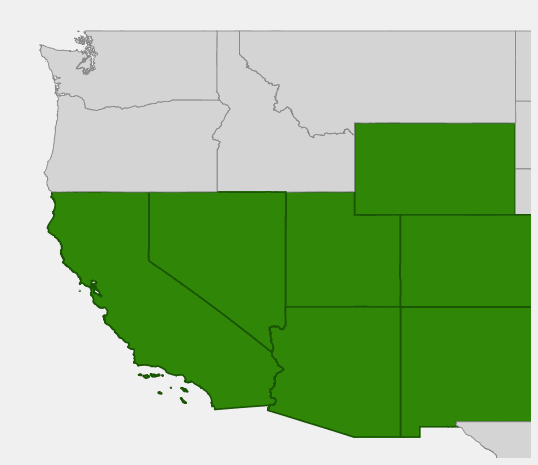
Populus fremontii is native to the western United States and northwestern Mexico, following the major river systems of the arid West from California’s Central Valley east through the Great Basin, Colorado Plateau, and Chihuahuan Desert. The species is broadly distributed across California, Nevada, Utah, Colorado, Arizona, New Mexico, and Wyoming, with its northern limit roughly coinciding with the Wyoming Basin. It extends south into Baja California, Sonora, and Chihuahua in Mexico, where it follows the Sonoran Desert river systems.
In Utah, Fremont Cottonwood is the dominant tree of river and stream corridors throughout the state — from the canyon country of the Colorado and Green River systems in the south and east, to the Weber River and Bear River drainages in the north. It forms the classic “gallery forest” of Utah’s canyon country, where narrow ribbons of lush green vegetation wind through otherwise stark desert landscapes. These cottonwood gallery forests are among the most biodiverse habitats in the entire Southwest, supporting breeding populations of dozens of bird species that are absent from surrounding desert habitats.
Two subspecies are generally recognized: the nominate P. fremontii ssp. fremontii, widespread across the Southwest, and P. fremontii ssp. mesetae of the Chihuahuan Desert. A third subspecies, P. fremontii ssp. pubescens, occurring in California and parts of Nevada, is sometimes recognized. All subspecies share the same basic ecology and wildlife value, differing primarily in leaf hairiness and geographic distribution.
📋 Regional plant lists featuring Fremont Cottonwood: Utah
Growing & Care Guide
Fremont Cottonwood is a tree for the long view — a landscape-scale species that transforms a property over decades. Plant it where it will have room to grow and access to reliable moisture, and it will reward you with stature, fall color, and wildlife richness beyond almost any other native tree in the Southwest.
Light
Fremont Cottonwood requires full sun for healthy growth. In its natural riparian habitat, it grows in open, sun-exposed riverbanks and floodplains. Shade tolerance is very low — in shaded conditions, the tree becomes weak and elongated, with poor fall color and reduced vigor. Plant it where it will receive 8+ hours of direct sun daily.
Soil & Water
This is a moisture-demanding tree. In nature, Fremont Cottonwood grows where its roots have access to permanent or seasonal groundwater — on riverbanks, in floodplains, or in canyon bottoms where subsurface water is available. In landscape settings, it requires regular deep watering, especially in summer: every 1–2 weeks for established trees in hot desert climates. It tolerates temporary flooding but not prolonged waterlogging. Soil type is secondary to moisture availability — cottonwoods grow in sand, gravel, silt, and clay, as long as moisture is adequate. This is not a xeriscape plant.
Planting Tips
Plant bare-root stock in late winter before bud break, or container stock in spring or fall. Cottonwoods establish readily — even large container plants transplant well if given adequate water. Stake for the first growing season in windy locations. The tree grows rapidly once established: 3–5 feet per year in good conditions. Site carefully — mature trees are very large and have aggressive surface roots that can impact paving, foundations, and underground utilities. Maintain at least 20 feet from structures and utilities.
Pruning & Maintenance
Fremont Cottonwood requires little pruning in youth. Remove dead or damaged branches as needed. If growing as a street or yard tree, raise the crown gradually by removing lower branches in winter. Be aware that the wood is soft and somewhat brittle — large branches may break in storms. Do not plant under power lines. Cottonwood is susceptible to several fungal diseases in humid conditions, but these are rarely serious in the drier Southwest climate.
Landscape Uses
- Riparian restoration — the defining tree for Southwestern stream and river restoration
- Windbreak — fast-growing, creates effective wind protection
- Wildlife garden anchor — unmatched cavity-nesting habitat
- Shade tree for large properties with good water access
- Floodplain stabilization — roots bind streambanks against erosion
- Bosque restoration — historically dominant in New Mexico/Arizona river bosques
Wildlife & Ecological Value
Fremont Cottonwood is arguably the single most important wildlife tree in the American Southwest. Its ecological contributions are vast and multi-layered.
For Birds
As noted in the batch data, the soft, easily excavated wood creates nest cavities for a wide array of cavity-nesting birds. Ladder-backed Woodpeckers, Gila Woodpeckers, Lewis’s Woodpeckers, and Northern Flickers all excavate primary cavities in cottonwood, which are then used secondarily by Western Screech-Owls, Elf Owls, American Kestrels, Lucy’s Warblers, Violet-green Swallows, and Western Bluebirds. The cotton from female trees is gathered by many songbirds — especially Yellow Warblers and Bewick’s Wrens — as nesting material. The insect fauna associated with cottonwood foliage and bark is enormous, providing food for insectivorous birds throughout the breeding season. Summer Tanagers, Yellow-breasted Chats, and Bell’s Vireos are signature cottonwood gallery forest species across the Southwest.
For Mammals
Beaver historically used Fremont Cottonwood as a primary food and construction material; where beaver populations are recovering in Utah, cottonwood plays a key role. Mule Deer and Elk browse young shoots and foliage, while Porcupines consume bark from upper branches. Raccoons, Ringtails, and Gray Foxes use cottonwood cavities and dense canopy for shelter and denning. The bat diversity in cottonwood riparian corridors is extraordinary — the large trees provide roost sites for many bat species that forage over adjacent open water and desert habitats.
For Pollinators
Cottonwood flowers are wind-pollinated and produce no nectar, but the trees support a vast diversity of insect life through other mechanisms. The extensive bark provides overwintering habitat for many native bee species. The foliage supports numerous specialist moth and butterfly caterpillars, including the larvae of Mourning Cloaks, which feed almost exclusively on cottonwood. The abundant insect life on cottonwood foliage is the base of the food web that supports the tree’s remarkable bird diversity.
Ecosystem Role
Cottonwood gallery forests are among the most biodiverse ecosystems in the Southwest — narrow ribbons of lush green that support far more species than the surrounding desert matrix. The shade they cast reduces water temperatures in adjacent streams, benefiting native fish species including several threatened species of native suckers and trout. Their leaf litter decomposes rapidly compared to desert vegetation, building rich organic soils that support diverse plant communities and invertebrate life. In the post-dam era, Fremont Cottonwood recruitment has been severely limited in many rivers, making restoration planting and habitat protection critically important.
Cultural & Historical Uses
Fremont Cottonwood has been used by the peoples of the Southwest for thousands of years. The Hopi, Navajo, Zuni, and various Pueblo peoples used cottonwood extensively, and it remains culturally significant today. Most famously, cottonwood root wood was (and remains) the traditional material for carving Kachina dolls (tithu) in Hopi and other Pueblo traditions — the lightweight, easily carved root wood is considered the appropriate material for these sacred ceremonial objects.
The bark was used for cordage and as a food source in early spring, when the inner bark (cambium) contains stored starches and sugars and was eaten fresh or dried and ground into flour. Young shoots and leaves were cooked and eaten as vegetables. The soft, straight wood was used for cradle boards, small tools, and firewood. The cotton from female trees was gathered for fire-starting tinder and as padding material. Medicinally, cottonwood bark contains salicylates (similar to aspirin) and was used in infusions to treat pain, fever, and inflammation across many Indigenous cultures.
For Anglo settlers of the Southwest, cottonwood groves were critically important landmarks — visible from miles away across desert landscapes, they reliably indicated water sources and provided shade and building material in otherwise treeless desert environments. Many historic campsites, stage stops, and early ranches were located in or near cottonwood groves. The wood was widely used for fence posts, corrals, and early construction despite its tendency to warp and check as it dries. Today, Fremont Cottonwood is recognized as a cornerstone restoration species for the depleted riparian corridors of the Southwest, and significant resources are invested in protecting and restoring cottonwood gallery forests throughout its range.
Frequently Asked Questions
How large will Fremont Cottonwood get?
Under ideal conditions — full sun, ample water, good soil — Fremont Cottonwood can reach 60 to 100 feet tall with a crown spread of 50–75 feet. In typical landscape conditions with regular but not unlimited water, expect 40–60 feet tall and 30–50 feet wide at maturity. Plan accordingly — this is not a small-scale plant.
How much water does Fremont Cottonwood need?
More than most other native trees in the Southwest. Young trees (1–3 years) need watering every 1–2 weeks in summer. Established trees need deep watering every 2–4 weeks in the hottest months, or they will drop leaves and decline. In non-riparian garden settings, this tree requires committed irrigation. It is best planted where it has access to subsurface moisture — near dry washes, in floodplains, or with drip irrigation.
Is the cotton from female trees a problem?
The “cotton” — masses of white fluffy seeds — from female trees can be significant in productive years. It accumulates in corners, clogs screens, and may be a nuisance. If you want to avoid the cotton, source male trees from native plant nurseries, or plant seedlings knowing you won’t know the sex until the tree flowers (usually at 5–7 years of age).
Does Fremont Cottonwood have invasive roots?
Yes — cottonwood roots are extensive and aggressive, particularly seeking out water sources. Keep cottonwood at least 20–30 feet from foundations, underground pipes, and pavement. Near the tree, surface roots may be prominent and can disrupt nearby plantings and hardscape.
Can I grow Fremont Cottonwood from cuttings?
Yes, easily. Hardwood cuttings taken in late winter from 1-year-old growth root very readily if kept moist — cottonwood is among the easiest trees to propagate by cuttings. Even large branch sections can be pushed directly into moist soil in early spring and will root. This makes it ideal for streambank revegetation projects using live stakes.

Looking for a nursery that carries Fremont Cottonwood?
Browse our native plant nursery directory: Utah