
Giant Vetch (Vicia nigricans)
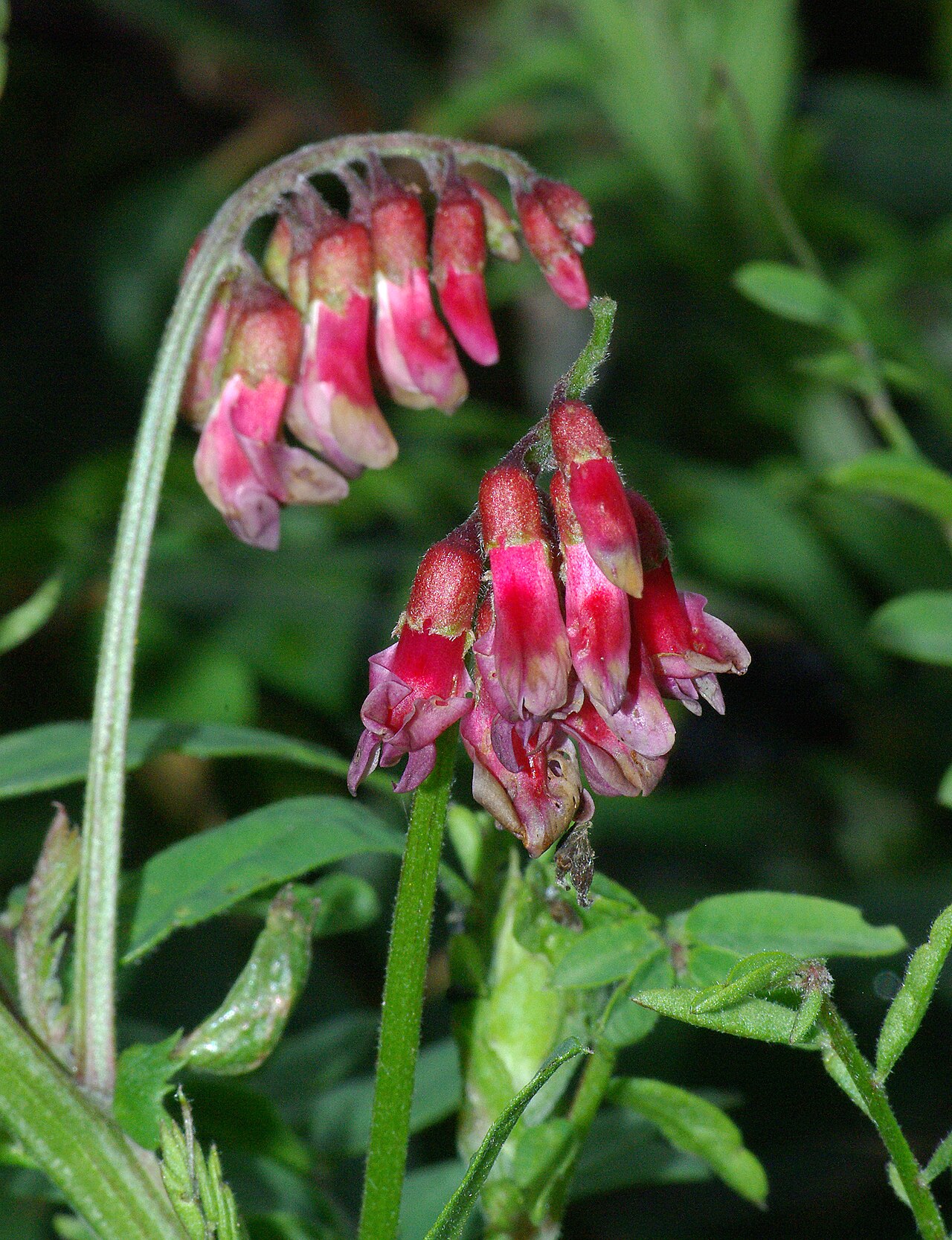
Vicia nigricans, known as Giant Vetch, is the largest native vetch of the Pacific Coast, a vigorous perennial vine in the pea family (Fabaceae). The North American plants belong to Vicia nigricans ssp. gigantea (also treated as var. gigantea), and many older books call it Vicia gigantea. The species also has a second subspecies far away in Chile, which gives it the less common name black vetch.
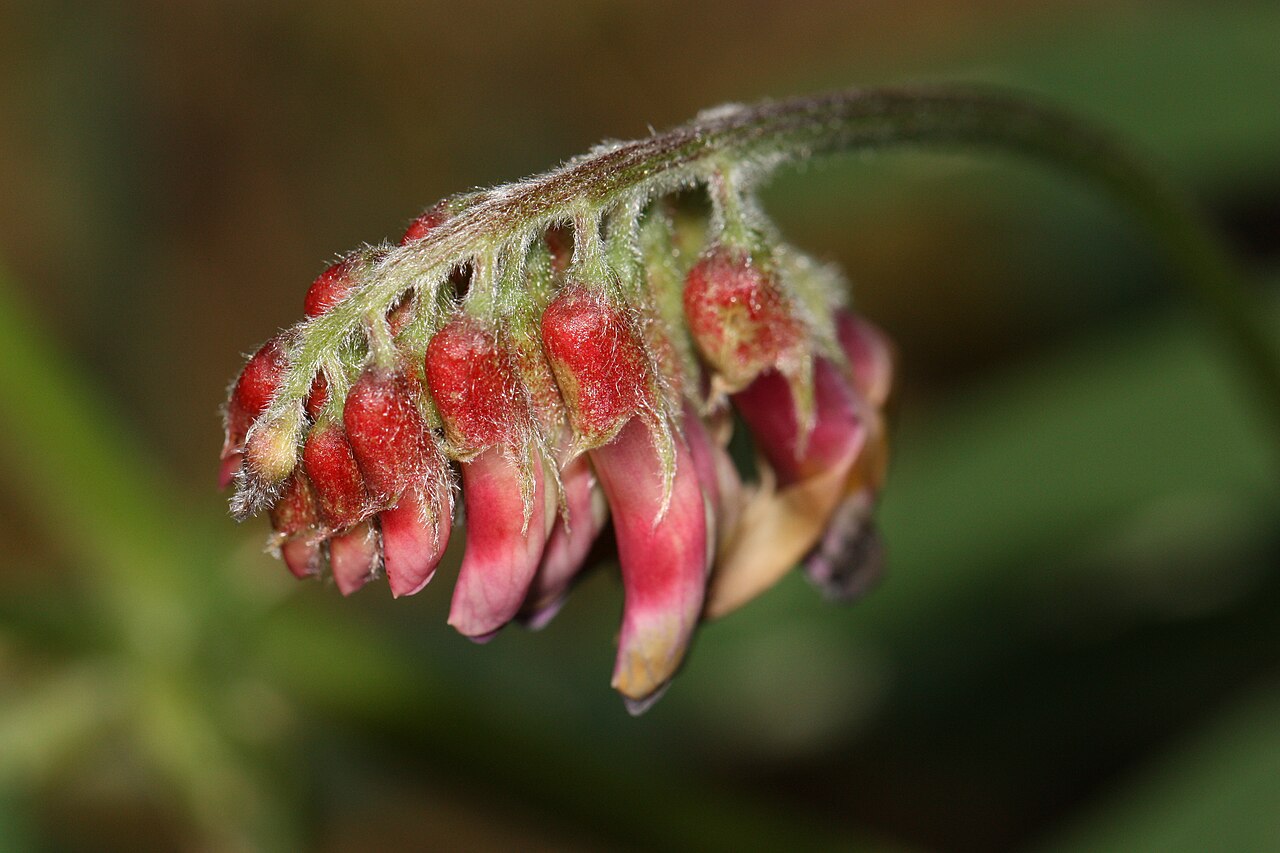
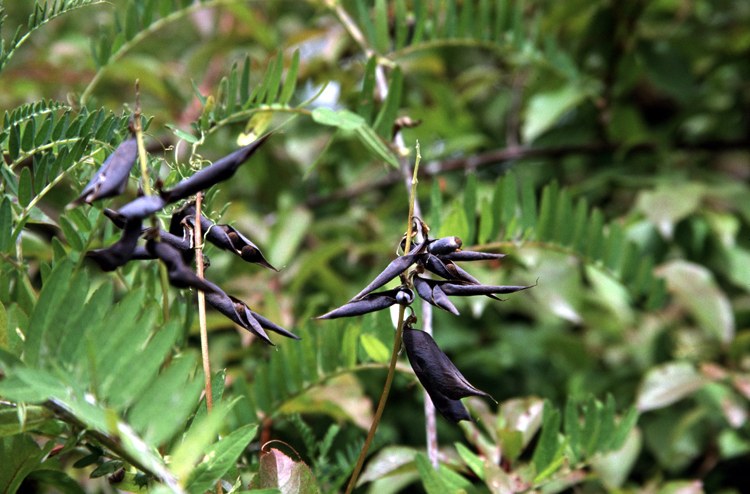
Giant vetch climbs with branched tendrils over shrubs, driftwood and fences, sending up stout, ridged stems that can reach about 6 feet. Its feathery leaves carry many pairs of narrow leaflets, and from spring into summer it hangs out dense, one-sided clusters of tubular flowers in an unusual mix of colors: pink, rose, dull red, and fading yellowish or orange-tan. The pods that follow turn jet black when ripe.
This is a plant of the coastal fog belt, growing from southern Alaska through British Columbia, Washington and Oregon to California. Look for it at beach margins, on headlands, in thickets and forest openings, and along streams near the sea. It is an excellent nectar plant for bumblebees and a useful nitrogen-fixing vine for wild gardens and coastal restoration.
Identification
Look for a big, tendril-climbing vine near the coast with many narrow leaflets per leaf and drooping, one-sided clusters of pinkish-red to yellowish tubular flowers that ripen into black pods.
Growth Habit
Giant vetch is a perennial herb that dies back to the ground in winter in colder spots and regrows each spring from a stout rootstock. The stems are thick for a vetch, hollow, ridged and often somewhat hairy. They scramble across the ground or climb 3 to 6 feet into shrubs and over logs, held by tendrils at the leaf tips. Large plants can form tangled patches several feet across.
Leaves
The leaves are pinnately compound and end in a branched tendril. Each leaf has roughly 9 to 13 pairs of leaflets (sometimes more), and the leaflets are lance-shaped to narrowly oblong, up to about 1 1/2 inches long, with a tiny point at the tip. The many closely spaced leaflets give the plant a fine, feathery look that is distinctive among Pacific Coast vetches.
Flowers
Flowers appear from about April to July, often starting earlier in California. They are borne in long-stalked, one-sided racemes of up to about 15 to 20 flowers that tend to droop. Each flower is a typical pea blossom about 1/2 to 3/4 inch long, with a hairy calyx about half as long as the corolla. Colors vary from pale pink and rose to dark reddish purple, and some flowers are yellowish or orange; individual flowers often fade from reddish to tan as they age, so one cluster can show several shades.
Fruit & Seeds
The fruit is a flattened legume pod up to about 1 1/2 inches long and roughly 1/2 inch wide. The pods are green at first and turn glossy black as they dry, then split open and twist to release round seeds in mid to late summer.
Look-alikes
American vetch (Vicia americana) is smaller and more delicate, with fewer leaflets (usually 4 to 8 pairs) and loose clusters of only a few purple flowers. Beach pea (Lathyrus japonicus) and Pacific pea (Lathyrus vestitus) have fewer, broader leaflets and larger, showier purple to lavender flowers. Introduced vetches such as hairy vetch (Vicia villosa) and bird vetch (Vicia cracca) have long, crowded clusters of violet-blue flowers rather than giant vetch’s pinkish-red to yellowish ones.
Safety Notes
Some coastal Indigenous peoples are reported to have eaten the young seeds, but many vetch seeds contain compounds that can be harmful in quantity, so do not treat giant vetch as a food plant. Keep pets and livestock from eating large amounts of the seeds.
Quick Facts
| Scientific Name | Vicia nigricans ssp. gigantea |
| Family | Fabaceae (pea family) |
| Plant Type | Herbaceous perennial vine |
| Mature Height | Climbing stems 3–6 ft long |
| Mature Spread | 3–6 ft |
| Growth Rate | Fast |
| Sun Exposure | Full sun to partial shade |
| Water Needs | Moderate; moist soil, tolerates summer-dry coastal sites |
| Soil Type | Sandy, loamy or gravelly; coastal soils |
| Soil pH | About 5.5–7.5 |
| Bloom Time | April–July (earlier in California) |
| Flower Color | Pink, rose, dull red, purplish or yellowish |
| Fall Color | None; stems die back |
| Fruit | Flat pods that turn black when ripe |
| Deer Resistant | No; browsed by deer |
| USDA Hardiness Zones | 6–9 |
Native Range
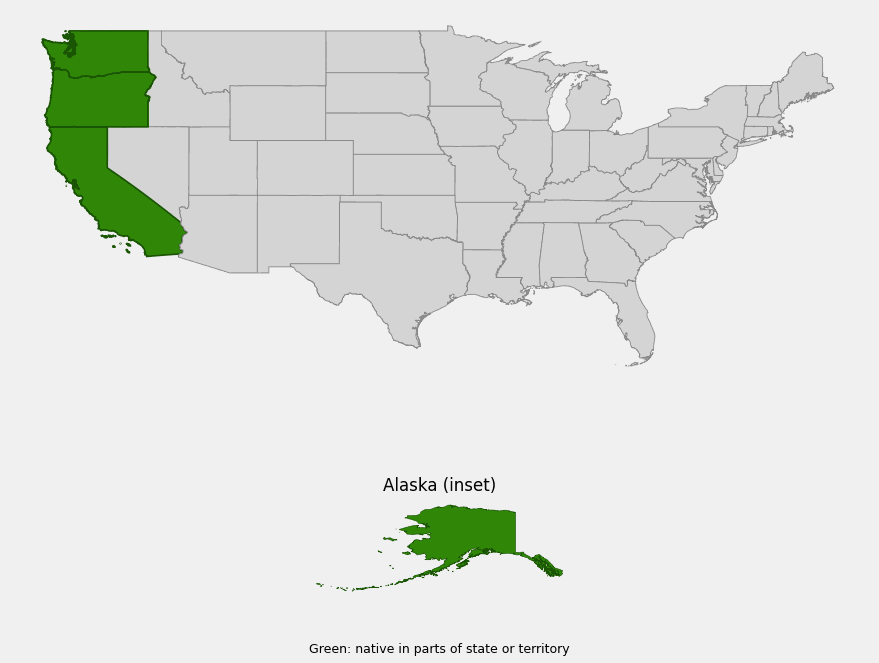
Giant vetch is native to the Pacific Coast of North America, from southern Alaska through coastal British Columbia to Washington, Oregon and California. USDA PLANTS lists it as native in Alaska, California, Oregon and Washington. The species as a whole has a striking split range: the other subspecies, Vicia nigricans ssp. nigricans, grows in Chile, thousands of miles to the south.
In Washington it occurs west of the Cascade crest in the coastal counties, and in Oregon it grows along the coast and inland to the Willamette Valley. In California it follows the coast and nearby hills from the Oregon border south through the North Coast and San Francisco Bay Area to the Central Coast. In Alaska and British Columbia it is a plant of the coastal fringe.
Typical habitats are beach margins and the edges of dunes, coastal bluffs and headlands, thickets, forest openings and clearings, and streambanks near the coast, mainly at low elevations. It favors moist, cool, foggy places and often climbs over salal, salmonberry, coyote bush and driftwood.
📋 Regional plant lists featuring Giant Vetch: Western Oregon & Western Washington · California & Nevada · Alaska
Growing & Care Guide
Giant vetch is seldom sold in nurseries, but native seed suppliers and native plant society sales in the Pacific Northwest and California sometimes offer it. It is easy to grow from seed and suits informal, wild corners near the coast where a vigorous vine has room to roam.
Light
Grow it in full sun to partial shade. It flowers best in sun, and in its natural setting it often climbs out of shade toward the light at forest edges.
Soil & Water
Giant vetch does well in sandy, loamy or gravelly soil with average fertility; like other legumes it fixes its own nitrogen, so rich soil is not needed. It prefers soil that stays somewhat moist in spring and early summer. Along the foggy coast it needs little or no summer water once established; farther inland, give it occasional deep watering in dry spells.
Planting Tips
Give it something to climb: a fence, trellis, brush pile, or sturdy native shrubs such as salal, coyote bush or Nootka rose. It mixes well with other coastal natives in a hedgerow or wildlife planting. Because it can sprawl over smaller plants, keep it away from delicate perennials.
Pruning & Maintenance
Cut the dead stems back in late fall or winter, or leave them in place as cover for insects. Pull or cut back stems that wander where you don’t want them. Do not fertilize.
Propagation
Grow it from seed. Collect the black pods just as they begin to split in summer. Like most vetches, the seeds have a hard coat; nick them or soak them in warm water overnight before sowing in fall or early spring. Seedlings grow quickly and often bloom in their second year. Established clumps can also be divided in early spring.
Landscape Uses
- Coastal wildlife gardens: a fast, flowering vine for fences, brush piles and hedgerows
- Bumblebee and pollinator gardens: long bloom of nectar-rich tubular flowers
- Restoration: coastal scrub, dune edges, forest openings and streambanks
- Soil improvement: fixes nitrogen with root nodule bacteria
- Naturalistic screening: covers stumps, logs and rough slopes in summer
Wildlife & Ecological Value
Giant vetch feeds pollinators for months and adds nitrogen and cover to coastal plant communities.
For Pollinators
Bumblebees are the main pollinators; they are strong enough to push open the pea-shaped flowers and reach the nectar inside. Other bees and butterflies also visit. Vetches in general are larval host plants for several small butterflies, including blues such as the silvery blue and western tailed-blue.
For Birds
The tangled stems give cover to small birds in coastal thickets, and seed-eating birds and quail may pick up seeds that fall from the split pods. Insects that live on the foliage are food for nesting songbirds.
For Mammals
Deer and elk browse the tender stems and leaves, and small mammals eat the seeds.
Ecosystem Role
Like other legumes, giant vetch hosts nitrogen-fixing bacteria in its root nodules, adding nitrogen to the sandy, poor soils of dunes and coastal bluffs. Its scrambling stems help stabilize loose soil on slopes and streambanks.
Cultural & Historical Uses
William Jackson Hooker described the North American plant as Vicia gigantea in the early 1800s, from specimens collected on the Northwest Coast, while Hooker and George Arnott described Vicia nigricans from Chile. Later botanists concluded that the two belong to one species, so the northern plant became Vicia nigricans ssp. gigantea. The name nigricans means “becoming black,” for the pods and the way the plant darkens as it dries.
The split between coastal North America and Chile is a well-known pattern in botany. A number of plants share it; one common explanation is that migrating birds carried seeds between the two regions long ago.
Ethnobotanical sources report that some Indigenous peoples of the Northwest Coast ate the young seeds of giant vetch, raw or cooked, much like peas. Today it is valued mostly as a wildflower and pollinator plant.
Frequently Asked Questions
Why is it called giant vetch?
It is the largest native vetch on the Pacific Coast, with stout stems that can climb about 6 feet and long, many-leafleted leaves.
What color are giant vetch flowers?
They vary from pink and rose to dull red, purplish, yellowish or orange-tan, and often fade from reddish to tan as they age, so one cluster can show several colors.
Is giant vetch invasive?
No. It is a native plant of the Pacific Coast. The weedy vetches that invade fields and roadsides there are introduced species such as hairy vetch and bird vetch.
Can I eat giant vetch seeds?
Some Indigenous peoples are reported to have eaten the young seeds, but many vetch seeds can be harmful in quantity, so it is best not to eat them.
Where does giant vetch grow?
It grows near the coast from southern Alaska and British Columbia through Washington and Oregon to California, at beach margins, on bluffs, in thickets and along streams.

Looking for a nursery that carries Giant Vetch?
Browse our native plant nursery directory: Alaska · California · Oregon · Washington

