
Interior Sandbar Willow (Salix interior)
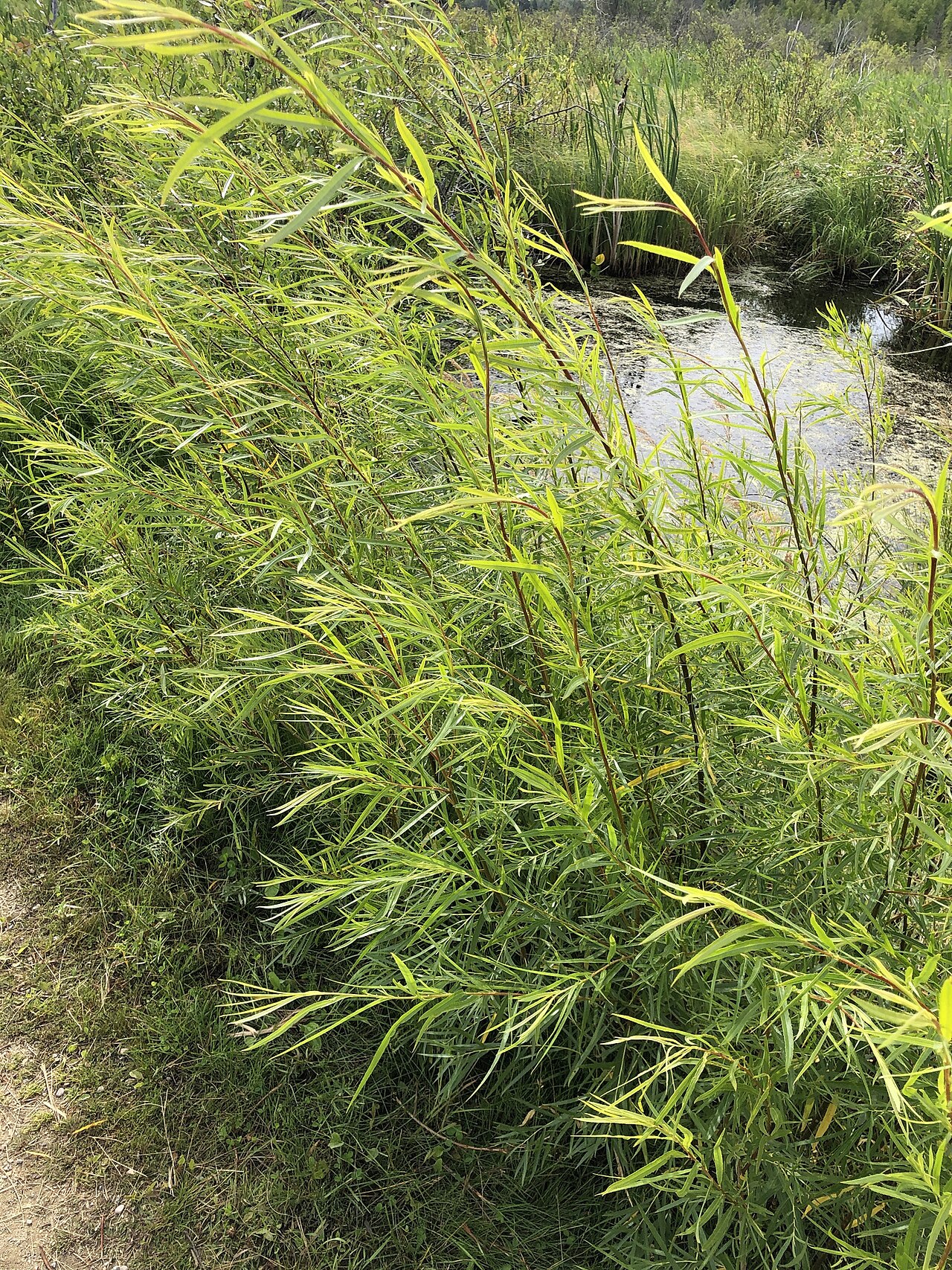
Salix interior, known as Interior Sandbar Willow or simply sandbar willow, is a fast-growing, thicket-forming shrub of riverbanks, sandbars and wet ditches across much of North America. It belongs to the willow family (Salicaceae). It ranges from Alaska and the Yukon across Canada and south through the Great Plains, the Midwest and the East to Louisiana and Mississippi.
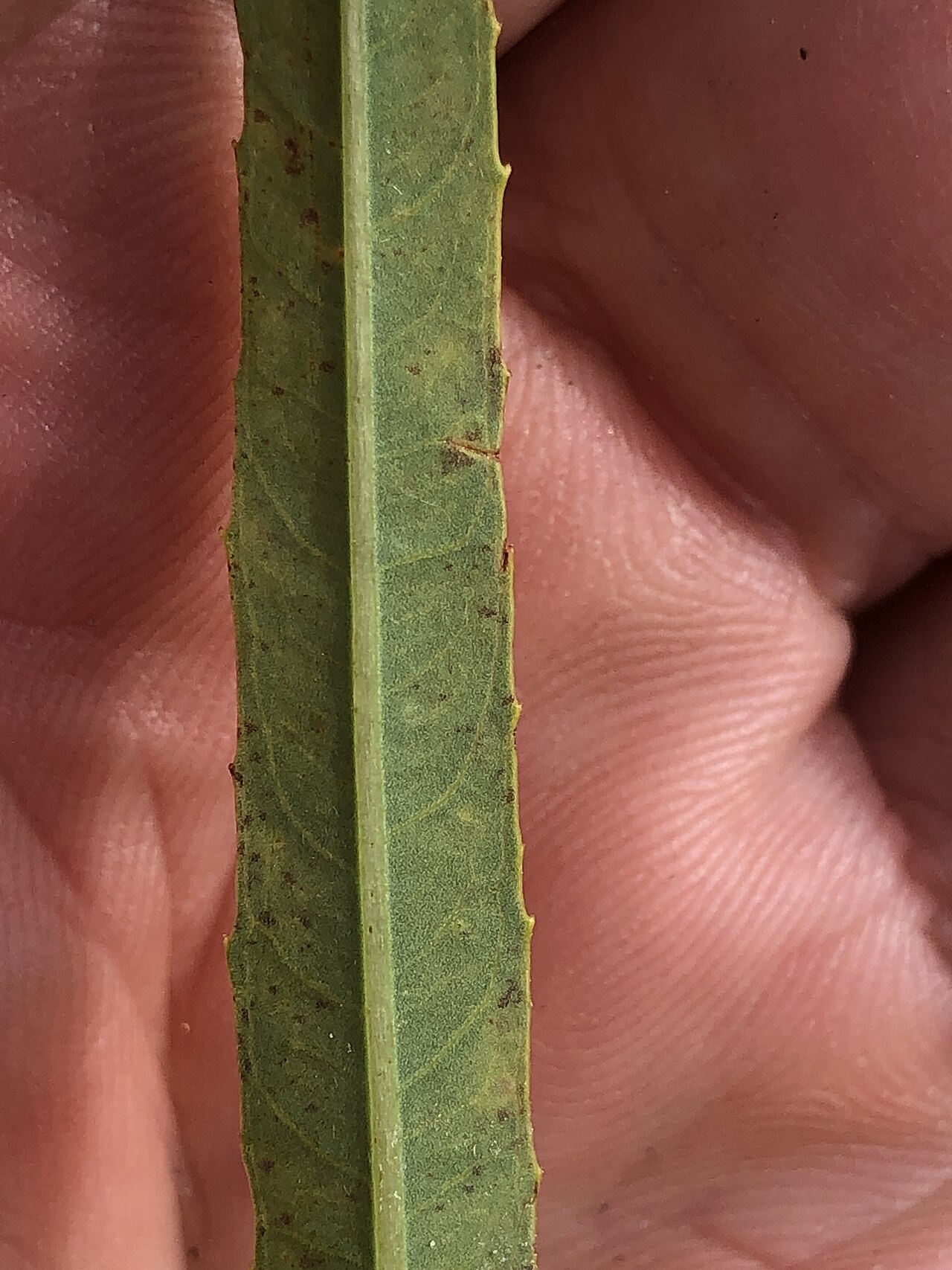
This willow has some of the narrowest leaves of any North American willow: long, linear blades many times longer than wide, with small, widely spaced teeth. It spreads by root suckers into dense colonies of slender stems, usually 6 to 15 feet tall. Catkins appear with the new leaves in spring, and plants often keep producing a few catkins into summer.
For decades many botanists treated this plant as a subspecies or variety of the western Sandbar Willow (Salix exigua), also called coyote or narrowleaf willow. USDA PLANTS and many current floras now treat the eastern, central and northern plants as their own species, Salix interior. It is one of the best native shrubs for stabilizing eroding streambanks and for wet, sunny restoration sites.
Identification
Look for a dense colony of slender, upright stems lining a river or sandbar, with very long, narrow leaves that have small, widely spaced teeth.
Growth Habit
Interior sandbar willow is a deciduous, multi-stemmed shrub, usually 6 to 15 feet tall and occasionally a small tree to about 25 feet. Roots spread just below the surface and send up new shoots, so a single plant becomes a thicket that can stretch for many yards along a bank. Young twigs are reddish brown to yellowish and flexible; older bark is gray-brown and smooth to slightly furrowed.
Leaves
The leaves are linear to narrowly lance-shaped, typically 2 to 6 inches long and often only 1/8 to 3/8 inch wide. The margins carry small, sharp, widely spaced teeth, each tipped with a tiny gland. Young leaves are often silky-hairy and grayish; mature leaves are green above and paler below, becoming nearly hairless. The leaves are attached by very short stalks and line the stems closely.
Flowers
Like all willows, it is dioecious: male and female catkins grow on separate plants. Catkins appear with or just after the new leaves, mostly from April to June, on short leafy shoots, and plants frequently bloom again in a smaller way through summer. Male catkins are yellow with pollen when open; female catkins are greenish and slender, 1 to 3 inches long.
Fruit & Seeds
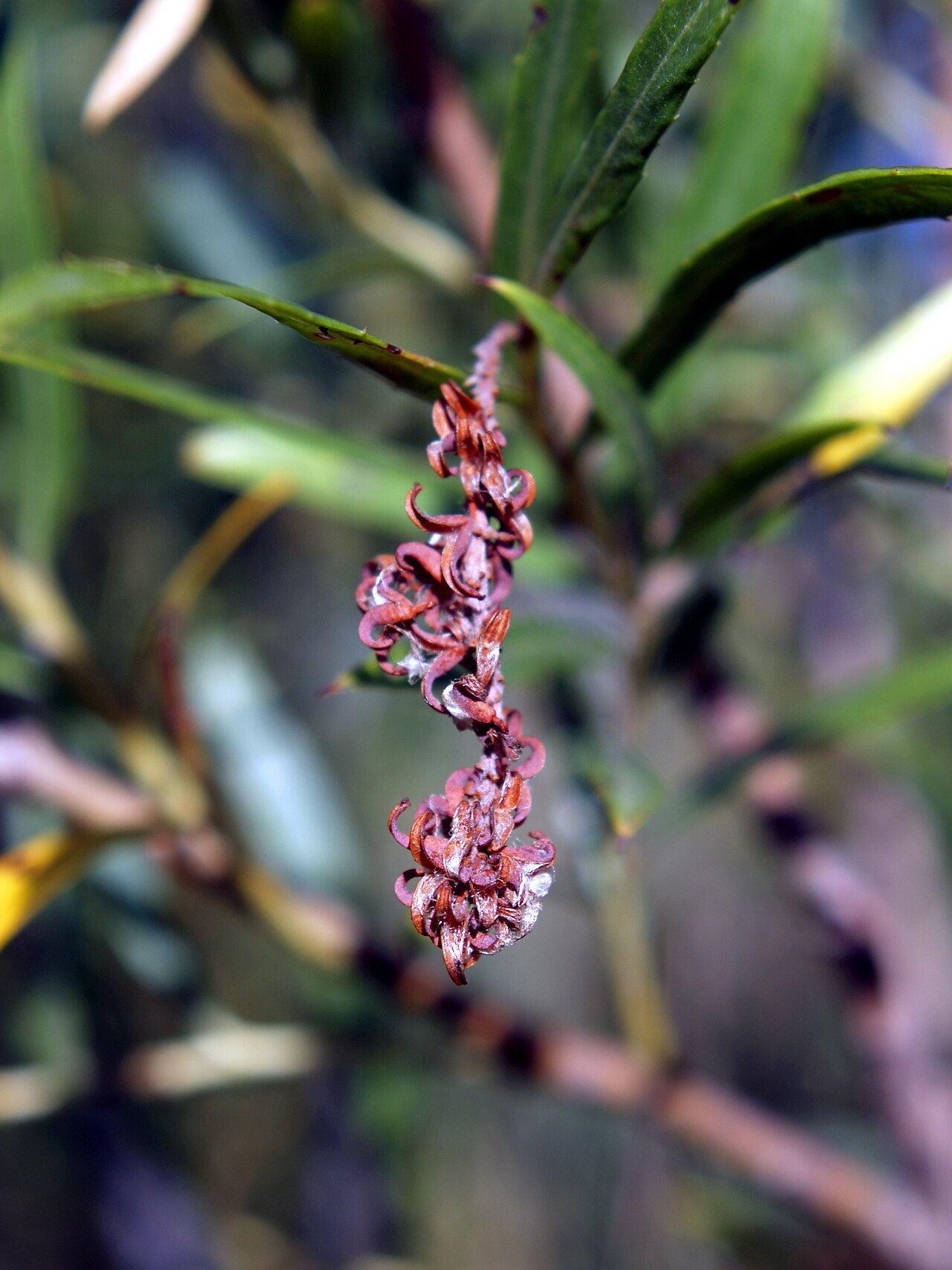
Female catkins ripen into clusters of small, narrow capsules that often turn reddish or brown, then split to release tiny seeds attached to silky white hairs. The seeds blow and float onto fresh, wet sand and mud, where they germinate within days. They lose viability quickly and are not stored in the soil.
Look-alikes
Sandbar willow (Salix exigua) of the West is the closest relative. Its leaves are usually toothless or have only a few minute teeth and are often grayer and silkier, and its range is mainly west of the Great Plains. Where the two meet in the Plains and the Rockies, intermediate plants occur. Black willow (Salix nigra) and Peachleaf willow (Salix amygdaloides) are trees with much wider, finely and evenly toothed leaves. Shrubby willows such as Heartleaf willow have broader leaves and do not form such extensive suckering colonies.
Safety Notes
Interior sandbar willow is not considered toxic. Like other willows, its bark contains salicin, a natural compound related to aspirin, so people who are sensitive to aspirin should avoid using it as a home remedy.
Quick Facts
| Scientific Name | Salix interior |
| Family | Salicaceae (willow family) |
| Plant Type | Deciduous, thicket-forming shrub |
| Mature Height | 6–15 ft (occasionally to 25 ft) |
| Mature Spread | Colony-forming; spreads indefinitely by suckers |
| Growth Rate | Fast |
| Sun Exposure | Full sun |
| Water Needs | High; moist to wet soil, tolerates flooding |
| Soil Type | Sand, gravel, silt or alluvial loam |
| Soil pH | About 6.0–8.0 |
| Bloom Time | April–June, with scattered catkins into summer |
| Flower Color | Yellow (male) or greenish (female) catkins |
| Fall Color | Yellow |
| Fruit | Small capsules releasing cottony seeds |
| Deer Resistant | No; browsed by deer, moose and beaver |
| USDA Hardiness Zones | 2–9 |
Native Range
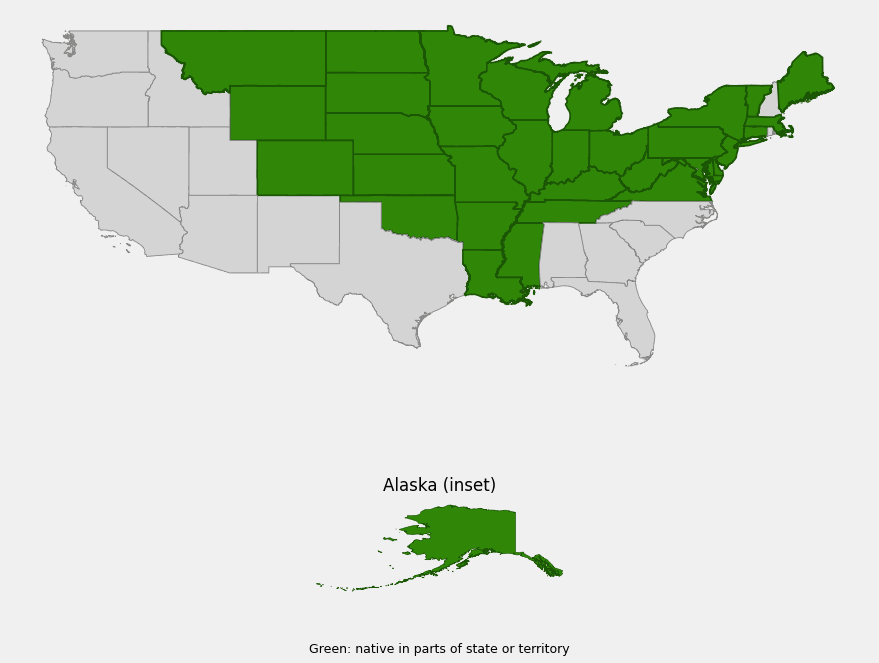
Interior sandbar willow has one of the widest ranges of any North American shrub. It grows from interior Alaska, the Yukon and the Northwest Territories east across the Canadian provinces to New Brunswick, and south through the Great Plains and the eastern United States. USDA PLANTS lists it as native in Alaska, Arkansas, Colorado, Connecticut, Delaware, Iowa, Illinois, Indiana, Kansas, Kentucky, Louisiana, Massachusetts, Maryland, Maine, Michigan, Minnesota, Missouri, Mississippi, Montana, North Dakota, Nebraska, New Jersey, New York, Ohio, Oklahoma, Pennsylvania, South Dakota, Tennessee, Virginia, Vermont, Wisconsin, West Virginia and Wyoming, plus the District of Columbia.
It is most common along the large rivers of the Midwest and Great Plains, including the Mississippi, Missouri, Ohio and Platte systems, and becomes more scattered toward the Atlantic coast. In eastern Colorado, Wyoming and Montana it reaches the western edge of its range, where it meets the western Salix exigua and the two can be hard to tell apart.
Its home is the shifting, sunny ground along water: sand and gravel bars, riverbanks, floodplain sloughs, lakeshores, wet ditches and roadside swales. It is one of the first woody plants to colonize newly deposited sand after floods, and its thickets trap silt and help build up new land along rivers.
📋 Regional plant lists featuring Interior Sandbar Willow: New York, Pennsylvania & Northern New Jersey · Ohio & Indiana · Montana & Wyoming · Michigan, Wisconsin & Eastern Minnesota · Kentucky & Tennessee · Nebraska, Kansas & Eastern Colorado · Connecticut, Massachusetts & Rhode Island · New Hampshire, Maine & Vermont · Maryland, Virginia & West Virginia · Delaware, Southern New Jersey & Long Island · Illinois, Iowa & Missouri · Alabama, Georgia & Mississippi · Alaska · Arkansas, Louisiana, Eastern Oklahoma & Eastern Texas · North Dakota, South Dakota & Western Minnesota
Growing & Care Guide
Interior sandbar willow is easy to establish and very fast-growing, but it spreads aggressively by suckers. Use it where you want a thicket, such as a streambank, pond edge or large rain garden, not in a small, formal bed.
Light
Plant it in full sun. It tolerates light shade but thins out and declines under a tree canopy, which is why it is replaced by taller trees as floodplain forests mature.
Soil & Water
It thrives in moist to wet sand, gravel or silt and tolerates seasonal flooding, burial by sediment and periods of standing water. Once established along a stream or pond it handles short dry spells, but it does not do well on dry upland soil. It grows in neutral to alkaline soils as well as moderately acidic ones.
Planting Tips
The classic way to plant it is with dormant live stakes: straight, 2- to 4-foot cuttings, about 1/2 to 1 inch thick, pushed or driven deep into moist bank soil in late fall to early spring so that most of the cutting is underground and the base reaches the water table. Plant stakes 2 to 3 feet apart for streambank work. Container plants can go in any time the ground is workable. Keep it well away from septic lines, drain tiles and foundations, as willow roots seek out water.
Pruning & Maintenance
Little care is needed. To keep a colony dense and low, cut some or all stems near the ground every few years in late winter; it resprouts vigorously. Remove suckers that spread beyond where you want them. Willows can be damaged by leaf beetles, rusts and cankers, but sandbar willow thickets usually outgrow the damage.
Propagation
It roots so easily from dormant hardwood cuttings that this is almost the only method used. Cuttings set in moist soil or even in a bucket of water root within a few weeks. Seed must be collected as capsules split in late spring and sown immediately on the surface of wet soil, because it stays viable for only days.
Landscape Uses
- Streambank stabilization: dense roots and flexible stems hold sand and silt along eroding banks
- Live staking and bioengineering: cuttings root readily in wattles, brush layers and live stakes
- Wetland and floodplain restoration: a pioneer shrub for sandbars, mitigation sites and wet swales
- Wildlife thickets: cover and nesting sites for songbirds near water
- Screening on wet ground: a quick, tall screen around ponds and drainage areas
Wildlife & Ecological Value
Interior sandbar willow thickets are busy wildlife habitat, providing early-season food for insects, browse for mammals and dense cover along water.
For Pollinators
The spring catkins supply pollen and nectar for native bees, including bumble bees and mining bees, at a time when few other plants are blooming. Willows as a group are major caterpillar host plants, supporting species such as the viceroy, mourning cloak and several sphinx moths, as well as many smaller moths and sawflies.
For Birds
Songbirds nest and forage in the thickets, which hold many insects. Riparian shrub nesters such as willow flycatchers, yellow warblers and Bell’s vireos use willow thickets along streams, and migrating warblers glean caterpillars and aphids from the leaves.
For Mammals
Beavers cut the stems for food and dam material, and the thickets resprout quickly after cutting. White-tailed deer, mule deer and moose browse the twigs and leaves, and rabbits and other small mammals shelter in the dense stems.
Ecosystem Role
As a pioneer of fresh sandbars and flood-scoured banks, it slows floodwater, traps sediment and stabilizes new land, paving the way for cottonwoods, other willows and later floodplain forest. Its shade cools stream edges, and its fallen leaves feed aquatic insects.
Cultural & Historical Uses
The species was described in 1900 by the American botanist William Rowlee as Salix interior, the name pointing to its range in the continent’s interior. Through the twentieth century it was often treated as Salix exigua var. interior or subsp. interior, part of a broad coyote willow complex. Many recent treatments, including USDA PLANTS, have returned it to species rank based on its toothed leaves, different hairs and largely separate range.
Its long, supple stems were used by Indigenous peoples of the Plains and Great Lakes regions for basket making, mats, fish traps and the frames of sweat lodges and other structures. The inner bark, like that of other willows, was used in traditional medicine for pain and fever.
Today interior sandbar willow is one of the standard plants for live staking and soil bioengineering. Conservation agencies use its cuttings by the thousands to stabilize streambanks, and wildlife agencies plant it for riparian cover.
Frequently Asked Questions
What is the difference between interior sandbar willow and sandbar willow (Salix exigua)?
Interior sandbar willow (Salix interior) grows across Alaska, Canada, the Great Plains and the eastern U.S. and has leaves with small, widely spaced teeth. Salix exigua, often called coyote or narrowleaf willow, is the western species with mostly toothless, grayer leaves. They were long treated as one species, and intermediate plants occur where their ranges meet.
Is interior sandbar willow invasive?
It is native, but it spreads aggressively by root suckers into large colonies. That makes it excellent for banks and wetlands and a poor choice for small gardens.
How fast does interior sandbar willow grow?
Very fast. Live stakes can grow several feet in their first season, and established colonies resprout quickly after cutting, flooding or beaver damage.
Can I plant it from cuttings?
Yes. Dormant cuttings pushed deep into moist soil in late fall to early spring root readily, which is why it is a favorite for live staking along streams.
Does interior sandbar willow need wet soil?
It does best in moist to wet sand or silt near water and tolerates flooding. It struggles on dry upland sites.

Looking for a nursery that carries Interior Sandbar Willow?
Browse our native plant nursery directory: Alaska & Arkansas · Colorado, Connecticut & Delaware · Illinois, Indiana, Iowa & Kansas · Kentucky, Louisiana, Maine, Maryland, Massachusetts, Michigan, Minnesota, Mississippi, Missouri & Montana · Nebraska, New Jersey, New York, North Dakota, Ohio & Oklahoma · Pennsylvania, South Dakota, Tennessee, Vermont & Virginia · West Virginia, Wisconsin & Wyoming

