Peachleaf Willow (Salix amygdaloides)
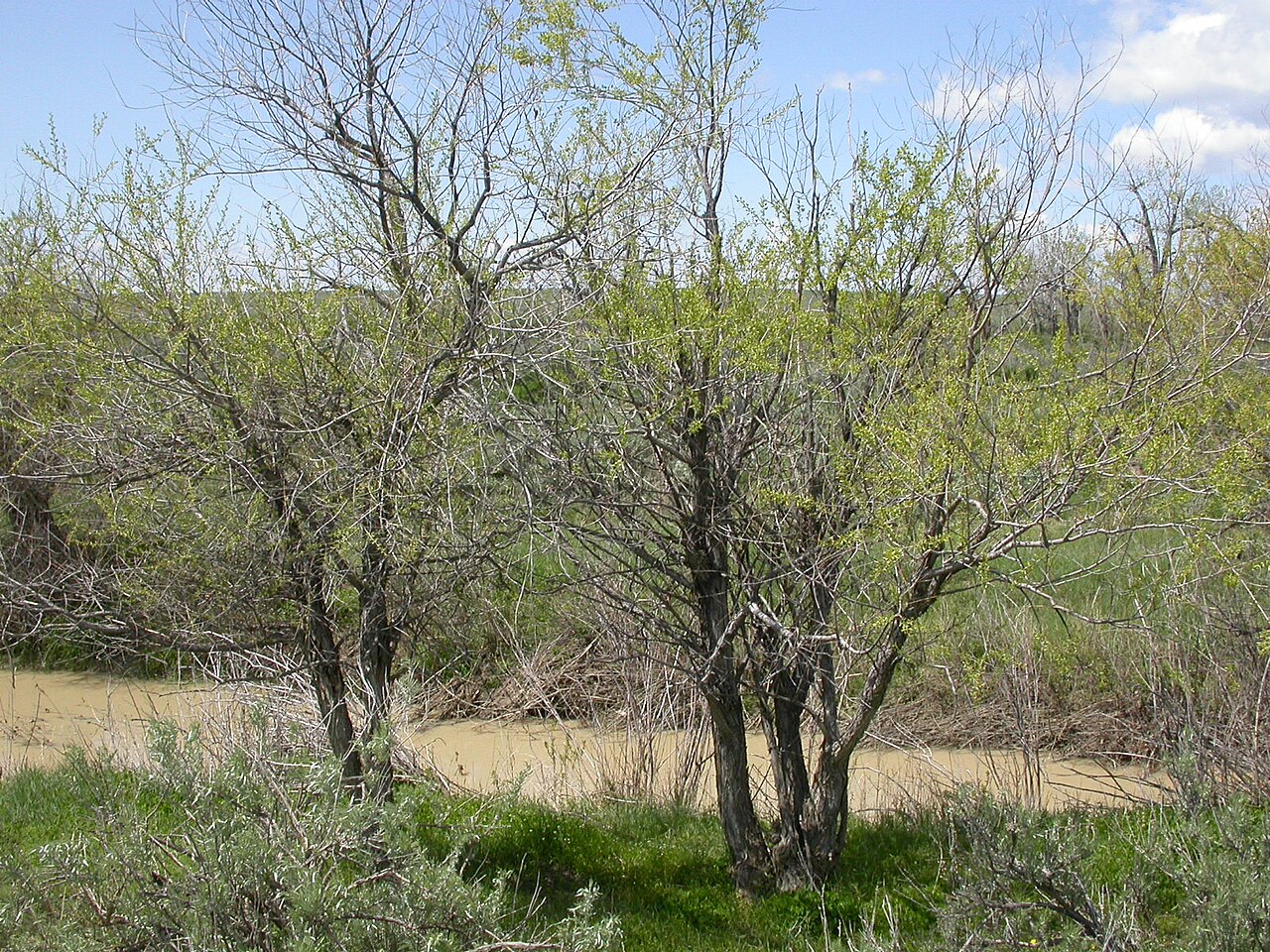
Salix amygdaloides, commonly known as Peachleaf Willow or almond-leaf willow, is the largest true willow native to the northern prairies — and, aside from the cottonwoods, the biggest native tree many prairie streams ever see. Named for leaves that echo the shape of a peach or almond leaf, it is a fast-growing, short-lived pioneer tree that stakes out riverbanks, lakeshores, and wet prairie drainages across a huge swath of central North America.
Growing anywhere from 13 to 66 feet (4–20 m) tall, Peachleaf Willow typically develops a single trunk, though multi-trunked individuals are common, especially on sites that have experienced ice damage, flooding, or browsing. Its yellowish-green, lance-shaped leaves with pale undersides flutter in the wind much like true peach or almond foliage, and its yellow catkins emerge alongside the leaves each spring, a reliable early signal that the prairie growing season has begun.
For restoration plantings, streambank stabilization, and wildlife habitat work across the Great Plains, Rocky Mountain foothills, and Upper Midwest, Peachleaf Willow is an exceptionally useful native tree — tolerant of wet soils, fast to establish, and valuable to an enormous range of wildlife. Its one real limitation is longevity: this is a tree built for speed and early riparian succession, not for permanence, and it is best used alongside longer-lived companions like cottonwood rather than as a sole canopy tree.
Identification
Peachleaf Willow is identified by its tree-like (rather than shrubby) growth form, its lance-shaped leaves with a notably pale, whitish underside, and its yellow spring catkins. Among the many willow species that share its riparian habitat, its larger stature and single (or few) trunk set it apart from the dense, multi-stemmed shrub willows more typical of streambanks.
Bark & Stems
Mature bark is gray-brown and develops furrows with age, while younger stems and twigs tend toward a yellowish to reddish-brown color, consistent with the genus Salix generally. The tree may grow with a single dominant trunk or, especially after storm or ice damage, several shorter co-dominant trunks arising from the same base.
Leaves
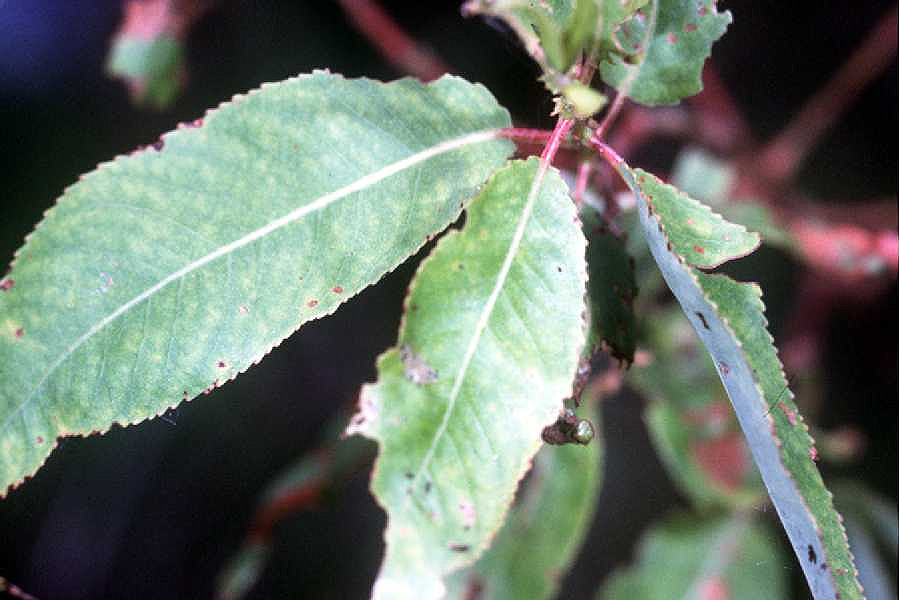
Leaves are lance-shaped (lanceolate), 1¼ to 5 inches (3–13 cm) long and ½ to 1½ inches (1–4 cm) wide, yellowish-green above with a notably pale, whitish underside and finely toothed (serrated) margins. The resemblance to peach or almond foliage — especially the pale leaf underside — gives the species both its common and scientific names (amygdaloides meaning “almond-like”).
Flowers
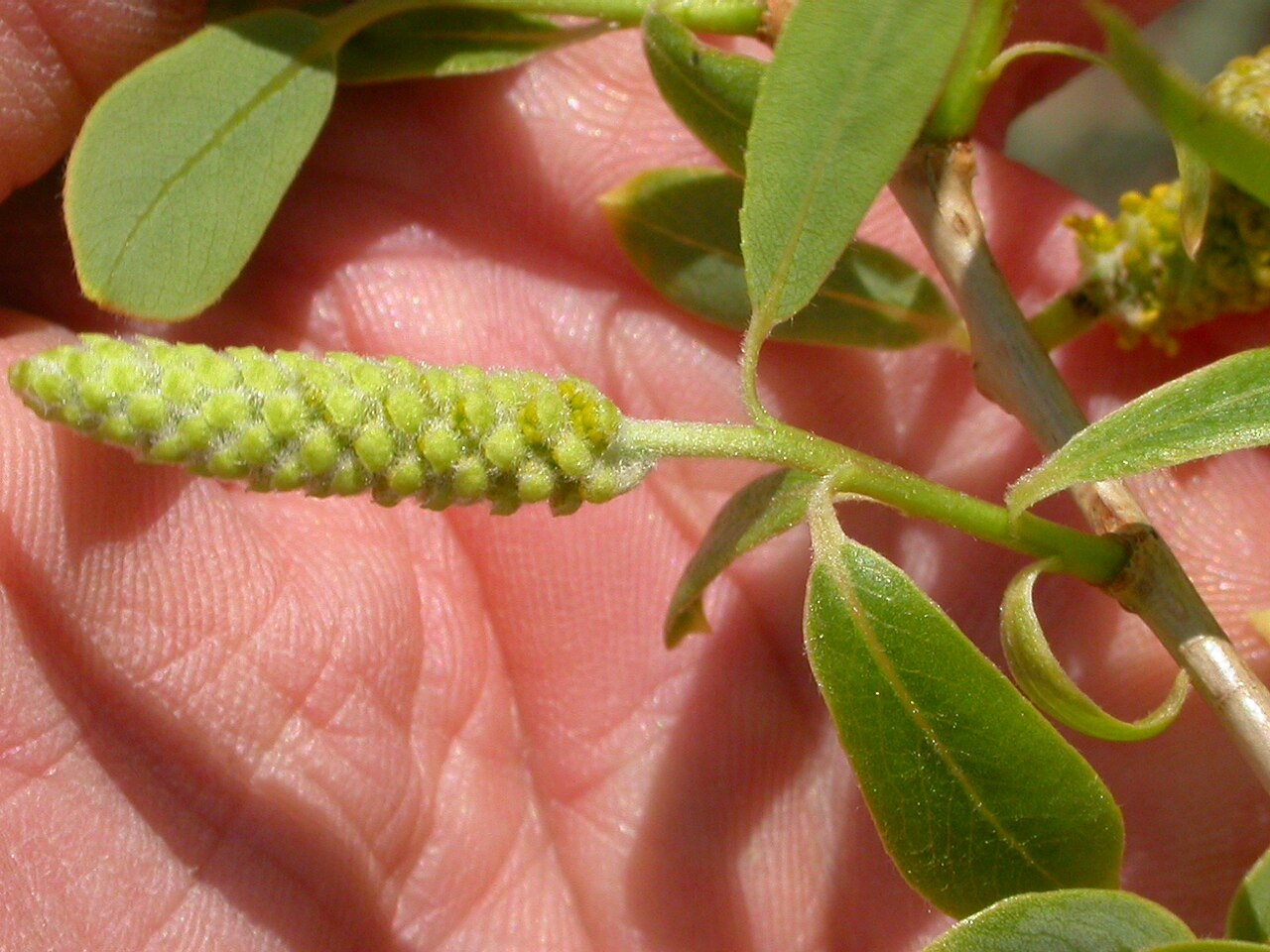
Like all willows, Peachleaf Willow is dioecious, with separate male and female plants. Flowers appear as yellow catkins, 1¼ to 3¼ inches (3–8 cm) long, emerging in spring alongside the new leaves — a slightly later bloom pattern than some of the earlier-flowering shrub willows that bloom before leaf-out.
Fruit & Seeds
The reddish-yellow fruit matures in late spring to early summer; each tiny capsule, about 3/16 to ¼ inch (4–6 mm) long, splits open to release numerous cottony-tufted seeds that disperse on the wind, a reproductive strategy shared with cottonwoods and shared across the willow family.
Quick Facts
| Scientific Name | Salix amygdaloides |
| Family | Salicaceae (Willow) |
| Plant Type | Deciduous tree |
| Mature Height | 13–66 ft (4–20 m) |
| Growth Rate | Fast |
| Sun Exposure | Full Sun |
| Water Needs | High (riparian, streamside, wet soils) |
| Soil Type | Moist to wet; sandy, silty, or loamy streambank and lakeshore soils |
| Soil pH | Adaptable; neutral to slightly alkaline tolerated |
| Bloom Time | Spring, with leaf emergence |
| Flower Color | Yellow |
| Fall Color | Pale yellow |
| Fruit | Reddish-yellow capsules with wind-dispersed, cottony seeds |
| Deer Resistant | No (browsed by deer, elk, and beaver) |
| USDA Hardiness Zones | 3–7 |
Native Range
Peachleaf Willow is native to central North America, east of the Cascade Range, spanning a vast area from southern Canada — British Columbia east to Quebec — south through much of the Rocky Mountain states, the Great Plains, and into the Midwest and Ohio Valley. It reaches its eastern limits around Kentucky and Ohio and extends south into Arizona and New Mexico along riparian corridors at higher elevations. It is presumed extirpated (locally extinct) in Kentucky as of recent state botanical surveys, marking the southeastern edge of a range that has contracted somewhat at its margins.
Throughout its range, Peachleaf Willow is a riparian specialist, found along streams, rivers, and lakeshores, often growing alongside — or giving way over time to — cottonwoods, which share its need for consistently moist soil and full sun. On the northern Great Plains, where tall trees are otherwise scarce, Peachleaf Willow and cottonwood are frequently the only trees of significant size along entire stretches of prairie waterway, making their presence disproportionately important to wildlife adapted to woodland structure in an otherwise open landscape.
Because it grows quickly and tolerates the fluctuating, flood-prone conditions typical of natural streambanks, Peachleaf Willow is also widely used in riparian restoration and streambank stabilization projects across its native range, extending its functional presence beyond naturally occurring populations into deliberately replanted riparian corridors.
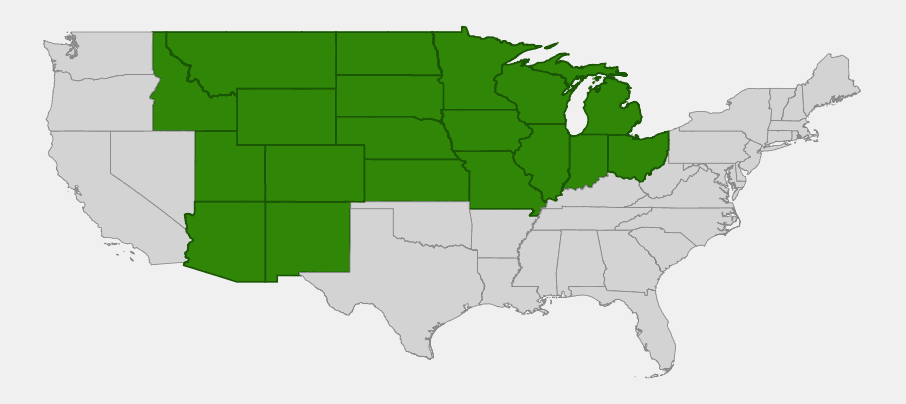
📋 Regional plant lists featuring Peachleaf Willow: Idaho, Eastern Oregon & Eastern Washington, Montana & Wyoming, Utah & Western Colorado, Arizona & New Mexico, Nebraska, Kansas & Eastern Colorado, North Dakota, South Dakota & Western Minnesota, Michigan, Wisconsin & Eastern Minnesota, Illinois, Iowa & Missouri, Ohio & Indiana
Growing & Care Guide
Peachleaf Willow is an easygoing, fast-establishing native tree for any site with reliably moist to wet soil and full sun — exactly the kind of location where many other landscape trees struggle.
Light
Full sun is essential. As a pioneer species of open streambanks and lakeshores, Peachleaf Willow does not perform well in shaded or understory conditions and will become thin and weak-stemmed without adequate light.
Soil & Water
This is a tree for consistently moist to wet sites: streambanks, pond and lake margins, low spots that collect runoff, or any location with a shallow water table. It tolerates occasional flooding well and is not a good match for dry upland soils, where it will struggle compared to true drought-adapted trees.
Planting Tips
Plant bare-root or container stock in fall or early spring near a reliable water source — streambank, pond edge, or low wet area. Because willows root readily from cuttings, live stakes (dormant branch cuttings pushed directly into moist soil) are a common, inexpensive propagation and restoration technique for this species, widely used in streambank stabilization work.
Pruning & Maintenance
Remove dead, damaged, or storm-broken branches as needed; this fast-growing, relatively weak-wooded tree is prone to breakage in ice storms and high wind, and periodic structural pruning when young can help reduce future damage. Because it is short-lived for a tree of its size, expect to eventually replace aging specimens with younger plantings as part of long-term riparian management.
Propagation
Propagate easily from dormant hardwood cuttings (live stakes) pushed into consistently moist soil, a method widely used in restoration plantings. Seed propagation is possible but more demanding, since willow seed loses viability within days to weeks and must be sown fresh on consistently moist, exposed soil.
Landscape Uses
- Streambank and shoreline stabilization — extensive roots help hold wet, erodible soils
- Riparian restoration plantings alongside cottonwood and shrub willows
- Wildlife habitat in wetland and pond-edge landscaping
- Fast shade near water features on larger rural properties
- Rain garden or bioswale anchor tree where consistent moisture is available
Wildlife & Ecological Value
Along prairie and foothill streams where tall trees are otherwise scarce, Peachleaf Willow provides a disproportionate share of the woody habitat structure that many wildlife species depend on.
For Birds
Peachleaf Willow provides nesting sites and cover for a wide range of riparian songbirds, including warblers, orioles, and flycatchers, while its early spring catkins offer one of the season’s first sources of pollen and nectar for insect-feeding birds arriving on spring migration.
For Mammals
Beaver readily use Peachleaf Willow for both food and dam/lodge construction material, and white-tailed deer, mule deer, and elk browse its foliage and twigs, particularly in winter when other browse is limited. Its riparian thickets also provide travel corridors and cover for a range of small mammals.
For Pollinators
As one of the earliest trees to flower in spring, Peachleaf Willow is an important early-season nectar and pollen source for native bees — including several specialist willow-associated bee species — as well as honeybees emerging from winter dormancy.
Ecosystem Role
As a fast-establishing pioneer species, Peachleaf Willow is often among the first trees to colonize newly exposed streambank or point-bar sediment after flooding, stabilizing soil and creating the shaded, structured conditions that allow longer-lived species like cottonwood to eventually establish. This successional role makes it a foundational species in the natural regeneration of prairie riparian corridors.
Cultural & Historical Uses
Like many willows, Peachleaf Willow’s flexible young branches and fibrous inner bark were historically used by Indigenous peoples across the Great Plains and Rocky Mountain region for basketry, cordage, and other practical woven items, following widespread traditional uses of willow species across North America. Willow bark generally also has a long history of use in traditional remedies, owing to naturally occurring salicin, a compound chemically related to the active ingredient in aspirin — though this page does not endorse any medicinal use, and such historical practices should be understood as history rather than guidance.
Settlers and ranchers on the northern Great Plains valued Peachleaf Willow, along with cottonwood, as one of the only sources of significant shade and windbreak structure in an otherwise largely treeless prairie landscape, and it was often left standing or even encouraged along homestead waterways for exactly that reason.
Today, the species’ primary practical value lies in restoration and conservation work: its fast growth, ease of propagation from cuttings, and tolerance of flood-prone soils make it one of the most widely used native trees in Great Plains and Rocky Mountain streambank stabilization and riparian habitat restoration projects.
Frequently Asked Questions
How is Peachleaf Willow different from other willows along the same stream?
Most willows sharing its riparian habitat are multi-stemmed shrubs, while Peachleaf Willow grows as a true tree with a single or few trunks, often reaching considerably taller than shrub willows like sandbar willow. Its pale, whitish leaf undersides are also a useful field mark.
How fast does Peachleaf Willow grow, and how long does it live?
It is a fast-growing tree, among the quickest of the prairie’s native trees to reach significant size, but it is correspondingly short-lived compared to cottonwood or bur oak. Plan for it as an early-successional, relatively short-lived component of a riparian planting rather than a permanent canopy tree.
Does Peachleaf Willow need to be right next to water?
It performs best with consistent access to soil moisture, which in practice usually means proximity to a stream, pond, lake, or area with a high water table. It is not a good choice for average garden soil that dries out between rains.
Is Peachleaf Willow good for erosion control?
Yes — its extensive, fibrous root system and ease of propagation from live stake cuttings make it one of the most commonly used native trees for stabilizing eroding streambanks across its range.
Can Peachleaf Willow be propagated by just sticking a cutting in the ground?
Yes, this is a standard and reliable method. Dormant hardwood cuttings (“live stakes”) pushed into consistently moist soil will often root and establish without special treatment, which is part of why this species is so widely used in restoration plantings.

Looking for a nursery that carries Peachleaf Willow?
Browse our native plant nursery directory: AZ · CO · ID, IL, IN, IA, KS · MI, MN, MO, MT · NE, NM, ND, OH · SD, UT · WI, WY