
Island Bush Snapdragon (Gambelia speciosa)
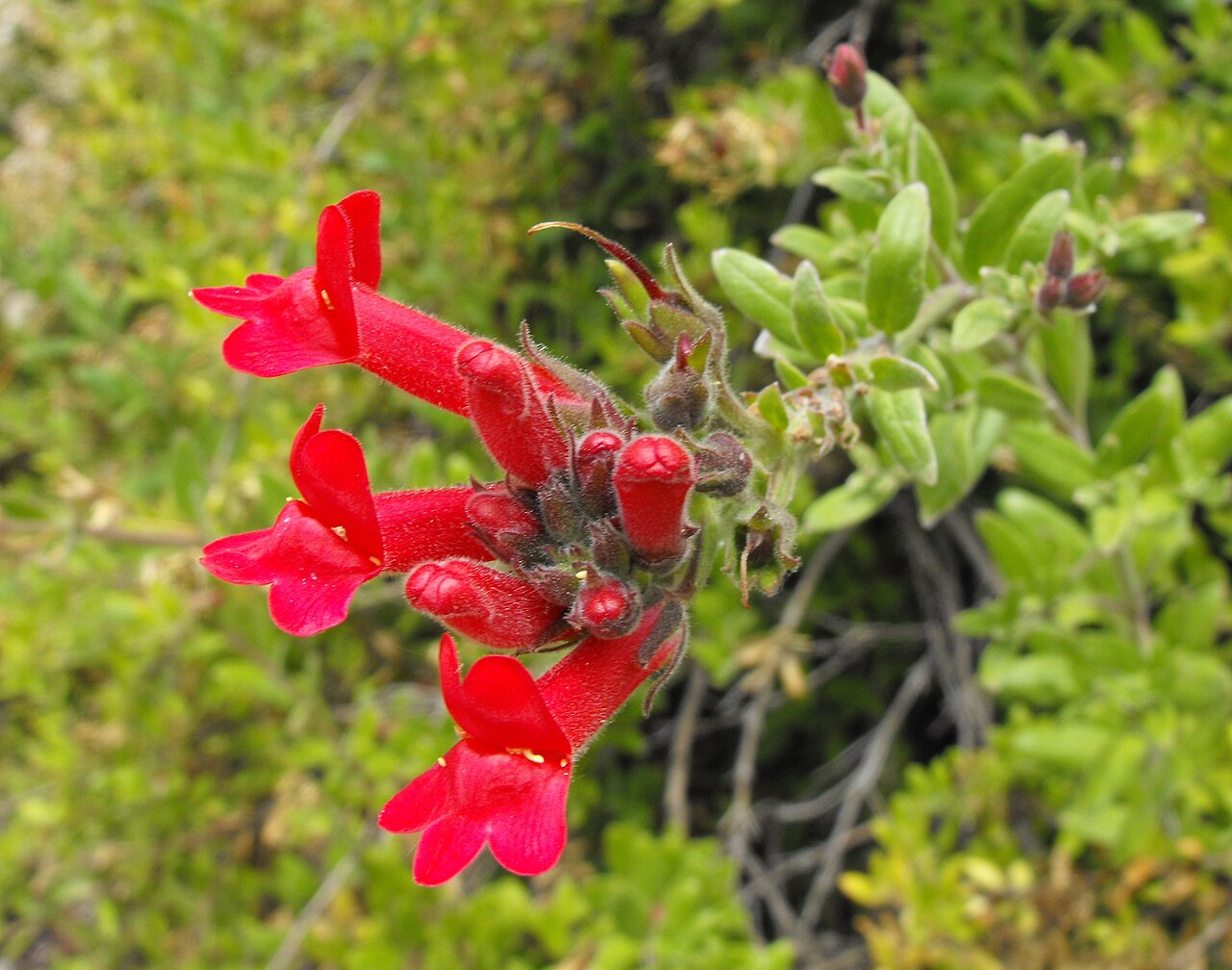
Gambelia speciosa, the Island Bush Snapdragon (also called showy island snapdragon or showy greenbright, and formerly Galvezia speciosa), is an evergreen shrub native to the southern California Channel Islands and Mexico’s Guadalupe Island. In the wild it grows on rocky cliffs, canyon walls and slopes in coastal scrub and chaparral, and it is rare there.
It is a sprawling to mounding shrub with bright green leaves and scarlet, tubular, two-lipped flowers that look like small snapdragons. It blooms over a long season, mainly in late winter and spring and often again later, and is a magnet for hummingbirds.
Although it is rare in nature, island bush snapdragon is a popular, easy-care plant in California native gardens, where it is grown from nursery stock. This guide covers how to identify it, where it grows wild, how to grow it and its value to wildlife.
Identification
Island bush snapdragon is a loose, evergreen shrub with oval, bright green leaves and red, tubular flowers clustered at the stem tips.
Form & Leaves
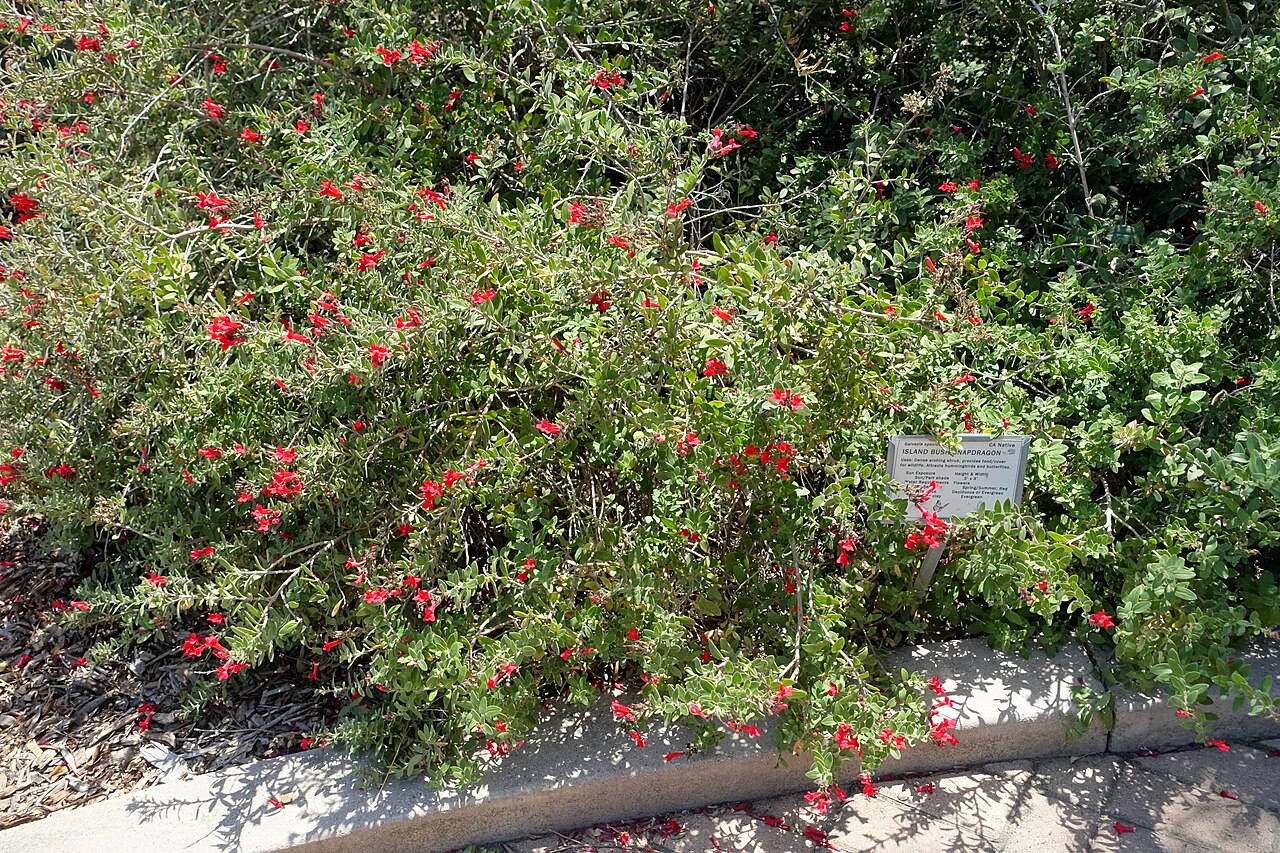
It grows 3 to 5 feet tall and spreads 4 to 8 feet, with long, arching or sprawling branches that may climb through neighboring shrubs or cascade over rocks. The leaves are opposite or in whorls of three, oval to elliptic, about ½ to 1½ inches long, bright green and often slightly hairy or sticky. Plants from different islands vary in hairiness.
Flowers
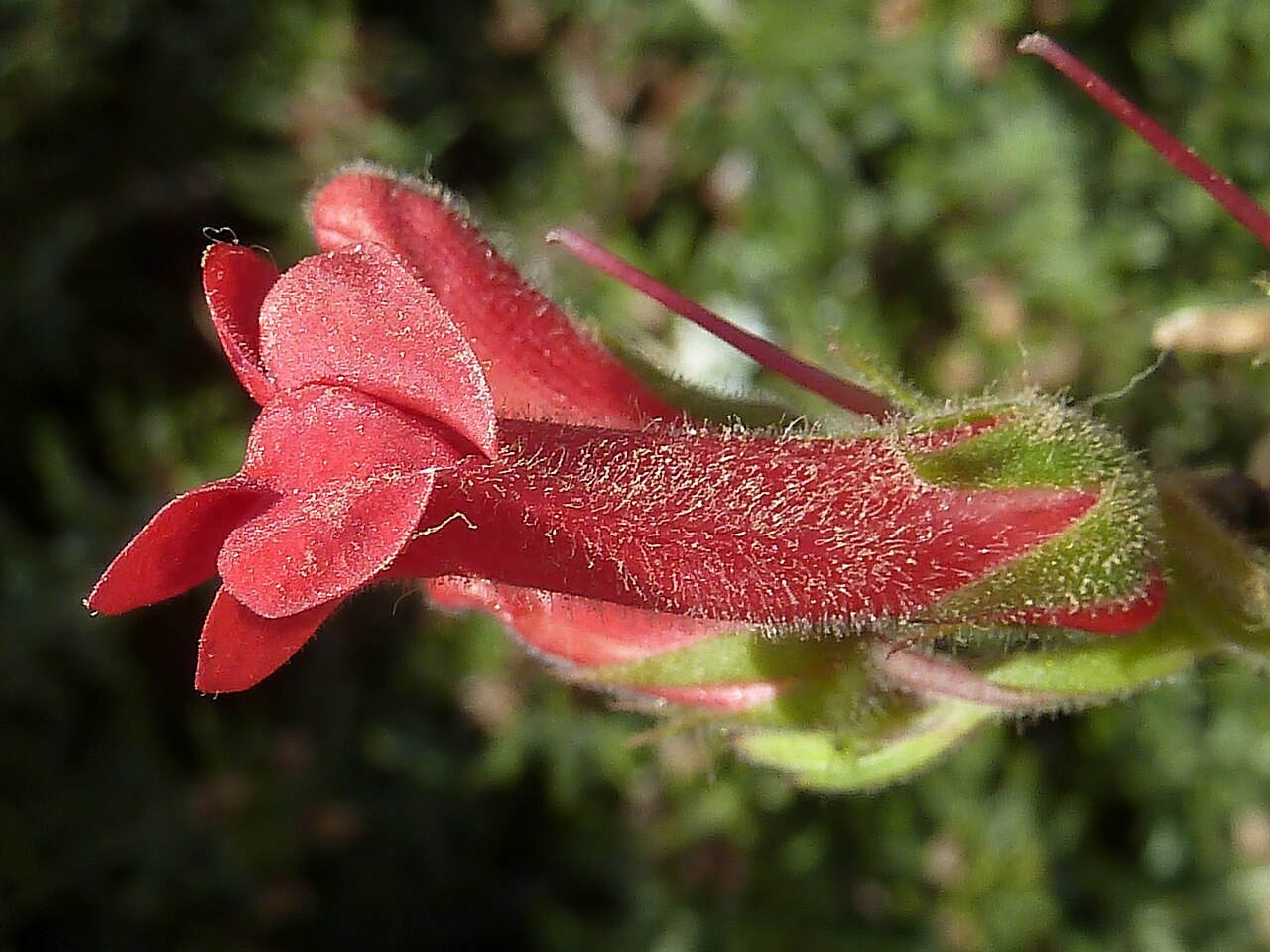
The flowers are borne in loose clusters at the ends of the branches. Each is a narrow, bright red tube about 1 inch long, with a short, two-lipped mouth like a snapdragon and a slight pouch at the base. The outside is finely velvety. Garden selections include pink-flowered forms. Flowering peaks from about February to June, with scattered flowers through much of the year in mild gardens.
Fruit
The fruit is a small, rounded capsule that opens by small pores at the top to release tiny seeds. It is often surrounded by the persistent calyx.
Look-alikes
Red-flowered Red Bush Monkeyflower has wider, flaring flowers with five spreading lobes and sticky, narrow leaves. California Fuchsia has longer, trumpet-shaped red flowers with protruding stamens and blooms in late summer and fall. Heart-leaved Penstemon is a climbing shrub with heart-shaped leaves and red-orange flowers in summer.
Quick Facts
| Scientific Name | Gambelia speciosa Nutt. (syn. Galvezia speciosa) |
| Family | Plantaginaceae (plantain family) |
| Plant Type | Evergreen shrub |
| Mature Height | 3–5 ft |
| Mature Spread | 4–8 ft |
| Growth Rate | Moderate to fast |
| Sun Exposure | Full sun to partial shade |
| Water Needs | Low; drought tolerant once established |
| Soil Type | Well-drained sandy, rocky or loamy soil |
| Soil pH | About 6.0–8.0 |
| Bloom Time | February–June, sporadically year-round |
| Flower Color | Scarlet red (pink selections exist) |
| Fall Color | None (evergreen) |
| Fruit | Small rounded capsule |
| Deer Resistant | Moderate |
| USDA Hardiness Zones | 9–11 |
Native Range
Island bush snapdragon is native to the southern California Channel Islands, chiefly Santa Catalina Island and San Clemente Island, and to Guadalupe Island off the coast of Baja California, Mexico. USDA PLANTS lists it in California only. It does not grow wild on the mainland, although it is widely planted in mainland gardens.
In the wild it grows on rocky cliffs, steep canyon walls, coastal bluffs and rocky slopes in coastal sage scrub and chaparral, often where its roots can reach moisture in rock crevices. It is listed in the California Native Plant Society’s Inventory of Rare and Endangered Plants (rank 1B), and decades of grazing by feral goats and other introduced animals on the islands reduced it to small, scattered populations on cliffs out of their reach.
Since the removal of feral goats from San Clemente Island and the reduction of grazing animals on Santa Catalina Island, many island plants, including this one, have begun to recover.
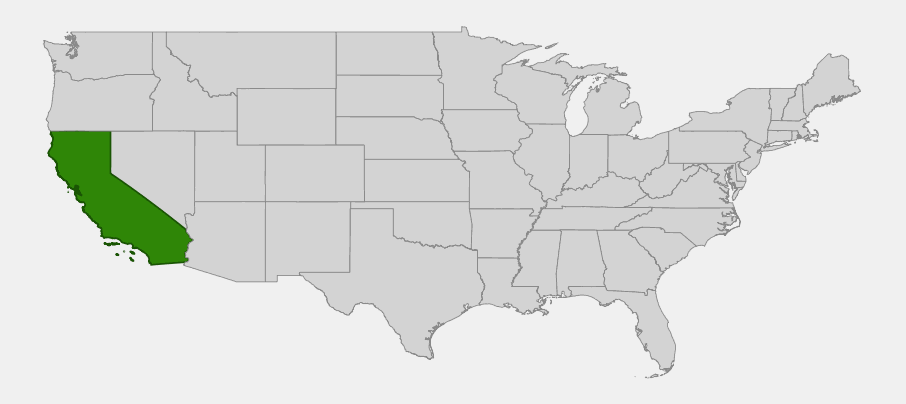
📋 Regional plant lists featuring Island Bush Snapdragon: California & Nevada
Growing & Care Guide
Island bush snapdragon is widely available from California native plant nurseries and is one of the easiest native shrubs for hummingbird gardens in mild coastal and inland California. Buy nursery-propagated plants; never collect from the rare wild populations on the islands. It suits zones 9 to 11 and tolerates light frost, recovering from brief dips to the mid-20s °F.
Light
Full sun near the coast; partial or afternoon shade inland, where it stays greener and fuller in summer heat. It is one of the better native flowering shrubs for light shade.
Soil & Water
It does best in well-drained soil and tolerates sand, rocky soil and clay if drainage is adequate. Once established, it needs only occasional deep watering in summer, every two to four weeks inland and less near the coast. Overwatering in heavy soil can cause root rot.
Planting Tips
Plant in fall or winter, 4 to 6 feet apart. Its sprawling habit suits slopes, the tops of walls and large containers, where it can cascade, or it can be trained against a fence. Pair it with sages, buckwheats and other low-water natives.
Pruning & Maintenance
Prune lightly after the main flush of flowers to keep it compact and encourage more blooms. Cut back older, woody stems by about one-third every few years to renew it. It has few pest problems.
Propagation
It roots easily from tip cuttings taken in spring or fall. Seed can be surface-sown in fall or winter and kept moist; it germinates without special treatment but is slower than cuttings.
Landscape Uses
- Hummingbird gardens: long-blooming scarlet flowers
- Slopes and walls: sprawling branches cascade over rocks
- Low-water native gardens: drought tolerant once established
- Light shade plantings: flowers well with afternoon shade
Wildlife & Ecological Value
Island bush snapdragon is a classic hummingbird flower and a valuable nectar source over a long season.
For Pollinators
Its red, tubular flowers are adapted for pollination by hummingbirds, especially Anna’s and Allen’s hummingbirds, which visit through much of the year.
For Birds
Beyond hummingbirds, the dense, evergreen branches give cover to small songbirds in gardens and on the islands.
For Mammals
The islands have few native mammals; the endemic island fox and deer mice may use the shrubs for cover. In gardens, deer browse it occasionally.
Ecosystem Role
On the Channel Islands, it is part of the cliff and canyon scrub community that survived on ledges out of reach of feral grazing animals. Its recovery is one sign of how island vegetation responds after grazing animals are removed.
Cultural & Historical Uses
Thomas Nuttall described the plant in 1848 as Gambelia speciosa, naming the genus for William Gambel, a young American naturalist and ornithologist who collected in California. It was later moved to Galvezia, and DNA studies have since returned it to Gambelia. Most nursery labels and older books still call it Galvezia speciosa.
The species name speciosa means “showy.” The common name “greenbright” is used in some references, but most gardeners know it as island snapdragon or island bush snapdragon.
Selections such as ‘Firecracker’, a compact red form, and ‘Boca Rosa’, with pink flowers, are widely sold for California gardens.
Frequently Asked Questions
Is island bush snapdragon native to California?
Yes. It is native to the southern Channel Islands of California, chiefly Santa Catalina and San Clemente islands, and to Guadalupe Island in Mexico.
Does island bush snapdragon attract hummingbirds?
Yes. Its red, tubular flowers are designed for hummingbirds, and it blooms over a long season.
Is island bush snapdragon rare?
In the wild, yes. It is on the California Native Plant Society’s rare plant list. In gardens it is common, grown from nursery stock.
How much water does island bush snapdragon need?
Little once established: occasional deep watering in summer inland, and less near the coast. Avoid overwatering in heavy soil.
What is the difference between Gambelia speciosa and Galvezia speciosa?
They are the same plant. Galvezia speciosa is the older name, and Gambelia speciosa is the currently accepted name.

Looking for a nursery that carries Island Bush Snapdragon?
Browse our native plant nursery directory: California

