
Lopsided Star Orchid (Epidendrum secundum)
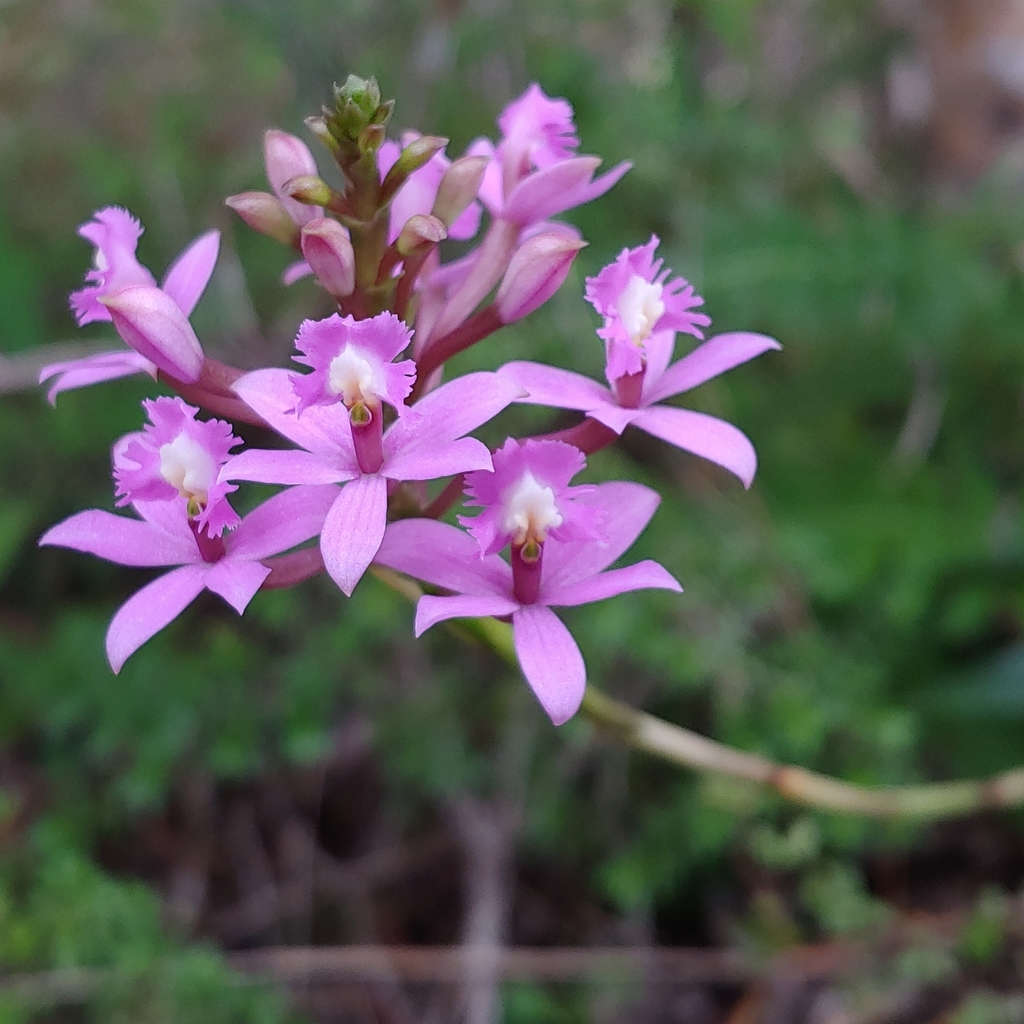
Epidendrum secundum, known as Lopsided Star Orchid, is a reed-stemmed orchid of open, sunny places in the mountains of Puerto Rico and across tropical America. It is one of the “crucifix orchids,” named for the small cross-shaped lip in the center of each flower. Its slender, cane-like stems, 1 to 4 feet tall and leafy along their length, end in a long, wiry stalk topped by a rounded cluster of small pink to purple flowers that keeps blooming for months.
In the United States it grows wild only in Puerto Rico, where it is found in the Cordillera Central and the western mountains, on road banks, rock outcrops, landslides and open slopes, often in the serpentine forests around Maricao. Outside Puerto Rico it ranges through the West Indies and from Central America south through the Andes and Brazil to Bolivia and Argentina.
Lopsided star orchid and its close relatives are among the easiest orchids to grow. Gardeners in frost-free climates grow them in the ground like perennials, and elsewhere they make tough, sun-loving container plants and houseplants. This guide covers how to identify it, where it grows in Puerto Rico, how to grow it outdoors and indoors, and its role in the wild.
Identification
Reed-stemmed Epidendrum orchids all look rather alike. The lopsided star orchid stands out by its usually pink to lilac flowers in a dense, rounded head, with a deeply fringed, three-lobed lip bearing a yellowish or white callus.
Leaves & Growth Habit
A terrestrial or rock-dwelling orchid that forms clumps of slender, upright, cane-like stems 1 to 4 feet tall, without pseudobulbs. The stems are covered by overlapping leaf sheaths and carry two rows of thick, leathery, oblong leaves 1½ to 4 inches long along their upper part. Plantlets (keikis) with their own roots often sprout from the stems and flower stalks.
Flowers
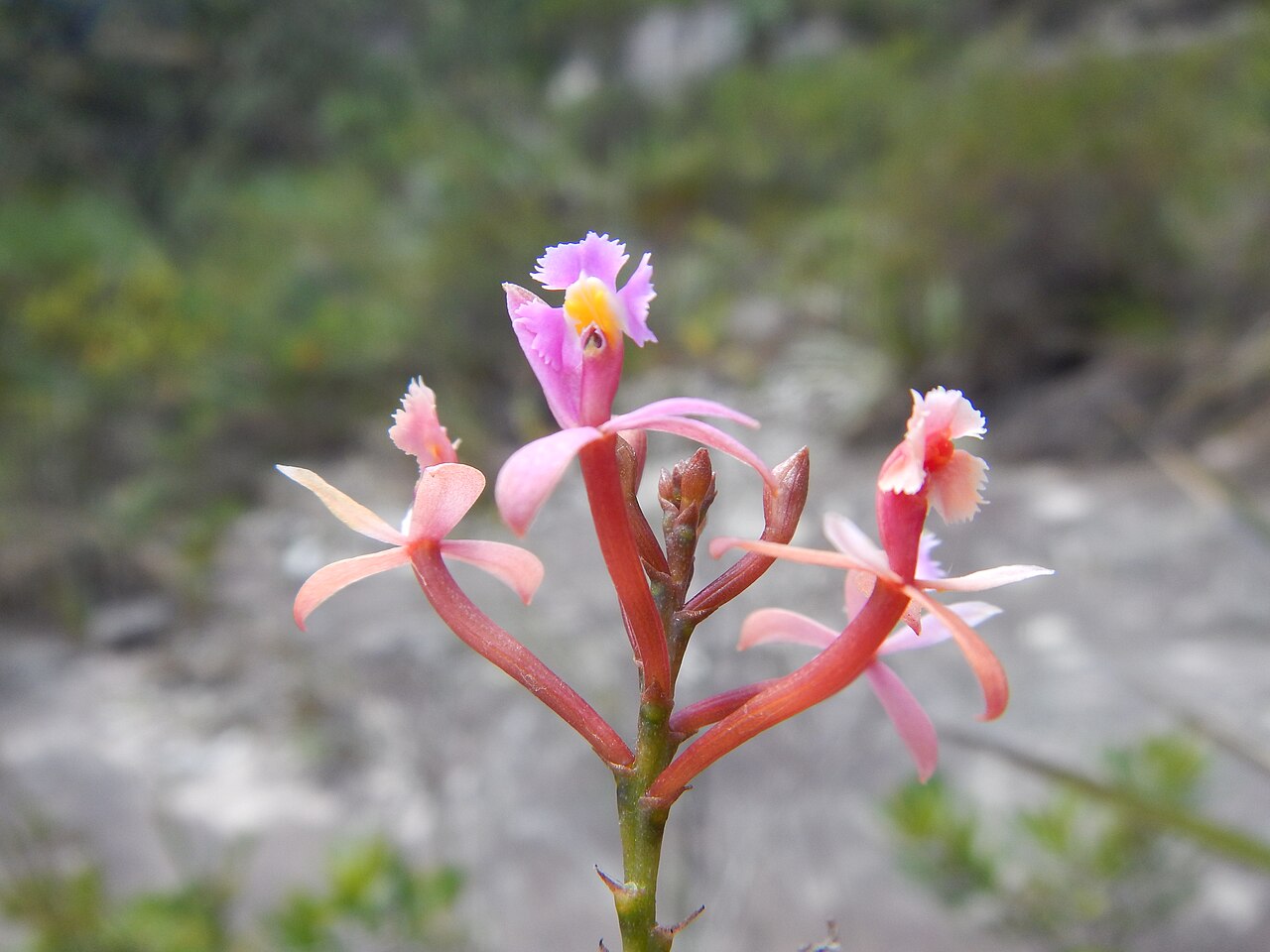
The flowering stalk is long and leafless, covered at its base with thin sheaths, and ends in a dense, rounded to slightly elongated cluster of many flowers, each about ¾ inch across. New buds keep opening at the tip, so a single stalk can bloom for months, and plants flower in almost any season. The flowers are non-resupinate, meaning the lip is held at the top of the flower rather than the bottom, and they are usually pink, magenta or lilac, but in parts of the range red, orange or yellow.
Lip
The lip is joined to the column all the way to its tip and is divided into three lobes with finely fringed or toothed edges, forming the small “crucifix.” At its center is a raised, warty callus, often yellow or white, which contrasts with the petals.
Fruit & Look-alikes
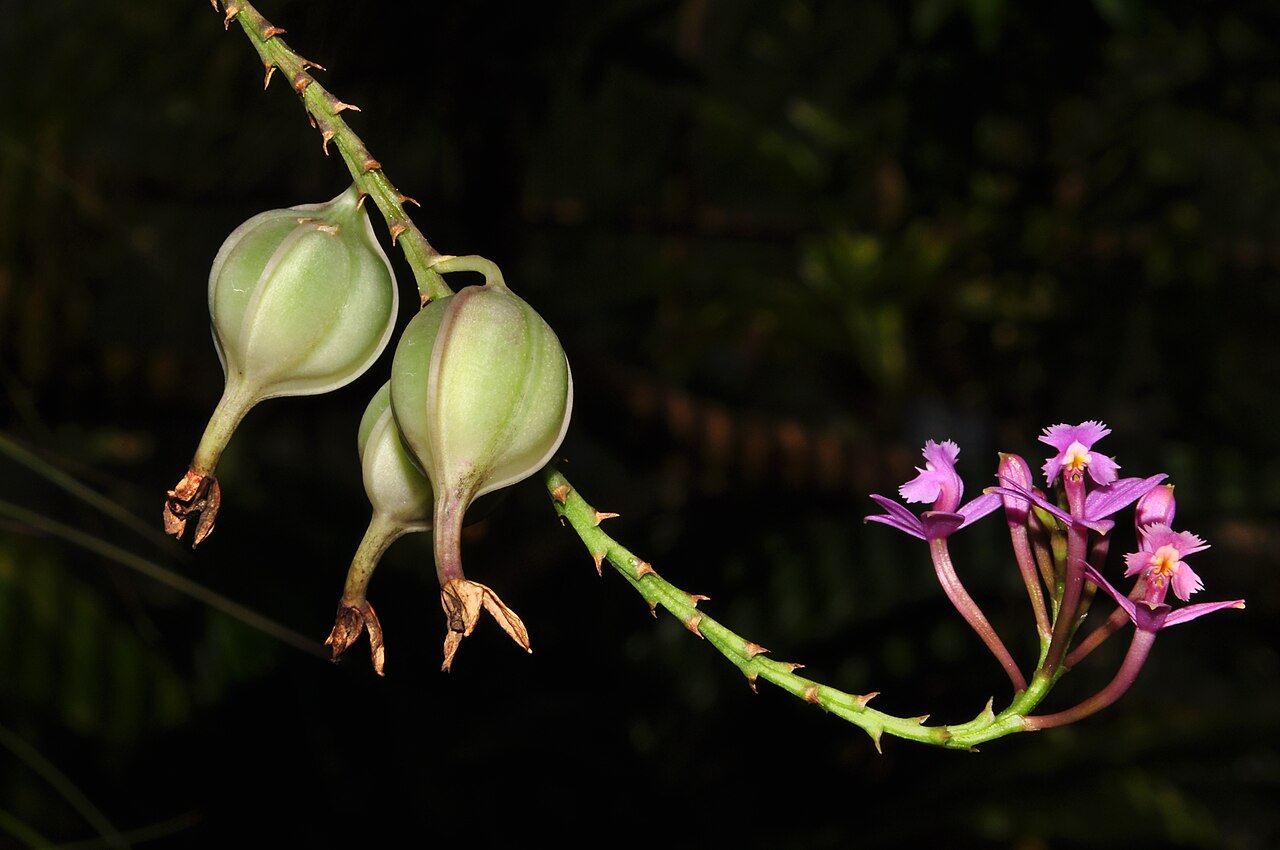
The fruit is an oval, ribbed green capsule that splits to release dust-like seeds. Orchid researchers Joseph Arditti and Abdul Ghani noted that its seeds, about 6 mm long, are the longest known in the orchid family. The popular cultivated crucifix orchids Epidendrum ibaguense and Epidendrum radicans are not native to Puerto Rico; their flowers are resupinate (lip at the bottom), usually orange or red. Other Puerto Rican reed-stemmed epidendrums have green, white or smaller flowers.
Quick Facts
| Scientific Name | Epidendrum secundum (syn. Epidendrum elongatum) |
| Family | Orchidaceae (orchid family) |
| Plant Type | Terrestrial or lithophytic reed-stemmed orchid; evergreen perennial |
| Mature Height | 1–4 ft (flower stalks can add 1–2 ft) |
| Mature Spread | 1–2 ft clumps |
| Growth Rate | Moderate |
| Sun Exposure | Full sun to bright light |
| Water Needs | Medium; water freely in growth, let the mix dry slightly between waterings |
| Soil Type | Very well-drained, gritty or bark-based mix; thin rocky soil in the wild |
| Soil pH | Acidic to neutral |
| Bloom Time | Much of the year; individual stalks bloom for months |
| Flower Color | Pink, magenta or lilac (red, orange or yellow forms elsewhere) |
| Fall Color | None; evergreen |
| Fruit | Oval ribbed capsule with dust-like seeds |
| Deer Resistant | Not well documented |
| USDA Hardiness Zones | 10–13 outdoors; tolerates brief light frost |
Native Range
USDA PLANTS lists lopsided star orchid as native in Puerto Rico, the only part of the United States where it grows wild. On the island it is mainly a plant of the mountains, recorded from the Cordillera Central around Jayuya, Orocovis, Villalba and Cidra, and from the western uplands around Maricao, San Germán and Sabana Grande, including the Maricao State Forest.
Beyond Puerto Rico it has an enormous range, through the Greater and Lesser Antilles and from Central America south through Colombia, Venezuela, the Andes of Ecuador, Peru and Bolivia, and the highlands of Brazil to northern Argentina. Botanist Robert Dressler called it “the Epidendrum secundum complex” because it varies so much in size and flower color, and some of its many forms may deserve recognition as separate species.
It needs sun and open ground. It grows on road cuts, rocky banks, landslides, cliff faces, open slopes and the edges of montane forest, often in thin, rocky or serpentine soils where taller vegetation is sparse. Its ability to colonize disturbed, sunny banks makes it a familiar roadside orchid in the island’s mountains.
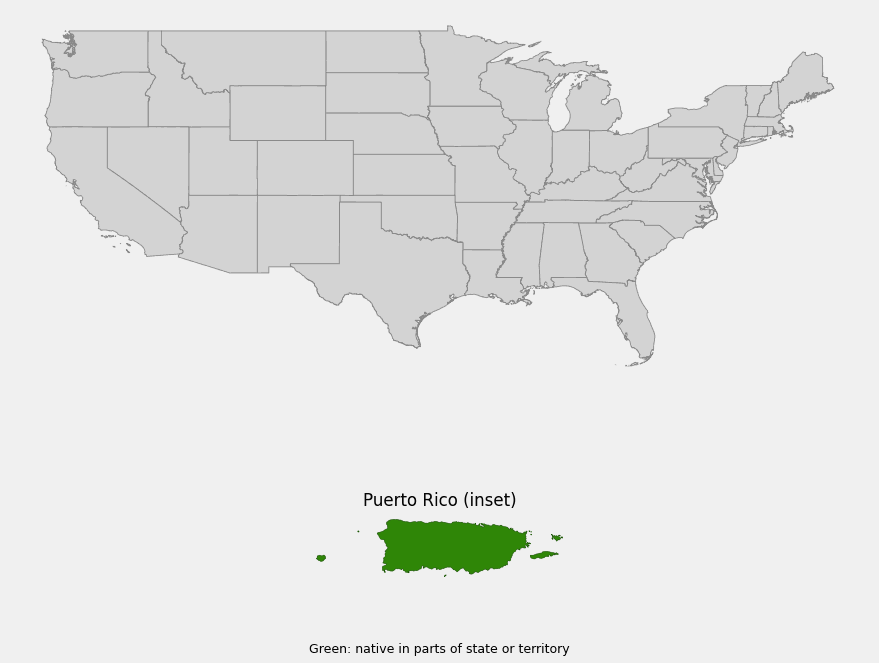
📋 Regional plant lists featuring Lopsided Star Orchid: Puerto Rico
Growing & Care Guide
Lopsided star orchid is grown far less often than the hybrid crucifix orchids sold at garden centers, but it is offered by orchid specialists, and its care is the same. Buy nursery-propagated plants and never remove orchids from the wild in Puerto Rico. In zones 10 to 13 it can be grown outdoors year-round; elsewhere, grow it in a pot and give it as much light as possible.
Light
Give it full sun to very bright light. Outdoors in the tropics and subtropics it does best in full sun or light afternoon shade. Indoors, place it in a south- or west-facing window or under strong grow lights; too little light gives weak, floppy stems and few flowers. Plants can summer outdoors in sun once acclimated.
Soil & Water
Use a very well-drained mix, such as medium orchid bark with perlite, or a gritty terrestrial orchid mix; outdoors in frost-free areas it can grow in the ground in sandy or rocky, fast-draining soil or in raised beds. Water freely while it is growing, letting the top of the mix dry slightly between waterings, and never let it sit in soggy soil. Feed lightly with a balanced orchid fertilizer every few weeks in warm weather.
Planting Tips
Outdoors, plant it in a sunny bed, rock garden or large container in zones 10 to 13, where it tolerates heat and brief cool spells; it can take a light frost but not a hard freeze. Indoors, keep it above about 50°F (10°C), with good air movement and moderate to high humidity. Several canes together in one pot make the best show.
Pruning & Maintenance
Leave flower stalks in place as long as they keep producing buds, since they rebloom from the tip and often form keikis. Remove a stalk only when it turns brown. Old, leafless canes can be cut out at the base. Repot every two to three years, when the mix breaks down.
Propagation
The easiest method is to pot up keikis once they have several roots 1 to 2 inches long. Clumps can also be divided, keeping at least three canes per division, and stem sections laid on moist mix may sprout new plants. Growing orchids from seed requires sterile laboratory culture.
Landscape Uses
- Tropical gardens: long-blooming color in sunny beds and rock gardens in zones 10–13
- Houseplants and containers: a sun-loving, forgiving orchid for bright windows
- Butterfly gardens: flowers visited by butterflies in the wild
- Native plant collections: a Puerto Rican native orchid for island gardens
Wildlife & Ecological Value
On sunny mountain road banks in Puerto Rico, lopsided star orchid is one of the most visible native orchids, and its long flowering season provides color through much of the year.
For Pollinators
Its flowers are pollinated mainly by butterflies, which probe the flowers with their long tongues. Studies of related crucifix orchids suggest that they offer little or no nectar and attract butterflies by resembling nectar-rich flowers, a kind of deception common in orchids.
For Birds
It has little direct value to birds. The dust-like seeds are spread by wind, not by animals.
For Mammals
It is not known to be an important food plant for mammals in Puerto Rico.
Ecosystem Role
It is a pioneer of bare, sunny ground, colonizing road cuts, landslides and rocky banks along with ferns and grasses. Like all orchids, its tiny seeds need a partnership with soil fungi to germinate, and those fungi supply nutrients to the seedling.
Cultural & Historical Uses
The species was described in 1760 by the Dutch-Austrian botanist Nikolaus Joseph von Jacquin from plants he saw on his travels in the Caribbean. The name secundum means “turned to one side,” and the common name “lopsided star orchid” reflects the same idea. It has been described again and again under dozens of other names, which botanists now treat as synonyms; one of the most common in older books is Epidendrum elongatum.
Reed-stemmed epidendrums, sometimes called “poor man’s orchids,” are popular in tropical gardens because they grow like ordinary perennials, flower nearly all year and tolerate full sun. Most plants sold today are hybrids involving Epidendrum ibaguense, E. radicans and other species. Lopsided star orchid offers gardeners in Puerto Rico a native alternative with the same easy habit.
Its variability has made it a subject of research. Studies of its chromosomes have found very different counts in plants from different places, and scientists have used it and its relatives to study how orchids hybridize and form new species.
Frequently Asked Questions
Is lopsided star orchid native to the United States?
Yes, in Puerto Rico. USDA PLANTS lists it as native there, where it grows in the mountains on sunny banks and rocky slopes. It does not grow wild in the 50 states.
Can I grow it as a houseplant?
Yes. Give it a very bright south- or west-facing window or strong grow lights, a well-drained orchid mix, regular watering while it is growing, and temperatures above about 50°F. Low light is the most common reason it fails to bloom.
Can it grow outdoors?
Yes, in zones 10 to 13, in full sun to light shade and fast-draining soil or a raised bed. It can survive a light frost but not a hard freeze.
What is a keiki?
A keiki is a baby plant that forms on the stem or old flower stalk. When it has several roots an inch or two long, cut it off and pot it up to start a new plant.
Why is it called a crucifix orchid?
The three-lobed lip of the flower, joined to the column, forms a small cross shape in the center of each bloom. Several reed-stemmed Epidendrum species share the name.

Looking for a nursery that carries Lopsided Star Orchid?
Our nursery directory does not yet include Puerto Rico. Browse the native plant nursery directory by state: Alabama–Arkansas · California · Colorado–Hawaii · Idaho–Kansas · Kentucky–Montana · Nebraska–Oklahoma · Oregon · Pennsylvania–Virginia · Washington · West Virginia–Wyoming

