
Leavenworth’s Eryngo (Eryngium leavenworthii)
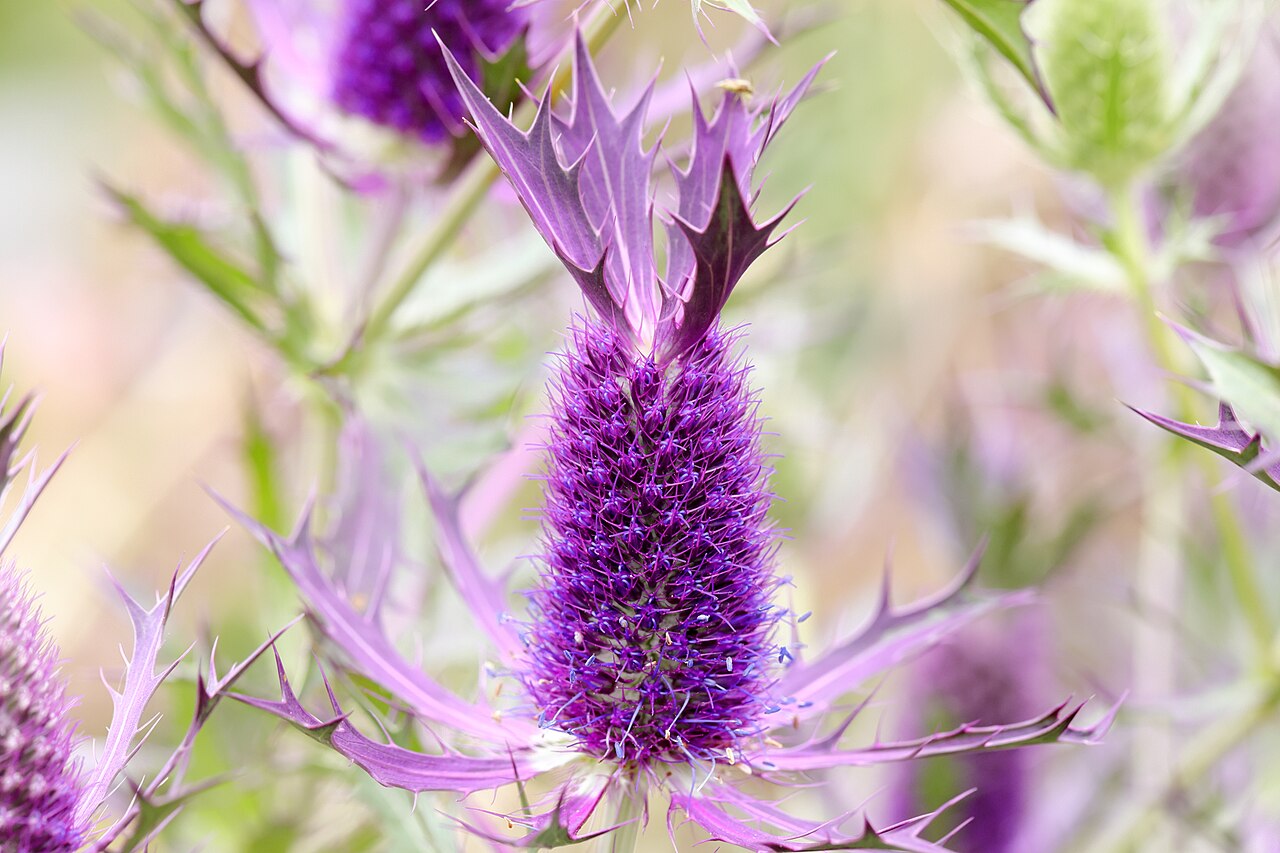
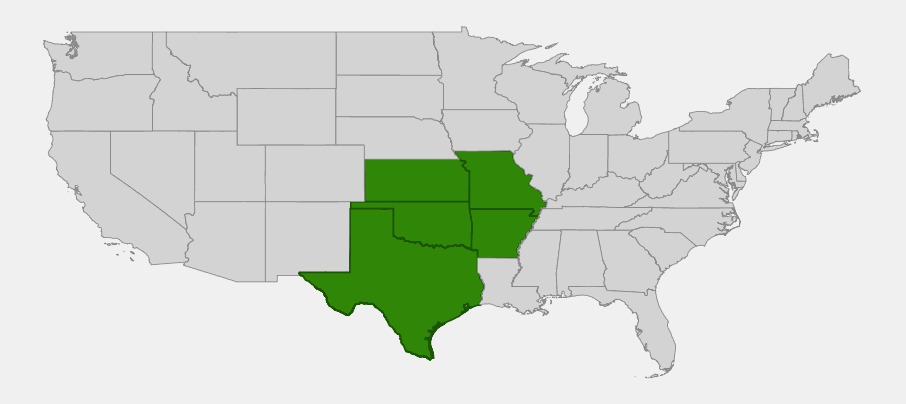
Eryngium leavenworthii, known as Leavenworth’s Eryngo (USDA: Leavenworth’s eryngo), is a striking native annual of the carrot family (Apiaceae) from the southern Great Plains. Though it looks like a thistle, it is related to carrots, parsley and the native rattlesnake master. It grows on rocky, limestone prairies, roadsides and open woods from Texas north through Oklahoma to Kansas, with outlying records in Arkansas and Missouri.
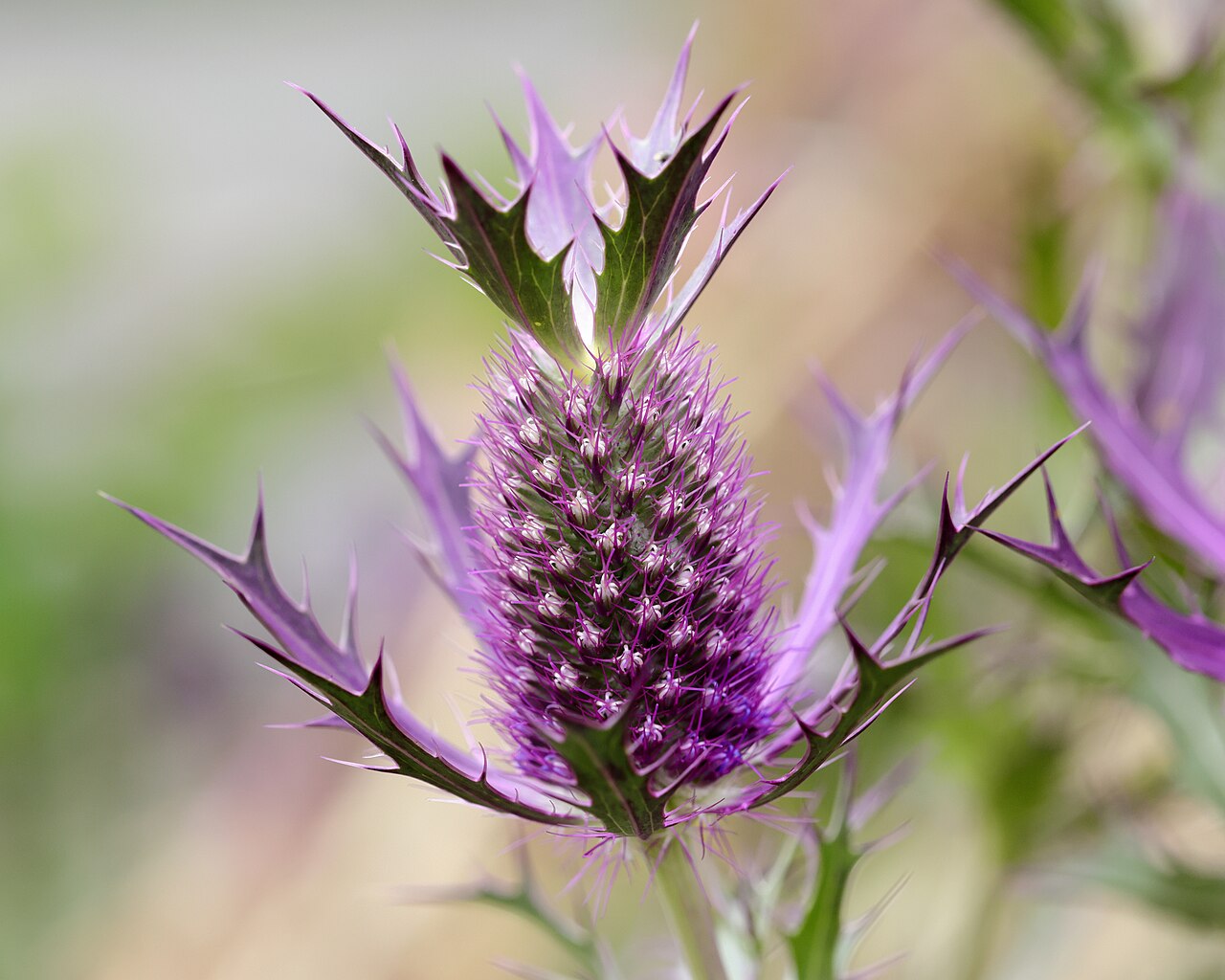
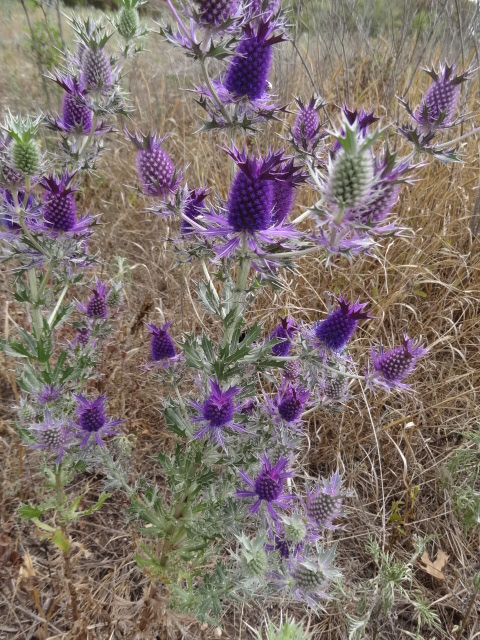
Plants grow 1-1/2 to 3-1/2 feet tall, branching above into a candelabra of stiff stems. In late summer and fall almost the entire plant turns shades of purple, from the spiny, deeply lobed leaves to the flower heads. Each head is a dense, egg-shaped to cylindrical cluster of tiny purple flowers 1-1/2 to 3 inches long, ringed below by spiny bracts and topped by a tuft of spiny bracts, so it looks like a small, fuzzy purple pineapple.
Leavenworth’s eryngo blooms from about July into fall, when many prairie plants are fading, and its flowers are busy with bees, wasps and butterflies. It is easy to grow from seed in sunny, dry gardens, reseeds itself, resists deer, and makes a dramatic, long-lasting cut or dried flower. Handle it with gloves: the leaves and bracts are sharply spiny.
Identification
With its purple color and spiny, pineapple-shaped heads, Leavenworth’s eryngo is unlike any other prairie plant once it blooms. Before it colors up it can be mistaken for a thistle.
Growth Form
An upright annual 1-1/2 to 3-1/2 feet tall, growing from a taproot. The stem is single below and broadly branched above, with the branches forking repeatedly to hold many heads. The plant is smooth (hairless) but very spiny, and it turns green-gray to purple as the season advances.
Leaves
The lower leaves are oblong and toothed and often wither by bloom time. The stem leaves are stalkless, clasp the stem, and are deeply cut into narrow, palm-like lobes, each edged and tipped with stiff spines.
Flowers
The flower heads are egg-shaped to cylindrical, 1-1/2 to 3 inches long and about 1/2 to 1 inch wide. They are packed with tiny flowers mixed with small spiny bractlets, and they turn deep purple to wine-red as they open, from about July to September and in some areas into November. Below each head is a ring of large, spiny, deeply toothed bracts, and the top of the head bears a tuft of leafy, spiny bracts like a pineapple crown.
Fruit & Seeds
Each flower produces a small, scaly, dry fruit that splits into two seeds. The heads dry to a silvery tan and hold their shape into winter.
Look-alikes
Thistles (Cirsium species) have heads made of tubular florets that form a brush-like top and seeds with feathery bristles, and they lack the crown of bracts on top. Rattlesnake Master (Eryngium yuccifolium) is a perennial with yucca-like leaves and round, whitish-green heads. Other prairie eryngos, such as Eryngium hookeri, have smaller heads without a conspicuous crown of bracts.
Safety
Leavenworth’s eryngo is not known to be toxic, but the leaves and bracts have stiff, sharp spines. Wear gloves when handling it or cutting it for arrangements, and keep it away from paths and play areas.
Quick Facts
| Scientific Name | Eryngium leavenworthii |
| Family | Apiaceae (carrot family) |
| Plant Type | Spiny annual wildflower |
| Mature Height | 1-1/2–3-1/2 ft |
| Mature Spread | 1–2 ft |
| Growth Rate | Fast |
| Sun Exposure | Full sun to part shade |
| Water Needs | Low; drought tolerant |
| Soil Type | Rocky, calcareous soils: limestone, caliche, clay, sandy loam |
| Soil pH | About 7.0–8.5 (neutral to alkaline) |
| Bloom Time | July–September; into November in some areas |
| Flower Color | Purple to wine-red |
| Fall Color | Whole plant turns purple, drying to silvery tan |
| Fruit | Small, scaly dry fruit splitting into two seeds |
| Deer Resistant | Yes; spiny foliage is avoided |
| USDA Hardiness Zones | 6–9 (grows as an annual) |
Native Range
Leavenworth’s eryngo is native to the south-central United States. USDA PLANTS lists it as native in the lower 48 states and records it from Texas, Oklahoma, Kansas, Arkansas and Missouri. The Lady Bird Johnson Wildflower Center describes its range as throughout Texas except the Rio Grande Plains and the Trans-Pecos, north to southwestern Arkansas and Kansas. It is common across north-central and central Texas, the Edwards Plateau, and much of Oklahoma, and reaches eastern and southeastern Kansas.
Records from Arkansas and Missouri are few and lie at the eastern edge of its range; treat them as outlying records. USDA also lists Wisconsin, but the herbarium collections from there come from a university garden and a fairground and represent plants that escaped or were introduced, so that state is not included here.
It grows in rocky prairies, limestone glades and hillsides, open woods, pastures, roadsides and old fields, mostly on shallow, calcareous soils over limestone, chalk or caliche. It often comes up in large numbers in disturbed ground and along highways, where it colors the roadsides purple in late summer.
📋 Regional plant lists featuring Leavenworth’s Eryngo: Nebraska, Kansas & Eastern Colorado · Illinois, Iowa & Missouri · Arkansas, Louisiana, Eastern Oklahoma & Eastern Texas · South & West Texas
Growing & Care Guide
Leavenworth’s eryngo is easy to grow from seed in sunny, well-drained sites and needs very little care. Seed is offered by native seed suppliers in Texas and the southern Plains, and it is sometimes grown as an ornamental elsewhere for its unusual purple heads.
Light
Full sun gives the strongest color and sturdiest plants. It tolerates light shade but may flop and color less.
Soil & Water
It thrives in poor, rocky, alkaline soils, including limestone, caliche and clay, and also grows in sandy loam. Good drainage matters more than soil type. It is drought tolerant and seldom needs watering after germination; rich, moist soil and fertilizer produce weak, floppy plants.
Planting Tips
Sow seed in fall on bare soil and press it in lightly; winter cold and moisture help it germinate in spring. It does not transplant well because of its taproot, so sow it where you want it to grow. Use it in prairie plantings and xeric gardens with grasses such as little bluestem and sideoats grama, and with late-season wildflowers.
Pruning & Maintenance
No pruning is needed. Leave the dried heads in place over winter for seed and structure, or cut them for arrangements. Wear gloves. Because it is an annual, allow some plants to drop seed each year to keep a patch going.
Propagation
Grow it from seed. Collect dried heads in fall and shake out the seed, then sow it in fall outdoors or give it several weeks of cold, moist stratification before spring sowing.
Landscape Uses
- Prairie and meadow plantings: late-season purple color among grasses
- Xeric and rock gardens: thrives in poor, dry, rocky soils
- Pollinator gardens: late-summer nectar for bees, wasps and butterflies
- Cut and dried flowers: long-lasting purple heads for arrangements
- Deer-resistant plantings: spiny foliage is avoided by deer
Wildlife & Ecological Value
Leavenworth’s eryngo blooms when many prairie wildflowers are done for the year, giving pollinators a valuable late-season food source.
For Pollinators
The tiny flowers produce nectar and pollen that attract bumble bees, honey bees, many small native bees, wasps and butterflies. Like other eryngos it is especially popular with wasps, including large solitary hunting wasps, which are important predators of garden pests.
For Birds
Seed-eating birds may pick seeds from the dried heads in fall and winter, and the stiff stems offer perches in open prairie.
For Mammals
The spiny leaves and bracts protect it from deer and most livestock, which avoid it.
Ecosystem Role
As a reseeding annual, it quickly fills bare and disturbed ground on rocky prairies and roadsides, supporting a diverse community of insects in late summer and fall when nectar is scarce.
Cultural & Historical Uses
The species honors Melines Conklin Leavenworth (1796–1862), an American army surgeon and botanist who collected plants while serving at army posts in the South, and who is credited with its discovery. John Torrey and Asa Gray named it for him in the 1840s.
Leavenworth’s eryngo is a favorite of roadside wildflower watchers in Texas and Oklahoma, where large stands turn highway rights-of-way purple in late summer. Its unusual shape has earned it nicknames such as “purple pineapple weed.”
Florists and gardeners value eryngos for dried arrangements because the spiny heads keep their shape and color for a long time. This species has also attracted attention from gardeners abroad and was featured in Curtis’s Botanical Magazine in 1999 as a garden-worthy annual.
Frequently Asked Questions
Is Leavenworth’s eryngo a thistle?
No. Though it looks like a thistle, it belongs to the carrot family (Apiaceae) and is related to rattlesnake master and sea hollies. Thistles are in the aster family.
Is it a perennial?
No. It is an annual that grows from seed each year, blooms from late summer into fall, and dies after setting seed. It reseeds readily in suitable sites.
Is it good for pollinators?
Yes. Its late-season flowers attract bees, butterflies and many kinds of wasps when few other prairie plants are blooming.
Can I use it as a cut flower?
Yes. The purple heads last a long time in arrangements and dry well. Wear gloves when cutting, because the bracts and leaves are spiny.
Does it grow in Wisconsin?
USDA lists Wisconsin, but herbarium records there are from a university garden and a fairground and represent introduced plants. Its native range is the southern Great Plains, from Texas north to Kansas.
