
Lanceleaf Frogfruit (Phyla lanceolata)
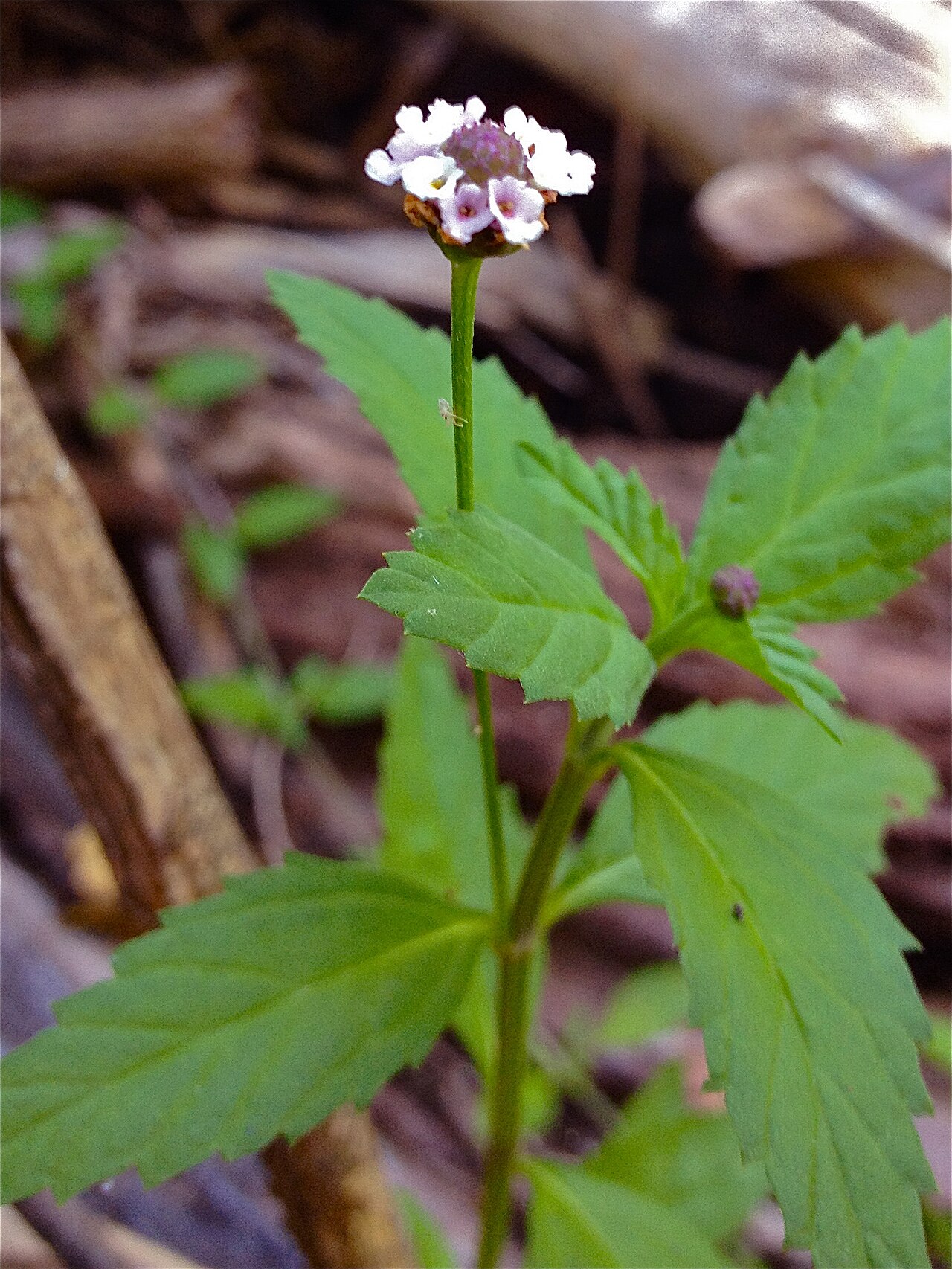
Phyla lanceolata, known as Lanceleaf Frogfruit (USDA: lanceleaf fogfruit), and also called northern fogfruit, is a low, spreading perennial of the verbena family (Verbenaceae). It was long known as Lippia lanceolata. It is one of the most widespread native wetland wildflowers in the United States, found from New York and southern Ontario to Florida and west across the Midwest and Great Plains to the Southwest and southern California.
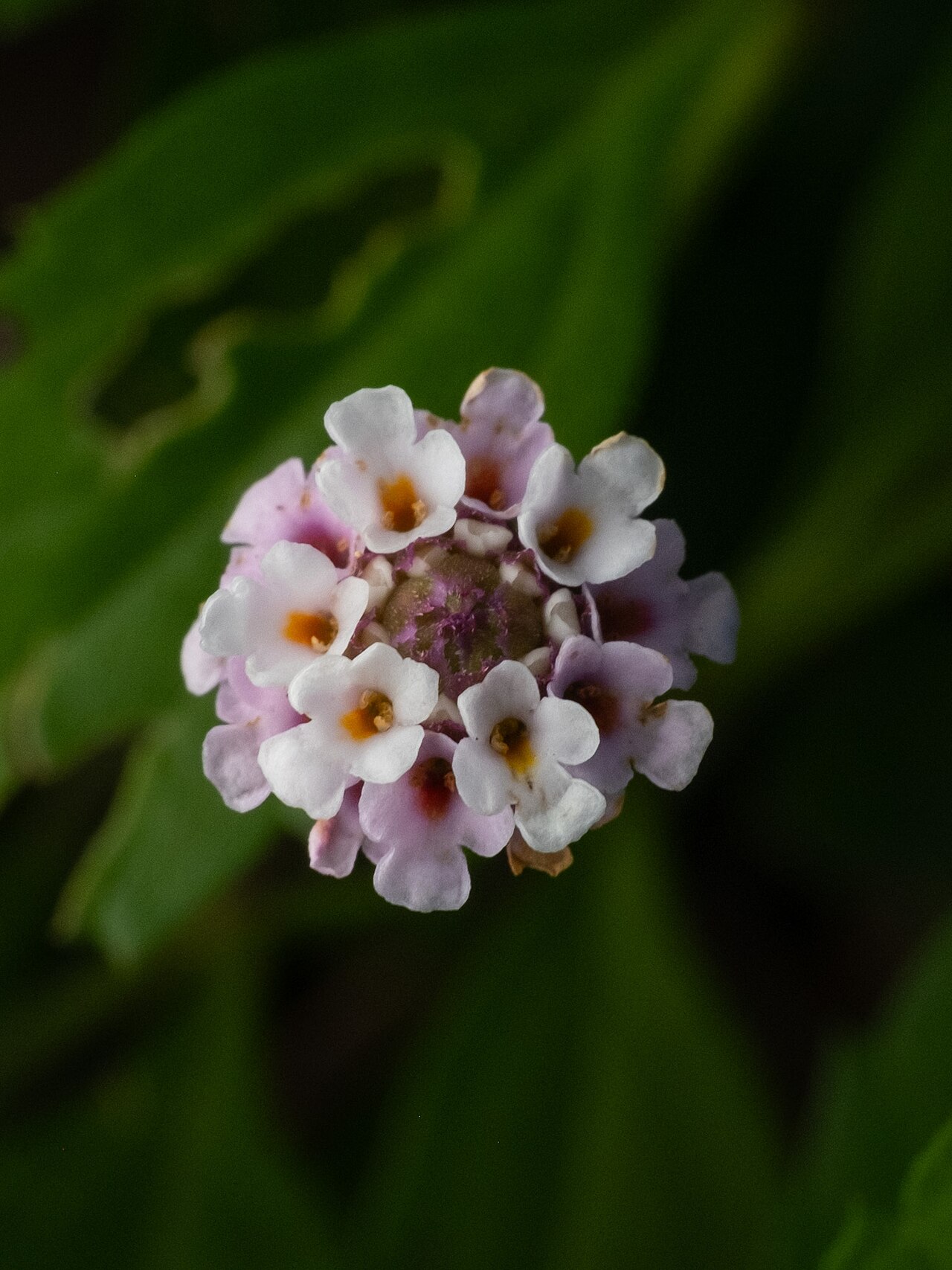
Its trailing and ascending stems spread across wet ground and root at the nodes, forming loose mats 6 inches to 2 feet tall, with paired, lance-shaped, toothed leaves. From late spring to fall it sends up small, round to thimble-shaped flower heads on long stalks. Each head carries a ring of tiny white to pale lavender flowers with yellow or orange throats, opening a few at a time around a purplish center, so the head looks like a miniature button bouquet.
Lanceleaf frogfruit grows on muddy shores, stream and pond edges, wet meadows, ditches and marshes. It is an excellent, low-maintenance groundcover for rain gardens and wet spots, a nectar plant for many small pollinators, and a larval host plant for butterflies such as the phaon crescent and common buckeye.
Identification
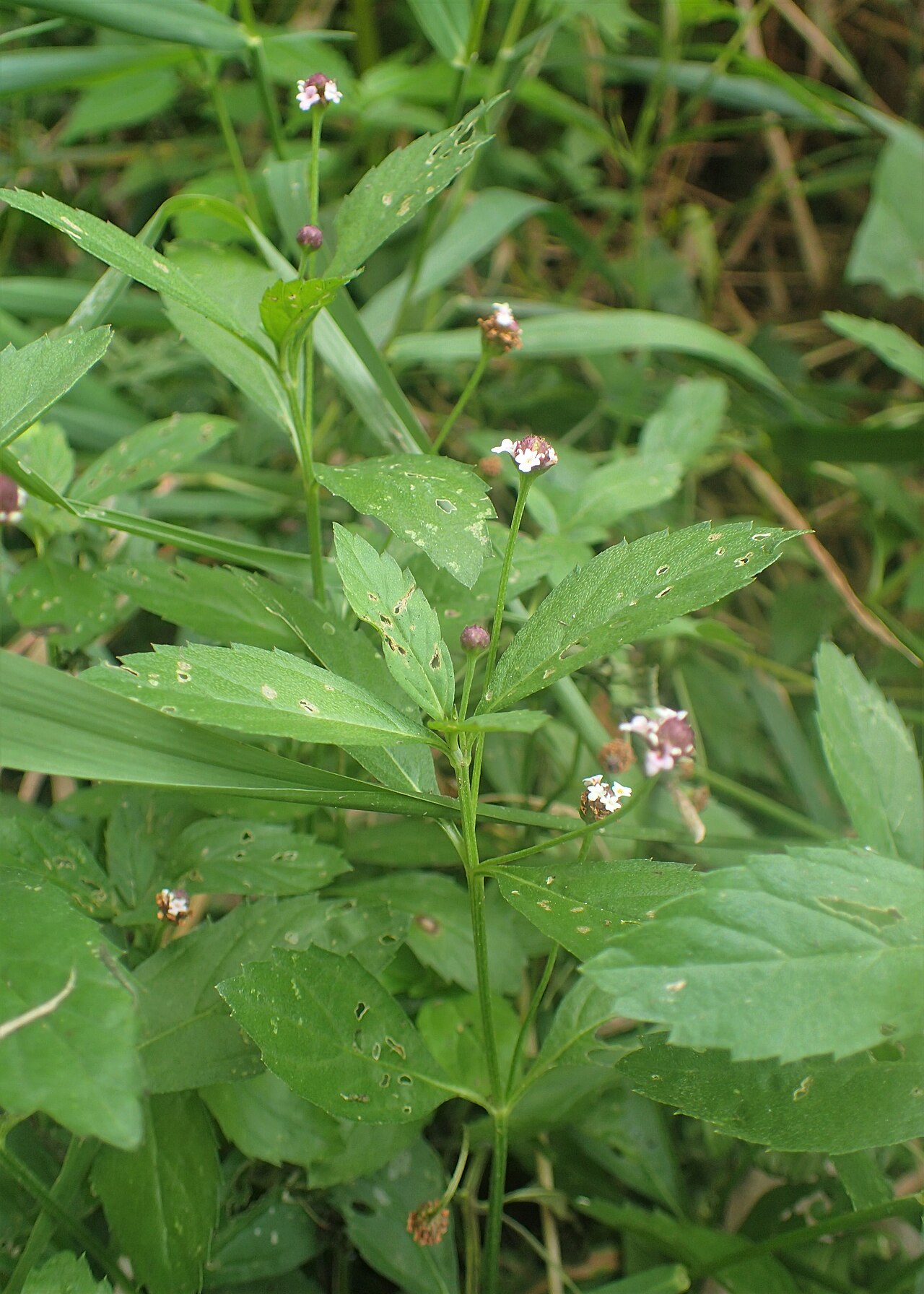
Lanceleaf frogfruit is easy to spot in wet places by its small, button-like flower heads on long, slender stalks and its paired, toothed leaves on sprawling stems.
Growth Form
A perennial herb with stems that creep along the ground and turn upward at the tips, often rooting where they touch moist soil. Stems are usually 1 to 2 feet long, four-angled and sparsely hairy, and the plant may form loose mats or grow upright through other vegetation, reaching up to about 2 feet tall.
Leaves
The leaves are opposite, lance-shaped to narrowly oval, about 1 to 3 inches long, with pointed tips and sharply toothed edges, usually from about the middle to the tip. The base tapers into a short stalk. They are bright to dark green and slightly rough to the touch.
Flowers
From about May to October or November, single flower heads rise on long, slender stalks from the leaf axils, usually longer than the leaves. Each head is round at first and becomes cylindrical, 1/4 to 3/4 inch long. The tiny flowers, about 1/8 inch across, are two-lipped, white to pale lavender or pinkish with a yellow to orange throat, and open in a ring around the head that moves upward as the season advances. The center of the head is purplish from the overlapping bracts.
Fruit
Each flower produces a tiny dry fruit that splits into two nutlets. The old heads become elongated and brown as the fruit ripens.
Look-alikes
Texas Frogfruit (Phyla nodiflora) is a lower, mat-forming plant of the South with shorter, wedge- or spoon-shaped leaves toothed only near the tip. Southern Fogfruit (P. stoechadifolia) of Florida and the Gulf Coast has narrow, upright leaves with rolled edges. Wedgeleaf frogfruit (P. cuneifolia) of the Plains and Southwest has small, wedge-shaped, gray-green leaves.
Safety
Lanceleaf frogfruit is not known to be toxic to people or pets. It is a harmless groundcover in rain gardens and wet lawns.
Quick Facts
| Scientific Name | Phyla lanceolata (formerly Lippia lanceolata) |
| Family | Verbenaceae (verbena family) |
| Plant Type | Herbaceous perennial; spreading wetland groundcover |
| Mature Height | 6 in–2 ft |
| Mature Spread | 1–3 ft; spreads by rooting stems |
| Growth Rate | Fast |
| Sun Exposure | Full sun to part shade |
| Water Needs | High; moist to wet soil, tolerates brief flooding |
| Soil Type | Mud, silt, sand or clay; wet to moist soils |
| Soil pH | About 5.5–8.0 |
| Bloom Time | May–October (into November in the South) |
| Flower Color | White to pale lavender with a yellow to orange throat |
| Fall Color | None; dies back after frost |
| Fruit | Tiny dry fruit splitting into two nutlets |
| Deer Resistant | Moderately; occasionally browsed |
| USDA Hardiness Zones | 4–10 |
Native Range
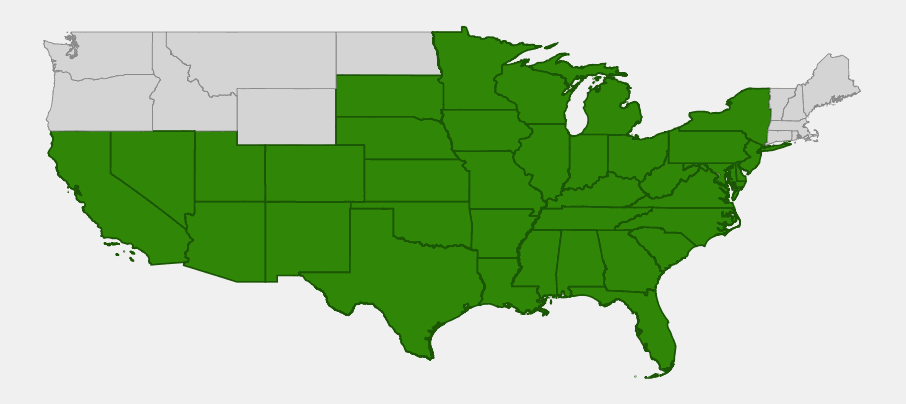
Lanceleaf frogfruit is native to much of North America, from southern Ontario through the eastern, central and southwestern United States into Mexico. USDA PLANTS lists it as native in Canada and the lower 48 states, records it from 36 states and the District of Columbia, and lists it in Ontario. It is common throughout the Midwest, the Great Plains, the Mississippi Valley, the Southeast and Texas, and less common toward the Atlantic coast and the Northeast.
In the West it grows mainly along rivers, springs, marshes and lakes: along the lower Colorado River, at desert wetlands such as Pahranagat Valley in southern Nevada, in Colorado, New Mexico and Arizona, and in southern California around San Diego and Riverside Counties. These western populations are scattered and tied to permanent water. In the Dakotas it reaches southeastern South Dakota and the Minnesota River country along the Minnesota border.
Typical habitats are muddy and sandy shores of rivers, streams, ponds and lakes, wet meadows and prairies, marshes, ditches, low pastures and the edges of floodplain forests. It is listed as an obligate or facultative wetland plant in every U.S. region and tolerates periodic flooding and trampling.
📋 Regional plant lists featuring Lanceleaf Frogfruit: New York, Pennsylvania & Northern New Jersey · Ohio & Indiana · Michigan, Wisconsin & Eastern Minnesota · Kentucky & Tennessee · Nebraska, Kansas & Eastern Colorado · Utah & Western Colorado · Maryland, Virginia & West Virginia · Delaware, Southern New Jersey & Long Island · Arizona & New Mexico · Illinois, Iowa & Missouri · Alabama, Georgia & Mississippi · North & South Florida · North & South Carolina · Arkansas, Louisiana, Eastern Oklahoma & Eastern Texas · South & West Texas · North Dakota, South Dakota & Western Minnesota · California & Nevada
Growing & Care Guide
Lanceleaf frogfruit is an easy, adaptable native groundcover for wet and moist places. It is sold by native plant nurseries, especially in the Midwest and South, as plugs or seed, and it establishes quickly.
Light
It grows in full sun to part shade. Full sun gives the densest growth and heaviest bloom; in shade it is more open and flowers less.
Soil & Water
Plant it in moist to wet soil: mud, silt, sand or clay. It thrives where water stands for short periods, such as rain gardens, pond edges and drainage swales, and tolerates brief flooding. It will grow in average garden soil if watered during dry spells, but it does best where the soil stays moist. No fertilizer is needed.
Planting Tips
Set plugs 12 to 18 inches apart in spring; the stems will root and fill in within a season or two. Use it as a living groundcover at the edge of ponds and streams, in the bottom of rain gardens, or between stepping stones in damp areas. Combine it with taller wetland plants such as swamp milkweed, blue vervain and great blue lobelia.
Pruning & Maintenance
Little care is needed. It tolerates occasional mowing and light foot traffic, and can be trimmed back if it spreads beyond its space. Cut back dead stems in late winter or early spring.
Propagation
It is easy to propagate by dividing rooted stems or by stem cuttings in spring or summer, which root readily in moist soil. It also grows from seed, which germinates best after a period of cold, moist stratification.
Landscape Uses
- Rain gardens and bioswales: a tough groundcover for wet, periodically flooded soil
- Pond and stream edges: stabilizes muddy banks with spreading, rooting stems
- Butterfly gardens: larval host for phaon crescent and common buckeye
- Pollinator plantings: long-season nectar for small bees and butterflies
- Wet lawn alternative: a low, walkable cover for damp areas
Wildlife & Ecological Value
Lanceleaf frogfruit blooms for months and supports a surprising variety of insects for such a small plant.
For Pollinators
Its tiny flowers provide nectar from late spring to fall for small native bees, including sweat bees and small carpenter bees, as well as wasps, flies and small butterflies such as skippers, crescents and hairstreaks. It is a larval host plant for the phaon crescent (Phyciodes phaon), the common buckeye (Junonia coenia) and, in the far South, the white peacock (Anartia jatrophae).
For Birds
Its seeds are tiny, but wetland birds forage among the mats for the insects it supports.
For Mammals
It is occasionally grazed by deer, rabbits and livestock. The dense mats give cover to small animals at the water’s edge.
Ecosystem Role
Its creeping, rooting stems help hold mud and sand on shorelines and in ditches, reducing erosion. As a long-blooming, widespread wetland plant, it is an important nectar source along waterways across much of the continent.
Cultural & Historical Uses
The name “frogfruit,” and the alternative “fogfruit,” are old American folk names for plants in the genus Phyla. Their origin is uncertain; they may refer to the plants’ habit of growing in wet, frog-filled places, and “fogfruit” may be a corruption of “frogfruit.” USDA uses “fogfruit” in its common names, while many wildflower guides prefer “frogfruit.”
In Louisiana, Acadian French speakers called the plant “caille eau,” reflecting an old belief that it could curdle water. The species was first described by the French botanist André Michaux as Lippia lanceolata, from plants he collected in North America, and was later moved to Phyla, the genus of the frogfruits.
In recent years, frogfruits have become popular with native plant gardeners as lawn alternatives and rain-garden groundcovers. Lanceleaf frogfruit, the most northern-ranging of the group, is the best choice for gardens in the Midwest and North.
Frequently Asked Questions
Is it frogfruit or fogfruit?
Both names are used. USDA calls this species lanceleaf fogfruit, while many guides use lanceleaf frogfruit. They refer to the same plant, Phyla lanceolata, once known as Lippia lanceolata.
How is it different from Texas frogfruit?
Texas frogfruit (Phyla nodiflora) forms flatter mats with shorter, wedge- or spoon-shaped leaves toothed only near the tip and grows mainly in the South. Lanceleaf frogfruit has longer, lance-shaped leaves toothed along much of the edge and is more cold-hardy.
Can I use it as a lawn substitute?
In damp, sunny areas, yes. It tolerates occasional mowing and light foot traffic and stays low, but it is best suited to moist soil and does not stay green in winter.
Which butterflies use it?
It is a larval host for the phaon crescent and common buckeye, and in the far South for the white peacock. Many small butterflies and bees visit its flowers for nectar.
Is it native in the West?
Yes. USDA lists it as native in California, Nevada, Utah, Arizona, New Mexico and Colorado, where it grows along rivers, springs and marshes. Western populations are scattered and tied to permanent water.

Looking for a nursery that carries Lanceleaf Frogfruit?
Browse our native plant nursery directory: Alabama, Arizona & Arkansas · California · Colorado, Delaware, Florida & Georgia · Illinois, Indiana, Iowa & Kansas · Kentucky, Louisiana, Maryland, Michigan, Minnesota, Mississippi & Missouri · Nebraska, Nevada, New Jersey, New Mexico, New York, North Carolina, Ohio & Oklahoma · Pennsylvania, South Carolina, South Dakota, Tennessee, Texas, Utah & Virginia · West Virginia & Wisconsin