
Narrow-Leaved Bedstraw (Galium angustifolium)
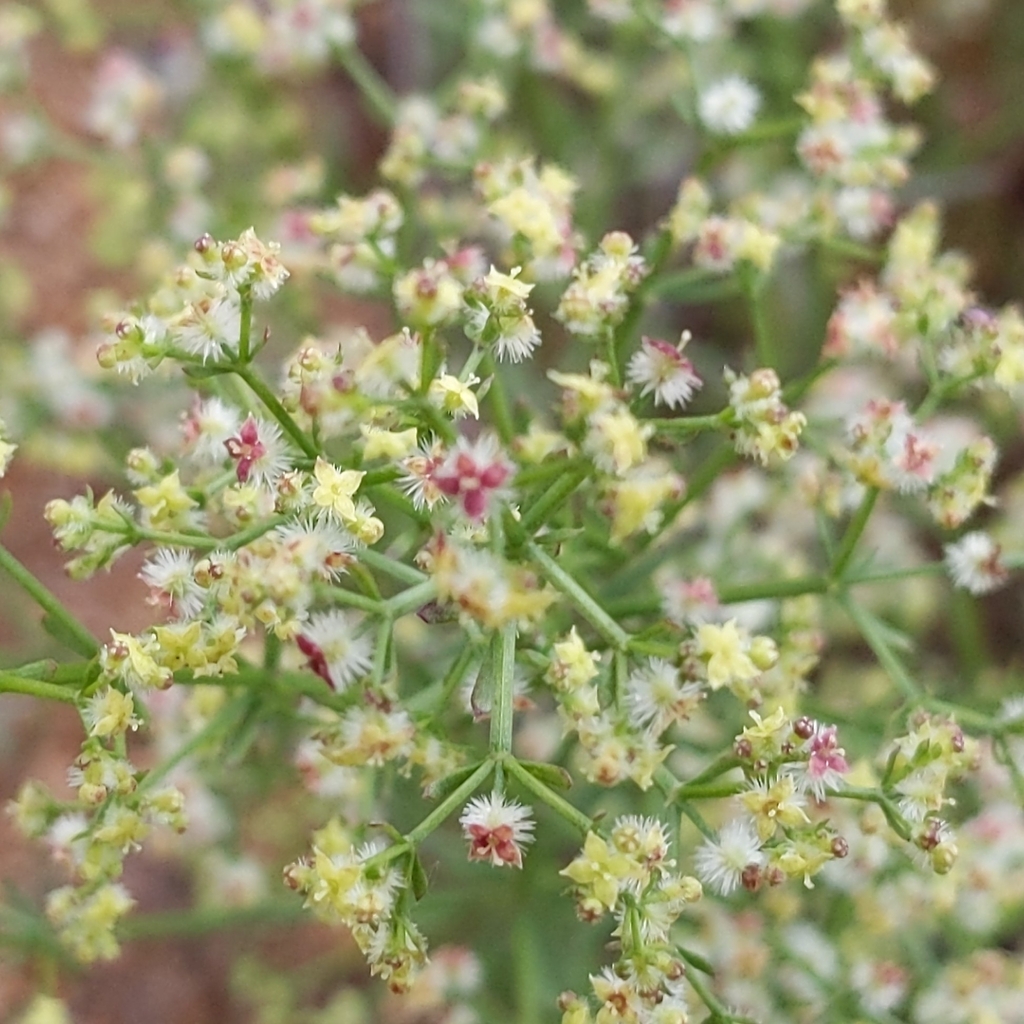
Galium angustifolium, known as Narrow-Leaved Bedstraw or narrowleaf bedstraw, is a bushy, woody-based perennial of the coffee family (Rubiaceae) native to California and northern Baja California. It forms an airy mound of many slender, upright stems, usually 1 to 3 feet tall, with small, narrow leaves in whorls of four. In spring and early summer the stem tips carry clouds of tiny pale yellow, greenish or reddish flowers, followed on female plants by small fruits covered in long white hairs.
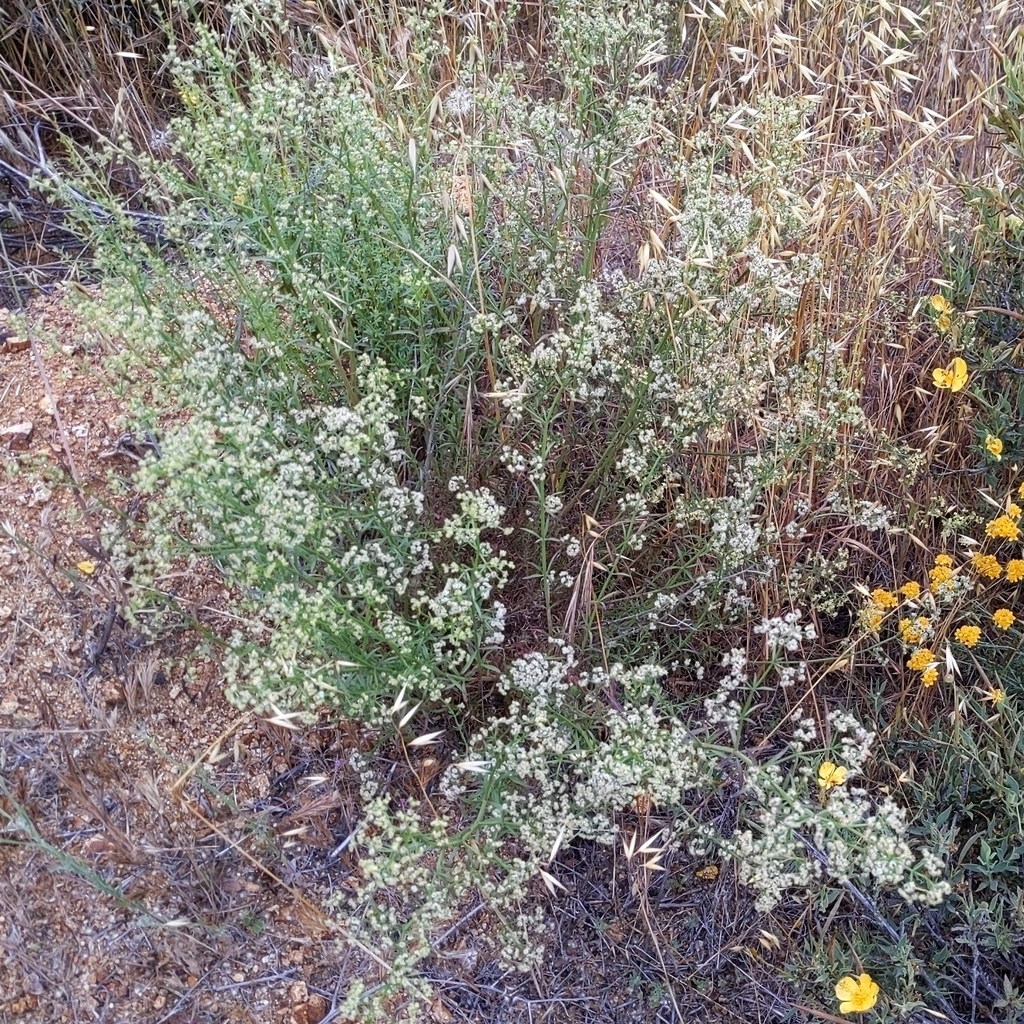
It is one of the most common bedstraws of the chaparral, coastal sage scrub and oak woodlands of central and Southern California, and it often grows tucked among shrubs on dry, rocky slopes and canyon walls. Unlike the weedy, sticky bedstraws (cleavers) that many gardeners know, it is a tidy, non-clinging subshrub. Plants are either male or female, and botanists recognize several subspecies, a few of which are rare and limited to small areas.
Narrow-leaved bedstraw is a subtle plant, valued more for its fine texture and its role in native plant communities than for showy flowers. It fits well in dry native gardens, slopes and habitat plantings in Southern California, where it needs no summer water once established. Buy plants or seed from native plant nurseries and never dig plants from the wild, especially the rare subspecies.
Identification
Look for a loose, bushy subshrub with many thin, erect green stems, small narrow leaves in whorls of four, and airy sprays of tiny four-lobed flowers or white-hairy fruits at the tips.
Growth Habit
Plants grow from a woody base and branch into many slender, wiry, often angled stems, forming a rounded, open mound 1 to 3 feet tall and about as wide. The stems may lean on surrounding shrubs. Plants are mostly green in spring and become drier and more twiggy in the summer drought.
Leaves
The leaves are in whorls of four at each node. They are narrow, linear to lance-shaped, usually 1/4 to 1 inch long, stiff, and often slightly rough to the touch or with rolled-under edges. Leaves on the upper branches are often smaller and more widely spaced, which gives the plant its fine, airy look.
Flowers
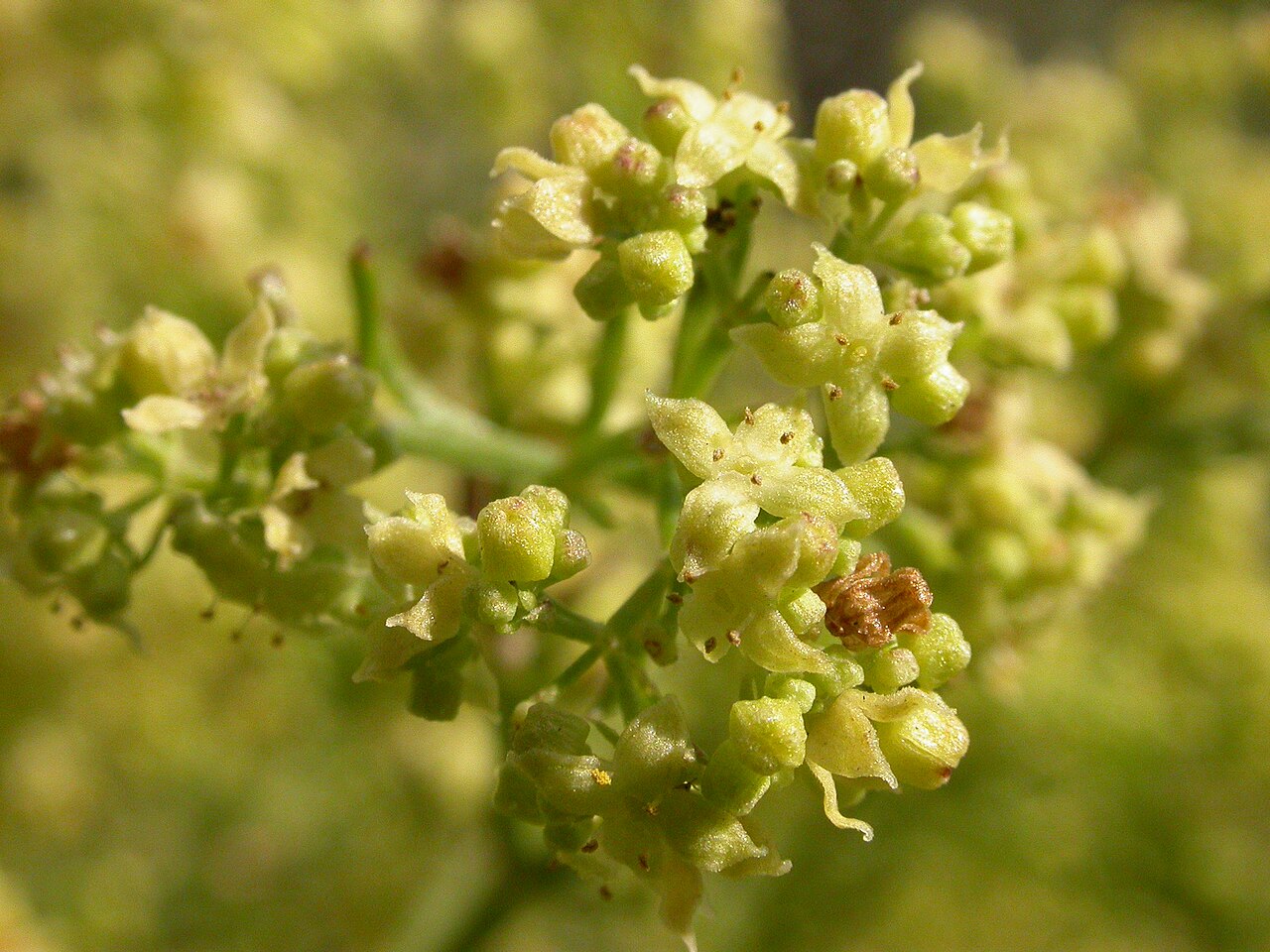
The flowers are tiny, about 1/8 inch across, with four spreading petal lobes, and are carried in loose, branched clusters at the ends of the stems. They are pale yellow to greenish-yellow, sometimes tinged red or pink. Plants are dioecious: each plant bears either male (staminate) or female (pistillate) flowers. Bloom time is mostly March to July, with some flowers later in moist years.
Fruit
Female plants produce small, paired, rounded fruits (nutlets) that are densely covered in long, straight white hairs. The fuzzy fruits make female plants look frosted in late spring and summer and are the easiest way to recognize the species in fruit.
Subspecies
Several subspecies are recognized in California, separated by leaf size, hairiness and range. The widespread subspecies angustifolium grows in the Coast Ranges and the mountains and foothills of Southern California. Others, such as the Borrego bedstraw (subspecies borregoense) and the San Jacinto Mountains bedstraw (subspecies jacinticum), are restricted to small areas and are tracked as rare by the California Native Plant Society.
Look-alikes
Graceful bedstraw (Galium porrigens) also grows in California chaparral but clambers through shrubs and has prickly, hooked hairs on its stems and smooth, fleshy fruits. Annual cleavers (G. aparine) is a sticky, sprawling annual with whorls of six to eight leaves. Other woody California bedstraws, such as G. andrewsii, are low, cushion-forming plants with very short leaves.
Quick Facts
| Scientific Name | Galium angustifolium |
| Family | Rubiaceae (coffee or madder family) |
| Plant Type | Perennial subshrub, woody at the base |
| Mature Height | 1–3 ft |
| Mature Spread | 1–3 ft |
| Growth Rate | Moderate |
| Sun Exposure | Full sun to part shade |
| Water Needs | Very low; dry summers once established |
| Soil Type | Rocky, sandy or loamy, well-drained |
| Soil pH | Slightly acidic to slightly alkaline (about 6.0–8.0) |
| Bloom Time | March–July |
| Flower Color | Pale yellow to greenish, sometimes reddish |
| Fall Color | None; summer-dormant twigs |
| Fruit | Paired nutlets covered in long white hairs (female plants) |
| Deer Resistant | Moderately; occasionally browsed |
| USDA Hardiness Zones | 8–10 |
Native Range
Narrow-leaved bedstraw is native to California and northern Baja California, Mexico. USDA PLANTS lists it as native only in California, where it is widespread in the Coast Ranges from the San Francisco Bay region southward, the Transverse Ranges, the Peninsular Ranges, the southern Sierra Nevada and Tehachapi foothills, and the Channel Islands.
It is especially common in the hills and mountains of Los Angeles, Orange, Riverside, San Bernardino and San Diego counties. Some subspecies extend into the mountains on the western edge of the deserts, and the rare Borrego bedstraw grows in rocky canyons in the Anza-Borrego Desert region.
It grows on dry, rocky or gravelly slopes, ridges, cliffs and canyon walls in chaparral, coastal sage scrub, oak woodland and open pine or pinyon-juniper woodland, usually below about 7,500 feet. It often grows in the partial shelter of larger shrubs.
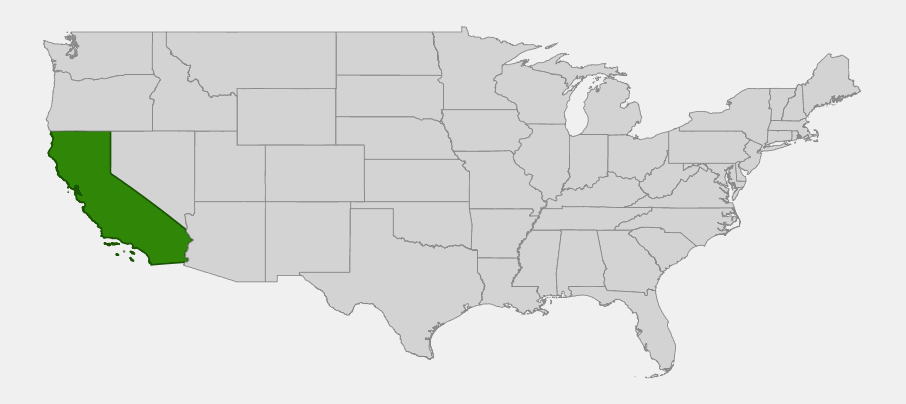
📋 Regional plant lists featuring Narrow-Leaved Bedstraw: California & Nevada
Growing & Care Guide
Narrow-leaved bedstraw is a tough, drought-adapted plant for Mediterranean-climate gardens. Give it sun, sharp drainage and little summer water, and it will slowly form a fine-textured mound among larger shrubs.
Light
Full sun near the coast; full sun to part shade inland. In the wild it often grows in the light shade of larger shrubs or at the base of rocks, and in hot inland gardens a little afternoon shade keeps it greener.
Soil & Water
Plant in well-drained rocky, sandy or loamy soil. Heavy clay is tolerated on slopes where water drains away. Water regularly the first winter and spring to establish it, then only occasionally in summer, or not at all near the coast. Overwatering in summer heat invites root rot. No fertilizer is needed.
Planting Tips
Plant from containers in late fall or winter so the rains can help establish roots. Space plants 2 to 3 feet apart. It looks best grouped with other chaparral and sage scrub plants, where its fine texture contrasts with broader-leaved shrubs. Remember that you need both male and female plants nearby for fruit.
Pruning & Maintenance
Little care is needed. In late summer or fall, cut back dead and twiggy stems to a few inches above the woody base to encourage fresh growth with the winter rains. Remove weedy annual grasses around it, which compete for water and add fire fuel.
Propagation
It can be grown from seed sown in fall or winter, and from cuttings of new growth taken in spring. Seed and plants are occasionally available from California native plant nurseries. Do not collect from rare subspecies.
Landscape Uses
- Dry gardens: a fine-textured filler among sages, buckwheats and manzanitas
- Slopes and banks: tolerates rocky, dry hillsides
- Habitat gardens: adds structure and cover for insects and lizards
- Restoration: part of chaparral and coastal sage scrub plantings
- Naturalistic plantings: soft, airy texture between larger shrubs
Wildlife & Ecological Value
Narrow-leaved bedstraw is a small but common part of chaparral and sage scrub communities, where it adds food and cover for insects and other small animals.
For Pollinators
The tiny flowers are visited by small bees, flies, beetles and other small insects. Galium species are also food plants for the caterpillars of some sphinx moths and other moths.
For Birds
Birds use the dense, twiggy stems for cover, and seed-eating birds may take the small fruits. Insects on the plants provide food for foraging birds.
For Mammals
Deer and rabbits browse it occasionally. Small mammals may eat the fruits and use the plants as cover under shrubs.
Ecosystem Role
As a long-lived subshrub that resprouts from its woody base, it helps hold soil on dry slopes and recovers after fire along with the surrounding chaparral shrubs.
Cultural & Historical Uses
The name “bedstraw” comes from Europe, where the dried stems of fragrant Galium species were once used to stuff mattresses. The genus name Galium comes from the Greek word for milk, because some species were used to curdle milk in cheese-making. The species name angustifolium means “narrow-leaved.”
Galium belongs to the coffee family, Rubiaceae, which also includes coffee, gardenias and the native buttonbush. Many species, including some bedstraws, have red dyes in their roots, and the related madder was a major source of red dye.
There are no well-documented traditional uses specific to narrow-leaved bedstraw, so it should not be used as a food or remedy. Today it is mainly valued by native plant gardeners and restoration ecologists as a fine-textured component of Southern California plant communities.
Frequently Asked Questions
Is narrow-leaved bedstraw sticky like cleavers?
No. Unlike the annual cleavers, it does not have clinging, hooked hairs on its stems, and it does not stick to clothing.
Why do some plants have fuzzy fruits and others do not?
Narrow-leaved bedstraw is dioecious. Only female plants produce the white-hairy fruits; male plants produce pollen only.
Does narrow-leaved bedstraw need summer water?
No. Once established it is adapted to dry summers. Occasional deep watering inland keeps it greener, but too much water in warm weather can cause rot.
Is narrow-leaved bedstraw rare?
The species as a whole is common in Southern California, but a few subspecies, such as Borrego bedstraw and San Jacinto Mountains bedstraw, are rare and limited to small areas.
Does it grow outside California?
In the United States it is native only to California. It also grows in northern Baja California, Mexico.

Looking for a nursery that carries Narrow-Leaved Bedstraw?
Browse our native plant nursery directory: California

