
Powdery Strap Airplant (Catopsis berteroniana)
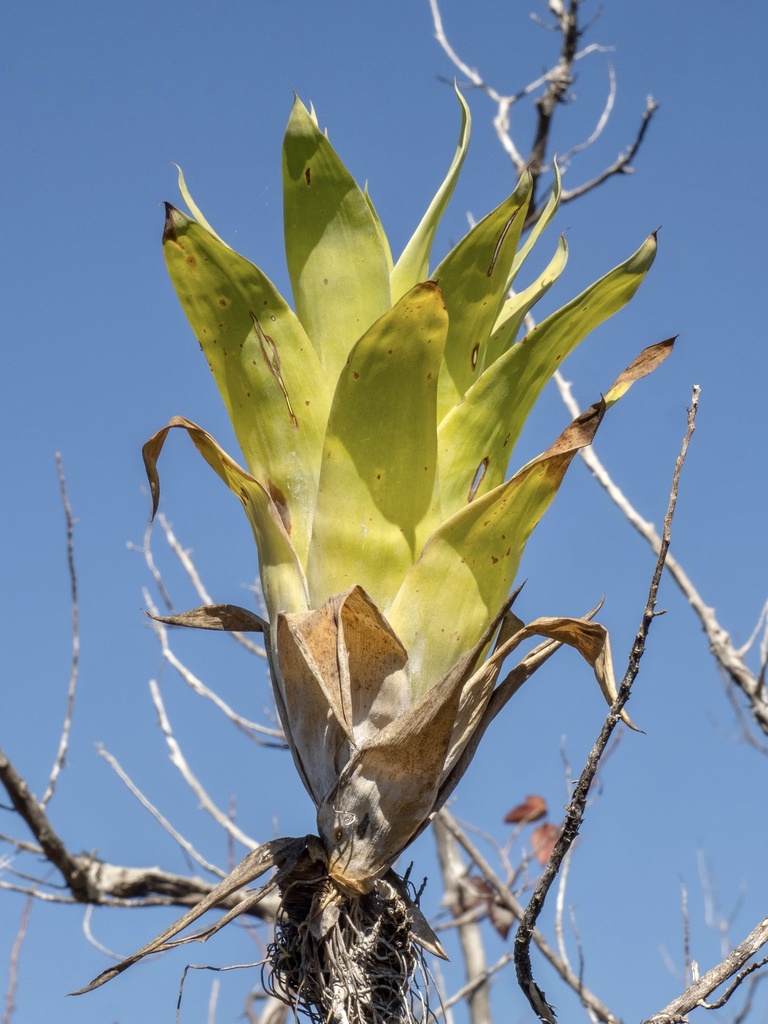
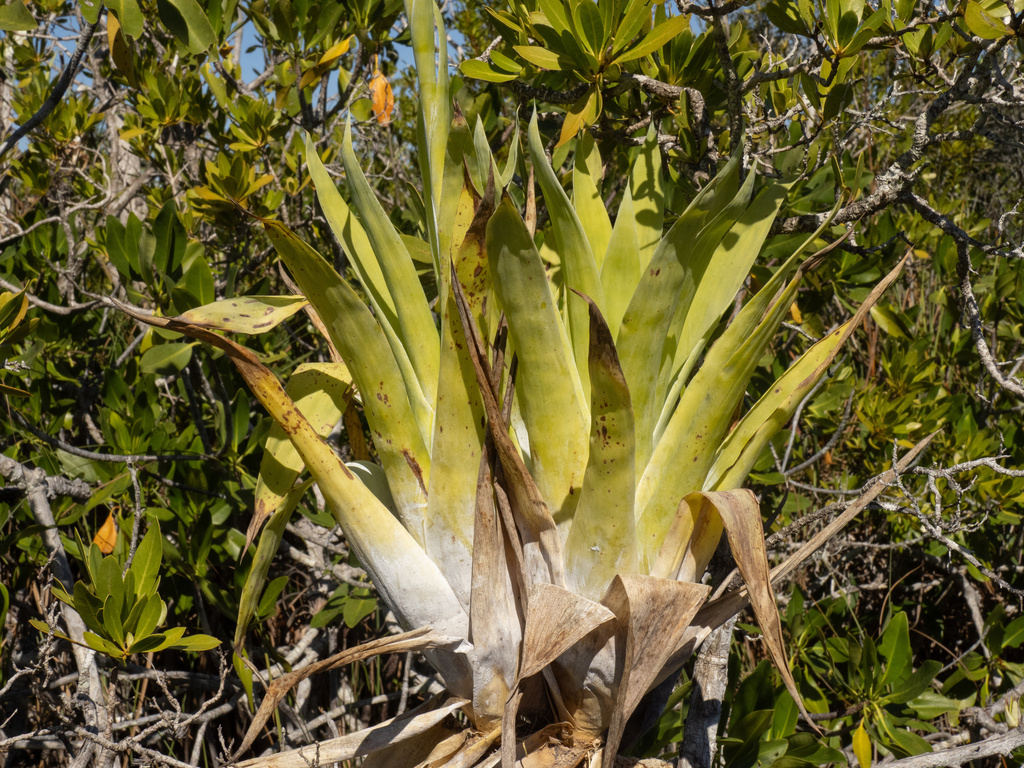
Catopsis berteroniana, known as Powdery Strap Airplant (also powdery catopsis or lantern of the forest), is an epiphytic bromeliad that grows perched on the branches of trees, not in soil. It forms an upright, vase-shaped rosette about 1 to 2 feet tall of smooth, strap-shaped, bright yellow-green leaves, coated at the base with a white, chalky powder. The leaf bases overlap to form a tank that holds rainwater.
It is famous among botanists as a possible carnivorous plant. The slippery powder reflects ultraviolet light, which may attract insects, and studies in Florida found that it traps many more insects in its tank than other bromeliads of similar size. The trapped insects break down in the water and may provide nutrients to the plant.
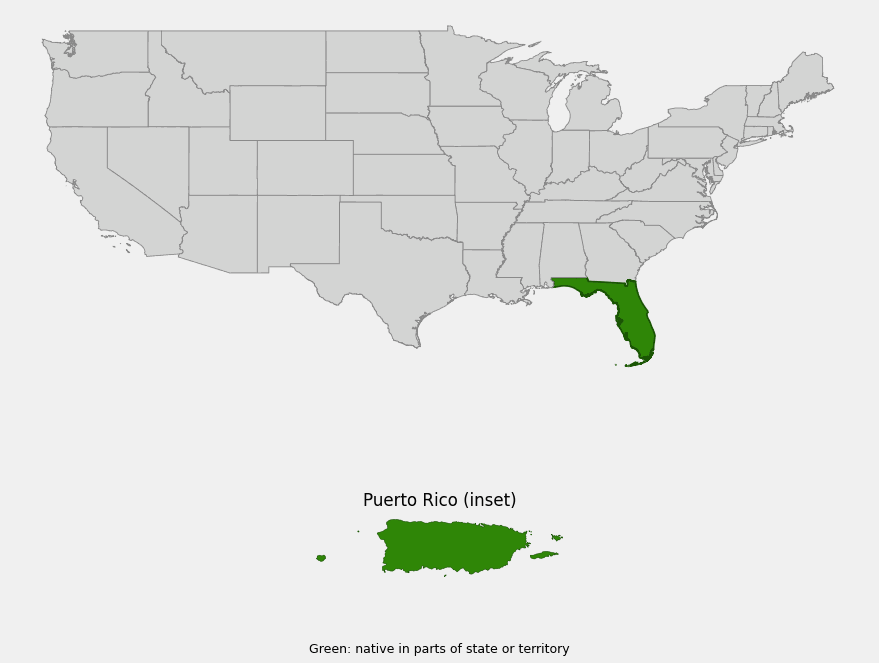
Powdery strap airplant is native from southern Florida through the Caribbean, including Puerto Rico and the U.S. Virgin Islands, to Central and South America. In Florida it is rare, found only in the far south, and it is listed by the state as endangered. Never collect it from the wild; it is rarely sold, but nursery-grown plants are occasionally available from bromeliad specialists.
Identification
Look for an upright, vase-shaped, bright yellow-green bromeliad perched high on a sunny branch, with smooth, spineless, strap-shaped leaves that are dusted with white powder near the base.
Growth Habit
Powdery strap airplant is an evergreen, perennial epiphyte. It grows singly or in small groups, attached to twigs and branches by wiry roots that serve only as anchors. The rosette is about 1 to 2 feet tall, tall and narrow, like a vase or lantern. Each rosette flowers once, then produces offsets (pups) and slowly dies.
Leaves
The leaves are 8 to 16 inches long and about 1 to 2 inches wide, smooth-edged (without the spines of many bromeliads), stiff and upright, and bright yellow-green to apple green. The lower parts of the leaves, and especially the inner leaf bases, are covered with a white, powdery wax that rubs off easily. The tightly overlapping leaf bases form a central tank that holds water and debris.
Flowers
The flower stalk rises from the center of the rosette and carries a slender, erect, usually branched spike well above the leaves, with many small flowers about 1/4 inch long. The flowers have greenish-yellow sepals and small white petals.
Fruit & Seeds
The fruit is a small, dry capsule that splits open to release seeds, each with a tuft of fine hairs that lets it drift on the wind to new branches, like the seeds of other airplants.
Look-alikes
Florida’s other two Catopsis species, the many-flowered airplant (C. floribunda) and the nodding strap airplant (C. nutans), are smaller, greener and grow in shadier swamps; the nodding airplant has drooping flower spikes. Spreading airplant and cardinal airplant have gray, scaly leaves, not smooth yellow-green ones. West Indian tufted airplant has a red and white flower spike.
Quick Facts
| Scientific Name | Catopsis berteroniana |
| Family | Bromeliaceae (bromeliad family) |
| Plant Type | Epiphytic tank bromeliad |
| Mature Height | 1–2 ft (rosette); flower spike taller |
| Mature Spread | 6–12 in |
| Growth Rate | Slow |
| Sun Exposure | Full sun to bright part shade |
| Water Needs | Moderate; keep the tank filled and humidity high |
| Soil Type | None; grows on tree branches (mount on wood) |
| Soil pH | Not applicable (tank water near neutral) |
| Bloom Time | Variable; can flower in several seasons |
| Flower Color | Small white flowers with greenish-yellow sepals |
| Fall Color | None; evergreen |
| Fruit | Small capsule with wind-dispersed, hairy seeds |
| Deer Resistant | Yes (grows out of reach in trees) |
| USDA Hardiness Zones | 10b–12 |
Native Range
Powdery strap airplant has a wide range in the American tropics, from southern Florida through the Greater and Lesser Antilles, Mexico and Central America to northern South America and southern Brazil. USDA PLANTS lists it as native in Florida, Puerto Rico and the U.S. Virgin Islands.
In Florida it is known only from the southern tip of the peninsula, mainly in Miami-Dade, Monroe and Collier counties, in and around Everglades National Park, the Big Cypress region and the Ten Thousand Islands. It is listed as endangered by the State of Florida. Like other native bromeliads in the state, it has suffered from the invasive Mexican bromeliad weevil (Metamasius callizona), whose larvae bore into the heart of the plant and kill it.
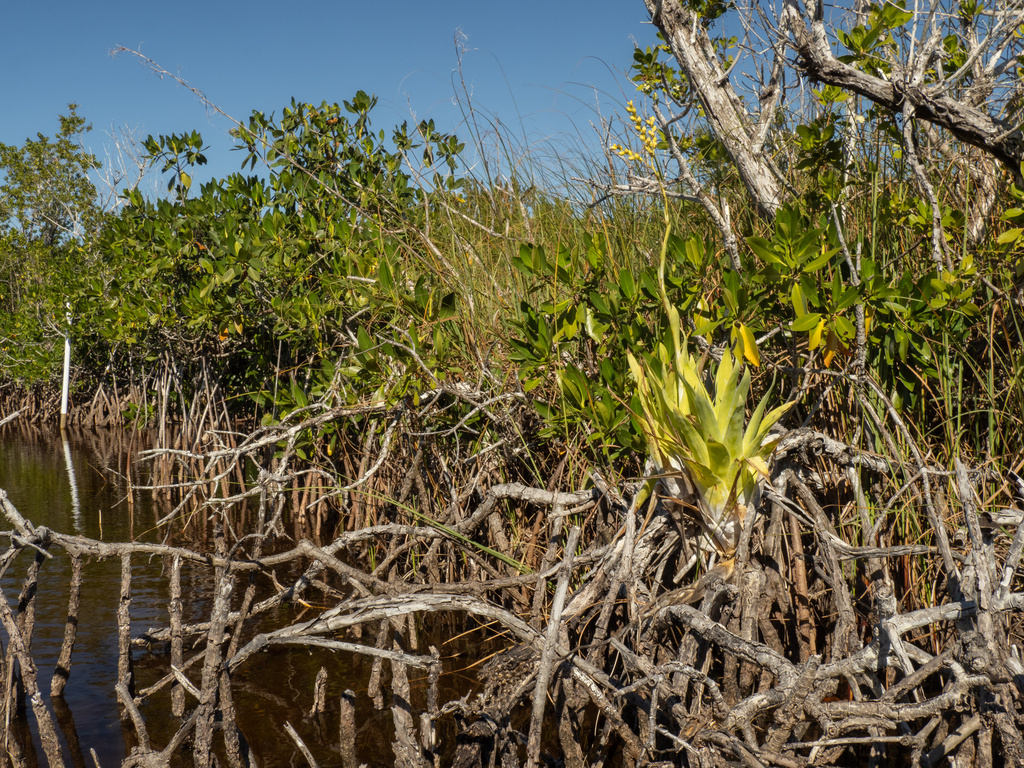
Unlike most bromeliads, which favor shade and humidity, it grows in bright, exposed spots: the sunny crowns of mangroves, buttonwoods and cypresses, and the open, upper branches of hammock and swamp trees.
📋 Regional plant lists featuring Powdery Strap Airplant: North & South Florida · Puerto Rico
Growing & Care Guide
Powdery strap airplant is grown by bromeliad collectors and can be grown outdoors in frost-free South Florida and Puerto Rico, or indoors as a bright-light houseplant. It is state-endangered in Florida: never collect it from the wild, and buy only nursery-propagated plants.
Light
It needs bright light: full sun to bright, filtered light. In low light it becomes soft, dark green and floppy. Indoors, grow it in a south- or west-facing window or under strong grow lights.
Soil & Water
It does not need soil. Mount it on a branch, cork or driftwood, or grow it in a small pot of very coarse orchid bark. Keep a little fresh water in the central tank and mist or water the plant when the roots dry out. Flush the tank every week or two to keep it clean, use rainwater or low-mineral water if possible, and give good air movement. Feed lightly with a dilute orchid or bromeliad fertilizer sprayed on the leaves.
Planting Tips
Outdoors in zones 10b to 12, tie it to a tree branch in a bright spot with soft wire or fishing line until the roots take hold. Protect it from temperatures below about 40°F. In South Florida, check plants for the bromeliad weevil and remove infested rosettes.
Pruning & Maintenance
Remove dead lower leaves and the spent flower spike. After flowering the mother plant slowly dies; leave the pups attached until they are about a third of the parent’s size, then separate them or let them form a clump.
Propagation
Separate offsets (pups) from the base of the plant after flowering. It can also be grown from fresh seed sown on a moist mount or fine bark, but seedlings take several years to mature.
Landscape & Indoor Uses
- Tree mounts: for sunny branches in South Florida and Puerto Rico gardens
- Houseplant: a bright-light, mounted bromeliad for sunny windows
- Bromeliad collections: an unusual, possibly carnivorous species
- Native habitat gardens: pairs with buttonwood, pond apple and airplants
Wildlife & Ecological Value
Each rosette is a tiny wetland in the treetops, with its own community of insects and other small animals.
For Pollinators
The small flowers are visited by small insects. Bromeliad pollination in this genus is not well studied.
For Birds
Birds drink from the water-filled tanks and hunt the insects that live in and around them.
For Mammals
Small tree-dwelling animals may drink from the tanks, but mammals do not feed on the plant.
Ecosystem Role
The tank water (phytotelmata) is a home for mosquito larvae of the genus Wyeomyia, other insect larvae and microorganisms. Insects that fall in and drown decompose and release nutrients, which the plant can absorb through its leaves, supporting the idea that it is partly carnivorous.
Cultural & Historical Uses
The genus name Catopsis comes from Greek words meaning “view from below” or “looking down,” perhaps because these plants are usually seen from below, high on tree branches. The species is named for Carlo Bertero, an Italian botanist who collected plants in the Caribbean and South America in the early 1800s.
In 1984 entomologists J. H. Frank and G. F. O’Meara found that in Florida, powdery strap airplants caught far more insects than other bromeliads of similar size, which led to the idea that this species may be carnivorous. Later studies have found no digestive enzymes, so whether it is truly carnivorous is still debated.
Its sunny, exposed perches and the chalky wax on its leaves may help it reflect intense sunlight and reduce water loss, adaptations that let it live where few other bromeliads can.
Frequently Asked Questions
Is powdery strap airplant carnivorous?
Possibly. Its slippery, UV-reflecting powder helps trap insects in its tank, and it catches many more insects than similar bromeliads, but it does not produce digestive enzymes. Botanists still debate whether it counts as carnivorous.
Is powdery strap airplant protected in Florida?
Yes. It is listed as endangered by the State of Florida. Never collect it from the wild.
Can I grow powdery strap airplant as a houseplant?
Yes, if you can give it very bright light, humidity and good air movement. Mount it on wood or grow it in coarse bark and keep a little water in the tank.
Where does powdery strap airplant grow in the United States?
In far southern Florida, mainly in and around the Everglades, and in Puerto Rico and the U.S. Virgin Islands.
Why are the leaves powdery?
The white powder is a waxy coating. It is very slippery and reflects ultraviolet light, which may attract insects and help them slide into the tank.

Looking for a nursery that carries Powdery Strap Airplant?
Browse our native plant nursery directory: Florida

