
Sea Rosemary (Heliotropium gnaphalodes)
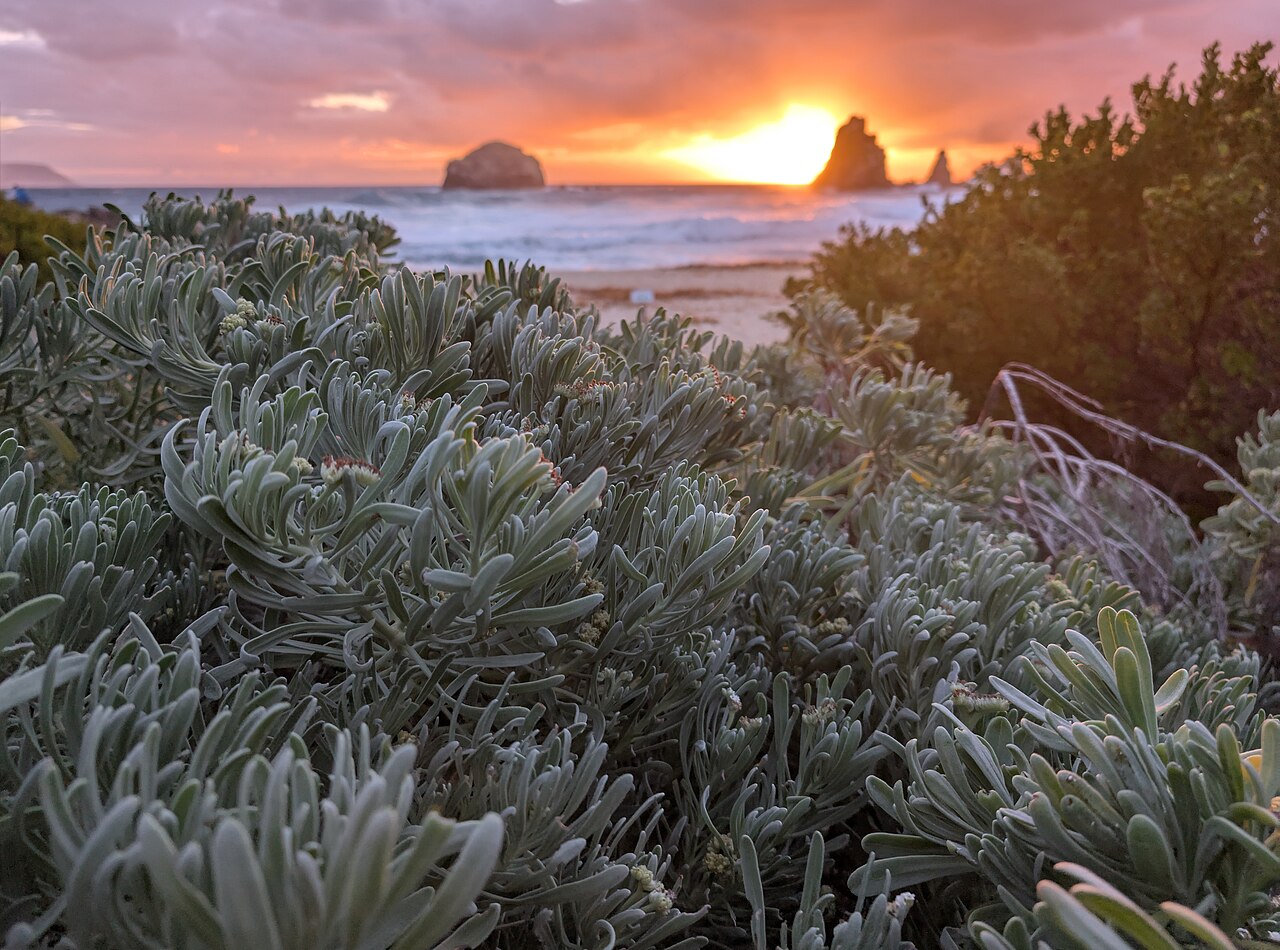
Heliotropium gnaphalodes, known as Sea Rosemary or sea lavender, is a silver-leaved evergreen shrub of the upper beach. It is one of a short list of plants that can live in loose sand within reach of storm waves, in full sun, in salt spray, with no fresh water except rain. Older books and many Florida nurseries still call it Argusia gnaphalodes or Tournefortia gnaphalodes; all three names refer to the same plant, and recent treatments including the Atlas of Florida Plants place it back in Heliotropium, in the borage family (Boraginaceae, sometimes split off as Heliotropiaceae).
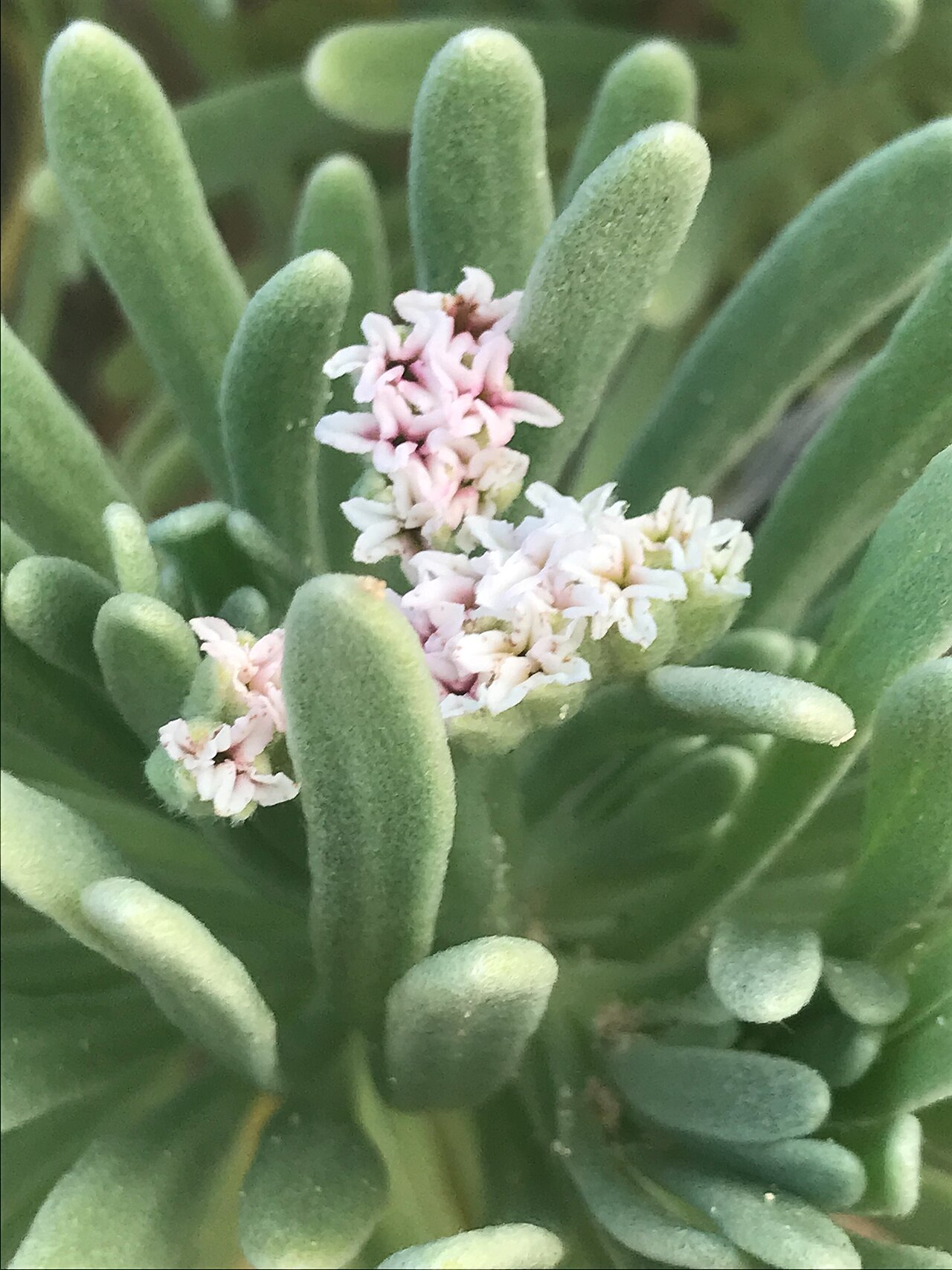
The common names are both borrowed. It is not a rosemary and not a true sea lavender (Limonium). The crowded, narrow, fleshy leaves simply look like rosemary from a distance, and they are covered in dense silky hairs that give the whole shrub a pale silver-gray color. The flowers are small, white with a pink or yellow eye, and they open along coiled sprays that unroll as they bloom. A plant can be in flower in any month, and it is often in flower and fruit at the same time.
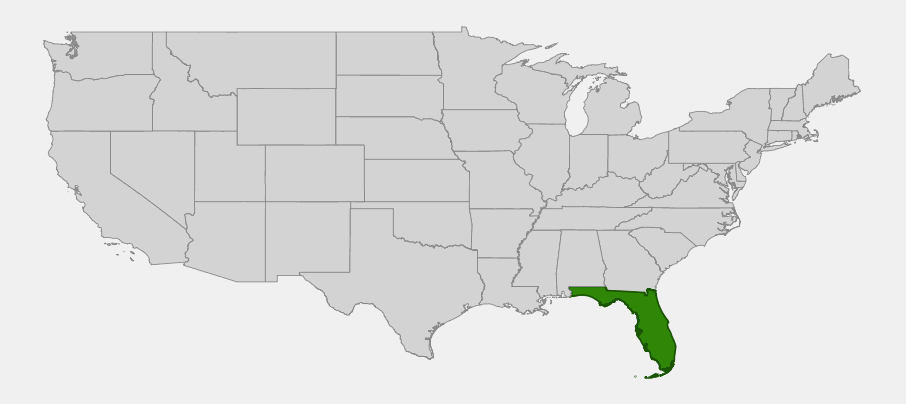
In the United States sea rosemary grows only in Florida, on the southeast coast, the Keys and parts of the southwest Gulf coast, plus Puerto Rico. Coastal development, beach raking, foot traffic and a series of hurricanes have thinned its Florida populations enough that the state lists it as Endangered. This guide covers how to tell it from the other silvery dune plants, where it grows, how to use it in a coastal landscape, and why you should only ever plant nursery-propagated stock.
Identification
Several beach plants are gray and fleshy, so look closely at the leaf arrangement and the flower spray. Sea rosemary is the one with narrow, spoon-shaped leaves packed into rosettes at the ends of thick gray branches, and with flowers in coils rather than in flat clusters or single trumpets.
Habit & Stems
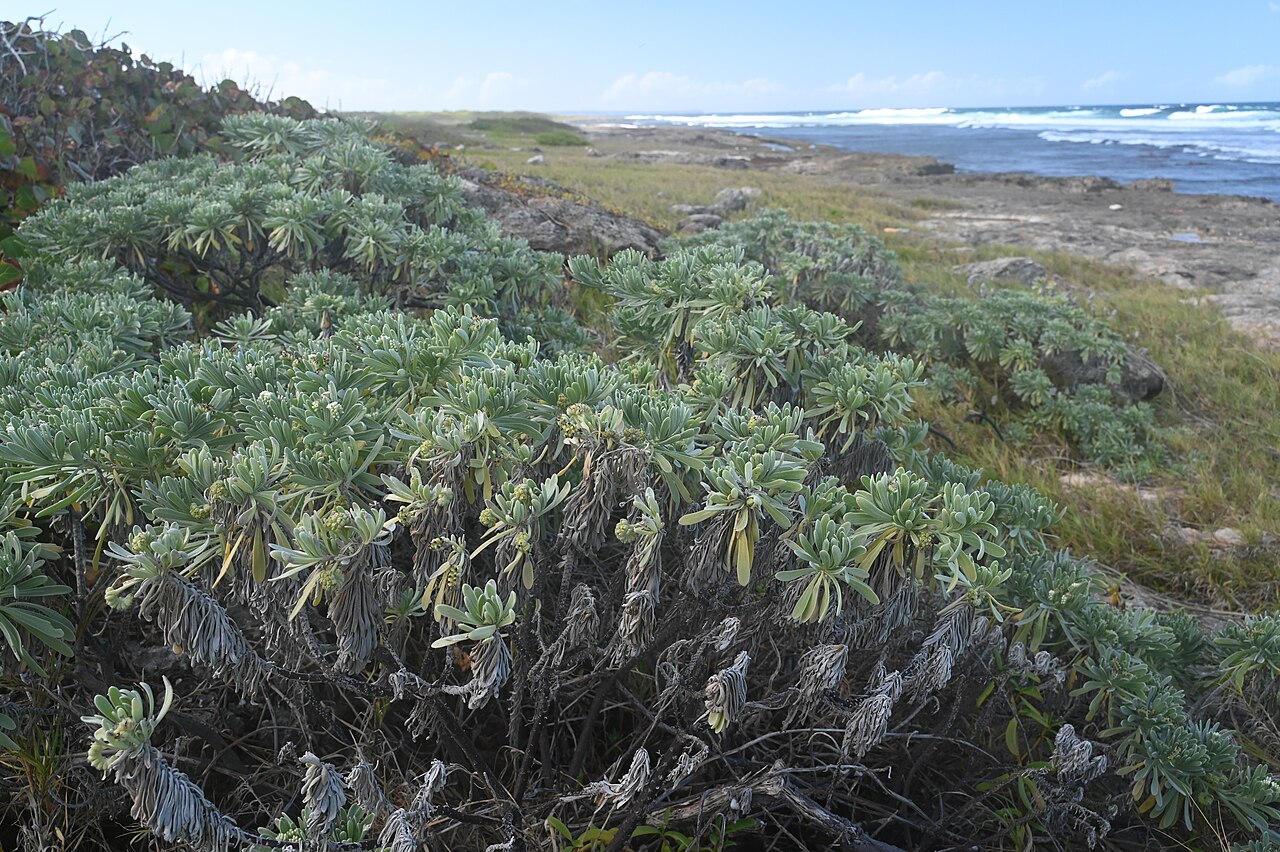
Sea rosemary is a sprawling, mounded evergreen shrub, usually 2 to 4 feet tall and 4 to 8 feet wide, occasionally reaching 5 or 6 feet tall in sheltered spots. Exposed plants on open beach stay much lower and wider, pressed into the shape of the prevailing wind. The branches are thick, brittle, crooked and pale gray, scarred with rings where old leaves dropped, and they branch repeatedly near the tips. Branches that are buried by drifting sand or knocked flat by storms often root where they touch, so one plant slowly spreads into a low thicket.
Leaves
The leaves are the best field mark. They are narrow and spatula-shaped, 1 to 3 inches long and under half an inch wide, thick and succulent, with the edges rolled slightly under. Dense silky hairs cover both surfaces and make the foliage silver-gray to almost white in strong sun. Leaves are crowded into tight rosettes at the branch tips, so the plant looks like a cluster of small silver shaving brushes. Older leaves turn straw-yellow before they drop, and the dried leaves often hang on the stem for a while.
Flowers
The flower clusters sit at the branch tips, among or just above the leaf rosettes. Each cluster is made of several branches that are tightly coiled when young and uncurl as the flowers open, a pattern botanists call a scorpioid cyme. The individual flowers are small, about a quarter inch across, with five rounded white lobes and a short tube, usually with a pink, purple or yellowish center. They are lightly fragrant. In south Florida a healthy plant flowers more or less year round, with the heaviest flush in spring and summer.
Fruit & Seeds
Each pollinated flower produces a small, rounded, corky fruit about a quarter inch across, green at first and drying tan to brown. It splits into two halves, each with one or two seeds. The fruit is buoyant and salt-tolerant, so it floats on seawater for long periods. This is how sea rosemary reaches new islands and why it is found on beaches throughout the Caribbean. Fruits are often present on the same branch tips as open flowers.
Quick Facts
| Scientific Name | Heliotropium gnaphalodes (syn. Argusia gnaphalodes, Tournefortia gnaphalodes, Mallotonia gnaphalodes) |
| Family | Boraginaceae (borage family; sometimes placed in Heliotropiaceae) |
| Plant Type | Evergreen shrub, sprawling and mounded |
| Mature Height | 2–4 ft typically; occasionally to 5–6 ft in sheltered sites |
| Mature Spread | 4–8 ft; older plants layer and spread wider |
| Growth Rate | Slow to moderate |
| Sun Exposure | Full sun |
| Water Needs | Very low once established; highly drought tolerant |
| Soil Type | Loose beach sand, shell and coral rubble; must drain sharply |
| Soil pH | Neutral to strongly alkaline, about 7.0–8.5 |
| Bloom Time | Year-round in south Florida, heaviest spring through summer |
| Flower Color | White with a pink, purple or yellow center |
| Fall Color | None; evergreen silver-gray foliage all year |
| Fruit | Small, rounded, corky, buoyant fruit splitting into two halves |
| Deer Resistant | Yes; the hairy, salty foliage is rarely browsed |
| USDA Hardiness Zones | 10–11 (damaged below about 30°F) |
Native Range
Sea rosemary is a Caribbean and western Atlantic coastal plant. In the United States, USDA PLANTS records it from Florida and Puerto Rico only, and the Atlas of Florida Plants maps it from the Atlantic coast counties of central and southern Florida south through the Keys, with scattered occurrences on the lower Gulf coast. Beyond U.S. waters it grows on beaches in Bermuda, the Bahamas, Cuba, Hispaniola, Jamaica, the Lesser Antilles, and along the Caribbean coasts of Mexico, Central America and northern South America.
It is strictly a plant of the coast. Sea rosemary grows on the open upper beach, the seaward face and crest of the first dune, coastal rock and coral rubble, and the sandy edges of coastal strand thickets. It does not move inland, and it does not persist where other vegetation closes over it. What it needs is sand that drains instantly, full unshaded sun, and the salt spray and wind that keep taller shrubs out.
Its Florida populations have declined. Beachfront construction, seawalls, beach raking and renourishment, off-road vehicles and foot traffic all remove the narrow band of habitat it occupies, and major hurricanes have erased whole colonies in the Keys. The Florida Department of Agriculture and Consumer Services lists sea rosemary as Endangered on the state Regulated Plant Index. Buy nursery-propagated plants from a licensed native plant nursery, and never dig, cut or collect seed from wild plants.
📋 Regional plant lists featuring Sea Rosemary: North & South Florida
Growing & Care Guide
Sea rosemary is easy in the one situation it wants and difficult everywhere else. Give it a hot, bright, sandy, fast-draining spot near salt water and leave it alone. Put it in irrigated, enriched, heavy or shaded ground and it rots, stretches, loses its silver color and dies, usually within a season or two.
Light
Full sun, all day, with no overhead shade. Sea rosemary evolved on open beach and has no tolerance for being shaded out. Plants under trees or on the north side of a building grow leggy, lose the dense rosettes and stop flowering.
Soil & Water
Pure sand, shell or coral rubble is ideal. The one absolute requirement is drainage: the root zone must never stay wet. Do not amend the planting hole with compost, peat or topsoil, and do not mulch heavily around the base. Water new plants to settle them in and then roughly once a week for the first few months, tapering off as they root. After the first year, rain alone is enough in Florida, and established plants can go through a long dry season untouched. Overwatering, especially with an automatic irrigation system aimed at nearby turf, is the most common way gardeners kill it.
Planting Tips
Plant from containers at the start of the rainy season so the roots establish before the dry months. Set plants at the same depth they grew in the pot, slightly high rather than slightly low. Space them 4 to 6 feet apart if you want a connected drift, which is how they grow naturally. Keep them out of the splash zone of irrigation heads and away from downspouts and low spots. Young plants on an exposed beach benefit from a temporary windbreak of sand fencing, not from staking, since the brittle branches snap against a stake.
Pruning & Maintenance
Almost none is needed. Remove storm-broken branches and any dead wood, cutting back to a live branch point. If a plant has grown awkward, prune lightly in spring; it resprouts from thick old wood more reluctantly than most shrubs, so avoid hard cutbacks. Never shear it into a hedge shape, which destroys the natural mounded form and the rosette pattern. Do not fertilize. Letting leaf litter and drifted sand collect under the plant mimics what happens on a natural beach.
Propagation
Nurseries raise sea rosemary mainly from seed and from cuttings. Fresh fruits can be cleaned and sown in coarse sand in a warm, bright place; germination is uneven and often takes several weeks to months. Semi-hardwood tip cuttings taken in warm weather root in sharp sand under light mist, though success is variable. Low branches sometimes layer naturally where sand buries them, and a rooted layer can be severed and moved. Because wild plants are state-listed, collecting seed or cuttings from them requires the landowner’s permission and, on public land, a permit.
Landscape Uses
- Beachfront and dune landscaping: one of the few shrubs that will live in the front line of salt spray and blowing sand
- Dune restoration: planted with sea oats and railroad vine to stabilize the back of the foredune, using nursery-grown material
- Coastal xeriscape: a silver accent for unirrigated sand gardens, rock gardens and parking islands in south Florida
- Low informal hedging: a loose, mounded screen along a beach walkway, never sheared
- Container plantings: a durable container shrub in coarse sand mix on a sunny seaside deck or terrace
Wildlife & Ecological Value
Sea rosemary is a small part of a very simple plant community, which makes what it does matter more. On a working beach it is often the only woody plant between the tide line and the dune crest.
For Pollinators
The flowers are small but numerous and available in almost every month, which makes sea rosemary a steady nectar source on a habitat with few flowering plants. Native bees, small wasps, flies and butterflies visit it, and in south Florida it is regularly worked by hairstreaks and other small butterflies that live in the coastal strand. Year-round bloom matters most in winter and in the weeks after a storm, when little else on the beach is flowering.
For Birds
Shorebirds and songbirds use sea rosemary thickets as cover rather than as food. The dense, low, branchy mounds give migrating warblers and other small birds shelter from wind and from predators on an otherwise bare beach, and they shade the sand where ground-feeding birds forage. On Caribbean islands, seabirds nest among and under the shrubs.
For Mammals
The hairy, salt-laden leaves are unpalatable, and deer and rabbits leave it alone. On barrier islands the main mammal connection is indirect: the shrubs trap sand and litter and create cooler, moister pockets used by small mammals and by beach-dwelling invertebrates.
Ecosystem Role
Sea rosemary is a dune builder. Its low branches catch wind-blown sand, the plant grows up through the accumulating sand, and over years that process raises and anchors the foredune that protects everything behind it. Its buoyant fruits make it a classic example of ocean drift dispersal, and it is one of the first woody colonizers of newly formed or storm-scoured beaches throughout the Caribbean. Because it occupies such a narrow band of shoreline, it is also an early casualty when that band is armored or developed.
Cultural & Historical Uses
Linnaeus described this plant in 1759 as Heliotropium gnaphalodes. The species name comes from Gnaphalium, the cudweeds, and refers to the woolly silver leaves. For most of the twentieth century it was shuffled between Tournefortia, Mallotonia and Argusia, and the name Argusia gnaphalodes is still the one on most Florida nursery tags and in state listing documents. Molecular work has since folded all of these back into a broadly defined Heliotropium, the treatment the Atlas of Florida Plants follows. A close relative with the same beach habit, Seaside Heliotrope, is a low herb rather than a shrub and grows on salt flats and beach wrack across a much wider U.S. range.
Across the Caribbean the plant has a long record of local medicinal use, usually as a leaf or root preparation for coughs, colds and stomach complaints, and it is sometimes called iodine bush or bay lavender for its smell when crushed. These are folk uses recorded in regional ethnobotanical surveys rather than tested remedies, and the plant is not used medicinally in Florida.
In Florida, sea rosemary has become a conservation emblem for the coastal strand. It is a regular part of dune restoration plantings in Miami-Dade, Broward, Palm Beach and the Keys, and it is grown by a number of licensed south Florida native nurseries. Its recovery after hurricanes is slow, and because fruits drift in on currents from the Bahamas and Cuba, Florida’s populations are connected to the wider Caribbean. Protecting beach habitat and planting propagated stock are the two things that actually help it.
Frequently Asked Questions
Is sea rosemary the same as Argusia gnaphalodes?
Yes. Argusia gnaphalodes, Tournefortia gnaphalodes and Mallotonia gnaphalodes are all synonyms of Heliotropium gnaphalodes. Florida nursery tags and state listing documents most often use Argusia, while the Atlas of Florida Plants and recent botanical treatments use Heliotropium.
Is it legal to grow sea rosemary in Florida?
Yes. Florida lists it as Endangered on the state Regulated Plant Index, which restricts taking plants from the wild, not growing propagated ones. Buy from a licensed native plant nursery and keep the receipt. Never dig plants, cut branches or collect fruit from wild colonies.
Can sea rosemary take salt water over its roots?
It takes heavy salt spray and brief inundation by storm surge, and its fruits float in seawater for weeks. It is not a mangrove, though. Soil that stays saturated, salty or fresh, will kill it. It wants sand that drains the moment the water stops.
Why is my sea rosemary turning green and leggy?
Almost always too much shade, too much water or both. Irrigation overspray and rich, amended soil make it stretch, lose the silver hairs and eventually rot at the base. Move it to a hotter, drier, sunnier spot in plain sand and stop watering it.
How cold can sea rosemary take?
It is a zone 10 to 11 plant. Leaves burn in the low thirties and plants are usually killed by a hard freeze, which is why it does not grow naturally north of central Florida’s Atlantic coast. In colder parts of the state, grow it in a container and move it under cover for freezes.

Looking for a nursery that carries Sea Rosemary?
Browse our native plant nursery directory: Florida