
Stokes’ Aster (Stokesia laevis)
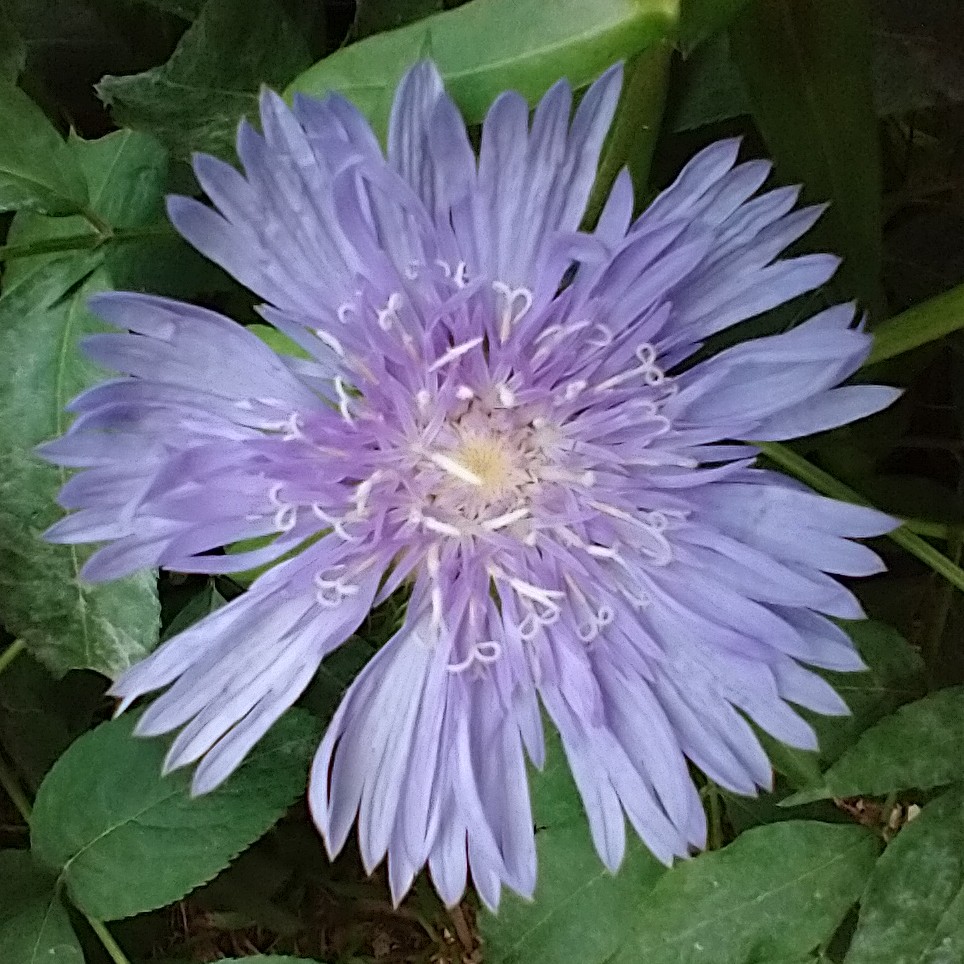
Stokesia laevis, Stokes’ Aster, is a showy perennial wildflower of the southeastern Coastal Plain with large, fringed, cornflower-like flower heads in lavender-blue, from late spring into summer. Each head is 2 to 4 inches across and sits above a low clump of long, smooth, dark green leaves.
It is the only species in the genus Stokesia, part of the aster family (Asteraceae), and it is native from North Carolina to Florida and west to Louisiana. In the wild it grows in moist pine savannas, bog edges and open, wet woodlands, and it is uncommon throughout much of that range.
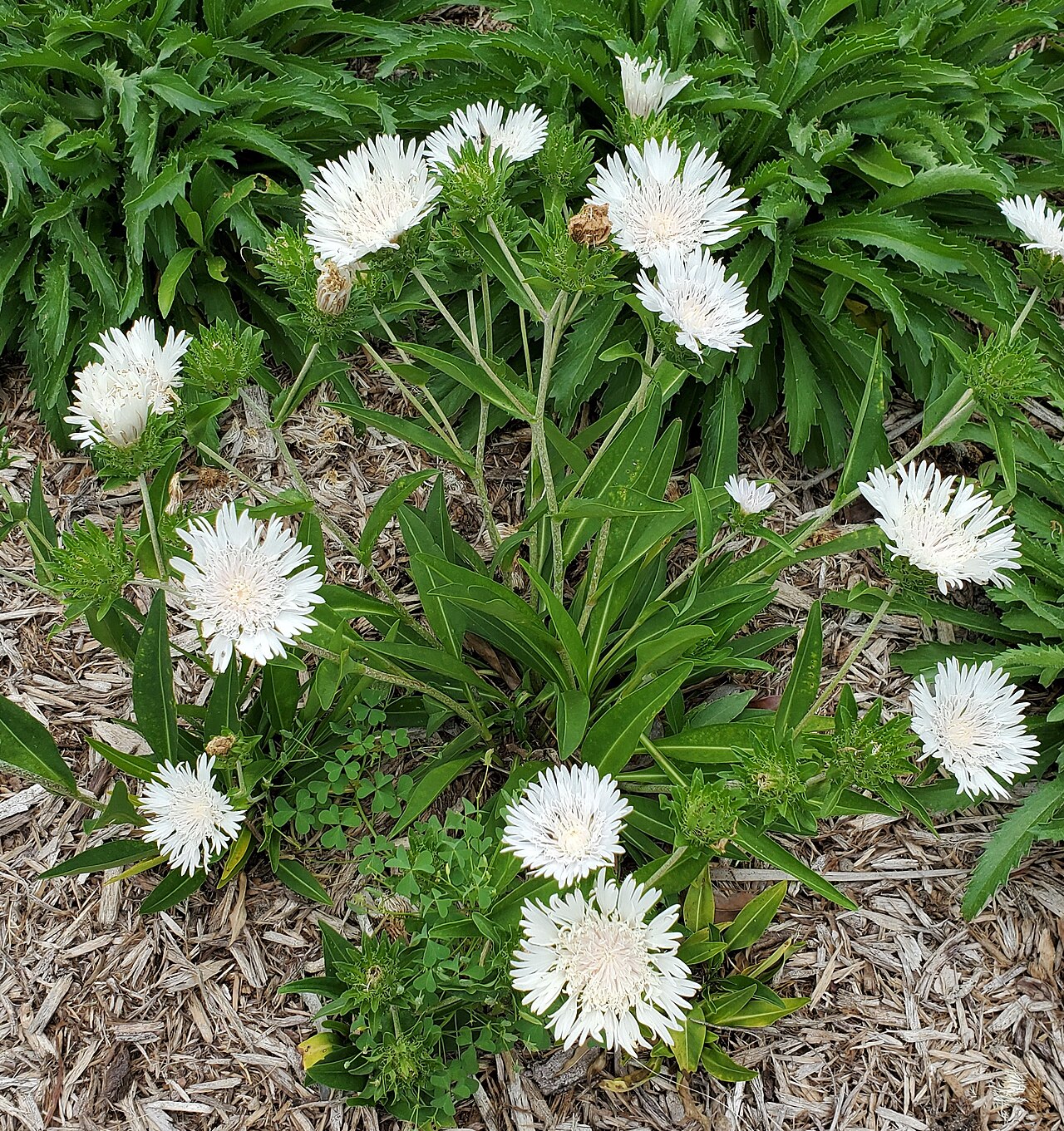
Unlike many of the wildflowers on this site, Stokes’ aster is a well-established garden plant, sold in most nurseries in many cultivars in blue, purple, pink, white and even pale yellow. It is easy to grow, long-blooming, and hardy far north of its native range.
Identification
Stokes’ aster looks more like a cornflower or a large bachelor’s button than a true aster. Its fringed flower heads and smooth, strap-like leaves make it easy to recognize.
Leaves
The basal leaves form a rosette or low clump. They are lance-shaped to strap-shaped, 4 to 8 inches long, smooth (the meaning of laevis), dark green and often with a pale midrib. In mild climates they stay green through winter. The stem leaves are smaller, clasp the stem and have a few spiny teeth at the base.
Stems
Leafy flowering stems are 1 to 2 feet tall and branch near the top, each branch ending in a single flower head. The stems are slightly hairy, especially when young.
Flowers
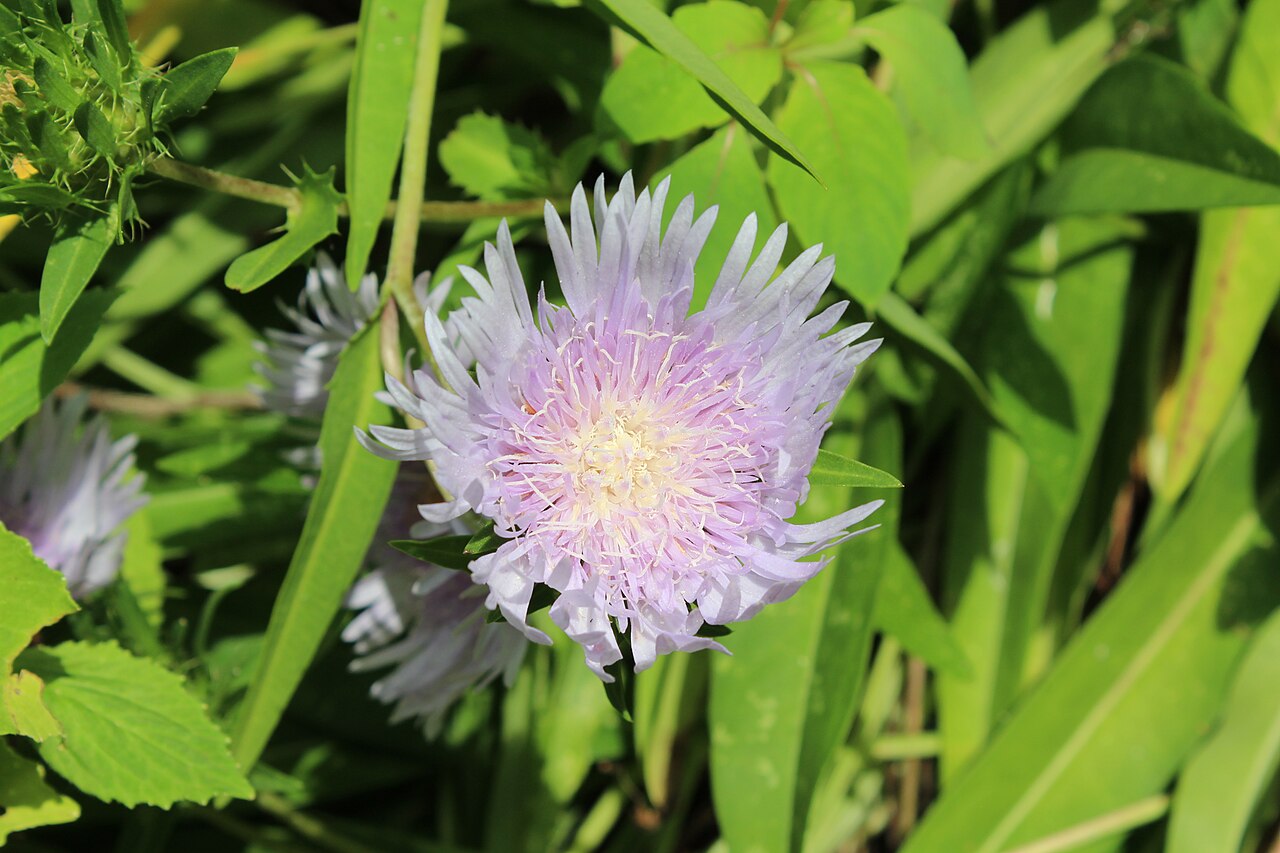
The flower heads are 2 to 4 inches across. All of the florets are tubular, but the outer ones are greatly enlarged, with a deeply five-lobed tip, giving the flower its fringed, ragged look. The inner florets are smaller and form a lighter center. Wild plants are usually lavender-blue; white and pink forms also occur. Each head is cupped by spiny, leafy bracts. Flowering starts in late spring and continues into summer, with occasional flowers into fall.
Fruit & Seeds
The seeds are four-angled cypselae topped with a few short, deciduous scales rather than a fluffy pappus. They ripen in the dry seed heads in late summer.
Quick Facts
| Scientific Name | Stokesia laevis |
| Family | Asteraceae (aster family) |
| Plant Type | Herbaceous perennial wildflower |
| Mature Height | 1–2 ft |
| Mature Spread | 1–1.5 ft |
| Growth Rate | Moderate |
| Sun Exposure | Full sun to part shade |
| Water Needs | Moderate to high; moist but well-drained soil |
| Soil Type | Moist, acidic sandy or loamy soil |
| Soil pH | Acidic, about 5.0–6.5 |
| Bloom Time | May–August (into fall in gardens) |
| Flower Color | Lavender-blue; also white, pink or purple |
| Fall Color | Evergreen to semi-evergreen leaves in mild climates |
| Fruit | Four-angled seeds (cypselae) |
| Deer Resistant | Fairly resistant |
| USDA Hardiness Zones | 5–9 |
Native Range
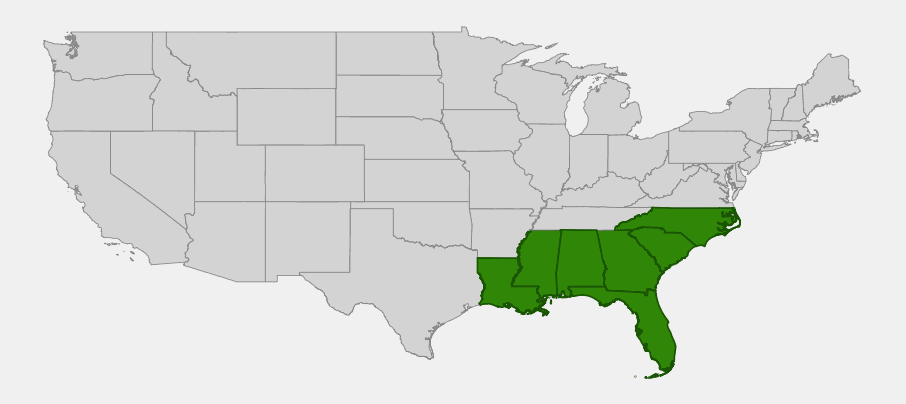
Stokes’ aster is native to the southeastern Coastal Plain, from eastern North Carolina south to northern Florida and west through Georgia, Alabama and Mississippi to eastern Louisiana. USDA PLANTS records it from Alabama, Florida, Georgia, Louisiana, Mississippi, North Carolina and South Carolina.
In Florida it is native to the northern part of the state, mainly the Panhandle, according to the Atlas of Florida Plants. Its habitats are moist longleaf pine savannas and flatwoods, the edges of pitcher-plant bogs, wet ditches, and open, moist woodlands, almost always on acidic soil.
It is uncommon to rare in the wild across much of its range, because the fire-maintained wet savannas it grows in have mostly been converted to farms, pine plantations and development. Garden plants are widely available, so there is no reason to dig wild plants.
📋 Regional plant lists featuring Stokes’ Aster: North & South Florida · Alabama, Georgia & Mississippi · North & South Carolina · Arkansas, Louisiana, Eastern Oklahoma & Eastern Texas
Growing & Care Guide
Stokes’ aster is one of the easiest native perennials for a sunny border in the Southeast and well beyond. Give it decent drainage, especially in winter, and it will bloom for years.
Light
Plant it in full sun for the most flowers. It tolerates part shade, especially afternoon shade in hot climates, but flowers less there.
Soil & Water
It likes moist, acidic, sandy or loamy soil that drains well. Although it grows in wet savannas in the wild, it rots in heavy clay that stays wet in winter. Water during dry spells in summer; it is not very drought tolerant. Average garden soil without much fertilizer is enough.
Planting Tips
Space plants 12 to 18 inches apart at the front or middle of a border, or in groups of three to five in a rain-garden edge or cottage garden. In Florida it grows best in the north and central parts of the state; in South Florida it is short-lived.
Pruning & Maintenance
Deadhead the faded flowers to extend flowering into late summer. Cut back the old flowering stems after bloom, but leave the basal leaves. Clumps can be divided every three or four years in spring or fall if they get crowded. It has few pest problems.
Propagation
Divide clumps in spring or early fall, or take root cuttings in fall. Seed of wild-type plants germinates readily when sown in spring, and plants may self-sow a little in the garden. Seed from cultivars does not come true to color.
Landscape Uses
- Perennial borders and cottage gardens: long-blooming blue flowers at the front of the border
- Butterfly and pollinator gardens: nectar for butterflies and bees from late spring into summer
- Rain-garden edges and savanna gardens: in moist, acidic, sunny ground
- Cut flowers: long-lasting cut flowers
Wildlife & Ecological Value
In a pine savanna, the large blue flowers of Stokes’ aster stand out among the grasses and are visited by many insects.
For Pollinators
The flowers are visited by butterflies such as swallowtails, skippers and sulphurs, as well as bumble bees, native bees and honey bees. Its long bloom season makes it a dependable nectar source in early summer.
For Birds
Goldfinches and other seed-eating birds may pick at the ripe seed heads. It is of limited importance to birds otherwise.
For Mammals
Deer and rabbits usually leave it alone, which makes it useful in suburban gardens.
Ecosystem Role
Stokes’ aster is part of the very diverse groundcover of longleaf pine savannas, which depend on frequent fire. Its basal leaves sit close to the ground and resprout quickly after a burn.
Cultural & Historical Uses
The genus was named for Jonathan Stokes (1755–1831), an English physician and botanist. The plant was introduced to European gardens in the 1700s and has been grown in gardens on both sides of the Atlantic since.
Stokesia is a monotypic genus: Stokesia laevis is its only species. It is a member of the ironweed tribe (Vernonieae) of the aster family, which explains why it looks so different from true asters.
Breeders have selected many cultivars, including ‘Blue Danube’ (large blue flowers), ‘Klaus Jelitto’, ‘Purple Parasols’ (flowers that change from blue to purple), ‘Mary Gregory’ (pale yellow), ‘Peachie’s Pick’ and ‘Colorwheel’. They are fine garden plants; for restoration in its native range, choose seed-grown, wild-type plants.
Frequently Asked Questions
Is Stokes’ aster native?
Yes. It is native to the southeastern United States, from North Carolina to Florida and west to Louisiana. It is listed as native by USDA PLANTS and the Atlas of Florida Plants.
Is Stokes’ aster a true aster?
No. Despite its name, it belongs to a different group of the aster family (the ironweed tribe) and is the only species in the genus Stokesia.
How long does Stokes’ aster bloom?
Mainly from late spring through summer, roughly May through August. Deadheading can prolong flowering, and a few flowers may appear into fall.
Is Stokes’ aster deer resistant?
It is generally avoided by deer and rabbits, although no plant is completely deer-proof.
Can I grow Stokes’ aster in South Florida?
It is native to north Florida and grows best in north and central Florida. In South Florida it tends to be short-lived because of the heat and the lack of a winter rest.

Looking for a nursery that carries Stokes’ Aster?
Browse our native plant nursery directory: Alabama · Florida & Georgia · Louisiana & Mississippi · North Carolina · South Carolina