
Goldenclub (Orontium aquaticum)
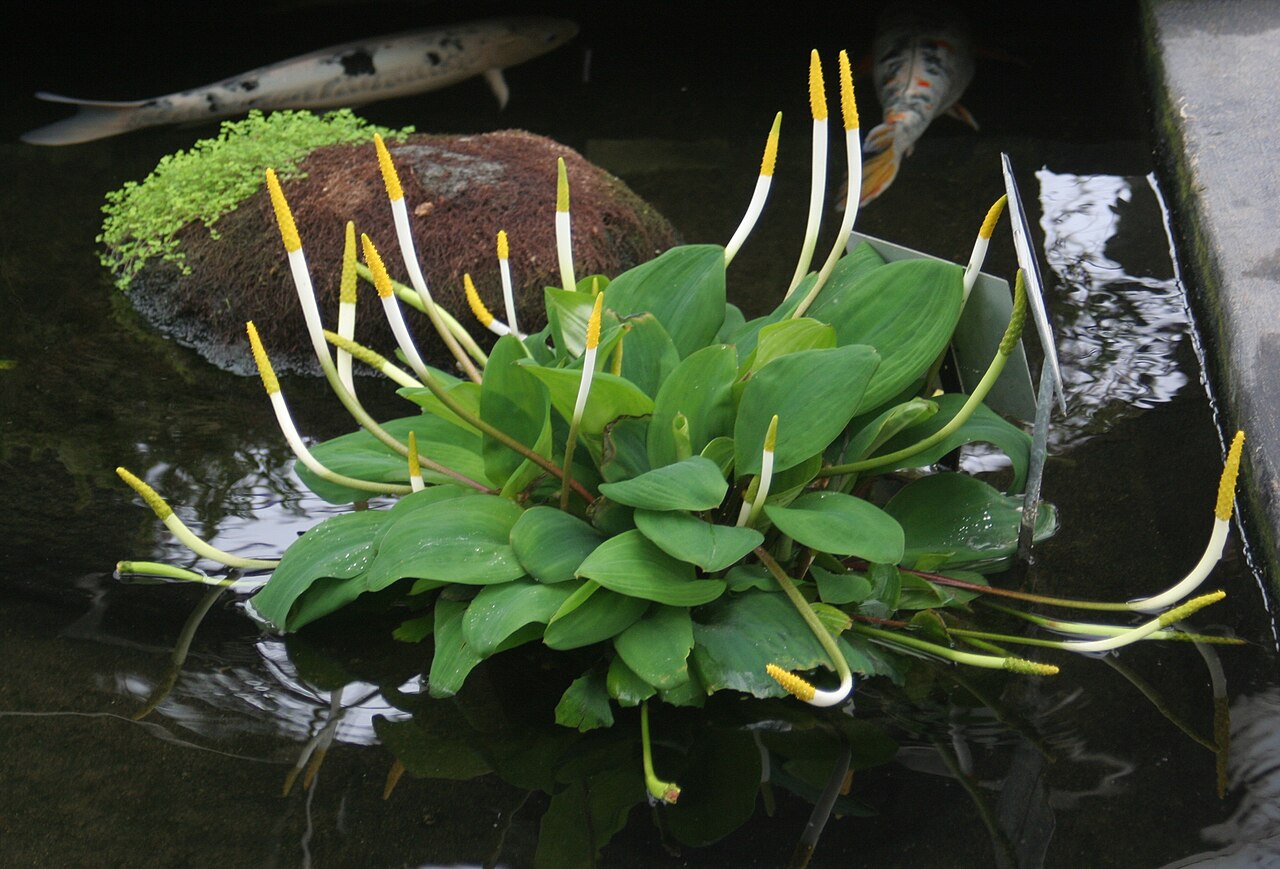
Orontium aquaticum, known as Goldenclub or neverwet, is an aquatic perennial of slow streams, swamps and pond margins in the eastern United States. It forms clumps of long-stalked, elliptic, blue-green leaves that stand above the water or float on its surface, and in late winter and spring it sends up curving white stalks, each tipped with a narrow, bright golden “club” of tiny flowers. A colony in bloom looks like a scatter of lit matches over dark water.
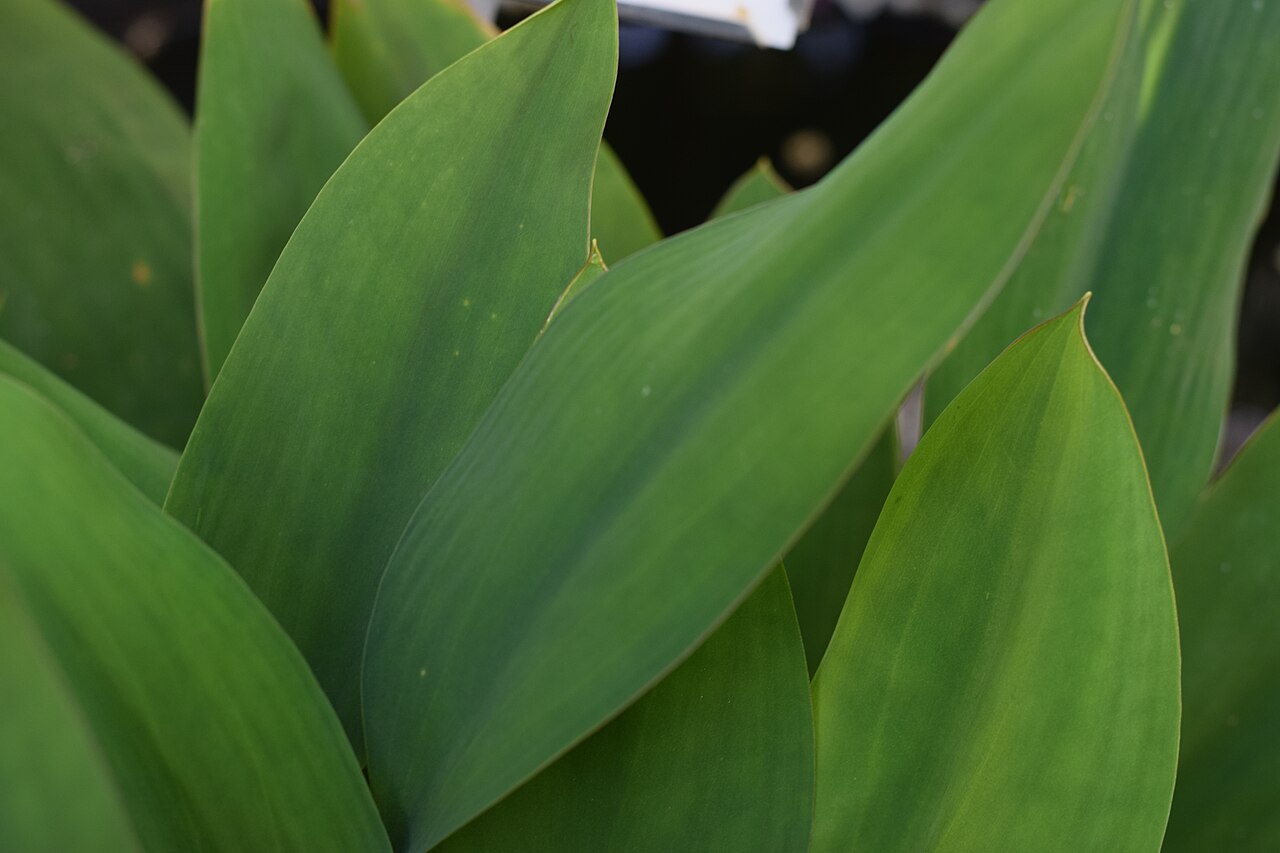
Goldenclub is a member of the arum family (Araceae), along with arrow arum, skunk cabbage and jack-in-the-pulpit, and it is the only living species in its genus. Its leaves have a velvety, water-repellent surface: water beads up and rolls off, and leaves pushed underwater come up dry, which explains the name neverwet. Both the Atlas of Florida Plants and USDA PLANTS call it goldenclub.
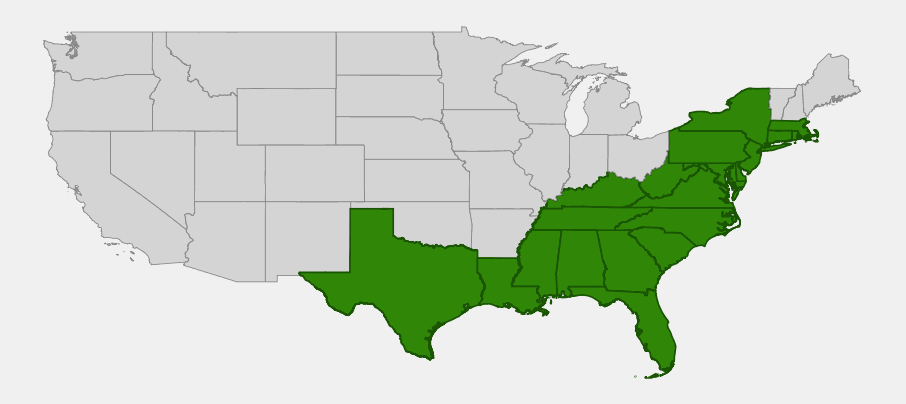
It is native from Massachusetts and New York south to Florida and west to Kentucky, Tennessee, Louisiana and eastern Texas, mostly on the Atlantic and Gulf Coastal Plains. It is a striking, low-maintenance plant for ponds and water gardens. Like other arums, the raw plant contains needle-like calcium oxalate crystals and should not be eaten. This guide covers identification, range, care and wildlife value.
Identification
No other North American plant looks quite like goldenclub in flower. Out of flower, look for long-stalked, elliptic, blue-green leaves with a soft, matte surface that sheds water.
Rhizome & Roots
It grows from a thick, vertical rhizome that can be buried deeply in mud, anchored by stout, contractile roots that pull the plant down into the sediment. Clumps expand slowly over time.
Leaves
The leaves rise from the base on long, spongy stalks. The blades are elliptic to oblong, usually 5 to 12 inches long (larger in deep water), with parallel veins and no lobes. They are dark blue-green above, paler beneath, and have a velvety, water-repellent surface. In shallow water and on mud the leaves stand upright; in deeper water they float. The plant is largely evergreen in the Deep South and dies back in winter farther north.
Flowers
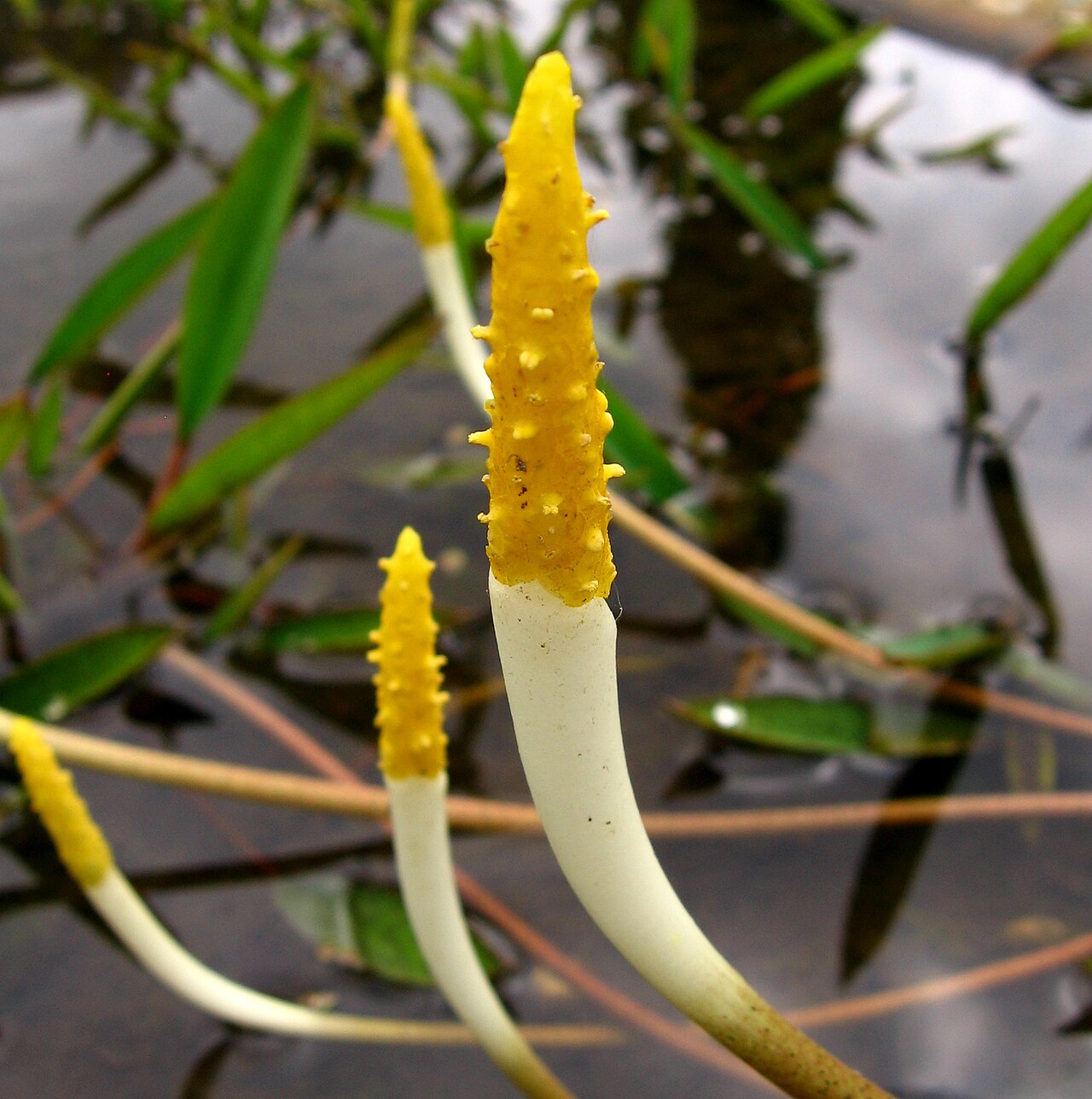
The flowering stalk is long and curved, green near the base and conspicuously white for several inches below the flower spike. The spike (spadix) is 1 to 2 inches long, narrow and golden yellow, densely covered with tiny bisexual flowers. The spathe, the hood that surrounds the spadix in most arums, is reduced to a small sheath at the base of the stalk and falls early, so the spadix is fully exposed. Flowering is from late winter to spring: as early as January or February in Florida, and April to June in the north.
Fruit & Seeds
After flowering the stalks bend down toward the water. The fruits are small, blue-green, one-seeded berries clustered along the old spadix. The seeds are large and green and usually fall into the water near the parent.
Similar Species
Arrow arum (Peltandra virginica) and white arrow arum have arrowhead-shaped leaves and a spadix wrapped in a green or white spathe. Spatterdock has larger, notched, heart-shaped leaves and yellow cup-shaped flowers. Floating goldenclub leaves can be told apart from water-lily leaves by their lack of a notch.
Quick Facts
| Scientific Name | Orontium aquaticum L.; also called neverwet |
| Family | Araceae (arum family) |
| Plant Type | Aquatic herbaceous perennial (emergent or floating-leaved) |
| Mature Height | 1–2 ft above the water or mud |
| Mature Spread | 1–2 ft per clump |
| Growth Rate | Slow to moderate |
| Sun Exposure | Full sun to part shade |
| Water Needs | Wet soil to water about 1 ft deep |
| Soil Type | Mucky, peaty or sandy pond and stream bottoms |
| Soil pH | Acidic, about 4.5–6.5 |
| Bloom Time | Late winter–spring (January–June depending on latitude) |
| Flower Color | Golden yellow spike on a white stalk |
| Fall Color | Leaves die back in winter in the north; mostly evergreen in the Deep South |
| Fruit | Small blue-green one-seeded berries |
| Deer Resistant | Yes; contains calcium oxalate crystals |
| USDA Hardiness Zones | 6a–10b |
Native Range
Goldenclub is native to the eastern United States. USDA PLANTS lists it in Massachusetts, Rhode Island, Connecticut, New York, New Jersey, Pennsylvania, Delaware, Maryland, the District of Columbia, Virginia, West Virginia, Kentucky, Tennessee, North Carolina, South Carolina, Georgia, Florida, Alabama, Mississippi, Louisiana and Texas, where it is occasional in the southeast of the state. It is most common on the Atlantic and Gulf Coastal Plains and becomes scattered inland. In Florida, the Atlas of Florida Plants maps it in the panhandle and the northern and central peninsula.
It does not occur in Canada or Mexico.
It grows in shallow, slow-moving or still, usually acidic water: blackwater streams and spring runs, the edges of swamps and cypress ponds, lake margins, ditches and mucky shores. It often grows in partial shade under swamp trees and is typically found in water from a few inches to about a foot deep.
📋 Regional plant lists featuring Goldenclub: North & South Florida · Alabama, Georgia & Mississippi · North & South Carolina · Maryland, Virginia & West Virginia · Kentucky & Tennessee · Arkansas, Louisiana, Eastern Oklahoma & Eastern Texas · New York, Pennsylvania & Northern New Jersey · Delaware, Southern New Jersey & Long Island · Connecticut, Massachusetts & Rhode Island
Growing & Care Guide
Goldenclub is one of the most distinctive native plants for a pond or water garden. It is sold by many aquatic and native plant nurseries and is easy to grow in shallow water. Buy nursery-grown plants rather than digging them from the wild; the deep rhizomes are hard to move and wild colonies are slow to recover.
Light
It grows in full sun to part shade. In full sun it flowers best; in shade it produces larger, floating leaves and fewer flower spikes.
Soil & Water
Plant it in mucky or sandy, acidic soil with water from a couple of inches to about a foot deep. It also grows in permanently saturated mud at the water’s edge. Slow-moving water is ideal, but still ponds work well. Avoid alkaline, limed soil. It will not survive in dry garden soil.
Planting Tips
In a lined pond or water garden, plant it in a wide, deep container (at least 10 inches deep) filled with heavy loam or aquatic planting mix, cover the surface with gravel, and set the pot so the crown sits under 2 to 12 inches of water. In natural ponds, plant directly into the mud along the shallow margin. Plant in spring or fall. Allow room for the long leaf stalks to spread. It pairs well with pickerelweed, arrow arum and native water lilies.
Pruning & Maintenance
Remove yellowed leaves and spent flower stalks as needed. Divide or repot container plants every few years when they become crowded. It is not aggressive and spreads slowly. Wear gloves when handling broken roots and stems if you have sensitive skin, since the sap contains irritating calcium oxalate crystals.
Propagation
Sow the large green seeds as soon as they ripen in late spring by pressing them into mud under shallow water; they do not tolerate drying. Seedlings take a few years to reach flowering size. Established clumps can be divided in early spring by cutting the rhizome into sections, each with a growing point and roots.
Landscape Uses
- Ponds and water gardens: eye-catching spring flowers and blue-green foliage
- Stream and shoreline plantings: shallow margins of blackwater streams and ponds
- Container water gardens: in a tub or half-barrel on a sunny patio
- Wetland restoration: for swamp, stream and pond-edge projects
- Rain garden basins: where water stands for long periods
Wildlife & Ecological Value
Goldenclub is an early-season plant of shallow water. Its flowers open when few other aquatic plants are blooming, and its leaves and stems give cover to small aquatic animals.
For Pollinators
The tiny flowers produce abundant pollen and are visited by small bees, flies and beetles. Pollination biology has been little studied, but the exposed, pollen-rich spadix is typical of plants visited by generalist insects.
For Birds
It is not a major food source for birds, but wading birds and ducks forage among its leaves for small fish, snails and aquatic insects.
For Mammals
The calcium oxalate crystals in the leaves and roots make it unpalatable, and deer and other mammals rarely eat it.
Ecosystem Role
Its deep roots and rhizomes help anchor soft mud on stream banks and pond margins. The submerged leaf stalks and floating leaves shelter aquatic insects, snails, tadpoles and small fish.
Cultural & Historical Uses
Carl Linnaeus named Orontium aquaticum in 1753. The genus name comes from an ancient Greek name for a plant said to grow in the Orontes River in Syria. Fossil relatives of goldenclub, including Orontium mackii from Late Cretaceous rocks in New Mexico and Orontium wolfei from Eocene rocks in Washington state and British Columbia, show that the genus has a very long history in North America.
Like other members of the arum family, goldenclub contains needle-shaped crystals of calcium oxalate, which cause intense burning and swelling of the mouth and throat if the raw plant is eaten. Historical accounts report that some Native American peoples ate the rhizomes and seeds after thorough drying and repeated boiling or roasting, which breaks down the crystals. It should not be eaten.
The water-repellent leaves are its most memorable feature, and children who find it along a stream often enjoy dunking a leaf and watching it come up dry. The effect comes from the fine, waxy texture of the leaf surface, which traps a thin layer of air, much like the better-known lotus leaf.
Frequently Asked Questions
Why is goldenclub called neverwet?
Its leaves have a velvety, water-repellent surface. Water beads up and rolls off, and leaves pushed underwater come back up dry.
Is goldenclub poisonous?
The raw plant contains calcium oxalate crystals, which cause painful burning and swelling of the mouth and throat if eaten, and the sap can irritate sensitive skin. Do not eat any part of it, and keep children and pets from chewing it.
How deep should I plant goldenclub?
Set the crown under about 2 to 12 inches of water. It also grows in saturated mud at the water’s edge.
When does goldenclub bloom?
In late winter and spring: as early as January or February in Florida, and from April to June in the northern part of its range.
Will goldenclub take over my pond?
No. It spreads slowly from a deep rhizome and forms compact clumps, so it is easy to manage in small ponds and containers.

Looking for a nursery that carries Goldenclub?
Browse our native plant nursery directory: Alabama · Connecticut, Delaware, Florida & Georgia · Kentucky, Louisiana, Maryland, Massachusetts & Mississippi · New Jersey, New York & North Carolina · Pennsylvania, Rhode Island, South Carolina, Tennessee, Texas & Virginia · West Virginia