
Spiny Tree Fern (Cyathea horrida)
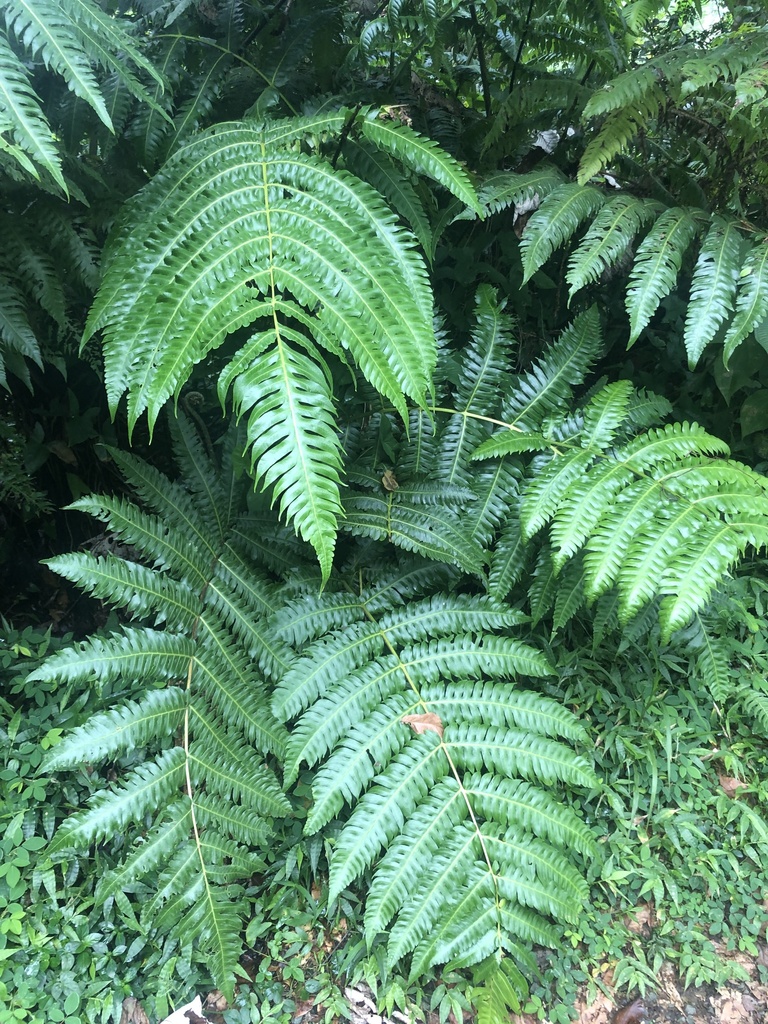
Cyathea horrida, the Spiny Tree Fern, is a bold, short-trunked tree fern of Puerto Rico’s wet mountain forests. USDA PLANTS lists it under the accepted name Cnemidaria horrida with the common name deepwoods fern; it has also been called Hemitelia horrida, and Linnaeus first named it Polypodium horridum. The Latin horrida means “bristly” or “prickly,” a reference to the spines on its leaf stalks. It belongs to the scaly tree fern family, Cyatheaceae.
Unlike the tall, slender-trunked tree ferns that rise above the canopy in El Yunque, the spiny tree fern usually has a short, stout trunk, sometimes barely above the ground, crowned by a rosette of long, glossy, once-divided fronds. Its broad, deeply lobed leaflets look more like those of a giant sword fern than of a lacy tree fern, which makes it one of the easiest tree ferns in Puerto Rico to recognize.
It grows in the shade of wet forest, along ravines, streams, trails and road banks, in the Luquillo Mountains, the Cordillera Central, the Sierra de Cayey and the moist northern karst. Beyond Puerto Rico it ranges through the Greater and Lesser Antilles to Central and South America. This guide covers how to identify it, where it grows, how it can be grown in shady tropical gardens, and its place in Puerto Rico’s forests.
Identification
Puerto Rico has more than a dozen tree ferns. Most have finely divided, lacy fronds; spiny tree fern stands out because its fronds are divided only once, into long, broad leaflets with lobed edges, and because its trunk is usually short.
Trunk
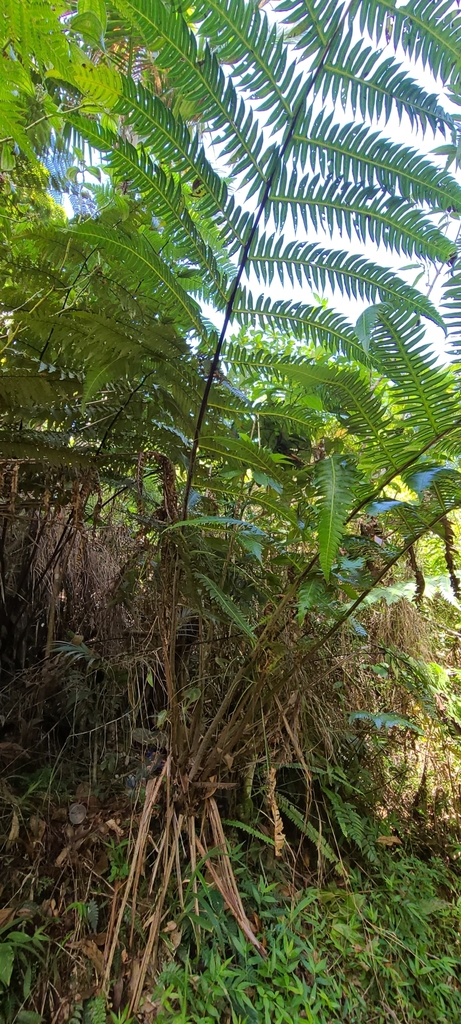
The trunk is erect, stout and usually short, often only knee- to waist-high and on younger plants hidden among old leaf bases; older plants in favorable spots grow taller. It is covered with the persistent bases of old leaf stalks and a mat of wiry roots, and old, dead fronds often hang down around it like a skirt.
Fronds
The fronds are large, commonly several feet long, arching outward from the top of the trunk. Each frond is once-pinnate: a central axis bearing pairs of long, lance-shaped leaflets (pinnae) up to a foot or more long, each cut about halfway or more to its midrib into rounded, slightly curved lobes. The leaflets are glossy, medium to dark green above and paler beneath. A distinctive feature of the group once separated as Cnemidaria is that the lower veins of neighboring lobes often meet and join, forming small loops along the midrib of each leaflet.
Stalks & Spines
The leaf stalks (stipes) and the main axis are stout, pale green to straw-colored or brownish, and armed with short, sharp spines, especially toward the base. Handle the plant with care. Young fronds unroll from tight fiddleheads covered with scales.
Spores
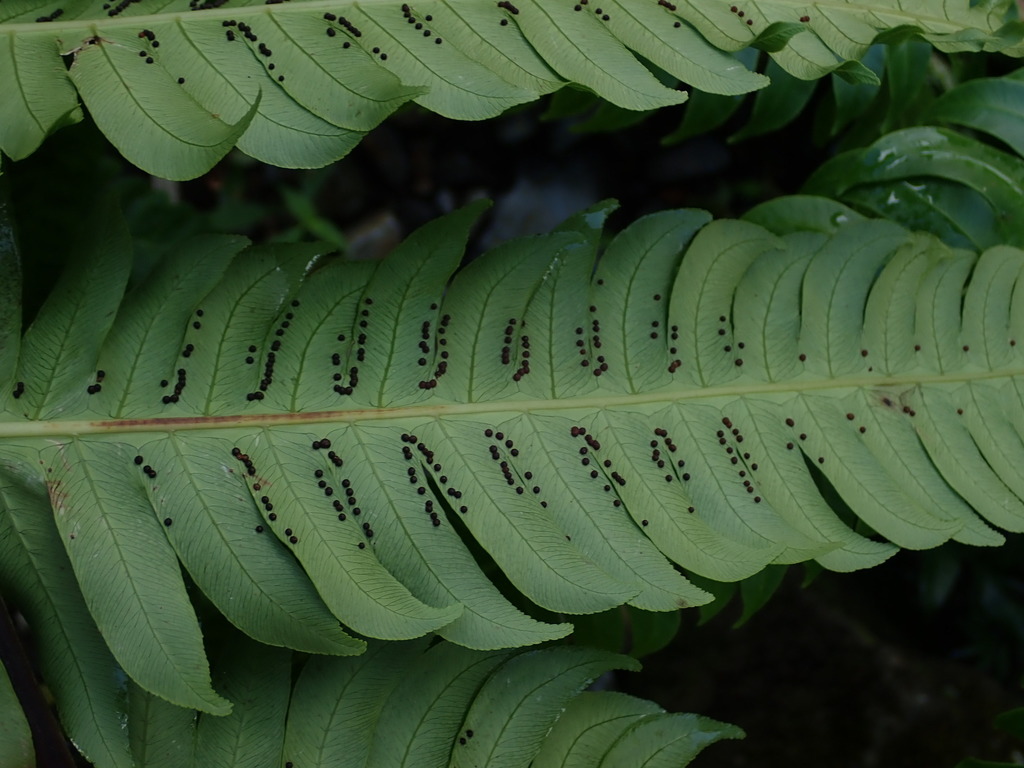
Fertile fronds look like sterile ones but carry small, round, dark sori on the underside, arranged in a row along the veins on each side of the lobes. As in other Cyatheaceae, each sorus releases enormous numbers of dust-like spores that travel on the wind. Spores germinate on moist, shaded soil to form tiny, heart-shaped gametophytes, from which new ferns grow.
Quick Facts
| Scientific Name | Cyathea horrida (L.) Sm. (USDA accepted name Cnemidaria horrida (L.) C. Presl; syn. Hemitelia horrida) |
| Family | Cyatheaceae (scaly tree fern family) |
| Plant Type | Evergreen short-trunked tree fern; USDA common name “deepwoods fern” |
| Mature Height | Usually 3–8 ft including fronds; trunk often short |
| Mature Spread | 5–10 ft |
| Growth Rate | Slow to moderate |
| Sun Exposure | Shade to part shade |
| Water Needs | High; constantly moist soil and humid air |
| Soil Type | Moist, humus-rich forest soil; also soils over limestone |
| Soil pH | Acid to near neutral |
| Bloom Time | None; reproduces by spores |
| Flower Color | None (fern) |
| Fall Color | None; evergreen |
| Fruit | None; round sori with dust-like spores on frond undersides |
| Deer Resistant | Not applicable in Puerto Rico; spiny stalks |
| USDA Hardiness Zones | 10b–12 (frost-free, humid); greenhouse elsewhere |
Native Range
Spiny tree fern has a wide range in the American tropics. Herbarium and observation records summarized by GBIF come from the Greater Antilles (Puerto Rico, Cuba, Jamaica and Hispaniola), several islands of the Lesser Antilles, and from Central America and northern and western South America, with many records from Colombia, Venezuela, Ecuador and Peru. The Institute for Regional Conservation lists it as native to the Greater Antilles, Central America and South America. Within the United States it is native only in Puerto Rico, where USDA PLANTS lists it under the name Cnemidaria horrida.
In Puerto Rico it is widespread in the wetter mountains. Specimens come from the Luquillo Mountains (Río Grande, Naguabo, Luquillo, Fajardo and Canóvanas), the Sierra de Cayey (Cayey, Patillas, San Lorenzo, Guayama), the Cordillera Central (Adjuntas, Orocovis, Utuado, Ponce, Lares, Las Marías) and the western mountains around Maricao and Mayagüez, as well as the karst region of Arecibo and Ciales. The Institute for Regional Conservation records it in El Yunque National Forest and in Maricao and Río Abajo state forests, at middle and high elevations, on both ordinary forest soils and limestone karst.
Collectors describe its habitat as wet mountain forest, rain forest, wooded ravines and gullies, moist wooded banks, regenerating forest and shaded trailsides and road banks, including the edges of old coffee plantations. It is a plant of moist shade, but it readily occupies disturbed, partly open sites such as road cuts within the forest.
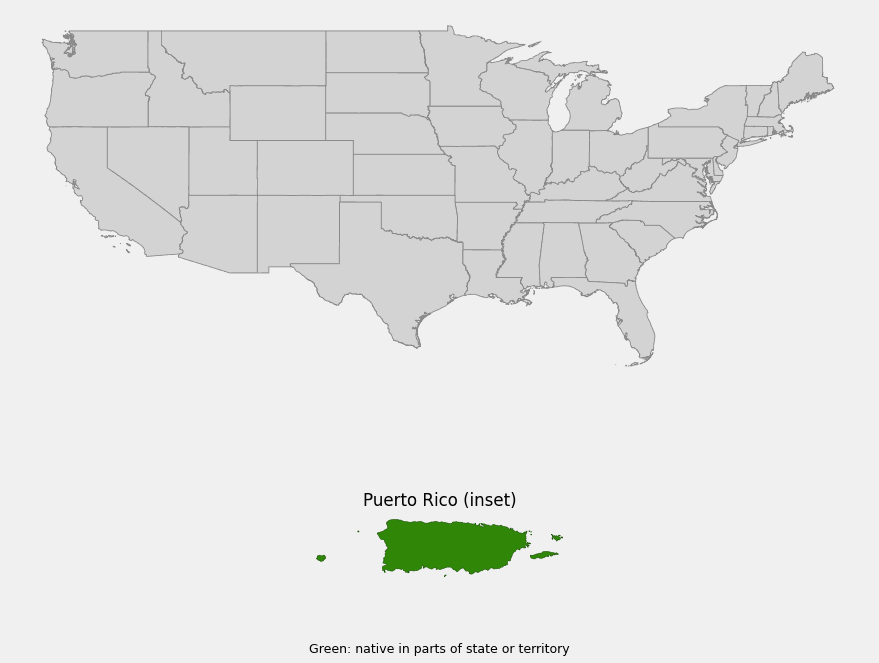
📋 Regional plant lists featuring Spiny Tree Fern: Puerto Rico
Growing & Care Guide
Spiny tree fern is rarely sold, but where nursery-grown or spore-grown plants are available it makes a striking, architectural fern for shady, humid gardens. In Puerto Rico it suits gardens in the wetter mountains and the humid north and east. On the U.S. mainland it can only be grown outdoors in frost-free, humid areas such as parts of South Florida and Hawaii, in deep shade with regular watering; elsewhere it is a plant for a warm, humid greenhouse or conservatory. Never dig tree ferns from the wild: they transplant poorly, grow slowly, and collecting is prohibited in El Yunque and the commonwealth forests.
Light
Give it shade or bright, filtered light. Strong sun scorches the fronds, especially in dry air. A spot under trees or on the shady side of a building works well.
Soil & Water
Plant it in deep, moist, humus-rich soil with good drainage. Keep the soil evenly moist at all times and water the trunk as well as the soil during dry spells, since tree fern trunks take up water through their roots and root mat. High humidity is important; dry wind browns the fronds.
Planting Tips
Choose a sheltered spot out of the wind. Plant at the same depth it grew in its container and mulch with leaf litter. Give it room: the fronds spread widely, and the spiny stalks are unpleasant beside a narrow path.
Pruning & Maintenance
Cut off old, brown fronds close to the trunk with pruners, wearing gloves because of the spines. Never cut the growing tip at the top of the trunk; tree ferns have a single growing point, and damaging it can kill the plant. Feed lightly with a diluted balanced fertilizer during active growth.
Propagation
Tree ferns are grown from spores. Collect a fertile frond when the sori darken, let it dry on paper to release the spores, and sow them thinly on sterile, moist, fine mix in a covered container in bright shade. The gametophytes appear in weeks; young ferns follow over months, and plants take several years to reach good size.
Landscape Uses
- Shade gardens in Puerto Rico: a bold, tropical accent in humid shade, especially in mountain gardens
- Ravine and stream-bank plantings: for moist, shaded slopes
- Conservatories and greenhouses: for collectors of tree ferns on the mainland
- Education: an example of the rich tree fern flora of Puerto Rico’s forests
Wildlife & Ecological Value
Tree ferns are a characteristic part of the understory in Puerto Rico’s wet forests. Their crowns, trunks and leaf litter create shelter and microhabitats for many small animals and plants.
For Pollinators
As a fern, it has no flowers and offers nothing to pollinators.
For Birds
Its dense, arching crowns give cover to understory birds. Birds that hunt insects and other small prey in the forest understory, such as the Puerto Rican tody, forage among ferns and the shaded vegetation of ravines and trailsides where it grows.
For Mammals
Puerto Rico has few native land mammals other than bats, and none are known to depend on this fern.
Ecosystem Role
The fibrous trunks and root mats of tree ferns hold moisture and provide a foothold for mosses, small ferns and other epiphytes. Their crowns and old leaf skirts shelter coquí frogs, lizards and invertebrates. As a fern that colonizes road banks, landslides and regenerating forest, it also helps cover and stabilize bare soil on steep, wet slopes.
Cultural & Historical Uses
Linnaeus described this fern in 1753 as Polypodium horridum, at a time when nearly all ferns with round sori were placed in Polypodium. It was later moved to Cyathea by James Edward Smith and to Hemitelia by Robert Brown and Kurt Sprengel. In 1836 the Czech botanist Carl Presl placed it in a new genus, Cnemidaria, characterized by its once-divided fronds, joined veins and small, scale-like indusia.
Whether Cnemidaria should stand as a separate genus has been debated ever since. USDA PLANTS still uses Cnemidaria horrida, while many recent fern classifications based on DNA studies place it back in Cyathea as Cyathea horrida, the name used here and by the Institute for Regional Conservation. Both names refer to the same plant.
In Spanish, tree ferns are generally called helechos arborescentes or helechos gigantes; spiny tree fern does not appear to have a widely used Puerto Rican name of its own. The USDA common name, deepwoods fern, reflects its home in the shade of deep forest.
Frequently Asked Questions
Is this a Cyathea or a Cnemidaria?
Both names are in use for the same plant. USDA PLANTS lists it as Cnemidaria horrida; many fern specialists and the Institute for Regional Conservation now use Cyathea horrida. An older synonym is Hemitelia horrida.
How do I tell it from other tree ferns in Puerto Rico?
Look at the fronds: spiny tree fern has once-divided fronds with long, broad, lobed leaflets, unlike the finely divided, lacy fronds of most other tree ferns. Its trunk is usually short, and its leaf stalks carry sharp spines.
Where can I see it?
Along trails, streams and road banks in El Yunque National Forest and in the wet forests of the Cordillera Central, the Sierra de Cayey and the western mountains around Maricao.
Can I grow it on the U.S. mainland?
Only outdoors in frost-free, humid places such as parts of South Florida and Hawaii, and then in shade with regular watering. Elsewhere it needs a warm, humid greenhouse. Buy nursery- or spore-grown plants only.
Is it endangered?
No. It is widespread in the American tropics and fairly common in Puerto Rico’s wet forests, and it is not listed under the U.S. Endangered Species Act. Wild plants should still be left in place.

Looking for a nursery that carries Spiny Tree Fern?
Our nursery directory does not yet include Puerto Rico. Browse the native plant nursery directory by state: Alabama–Arkansas · California · Colorado–Hawaii · Idaho–Kansas · Kentucky–Montana · Nebraska–Oklahoma · Oregon · Pennsylvania–Virginia · Washington · West Virginia–Wyoming