
Spreading Wood Fern (Dryopteris expansa)
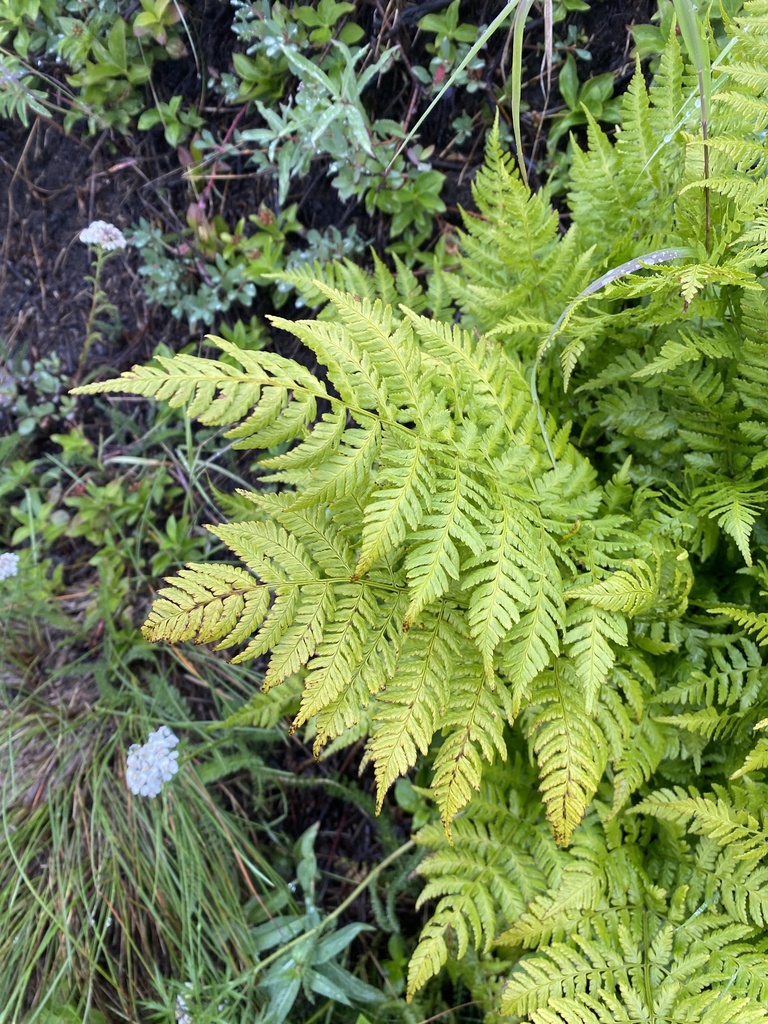
Dryopteris expansa, known as Spreading Wood Fern, northern wood fern or northern buckler fern, is a large, lacy fern of cool, moist forests across the northern half of the world. In North America it ranges from Alaska and the Yukon south through the Pacific Northwest and the northern Rocky Mountains, with a separate cluster of populations around the upper Great Lakes and in eastern Canada. Its broad, triangular fronds, divided two to three times into small toothed segments, can reach about 3 feet long.
It belongs to the wood fern family (Dryopteridaceae) and is closely related to the familiar spinulose wood fern and evergreen wood fern. Botanists have at times treated it as Dryopteris assimilis or lumped it into Dryopteris dilatata, the broad buckler fern of Europe, so older field guides may list it under those names. It is also one parent of the mountain wood fern (Dryopteris campyloptera), a hybrid-derived species of the Northeast and the Appalachians.
In the Pacific Northwest, spreading wood fern is a common part of the fern layer in moist conifer forests, often growing on rotting logs, stumps and streambanks alongside sword fern, lady fern and devil’s club. Its rhizomes were a traditional starchy food of Indigenous peoples on the Northwest Coast. This guide covers how to identify it, where it grows, how to grow it in a shady, moist native garden, and its role in the forest.
Identification
Several wood ferns look alike, and spreading wood fern is easiest to confirm by checking three things together: the shape of the lowest pair of leaflets, the scales on the stalk, and the very finely divided, broadly triangular blade.
Growth Habit & Rhizome
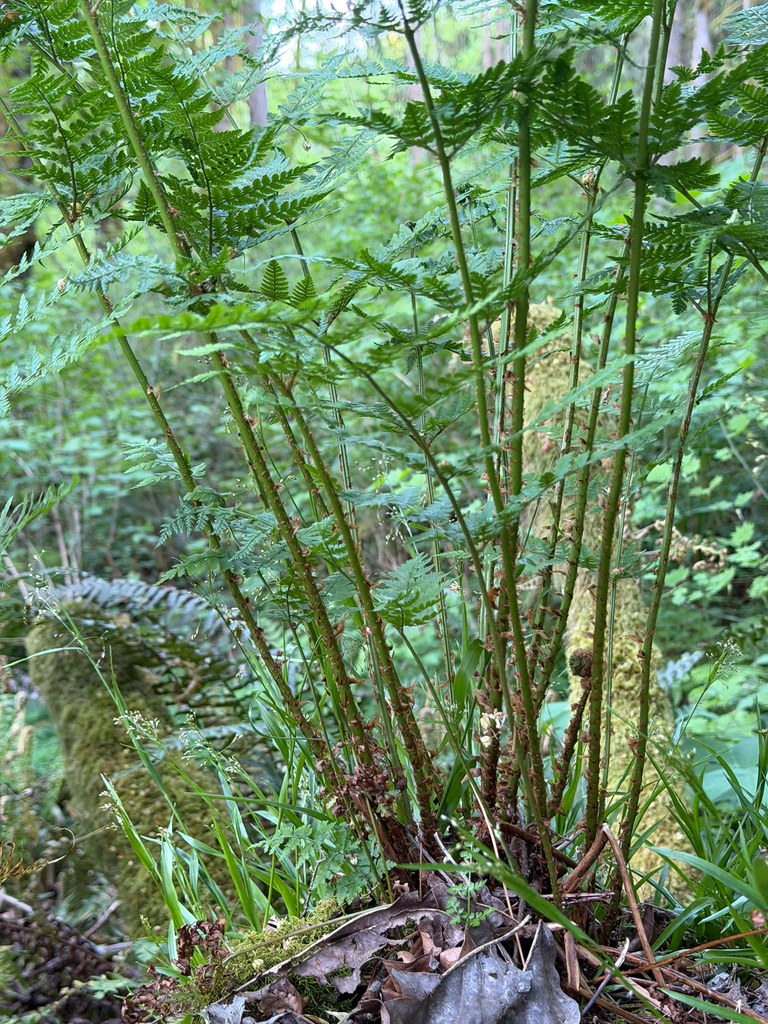
Spreading wood fern grows from a short, stout, upright or slightly creeping rhizome that produces a vase-shaped crown of fronds. Individual plants are usually 1 to 3 feet tall, larger in rich, sheltered sites and much smaller on rocky or high-elevation sites. The fronds are deciduous: they die back in fall and new fiddleheads appear in spring.
Fronds
The blade is broadly triangular to egg-shaped, widest near the base, and two to three times divided (bipinnate-pinnatifid to tripinnate). The final segments are small, with sharp, often bristle-tipped teeth, giving the frond a soft, lacy texture. The stalk (stipe) is usually one-quarter to one-third the length of the whole frond.
The Lowest Leaflets
Look at the lowest pair of leaflets (pinnae). On spreading wood fern, they are strongly lopsided: the first lower pinnule on each, the one pointing down toward the ground, is clearly longer than the pinnule above it. This feature, shared with spinulose wood fern, separates it from many other wood ferns.
Stipe Scales & Sori
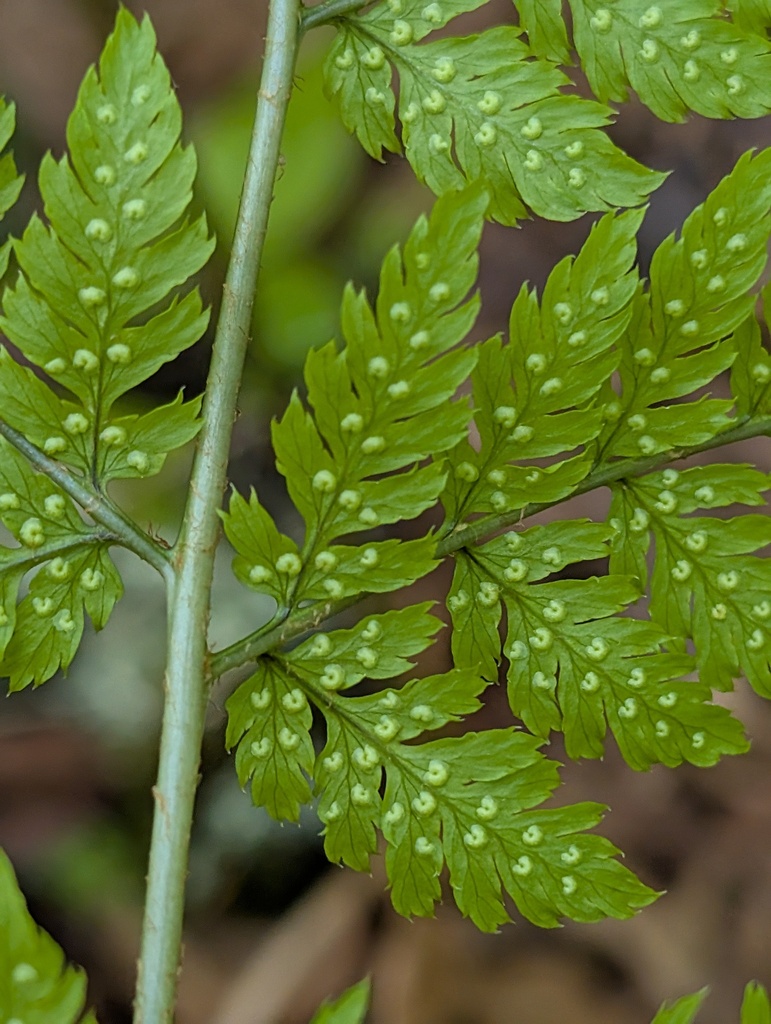
The base of the stipe is covered with scales that are pale brown with a darker brown central stripe. On spinulose wood fern the scales are usually uniformly pale brown. On the underside of the frond, the sori are round and sit midway between the midvein and the edge of each segment, covered by a small kidney-shaped indusium that may shrivel by late summer.
Look-alikes
Spinulose wood fern (Dryopteris carthusiana) has narrower, more upright, less lacy fronds and plain pale scales, and it overlaps with spreading wood fern in the Great Lakes region and parts of the West. Mountain wood fern (D. campyloptera) is mainly eastern. Lady fern has a similar lacy look but elongated, often curved sori and a frond that narrows toward the base. Hybrids between wood fern species are frequent, so some plants show intermediate features.
Quick Facts
| Scientific Name | Dryopteris expansa (C. Presl) Fraser-Jenk. & Jermy |
| Family | Dryopteridaceae (wood fern family) |
| Plant Type | Deciduous perennial fern from a short rhizome |
| Mature Height | 1–3 ft (fronds up to about 3 ft long) |
| Mature Spread | 1.5–3 ft |
| Growth Rate | Moderate |
| Sun Exposure | Part shade to full shade |
| Water Needs | Moderate to high; soil should stay moist |
| Soil Type | Moist, humus-rich forest soil, rotting wood or rocky talus |
| Soil pH | Acidic, about 4.5–6.5 |
| Bloom Time | None (reproduces by spores, mid to late summer) |
| Flower Color | None; a non-flowering fern |
| Fall Color | Fronds yellow to tan before dying back |
| Fruit | None; round sori with kidney-shaped indusia |
| Deer Resistant | Generally browsed little |
| USDA Hardiness Zones | 2–8 |
Native Range
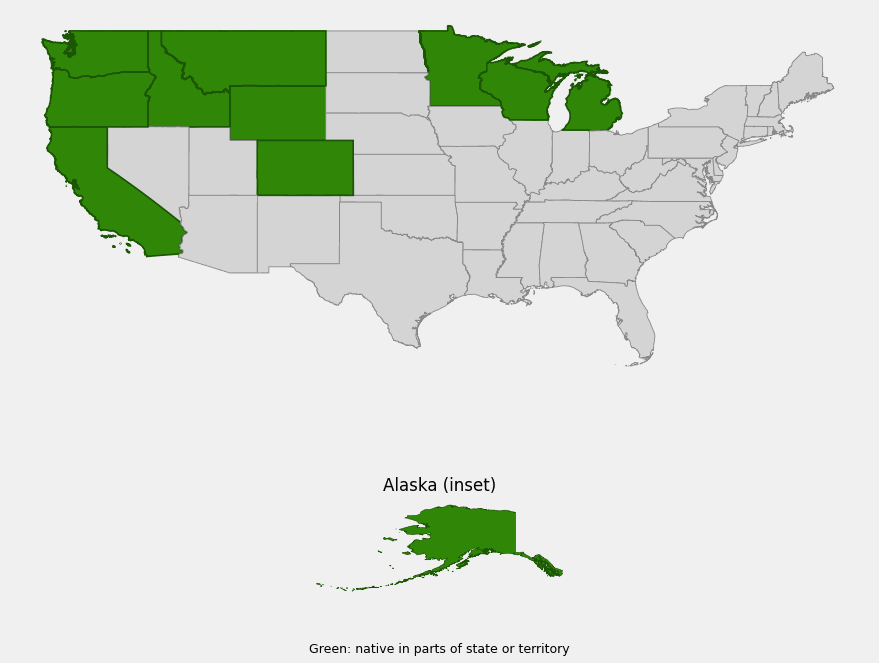
Spreading wood fern is circumboreal: it grows in northern and mountain forests of Europe, Asia and North America. USDA PLANTS lists it as native in Alaska, Washington, Oregon, California, Idaho, Montana, Wyoming, Colorado, Minnesota, Wisconsin and Michigan, and in Canada from British Columbia, Yukon and the Northwest Territories east through Alberta and Ontario to Quebec, Labrador and Newfoundland. It is also native to Greenland.
Its main North American stronghold is the Pacific Northwest and coastal Alaska, from the Aleutians and Southeast Alaska through British Columbia, western Washington and western Oregon, reaching its southern limit along the coast in northwestern California. Inland it grows in the moist forests of northern Idaho, western Montana and northwestern Wyoming, with scarce, outlying records farther south in the Colorado Rockies. A separate eastern group of populations grows around Lake Superior, in northeastern Minnesota, northern Wisconsin and Michigan’s Upper Peninsula, continuing into Ontario, Quebec and the Atlantic provinces.
It favors cool, shaded, constantly moist sites: wet conifer forests, streambanks and seeps, rotting logs and stumps, the edges of bogs and swamps, and rocky talus slopes where snowmelt keeps the soil damp. In the Northwest it ranges from sea level into the subalpine zone, and in Alaska it also grows in open subalpine meadows and alder thickets.
📋 Regional plant lists featuring Spreading Wood Fern: Idaho, Eastern Oregon & Eastern Washington · Montana & Wyoming · Michigan, Wisconsin & Eastern Minnesota · Alaska · Western Oregon & Western Washington · California & Nevada
Growing & Care Guide
Spreading wood fern is an easy, graceful fern for shady gardens in cool, moist climates, especially in the Pacific Northwest, Alaska and the northern Great Lakes. It is offered mainly by native plant and fern specialist nurseries. Plants sold as broad buckler fern (Dryopteris dilatata) are usually the European species rather than this North American native, so check the label.
Light
Give it part shade to full shade. Bright, dappled light under deciduous trees or the open shade on the north side of a building suits it well. In cool coastal gardens it tolerates some morning sun if the soil stays moist; in hot, sunny spots the fronds scorch and turn brown by midsummer.
Soil & Water
Plant it in moist, acidic, humus-rich soil that never dries out completely. Leaf mold, rotted wood and conifer needles all help recreate its forest-floor home. Water regularly during dry spells, especially in the first two summers. It will grow in wet soil near streams and ponds, but not in standing water.
Planting Tips
Plant potted ferns in spring or early fall, setting the crown at soil level rather than burying it. Space plants 2 to 3 feet apart. It looks best in drifts with other native woodland plants, or tucked against a mossy log or stump, which it often grows on in the wild. Mulch with leaves or fine bark to keep the roots cool.
Pruning & Maintenance
The fronds die back each fall. Leave them in place over winter as natural mulch and shelter for insects, then cut or pull away the dead fronds in early spring before the new fiddleheads unfurl. Otherwise it needs little care; it is rarely bothered by pests.
Propagation
Established clumps can be divided in early spring by cutting off side crowns with a portion of rhizome and roots. It can also be grown from spores collected in late summer when the sori turn dark brown: sow them on the surface of sterile, moist potting mix under a clear cover and keep them in bright, indirect light. The tiny heart-shaped gametophytes develop first, and young fronds follow in a few months.
Landscape Uses
- Shade gardens: lacy, light-green fronds that brighten deep shade under conifers
- Woodland and stream-edge plantings: thrives in cool, moist soil along creeks, seeps and ponds
- Rain gardens in shade: tolerates periodically wet, humus-rich soil
- Stumpery and log gardens: naturally grows on rotting logs and stumps
- Forest restoration: a native understory fern of moist northern and coastal forests
Wildlife & Ecological Value
Like most ferns, spreading wood fern offers no flowers, nectar or fruit, but it is an important structural part of the forest understory.
For Pollinators
Ferns reproduce by spores and do not need pollinators. Its value to insects is mainly as shelter: the dense crowns and the layer of dead fronds in winter shelter beetles, spiders and overwintering insects.
For Birds
Ground-foraging birds such as thrushes, wrens and towhees hunt insects among the fronds and leaf litter, and the fern layer provides cover for ground-nesting birds in moist forests.
For Mammals
Deer and elk browse ferns occasionally, especially the young fronds in spring, but wood ferns are generally not a preferred food. The fern layer gives cover to small mammals, salamanders and frogs in damp forests.
Ecosystem Role
Spreading wood fern helps hold soil on streambanks and moist slopes, and it is often among the first plants to colonize fallen logs and old stumps in coastal forests. Its fronds add organic matter to the forest floor each year as they decay.
Cultural & Historical Uses
The genus name Dryopteris combines the Greek drys, oak or tree, and pteris, fern, so “oak fern” or “wood fern”. The species name expansa means spread out, referring to the broad, wide-spreading fronds.
On the Northwest Coast, Indigenous peoples, including Haida, Nuxalk and Kwakwaka’wakw communities, harvested the thick rhizomes and the clustered bases of the old fronds of this fern and cooked them, usually by steaming or pit-roasting, as a starchy food in late winter and early spring. The USDA PLANTS profile also notes that the starchy rootstocks were eaten by local Native people.
Wood fern rhizomes contain bitter compounds, and related species such as male fern were once used in medicine as a treatment for intestinal worms, which could be poisonous in larger doses. Do not eat or use any wood fern as food or medicine. Spreading wood fern is best enjoyed as a living part of the forest and a reliable native fern for shady gardens.
Frequently Asked Questions
Is spreading wood fern evergreen?
No. Its fronds die back in fall, unlike the evergreen sword fern and evergreen wood fern. New fiddleheads appear in spring.
How do I tell spreading wood fern from spinulose wood fern?
Spreading wood fern has a broader, lacier, more triangular blade, and the scales at the base of the stalk are pale brown with a dark central stripe. Spinulose wood fern has narrower, more upright fronds and plain pale-brown scales. Both have a long lower pinnule on the lowest leaflets.
Where does spreading wood fern grow?
It grows in moist forests from Alaska and the Pacific Northwest to the northern Rockies, with outlying records in Colorado, and around Lake Superior in Minnesota, Wisconsin and Michigan, as well as across Canada, Greenland, Europe and Asia.
Can I grow spreading wood fern in my garden?
Yes, if you have shade and soil that stays moist. It does best in cool climates. Buy plants from native plant nurseries and avoid digging ferns from the wild.
Is spreading wood fern edible?
Its rhizomes were a traditional Indigenous food, prepared with specific methods. Wood fern rhizomes contain bitter, potentially toxic compounds, so it should not be eaten.

Looking for a nursery that carries Spreading Wood Fern?
Browse our native plant nursery directory: Alaska · California · Colorado · Idaho · Michigan, Minnesota & Montana · Oregon · Washington · Wisconsin & Wyoming

