Subalpine Fir (Abies lasiocarpa)
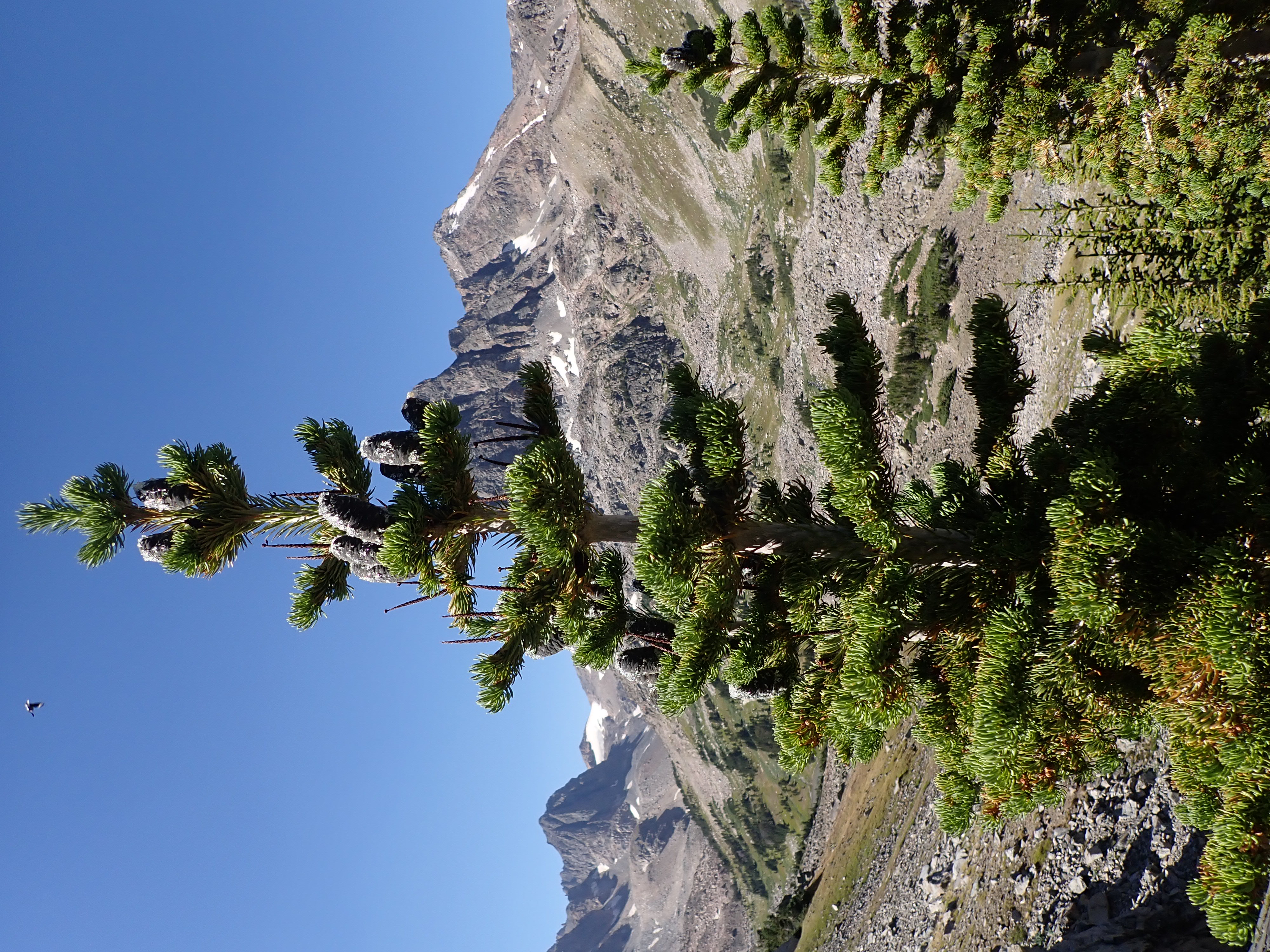
Abies lasiocarpa, commonly known as Subalpine Fir, Alpine Fir, or Rocky Mountain Fir, is one of the most striking and architecturally distinctive conifers of the western mountains. Its name comes from the Greek lasios (hairy) and karpos (fruit), referring to the woolly-bracted cones that characterize this high-elevation species. Growing in a narrow, dense, spire-shaped form that has become iconic in Rocky Mountain skylines, Subalpine Fir occupies the upper subalpine zone across an enormous range from Alaska and the Yukon south to the high mountains of Arizona and New Mexico, adapting with remarkable success to the short growing seasons, heavy snowpacks, and intense UV radiation of its high-altitude home.
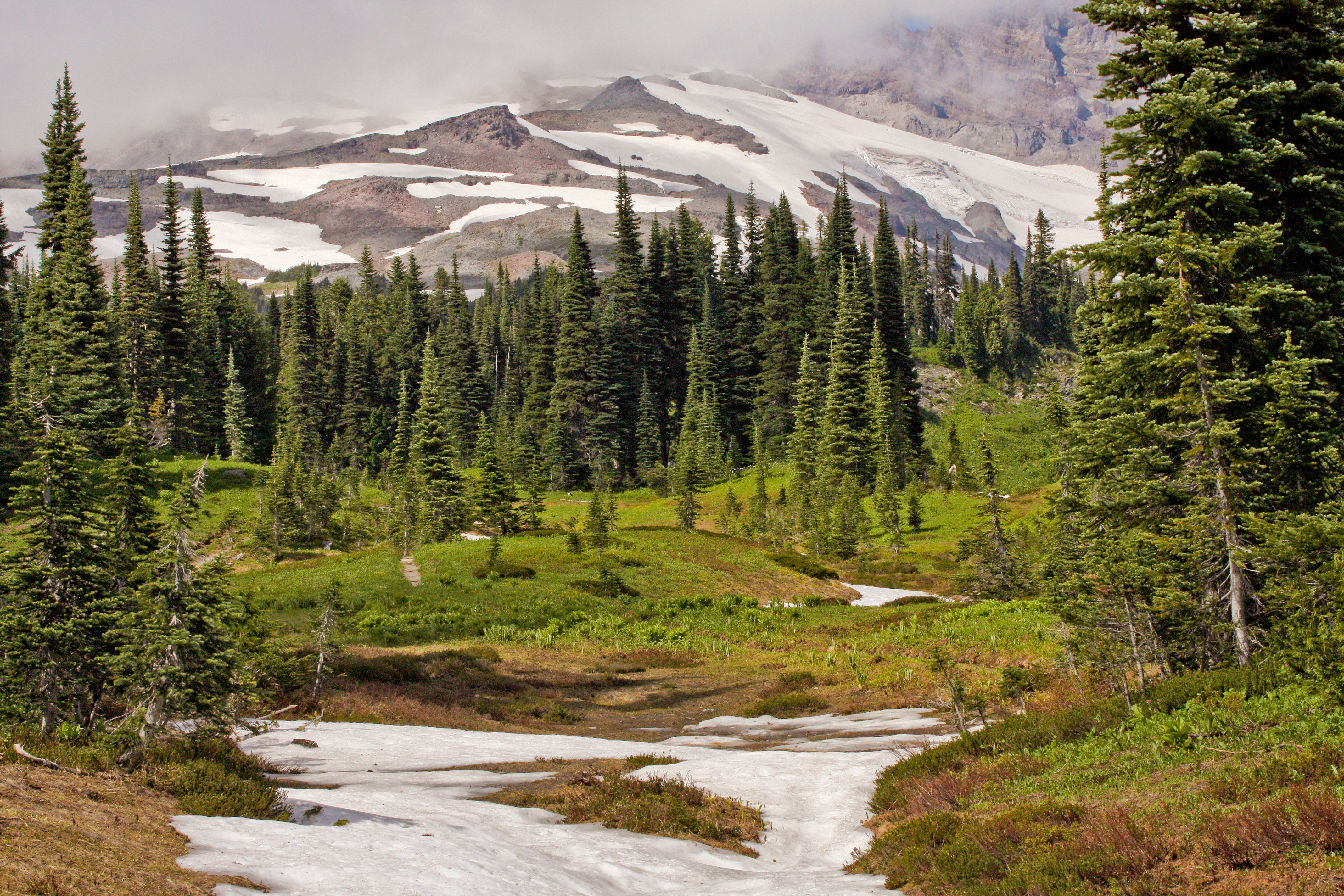
Subalpine Fir is the highest-elevation true fir in North America’s interior mountain ranges, commonly forming the last trees before treeline on mountain slopes throughout its range. In Utah, it is a dominant species in the subalpine forest zone of the Wasatch Range, Uinta Mountains, and other high ranges, typically growing at 8,000 to 11,500 feet elevation where it forms pure stands or mixes with Engelmann Spruce (Picea engelmannii). The narrow, spire-like crown of Subalpine Fir is a specific adaptation to heavy mountain snowpack — the shape sheds snow efficiently, preventing the limb breakage that would devastate a broader crown form at these elevations.
The plant list notes that Subalpine Fir provides cover for birds and food for squirrels, and that it is suitable for small spaces — a somewhat surprising assessment for a tree that can grow to 80 feet. However, this note likely reflects the species’ narrow crown form (rarely more than 6–8 feet wide) and its suitability as a columnar or spire accent tree that takes up minimal horizontal space while providing significant vertical presence and wildlife value. Its year-round evergreen density provides exceptional thermal cover for birds and small mammals in all seasons.
Identification
Subalpine Fir grows as a slender, spire-shaped conifer with a characteristically narrow, dense, pointed crown — often described as “candle-shaped” or “steeple-shaped.” At mature high-elevation sites, trees typically reach 60 to 80 feet tall with a trunk diameter of 12 to 24 inches, but growth is slow at subalpine elevations. At timberline, the tree may assume a krummholz (prostrate, wind-flagged) form, growing as a mat only a few feet tall. The bark of young trees is smooth, gray, and resin-blistered; on older trees it becomes rough and scaly. Lower branches persist to ground level on many trees, creating a full, dense pyramidal skirt that provides excellent wildlife shelter.
Needles
The needles are flat, ½ to 1¼ inches (12–32 mm) long, with a rounded or slightly notched tip (not sharply pointed, unlike spruce). They are dark blue-green on the upper surface with a white stomatal band on the underside, creating a two-toned appearance. Needles are arranged in a flattened, comblike manner along the twig, or may curve upward to give branches a “hockey stick” or swept-up appearance. When crushed, the needles have a distinctive sweet-resinous fragrance. Needles persist for 3–5 years, contributing to the dense, full appearance of the branches.
Cones
The seed cones are distinctive and immediately identify the species: they are cylindrical, 2½ to 4 inches (6–10 cm) long, erect (pointing upward from branches rather than hanging down like spruce), deep purple to nearly black when immature, becoming brown at maturity in September and October. Like all true firs, the cones disintegrate on the tree when ripe, releasing the winged seeds and dropping cone scale by scale rather than falling intact. The persistent central cone axis (“candle”) often remains on the branch after the rest of the cone has disintegrated. Cones are heavily bracted with woolly, exserted bracts — the feature that gives the species its scientific name.
Bark & Wood
The bark of young trees is smooth, silvery-gray, and typically dotted with resin blisters — pockets of aromatic resin that, when broken, release a pungent, balsam-like fragrance. This resin was used medicinally and for waterproofing by Indigenous peoples. Older bark becomes gray-brown, furrowed, and scaly but lacks the deep, dramatic furrows of Ponderosa Pine. The wood is soft, relatively lightweight, and straight-grained — used historically for lumber, paper pulp, and firewood, though the high-elevation habitat makes commercial harvest difficult.
Quick Facts
| Scientific Name | Abies lasiocarpa |
| Family | Pinaceae (Pine Family) |
| Plant Type | Evergreen Conifer Tree |
| Mature Height | 80 ft |
| Crown Width | 6–8 ft (very narrow, spire-shaped) |
| Sun Exposure | Full Shade to Full Sun (shade tolerant) |
| Water Needs | Moderate |
| Cone Color | Deep purple to black (immature), brown (mature) |
| Growth Rate | Slow to Moderate |
| Landscape Value | Columnar accent; narrow footprint for small spaces |
| USDA Hardiness Zones | 1–6 |
Native Range
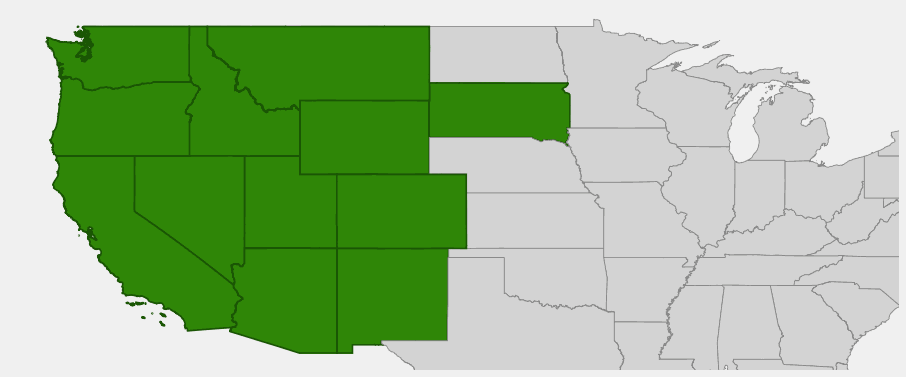
Subalpine Fir has one of the most extensive native ranges of any North American fir, occurring from the Yukon and interior Alaska south through British Columbia, Washington, Oregon, Idaho, Montana, and Wyoming, with major populations in Utah and Colorado, and isolated southern extensions into the high mountains of Arizona and New Mexico. In Utah, it is primarily found in the high mountain ranges — the Wasatch Mountains, the Uinta Mountains, and isolated high peaks throughout the state — at elevations from about 8,000 to 11,500 feet, near or above timberline.
The species is closely associated with Engelmann Spruce throughout most of its range, and the “Spruce-Fir forest” community they co-dominate is one of the most extensive high-elevation forest types in western North America. In Utah, Subalpine Fir often dominates on north-facing slopes and in areas with deep, persistent snowpack, while Engelmann Spruce more frequently occupies ridge tops and south-facing exposures. Near treeline, Subalpine Fir often transitions to the krummholz form — a prostrate, wind-swept mat of twisted, abbreviated growth shaped entirely by prevailing winds and the scour of wind-driven snow crystals.
Climate change poses a significant threat to Subalpine Fir throughout its range. As winter snowpacks decrease and growing seasons lengthen, the conditions that define subalpine habitat are shifting upslope — and the species faces increasing pressure from bark beetles, root diseases, and fire regimes altered by earlier snowmelt and longer dry summers. The iconic spire-shaped treeline forests that Subalpine Fir defines in Utah’s mountain skylines are among the ecosystems most sensitive to climate change in the region.
📋 Regional plant lists featuring Subalpine Fir: Utah
Growing & Care Guide
Subalpine Fir is a striking, architecturally distinctive tree for mountain gardens in Utah and the Rocky Mountain West, especially valued for its uniquely narrow, spire-shaped form that provides dramatic vertical accent without occupying significant horizontal space. While it is a high-elevation native that performs best in cool, moist mountain climates, it can be successfully grown at lower elevations with careful site selection and consistent moisture during establishment.
Light
Subalpine Fir is exceptionally shade-tolerant — one of the most shade-tolerant conifers in western North America. It can grow for decades in deep forest shade, waiting for a canopy gap to allow faster growth. In garden settings, it performs well from full sun to partial shade. At lower elevations than its natural range, afternoon shade is beneficial, reducing heat stress and moisture demand. The narrow crown casts relatively little shade itself, making it compatible with underplanting.
Soil & Water
Subalpine Fir grows best in well-drained, moist, acidic soils — conditions typical of high mountain slopes where snowmelt provides steady moisture through the growing season. At lower elevations, it benefits from supplemental irrigation through dry summer months, particularly during the first 3–5 years of establishment. It does not tolerate poorly drained, waterlogged soils or high soil temperatures. Mulching with 2–3 inches of wood chips helps retain moisture and keep the root zone cool. In Utah valley locations, plant in a north or east-facing exposure for best results.
Planting Tips
Plant in spring, choosing the coolest, most sheltered site available. At elevations below 6,000 feet in Utah, success becomes more challenging and site selection is critical — choose north-facing slopes or locations shaded from afternoon sun, and ensure reliable irrigation. At elevations above 7,000 feet, Subalpine Fir is more reliably successful. Start with small container-grown plants (1–2 gallon) rather than large specimens; smaller plants establish root systems more efficiently and often overtake large transplants within 3–5 years. The narrow crown form requires minimal spacing — 5–8 feet apart is adequate for most purposes.
Pruning & Maintenance
Subalpine Fir requires no pruning if grown in an appropriate site. Its natural spire form is the landscape asset — avoid any pruning that disrupts the narrow, pointed crown shape. Remove dead or damaged branches in late winter if needed. The species is susceptible to Cytospora canker (a fungal disease causing branch dieback) under drought stress conditions — maintaining adequate soil moisture is the best prevention. Annosus root rot can be an issue in warm-winter, low-elevation sites; avoid growing at elevations significantly below the natural range.
Landscape Uses
- Columnar accent tree — narrow spire form for small spaces, entries, and vertical emphasis
- Mountain garden specimen — authentic high-country feel for mountain property landscaping
- Wildlife shelter tree — dense, year-round evergreen cover for birds and small mammals
- Privacy screen — narrow but densely branched to the ground; effective screen with minimal width
- Winter landscape interest — dark green spires dramatic against snow
- Subalpine restoration — reforestation planting in disturbed mountain areas
Wildlife & Ecological Value
Subalpine Fir provides exceptional wildlife value in mountain ecosystems, functioning as a keystone structural species that creates habitat complexity in the otherwise relatively open subalpine zone.
For Birds
The dense, full-to-the-ground branching of Subalpine Fir creates outstanding thermal cover for birds during harsh mountain winters. Clark’s Nutcracker, Steller’s Jay, Gray Jay (Canada Jay), and various crossbill species feed on the seeds. The deep purple cones attract birds before they fully mature. Yellow-rumped Warblers, Hermit Thrushes, and numerous other species nest in subalpine fir thickets. Winter concentrations of Mountain Chickadees, Red-breasted Nuthatches, and Brown Creepers are found in fir forests, gleaning insects from bark and needles.
For Mammals
Red Squirrels (Chickarees) are the primary consumers of Subalpine Fir seeds in most of the species’ range, cutting cones and caching them in middens for winter food. Porcupines feed on the bark of Subalpine Fir, sometimes girdling and killing trees. Elk and deer use dense Subalpine Fir stands for thermal cover during winter storms. Black bears occasionally forage for squirrel middens containing cones. The root zone provides habitat for numerous small mammals including voles and pikas, which harvest and cache vegetation for winter.
For Pollinators
As a wind-pollinated conifer, Subalpine Fir does not provide nectar or pollen in a form accessible to most pollinators. However, the tree’s bark and resin wounds attract a variety of insects, and the foliage supports numerous caterpillar species that feed on fir needles and serve as food for insectivorous birds during the breeding season.
Ecosystem Role
Subalpine Fir plays a critical structural role in high-elevation ecosystems. Its ability to maintain dense canopy coverage right to the ground (when growing in the open) creates snowpack retention patterns that influence hydrology — subalpine fir stands intercept and hold snow, providing delayed water release into streams during spring and early summer. The trees act as snow fences, creating deep snowpack drifts on their leeward side that persist well into summer, creating unique microhabitats for moisture-dependent plants and animals. At timberline, the krummholz form of Subalpine Fir creates the only available overhead cover in an otherwise exposed alpine tundra environment, providing essential shelter for ptarmigan, pikas, and other alpine species.
Cultural & Historical Uses
Subalpine Fir was used extensively by the Indigenous peoples who inhabited the Rocky Mountain high country. The aromatic resin blisters in the bark were prized for medicinal applications — the resin was collected and used as an antiseptic salve for cuts and skin infections, as a chest rub for respiratory ailments, and as a ceremonial incense. The Blackfoot people used the resin as a deodorant and insect repellent. Many Great Basin and Rocky Mountain nations used the soft, fragrant needles as stuffing for pillows and bedding, and as a strewing material to freshen living spaces. Branches were also used as ceremonial boughs and in sweat lodge preparations.
The soft, straight-grained wood was used by Indigenous peoples for poles, small construction timbers, and fuel where it was accessible. At high elevation, straight timber of any species was scarce and valuable. The Shoshone people of the Rocky Mountain region used Subalpine Fir wood for tipi poles when other materials were not available, and the inner bark was occasionally consumed in spring as an emergency food source during times of scarcity. Bark strips were also woven into crude mats and used for temporary shelters.
In the history of western settlement, Subalpine Fir has been commercially logged throughout parts of its range, particularly in Washington, Oregon, and British Columbia where it grows at lower elevations and in more accessible terrain. The wood is used for pulpwood, structural lumber, and mine timbers. In Utah, the high-elevation distribution of most Subalpine Fir makes commercial exploitation impractical, and the species is primarily protected on National Forest land where it is recognized as a critical component of watershed protection and wildlife habitat. Today, Subalpine Fir is increasingly valued by mountain landscapers as a distinctive, architecturally unique ornamental tree that brings the spirit of the high Rockies to garden settings across the Intermountain West.
Frequently Asked Questions
How fast does Subalpine Fir grow?
Growth rate depends strongly on site conditions. At natural subalpine elevations with adequate moisture, Subalpine Fir is a slow-growing tree — adding just 6–12 inches per year. At lower elevations with supplemental irrigation and warmer temperatures, growth can be somewhat faster. The species is long-lived when grown in appropriate conditions, with some individuals exceeding 250 years of age. Patience is required, but the eventual landscape presence of a mature spire is spectacular.
Can Subalpine Fir grow at low elevations in Utah?
With careful site selection and consistent irrigation, Subalpine Fir can survive at lower elevations than its natural range in Utah. Sites with north or northeast exposure, protection from afternoon sun, and reliable summer moisture offer the best chances. Elevations above 5,500–6,000 feet are much more reliable than valley sites. Below 5,000 feet, summer heat and drought stress usually make Subalpine Fir a poor choice compared to more heat-tolerant species like White Fir (Abies concolor).
What is the difference between Subalpine Fir and White Fir?
White Fir (Abies concolor) grows at lower elevations (5,000–9,000 ft) and is more drought and heat tolerant, making it the better choice for most Utah valley and foothill gardens. Subalpine Fir occupies higher elevations (8,000–11,500 ft), has a narrower, more dramatically spire-like crown form, and produces the distinctive deep purple upright cones. In the garden, Subalpine Fir has a more striking, architectural form but demands cooler, moister conditions.
Do the cones of Subalpine Fir fall intact from the tree?
No — like all true firs (Abies species), the cones of Subalpine Fir disintegrate on the tree at maturity, shedding scales and seeds while leaving the central “candle” spike of the cone axis attached to the branch. This is a key identification feature that distinguishes true firs from pines, spruces, and hemlocks, which all drop their cones intact.
Is Subalpine Fir deer resistant?
Young Subalpine Fir plants can be heavily browsed by deer and elk, particularly in winter when other food is scarce. Protection with wire cages or fencing is recommended for plants less than 4 feet tall in areas with significant deer pressure. Larger, more established plants are less vulnerable to complete browsing damage but may still show branch browse on lower portions.

Looking for a nursery that carries Subalpine Fir?
Browse our native plant nursery directory: Utah