Texas Guayacan (Guaiacum angustifolium)
Guaiacum angustifolium, commonly called Texas Guayacan or Texas Lignum-vitae, is a tough, slow-growing evergreen shrub of the South Texas brush country and the Rio Grande Plains. It belongs to the small, mostly tropical Zygophyllaceae (caltrop) family, the same family that gave the Caribbean its famous “wood of life” timber trees, and like its relatives it is extraordinarily dense and durable. In Texas it rarely becomes more than a large, many-branched shrub, but in favorable sites it can grow into a small tree with a rounded, twiggy crown.
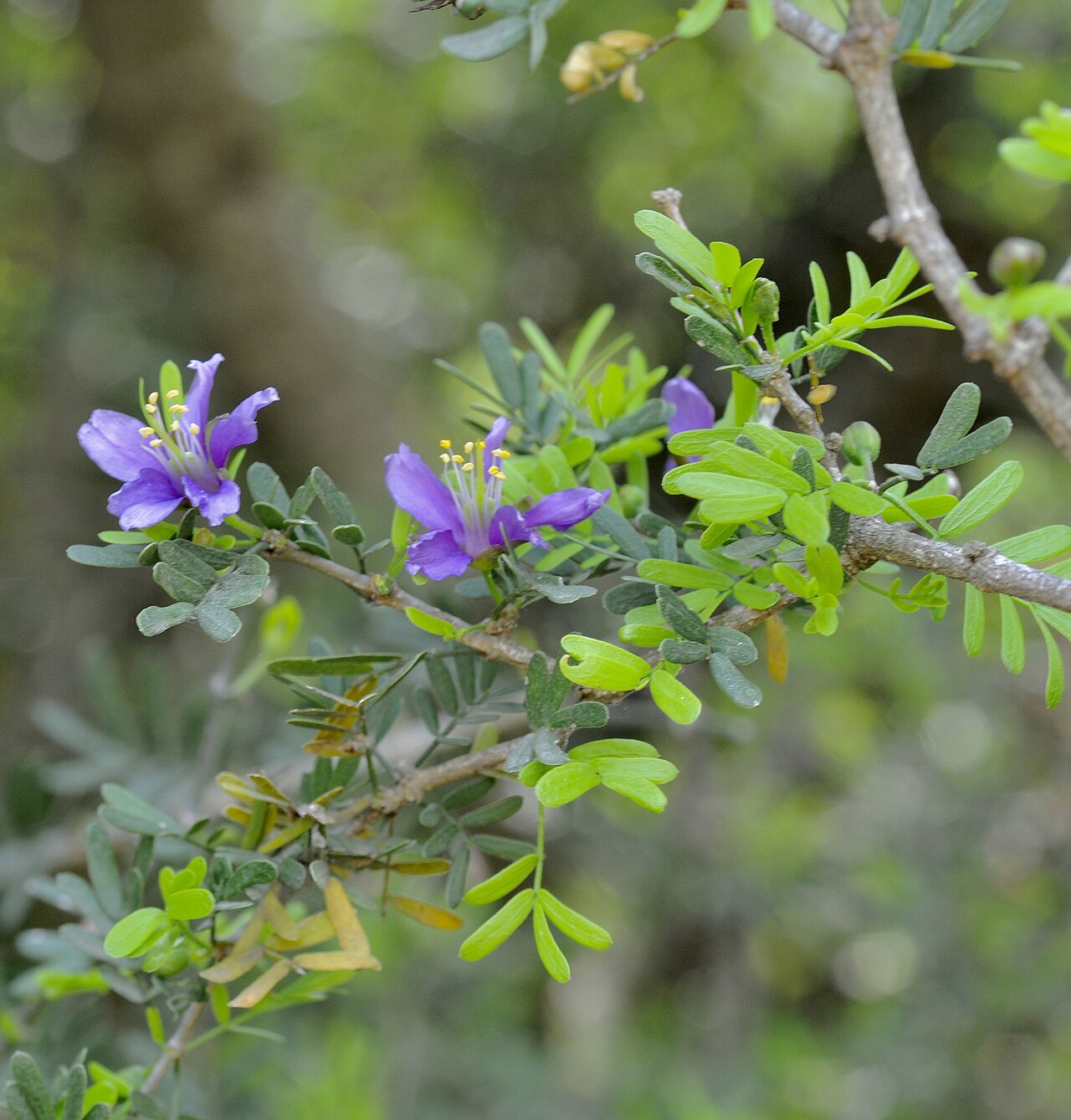
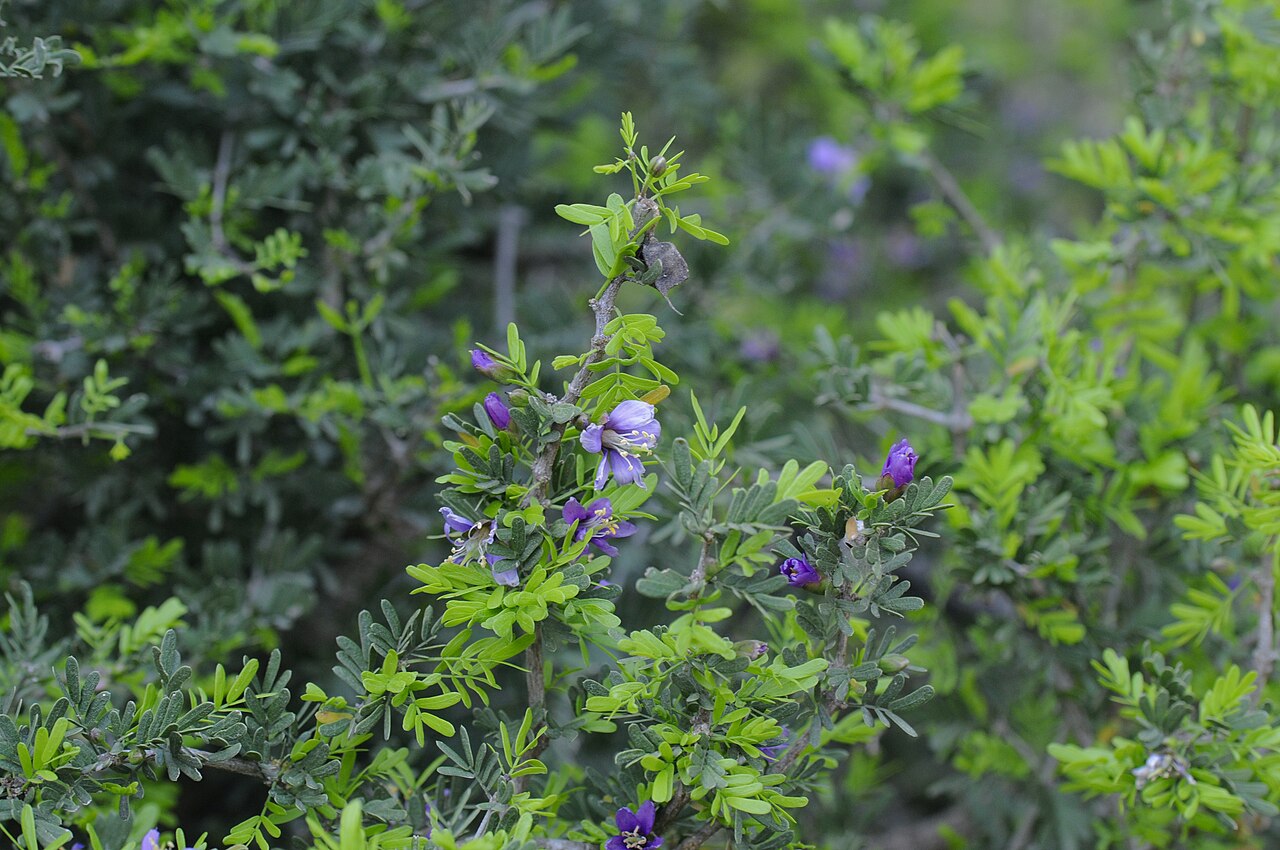
What makes guayacan a favorite of South Texas gardeners is its flower show. After a warm-season rain, a guayacan that looked gray and unremarkable for weeks suddenly covers itself in violet-blue, five-petaled flowers with bright yellow stamens, often repeating the display several times a season. The tiny, leathery, gray-green leaflets stay on the plant year-round, giving guayacan a quietly handsome evergreen presence between bloom flushes, and the orange seed capsules that follow add a second show later in the year.
Guayacan is essentially bulletproof once established: it shrugs off heat, caliche, drought, and browsing deer, and it needs no supplemental care beyond an occasional deep watering to keep the flowers coming. For xeriscapes, wildlife hedges, and native plantings anywhere from Laredo to Corpus Christi to the Lower Rio Grande Valley, it is one of the best flowering natives available.
Identification
Texas guayacan grows as a dense, rounded, multi-trunked shrub, typically 3 to 8 feet tall and wide, though old plants in good soil can reach 15 to 20 feet and take on a small-tree form with a short trunk. The growth habit is twiggy and compact, with many short, stiff branches arising close to the ground.
Bark & Stems
Young twigs are slender, gray-green and finely ridged, maturing to smooth, pale gray-brown bark with shallow furrows on older stems and trunks. The wood is exceptionally dense, hard, and resinous — a family trait shared with the true lignum-vitae trees of the Caribbean, though Texas guayacan is never harvested commercially for timber.
Leaves
Leaves are opposite, evenly pinnately compound, about 1/2 to 1 inch long, with 4 to 8 pairs of small, leathery, elliptical leaflets that fold slightly upward along the midrib. The foliage is a dusty blue-green to gray-green and stays on the plant through all but the hardest freezes, making guayacan one of the few evergreen native shrubs for South Texas.
Flowers & Fruit
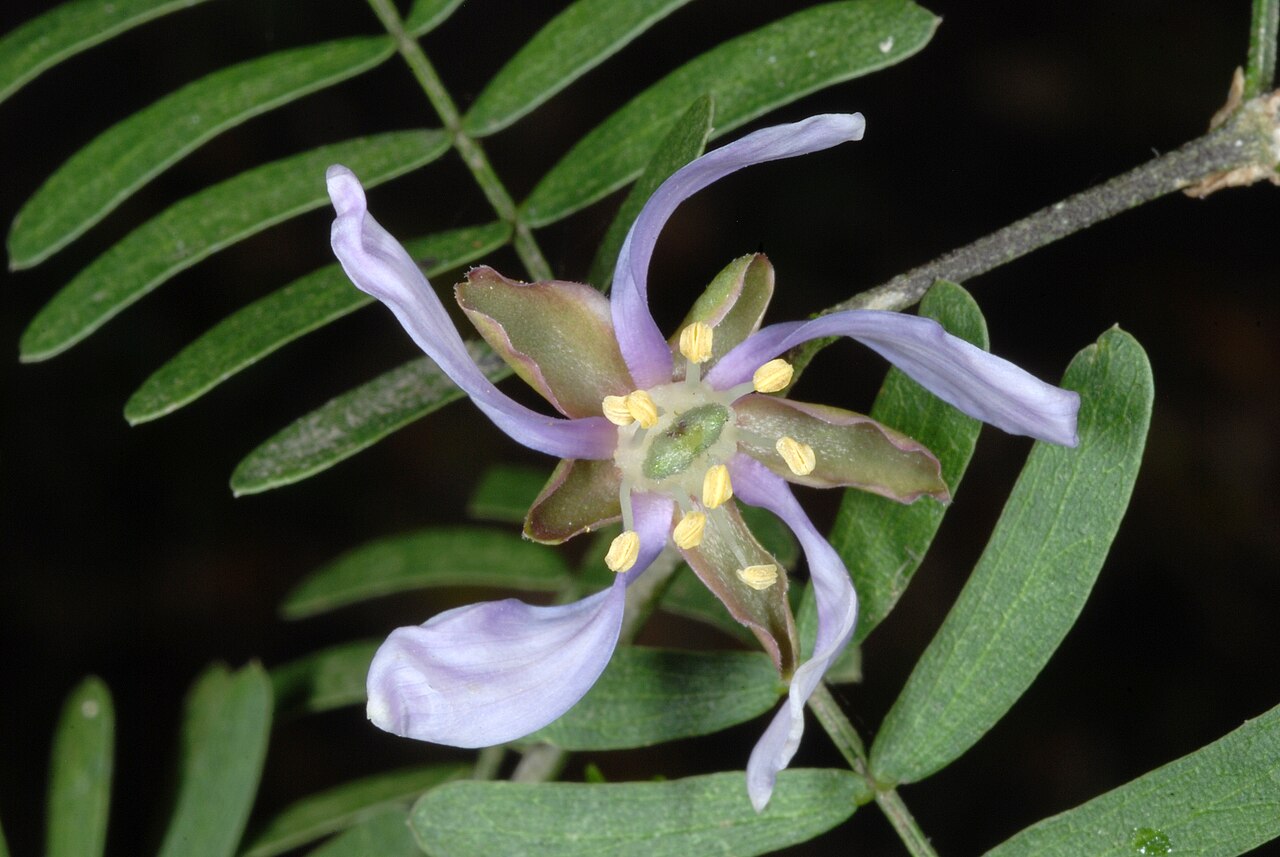
Flowers are about 3/4 inch across, with five narrow, slightly twisted violet-blue to lilac petals surrounding a cluster of eight yellow-tipped stamens and a small green ovary at the center. Bloom is triggered by rainfall and can occur almost any month from spring through fall, with the heaviest flush after spring and summer showers; each flower lasts only a day or two, but a well-watered shrub reblooms repeatedly. Flowers give way to small, two- to three-lobed, heart-shaped seed capsules that ripen orange to red and split open to reveal shiny black seeds, each partly wrapped in a fleshy red aril.
Quick Facts
| Scientific Name | Guaiacum angustifolium |
| Family | Zygophyllaceae (Caltrop) |
| Plant Type | Evergreen Shrub / Small Tree |
| Mature Height | 3–8 ft (occasionally to 20 ft) |
| Mature Spread | 3–8 ft, dense and rounded |
| Growth Rate | Slow |
| Sun Exposure | Full Sun |
| Water Needs | Low; very drought tolerant once established |
| Soil Type | Caliche, limestone, clay or sandy loam; well-drained |
| Soil pH | Neutral to alkaline |
| Bloom Time | Intermittently spring through fall, after rain |
| Flower Color | Violet-blue to lilac |
| Fall Color | None (evergreen) |
| Fruit | Small orange-red capsules with black, red-arilled seeds |
| Deer Resistant | Yes |
| USDA Hardiness Zones | 8b–11 |
Native Range
Texas guayacan is native to South and West Texas, where it is a characteristic shrub of the Tamaulipan thornscrub and Rio Grande Plains, ranging roughly from the Edwards Plateau and Lower Rio Grande Valley west along the Rio Grande to the Big Bend region and the Trans-Pecos. It is not native to any other U.S. state; in the United States it occurs only in Texas. Its range continues south into the adjoining Mexican states along the Rio Grande and into the central Mexican plateau.
In the wild it grows on dry, rocky or caliche-rich flats and low hillsides in thornscrub and open brushland, often alongside other classic South Texas natives. It tolerates heat and drought that would kill most woody plants, and it is frequently one of the few shrubs holding green leaves through a long dry summer.
Because of its dense, durable wood and handsome form, guayacan has long been valued by South Texas ranchers and gardeners, and it is now a mainstay of the native-plant nursery trade in the Rio Grande Valley and San Antonio area. Wild populations are not considered threatened, though the thornscrub habitat it depends on has been reduced in some areas by land clearing for agriculture.
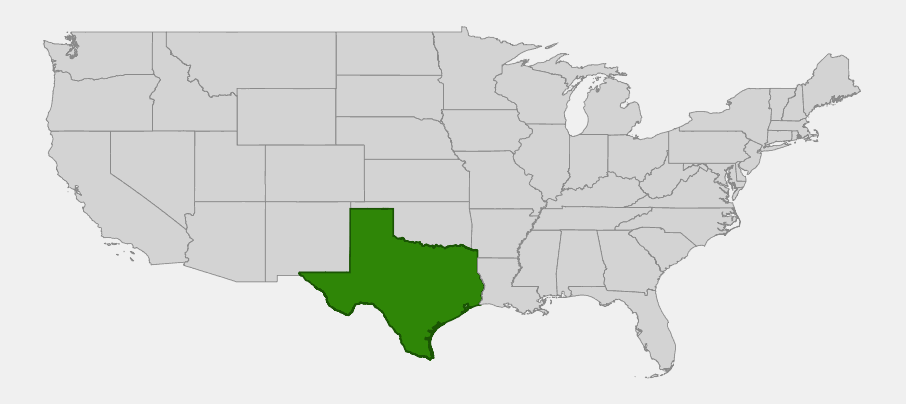
📋 Regional plant lists featuring Texas Guayacan: South and West Texas
Growing & Care Guide
Texas guayacan is as low-maintenance as native shrubs come, provided it has the heat, sun, and sharp drainage it evolved with. It is slow to establish but very long-lived once it gets going.
Light
Guayacan needs full sun to flower and grow well. It tolerates reflected heat from pavement and walls, which makes it a good choice for parking-lot islands, street medians, and other hot, exposed urban sites in South Texas.
Soil & Water
This shrub is built for poor, rocky, alkaline soils, including caliche, limestone gravel, and heavy clay, as long as drainage is reasonable. It needs regular water only while young; mature plants are extremely drought tolerant and can go through South Texas summers on rainfall alone, though an occasional deep soak during extended dry spells encourages heavier bloom. Overwatering or rich garden soil tends to produce rank, floppy growth and fewer flowers.
Planting Tips
Plant container-grown guayacan in fall or early spring so roots can establish before the heat of summer. Because growth is slow, start with the largest container size you can afford if you want quick results. Space plants 4 to 6 feet apart for an informal hedge or screen, or give a specimen plant room to reach its full rounded width. Guayacan transplants poorly once established, so choose its permanent spot carefully.
Pruning & Maintenance
Little pruning is needed; guayacan naturally holds a neat, rounded shape. Remove dead or crossing twigs in late winter if desired, and light shearing can shape it into a formal hedge, though this will reduce flowering somewhat. The plant has no significant pest or disease problems and needs no fertilizer in typical South Texas soils.
Landscape Uses
- Xeriscapes and rock gardens, where its drought tolerance and evergreen foliage shine
- Wildlife hedges and screens in South Texas native landscapes
- Street medians and parking islands that get reflected heat
- Pollinator gardens, for the repeated flushes of bee-friendly flowers
- Specimen planting near patios where the bloom can be enjoyed up close
- Thornscrub restoration projects in its native Rio Grande Plains range
Wildlife & Ecological Value
Despite its tough, spine-free appearance, Texas guayacan is a reliable food source in the South Texas brush country, where flowering shrubs that bloom outside the main spring flush are especially valuable.
For Pollinators
The violet flowers attract a wide range of native bees and other insects, and because bloom is triggered by rain rather than a fixed calendar, guayacan often provides nectar during dry-season gaps when fewer other plants are flowering.
For Birds
The dense, twiggy branching provides good cover and nesting structure for small brushland birds, including various sparrows and wrens common to South Texas thornscrub.
For Mammals
White-tailed deer rarely browse guayacan, which is part of why it has a reputation as deer resistant; this makes it valuable in areas with heavy deer pressure where few other flowering natives survive unprotected.
Ecosystem Role
As a slow-growing, long-lived evergreen, guayacan adds structural diversity and year-round cover to Tamaulipan thornscrub, a habitat type that has been reduced by land clearing in parts of South Texas. Its dense wood and persistent foliage make it a stable, long-term component of brushland plant communities.
Cultural & Historical Uses
The genus Guaiacum takes its name from the Taino word for the Caribbean lignum-vitae trees, whose extraordinarily dense, self-lubricating wood was prized for ship bearings, mallets, and tool handles from the age of sail into the twentieth century, and whose resin was used historically in folk remedies throughout the Caribbean and Latin America. Texas guayacan shares the family’s dense wood but has never been a commercial timber species in Texas, in part because the shrub rarely grows large enough to yield useful lumber.
Along the Rio Grande, ranchers and rural communities have long recognized guayacan for its hard, durable wood, sometimes used locally for small tool handles and fence parts, and its wood has occasionally been used in folk traditions in ways similar to its Caribbean relatives, though such historical uses are not medical guidance and the species is not grown commercially for that purpose today.
In recent decades guayacan’s main value has shifted to horticulture: South Texas native-plant nurseries promote it heavily for xeriscaping and wildlife gardens, and it has become a signature flowering shrub of Rio Grande Valley and San Antonio native landscaping, valued as much for its toughness as for its striking violet blooms.
Frequently Asked Questions
Is Texas guayacan the same plant as lignum-vitae?
It is a close relative. Guaiacum angustifolium belongs to the same small genus as the Caribbean lignum-vitae trees (Guaiacum officinale and Guaiacum sanctum), sharing the family’s exceptionally dense wood, but it is a distinct, smaller Texas species, not the commercial lignum-vitae timber tree.
Why isn’t my guayacan blooming?
Guayacan flowers in response to rainfall rather than on a fixed schedule, so a long dry spell can mean weeks without blooms. A deep watering during drought, followed by warm weather, often triggers a fresh flush of flowers within days.
How fast does Texas guayacan grow?
It is a slow grower, often adding well under a foot per year, especially while young. Patience pays off, though, since it is also extremely long-lived and needs very little care once established.
Is Texas guayacan native outside of Texas?
No. Within the United States it is found only in South and West Texas; it does not occur natively in New Mexico, Arizona, or any other state, though its range continues into adjoining areas of northern and central Mexico.
Will guayacan survive a hard freeze?
Established plants tolerate typical South Texas winters and brief dips into the 20s°F, but a hard, prolonged freeze can cause dieback, especially in young plants. In the colder parts of its range, siting it in a protected, south-facing spot helps it come through winter undamaged.

Looking for a nursery that carries Texas Guayacan?
Browse our native plant nursery directory: Texas