Texas Rainbow Cactus (Echinocereus dasyacanthus)
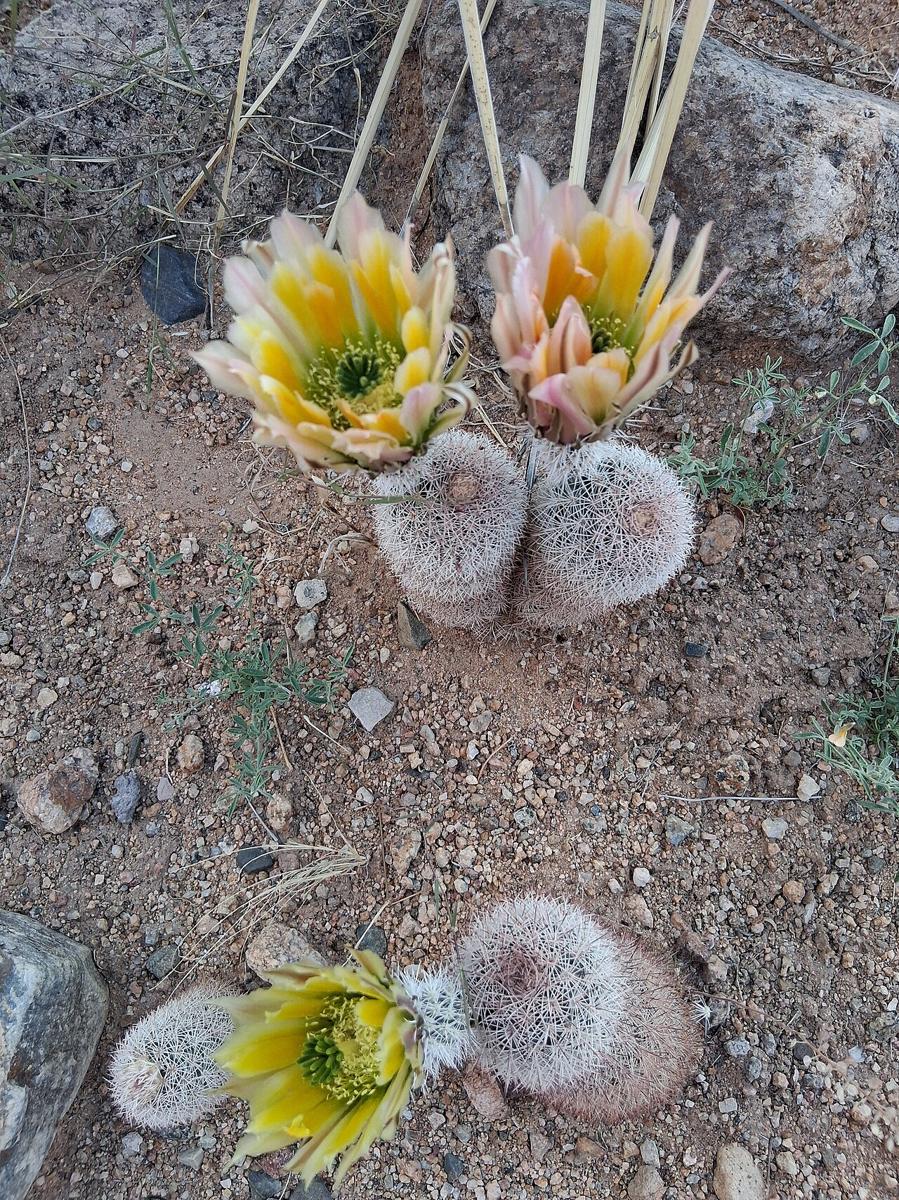
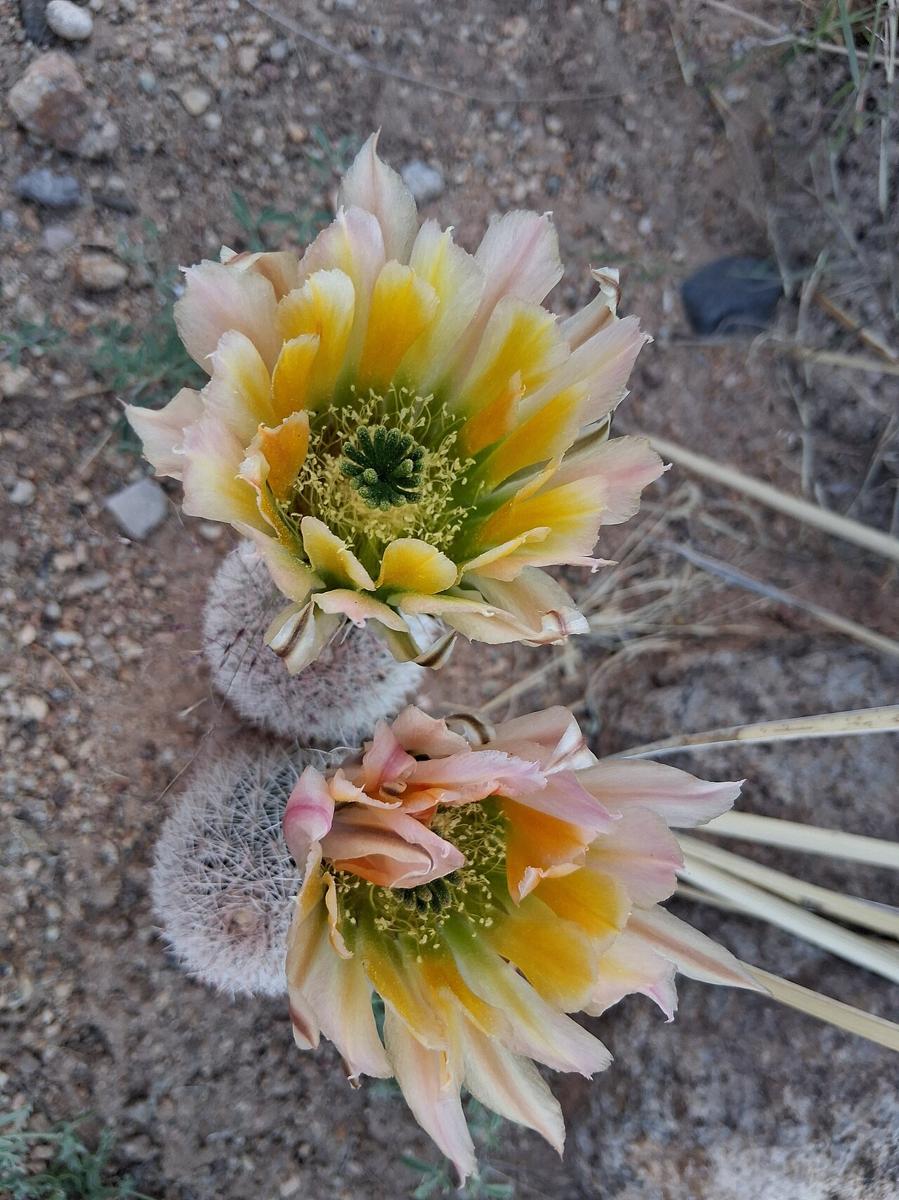
Echinocereus dasyacanthus, the Texas Rainbow Cactus (also spiny hedgehog cactus or New Mexico rainbow cactus), is a small, densely spined cylindrical cactus of the Chihuahuan Desert’s rocky slopes and canyons, prized for having some of the largest and most spectacularly colored flowers of any North American hedgehog cactus. In mid-spring its stiff, straw-colored to pinkish spines give way at the crown to enormous blooms, often 3 to 4 inches across, in shades of yellow, gold, peach, pink and lavender, frequently banded or blended across a single flower in a way that lives up to the “rainbow” name.
Plants grow as a solitary cylinder when young and gradually branch from the base with age, eventually forming a loose clump of a few to several stems, each typically 6 to 12 inches tall. The dense covering of fine, comb-like spines gives the whole plant a soft, pastel appearance even before it flowers, ranging from pale straw to pink, tan or gray depending on the individual.
Within its limited native range in far West Texas and southern New Mexico, Texas rainbow cactus is treasured by rock garden and cactus enthusiasts for its outsized, jewel-toned flowers on a relatively small, easy-care plant, making it one of the best cold-hardy hedgehog cacti for a Chihuahuan Desert native garden.
Identification
Texas rainbow cactus is identified by its cylindrical, densely spined stems and, when in bloom, by flowers that are unusually large and often strikingly multicolored for a hedgehog cactus of its size.
Stem & Spines
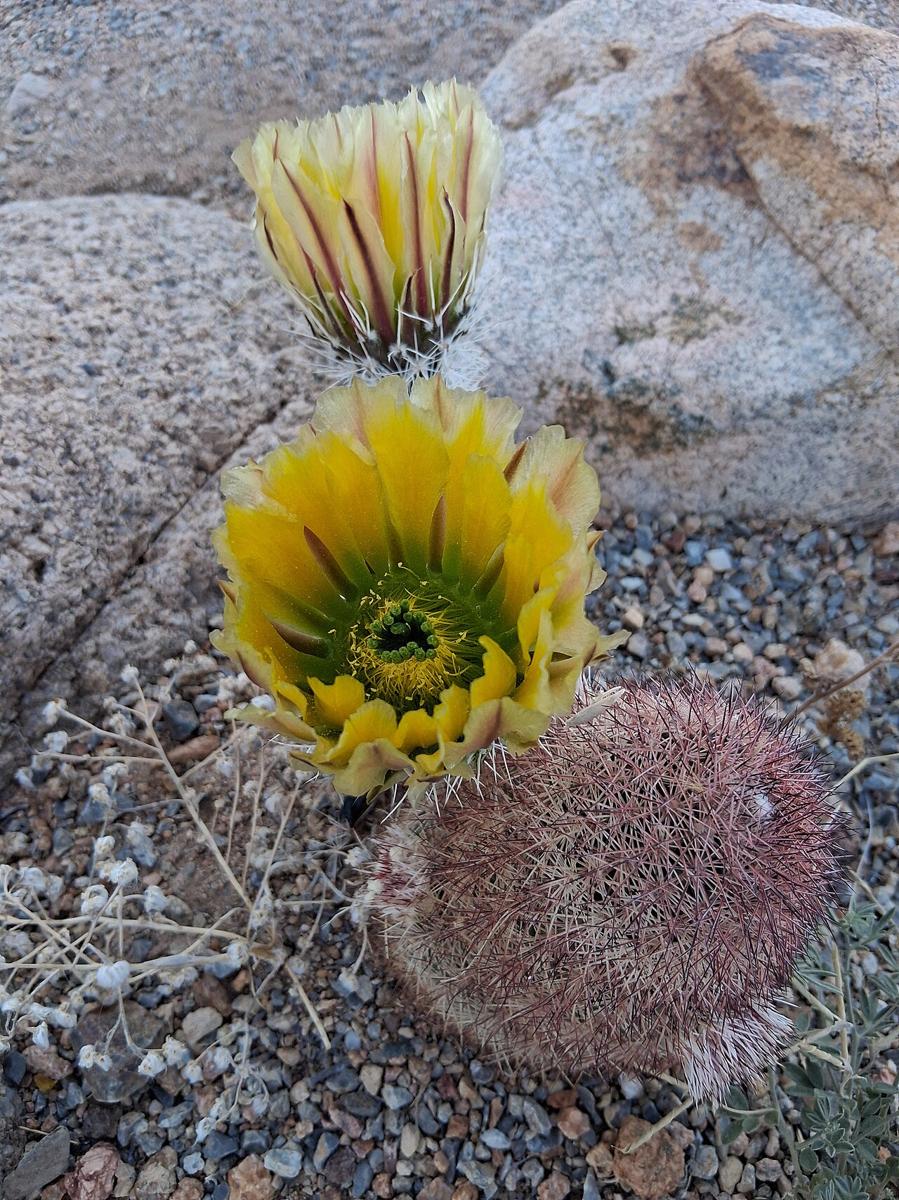
Stems are cylindrical, 6 to 12 inches tall and 2 to 3 inches thick, with 14 to 20 low ribs completely covered in dense, comb-like spines. Radial spines are numerous, short and fine, usually pale straw, tan or pinkish, while 1 to several longer central spines (up to about an inch) add a slightly shaggy texture. Older plants branch from the base to form small clumps.
Flowers
Flowers open from April into May at the stem tips, 3 to 4 inches across, among the largest of any hedgehog cactus relative to plant size. Color is highly variable even within a single population: commonly golden yellow to orange with a greenish throat, but ranging to pink, peach or lavender tones, sometimes with distinct multicolored bands across the petals, which is the source of the “rainbow” common name.
Fruit & Seeds
The fruit is a small, spiny, egg-shaped berry that ripens in early summer, turning from green to reddish as it matures, eventually splitting to reveal juicy flesh and small black seeds. Like the fruit of related hedgehog cacti, it is edible but minor compared to larger-fruited native cacti.
Quick Facts
| Scientific Name | Echinocereus dasyacanthus |
| Family | Cactaceae (Cactus) |
| Plant Type | Clumping hedgehog cactus |
| Mature Height | 6–12 in per stem |
| Mature Spread | 6 in – 1 ft as a clump |
| Growth Rate | Slow |
| Sun Exposure | Full Sun |
| Water Needs | Low; drought tolerant once established |
| Soil Type | Rocky, limestone or gravelly; sharply drained |
| Soil pH | Neutral to alkaline (about 7.0–8.5) |
| Bloom Time | April – May |
| Flower Color | Yellow, orange, pink or lavender, often multicolored |
| Fall Color | None (evergreen) |
| Fruit | Small spiny green-to-red edible berry, early summer |
| Deer Resistant | Yes |
| USDA Hardiness Zones | 7–10 |
Native Range
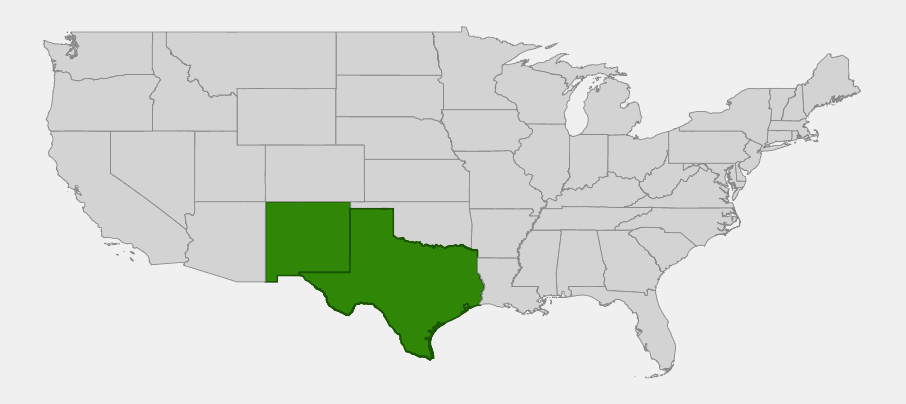
Texas rainbow cactus is native to the Trans-Pecos region of far West Texas and adjoining southern New Mexico, part of the Chihuahuan Desert. It occurs across nearly every county of the Texas Trans-Pecos, with populations extending north and west into the bootheel and southern desert basins of New Mexico.
Within this range, the species grows on rocky slopes, limestone and igneous outcrops, desert grassland and open Chihuahuan Desert scrub, generally between about 2,000 and 5,000 feet elevation. It prefers well-drained, often gravelly or rocky soil in full sun, typically growing scattered among creosote bush, lechuguilla and other classic Chihuahuan Desert plants rather than in dense colonies.
Texas rainbow cactus is not confirmed native outside Texas and New Mexico; gardeners elsewhere in the Southwest should source nursery-propagated plants and treat it as a regional specialty rather than a broadly adaptable native.
📋 Regional plant lists featuring Texas Rainbow Cactus: Arizona & New Mexico · Texas
Growing & Care Guide
Texas rainbow cactus is a rewarding, compact plant for gardeners within or near its Chihuahuan Desert range who want a hedgehog cactus with exceptional, oversized flowers.
Light
Full sun is essential for strong spination, compact growth and the heaviest flower production. In too much shade the plant becomes etiolated and blooms poorly.
Soil & Water
Plant in rocky, gravelly or limestone-based soil with excellent drainage; a raised bed or berm with added coarse gravel suits it well in heavier native soils. Water sparingly to establish, then reduce sharply; this species is adapted to the sharp wet-dry cycle of the Chihuahuan Desert and performs poorly in soil that stays consistently moist.
Planting Tips
Set out container plants in spring, at the same depth they grew in the pot, in a spot with reflected heat such as near light rock or gravel mulch. Give plants a few inches of clearance from other vegetation so air can circulate around the base, which helps prevent rot during occasional wet spells.
Pruning & Maintenance
No pruning is needed. The species has few pest or disease issues in appropriately sharp drainage and does not need fertilizer. As clumps age and branch, simply allow the natural form to develop without intervention.
Propagation
Offsets from a mature clump can be removed with a clean knife, allowed to callus for about a week, and rooted in a gritty, well-drained cactus mix. Seed propagation is also used, sown on the surface of a sandy mix and kept warm, though germination and growth to flowering size take patience.
Landscape Uses
- Rock gardens and gravel beds in Chihuahuan Desert and Trans-Pecos native plantings, where the oversized flowers are a standout
- Container and trough culture for collectors who want to appreciate the flower color variation up close
- Pollinator gardens, where the large, nectar-rich flowers draw strong native bee activity
- West Texas xeriscape accents paired with ocotillo, sotol and other Trans-Pecos natives
- Specialty cactus collections, given the striking individual-to-individual flower color variation
Wildlife & Ecological Value
Despite its narrow native range, Texas rainbow cactus contributes meaningfully to Chihuahuan Desert pollinator and wildlife communities.
For Pollinators
The unusually large, brightly colored flowers are a strong draw for native bees, which are the main pollinators, and the heavy nectar reward from such large blooms makes a flowering plant a notable local pollinator stop during its spring bloom window.
For Birds
Ground-foraging desert birds occasionally eat the small summer fruit, though it plays a minor role compared to larger desert fruit sources.
For Mammals
Small mammals and rodents eat the fruit when available and help disperse the seeds locally; the dense spine coverage otherwise protects the plant from most browsing.
Ecosystem Role
As a long-lived, slow-growing perennial adapted to rocky Chihuahuan Desert slopes, Texas rainbow cactus is a genuine indicator species of healthy, undisturbed desert grassland and scrub habitat in the Trans-Pecos, persisting in sites too rocky and dry for most other flowering plants.
Cultural & Historical Uses
Texas rainbow cactus has a smaller documented history of traditional use than many larger regional cacti, largely because of its modest size and limited range, but its small fruit has been gathered and eaten fresh by people within the Trans-Pecos region as a minor wild food, similar to other hedgehog cacti.
The species has long been admired by botanists and naturalists for the remarkable individual variation in its flower color, a trait that has made it a favorite subject of desert wildflower photography in Big Bend and the surrounding Trans-Pecos country, where its blooms are considered one of the highlights of the spring desert bloom season.
Among cactus collectors and rock-garden hobbyists, Texas rainbow cactus has become a sought-after species precisely because of this flower color variability, with growers often selecting and propagating particularly striking color forms for specialty collections.
Frequently Asked Questions
Why do the flowers vary so much in color?
Natural genetic variation across populations produces a wide range of flower colors in this species, from yellow and orange to pink and lavender, often banded on a single bloom. This variability is part of what makes the “rainbow cactus” name fitting and is one of the species’ most appealing traits for collectors.
Is Texas rainbow cactus cold-hardy?
Reasonably so for its desert origin; it is hardy to about USDA zone 7 and tolerates the cold snaps common in its Trans-Pecos and southern New Mexico range, provided the soil stays dry through winter.
How is it different from lace hedgehog cactus?
Texas rainbow cactus (Echinocereus dasyacanthus) has larger flowers and a more limited Trans-Pecos/southern New Mexico range, while lace hedgehog cactus (Echinocereus reichenbachii) has a denser, more tightly interlacing spine pattern and ranges more broadly across Texas, Oklahoma and New Mexico. Both are excellent native rock garden cacti.
Can I grow this cactus outside West Texas and New Mexico?
It can succeed in similarly dry, sunny, well-drained gardens elsewhere, but it is only considered native within the Chihuahuan Desert portions of Texas and New Mexico, so treat it as a regional specialty rather than a general Southwestern native.
Why isn’t my plant flowering?
Insufficient sun, soil that stays too moist, or a plant that hasn’t yet reached flowering maturity are the most common causes. Give it full sun, sharp drainage and patience; flowering typically begins once a stem reaches a reasonable size, often after several years.

Looking for a nursery that carries Texas Rainbow Cactus?
Browse our native plant nursery directory: Texas · New Mexico