
Texas Thistle (Cirsium texanum)
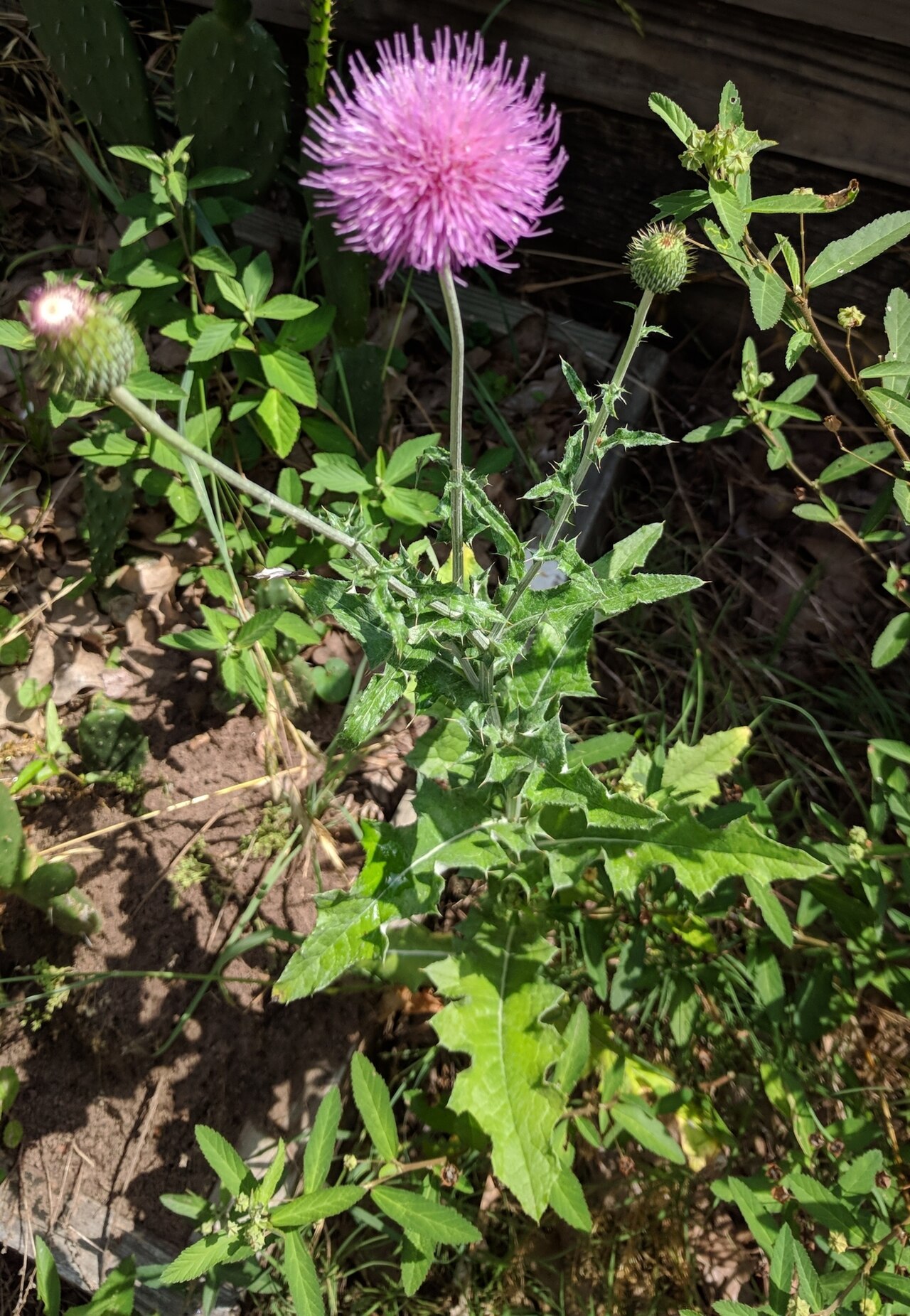
Cirsium texanum, the Texas Thistle, also called Texas purple thistle or southern thistle, is a native wildflower of prairies, pastures, roadsides and open woodland edges across Texas, Oklahoma and neighboring areas. It is a member of the aster family (Asteraceae) and grows as a biennial or short-lived perennial, producing a flat rosette of spiny leaves in its first season and tall, slender flowering stems topped with pink-purple, shaving-brush flower heads in late spring and summer.
Thistles have a bad reputation, and it is easy to see why: several Eurasian species, such as bull thistle and musk thistle, are aggressive weeds of pastures and roadsides. Texas thistle is not one of them. It is a native species that grows in balance with the grasses and wildflowers around it, and it is not listed as a noxious weed. Its flowers are among the best nectar sources of early summer for butterflies and bees, and its seeds and soft thistledown are prized by American goldfinches.
This guide explains how to recognize Texas thistle and tell it apart from invasive thistles, where it grows, how to include it in a wildflower meadow or wildlife garden, and why this spiny plant deserves a place in Texas landscapes.
Identification
Texas thistle is the most common native thistle across much of central and southern Texas. Look for leaves that are green above and white-woolly beneath, a slender, sparingly branched stem with relatively few leaves near the top, and flower heads that sit on long stalks rather than clustered tightly together.
Rosette & Stems
In its first year, Texas thistle forms a low, flat rosette of deeply lobed leaves anchored by a taproot. In its second spring, or in later years on perennial plants, it sends up one or a few upright stems, usually 2 to 5 feet tall. The stems are woolly, ribbed, and unbranched or branched only near the top. Unlike bull thistle, they are not lined with continuous spiny wings.
Leaves
The leaves are alternate, about 4 to 9 inches long near the base and progressively smaller toward the top of the stem, where they become narrow and widely spaced. They are lobed or wavy-margined, with yellowish spines at the tips of the lobes but relatively few spines elsewhere. The upper surface is green and nearly smooth, while the underside is covered in dense white wool, a contrast that is a good field mark.
Flowers
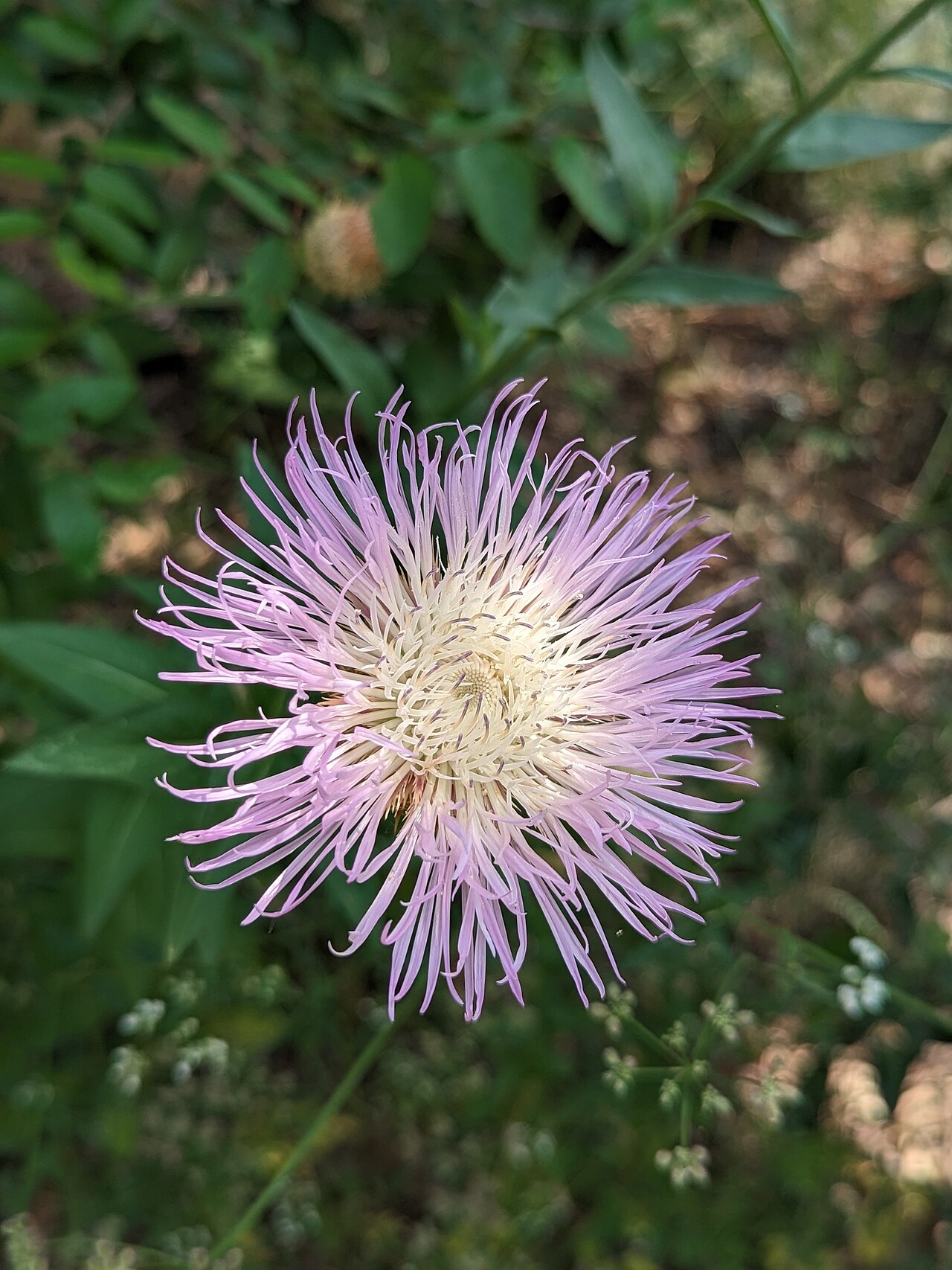
Each stem or branch ends in a single flower head about 1 to 2 inches across. The head is made entirely of disk florets, with no ray flowers, and the slender florets fan out like the bristles of a shaving brush. They range from rose-purple to lavender and occasionally pale pink. The bracts that form the cup beneath the head are narrow, overlapping and tipped with short, weak spines. Texas thistle blooms mainly from April to July, sometimes into August.
Seeds & Look-alikes
After flowering, the heads ripen into small, smooth seeds (achenes), each topped with a plume of feathery bristles that carries it on the wind. Bull thistle (Cirsium vulgare), an introduced weed, has spiny-winged stems and leaves that are rough and prickly above. Musk thistle (Carduus nutans), also introduced, has large nodding heads with broad, spine-tipped bracts. The native Purple Thistle (C. horridulum) is far more densely spiny and has a ring of spiny leafy bracts around each head.
Quick Facts
| Scientific Name | Cirsium texanum (syn. Carduus austrinus) |
| Family | Asteraceae (aster family) |
| Plant Type | Herbaceous biennial or short-lived perennial with a taproot |
| Mature Height | 2–5 ft in flower |
| Mature Spread | 1–2 ft |
| Growth Rate | Fast |
| Sun Exposure | Full sun |
| Water Needs | Low; drought tolerant once established |
| Soil Type | Well-drained clay, loam, sand or limestone soils |
| Soil pH | About 6.0–8.5 |
| Bloom Time | April–July, sometimes into August |
| Flower Color | Rose-purple to lavender, occasionally pale pink |
| Fall Color | None; plants die back after seeding |
| Fruit | Small achene with a feathery plume (thistledown) |
| Deer Resistant | Yes; the spiny leaves are rarely browsed |
| USDA Hardiness Zones | 6–9 |
Native Range
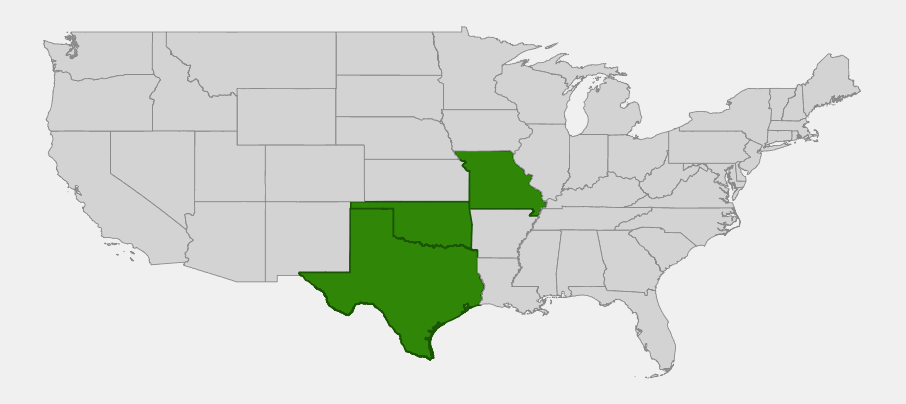
Texas thistle is a plant of the southern Great Plains and northern Mexico. USDA PLANTS records it as native in Texas, Oklahoma and Missouri. The Lady Bird Johnson Wildflower Center describes its range as prairies and roadsides “nearly throughout Texas, Oklahoma & Missouri, and south to northern Mexico,” where it grows in Coahuila, Nuevo León, Tamaulipas and nearby states.
It is most abundant in Texas, where it is one of the most familiar wildflowers of pastures, roadsides and prairie remnants in the Blackland Prairie, Cross Timbers, Edwards Plateau and South Texas Plains. It extends into the Rolling Plains and the Trans-Pecos and continues north across Oklahoma. Some floras also report scattered populations in eastern New Mexico, Arkansas and Louisiana, at the edges of its main range.
In Missouri it is near the northeastern limit of its range and much less common than in Texas. Throughout its range it favors open, sunny ground with some disturbance, such as grazed prairie, roadside right-of-ways, old fields and woodland openings.
📋 Regional plant lists featuring Texas Thistle: Illinois, Iowa & Missouri · Arkansas, Louisiana, Eastern Oklahoma & Eastern Texas · South & West Texas
Growing & Care Guide
Texas thistle is not a typical border perennial, but it is easy to grow in a sunny meadow, prairie planting or wildlife garden within its native range. Its main requirements are full sun, good drainage and room to complete its two-year life cycle and reseed.
Light
Plant Texas thistle in full sun. It tolerates a little afternoon shade but becomes lanky and flowers poorly in shady sites.
Soil & Water
It grows in almost any well-drained soil, from heavy blackland clay to sandy loam and rocky limestone ground. Once its taproot is established it is very drought tolerant and needs no supplemental water except during establishment. Avoid poorly drained, constantly wet sites. Fertilizer is unnecessary.
Planting Tips
Texas thistle is best grown from seed. Sow it in fall on bare or lightly raked soil in a meadow or prairie planting; seedlings form rosettes during the cool season and bloom the following spring or the year after. Because of its long taproot, it transplants poorly once established, so move seedlings while they are small. Site it away from paths and play areas, where the spines could be a nuisance.
Pruning & Maintenance
Little care is needed. Leave the flower heads to ripen if you want to feed goldfinches and allow the plant to reseed. If you want to limit spread, cut the stems just as the flowers fade. Wear sturdy gloves when handling the plants. Each plant dies after seeding (or after a few years if perennial), so leave some seedlings each year to keep it in the planting.
Propagation
Propagate by seed. Collect heads as they turn fluffy and shake out the plumed seeds. Seed sown in fall germinates readily as soil cools; spring-sown seed benefits from a short period of cold, moist stratification. Mature plants are not divided.
Landscape Uses
- Prairie and meadow plantings: a native thistle that fits naturally with grasses and other prairie wildflowers
- Butterfly and pollinator gardens: one of the strongest early-summer nectar plants in Texas
- Bird gardens: seeds and thistledown feed and supply nesting material for goldfinches
- Roadside and right-of-way plantings: tough, drought-tolerant and self-sustaining on poor soils
- Deer-resistant landscapes: spiny foliage is rarely browsed
Wildlife & Ecological Value
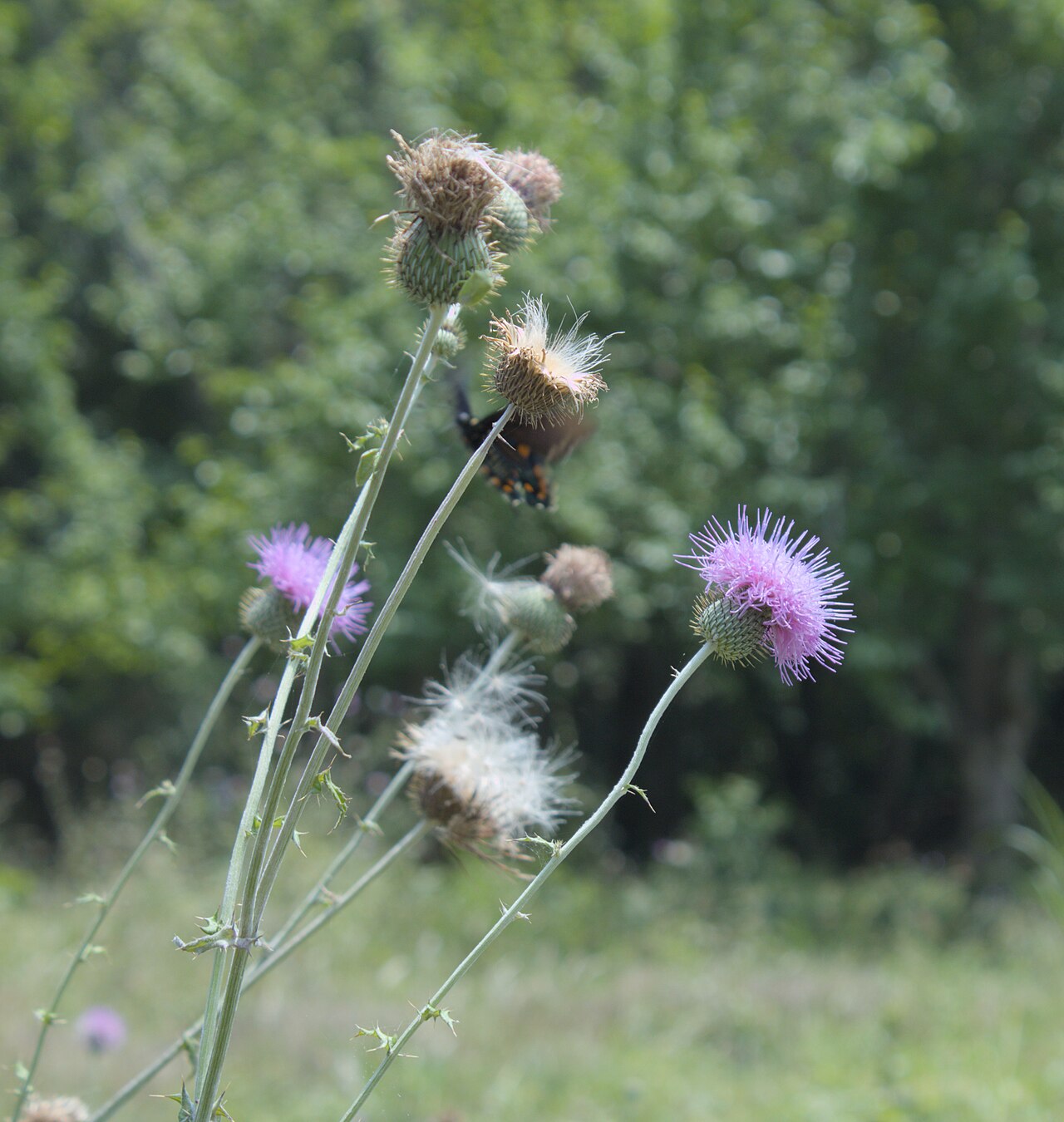
Native thistles are some of the most valuable wildlife plants in grassland ecosystems, and Texas thistle is no exception. Its large, nectar-rich flower heads, its seeds and its soft down are all used heavily by wildlife.
For Pollinators
The Lady Bird Johnson Wildflower Center notes that Texas thistle is a good nectar source for pollinators. Its flower heads draw swallowtails, skippers and monarchs, along with bumblebees and many smaller native bees. The foliage is a larval food plant for the painted lady butterfly (Vanessa cardui), whose caterpillars feed on many thistles.
For Birds
American goldfinches are closely tied to thistles. They feed heavily on the seeds and use the soft down to line their nests, which is one reason goldfinches nest later in the summer than most songbirds. Other seed-eating birds such as sparrows and finches also feed on the seeds.
For Mammals
The spines protect the plant from most browsing by deer and livestock, so Texas thistle often persists in grazed pastures where other wildflowers are eaten. Small mammals may eat the fallen seeds.
Ecosystem Role
As a biennial that colonizes disturbed openings, Texas thistle helps cover bare ground after grazing, drought or fire, and its deep taproot draws water and nutrients from lower soil layers. It is one of many native thistles in North America that support specialized insects, and conserving native thistles helps protect these insects while invasive thistles are controlled.
Cultural & Historical Uses
Texas thistle was described by Samuel Botsford Buckley, a nineteenth-century naturalist who served as state geologist of Texas and collected widely across the state. The botanist John Kunkel Small later named a similar plant Carduus austrinus, now treated as a synonym. The common name “southern thistle” reflects its range at the southern edge of the North American thistles.
The genus Cirsium is large and includes dozens of native North American species. Some thistle roots and peeled young stems were traditionally eaten by Indigenous peoples and settlers in various parts of the continent, but we have not found well-documented uses specific to Texas thistle, so it should not be treated as a food plant.
Today Texas thistle is valued mainly as a wildlife plant, and conservation groups increasingly encourage landowners to tell native thistles apart from invasive ones. Spraying or mowing every thistle removes important nectar and seed sources. Learning to recognize Texas thistle and leaving it in pastures and roadsides is a simple way to support pollinators and goldfinches.
Frequently Asked Questions
Is Texas thistle a noxious weed?
No. Texas thistle is a native wildflower and is not one of the invasive Eurasian thistles, such as musk thistle, bull thistle and Canada thistle, that are listed as noxious weeds. It grows in balance with other prairie plants and rarely forms dense stands.
How can I tell Texas thistle from invasive thistles?
Look at the leaves and stems. Texas thistle leaves are green above and white-woolly underneath, with spines mainly at the lobe tips, and its stems lack continuous spiny wings. Bull thistle has prickly-rough leaf tops and spiny winged stems, and musk thistle has large nodding heads with broad, spiny bracts.
Do butterflies use Texas thistle?
Yes. Its flowers are a rich nectar source for butterflies, including swallowtails and monarchs, and the leaves feed painted lady caterpillars.
Why do goldfinches like thistles?
American goldfinches eat thistle seeds and line their nests with thistledown, and they time their nesting to coincide with thistle seed production in mid to late summer.
Is Texas thistle annual or perennial?
It is usually a biennial: a rosette in the first year, flowering and setting seed in the second, then dying. Some plants persist for a few years as short-lived perennials. It maintains itself in a planting by reseeding.
