Torrey Yucca (Yucca torreyi)
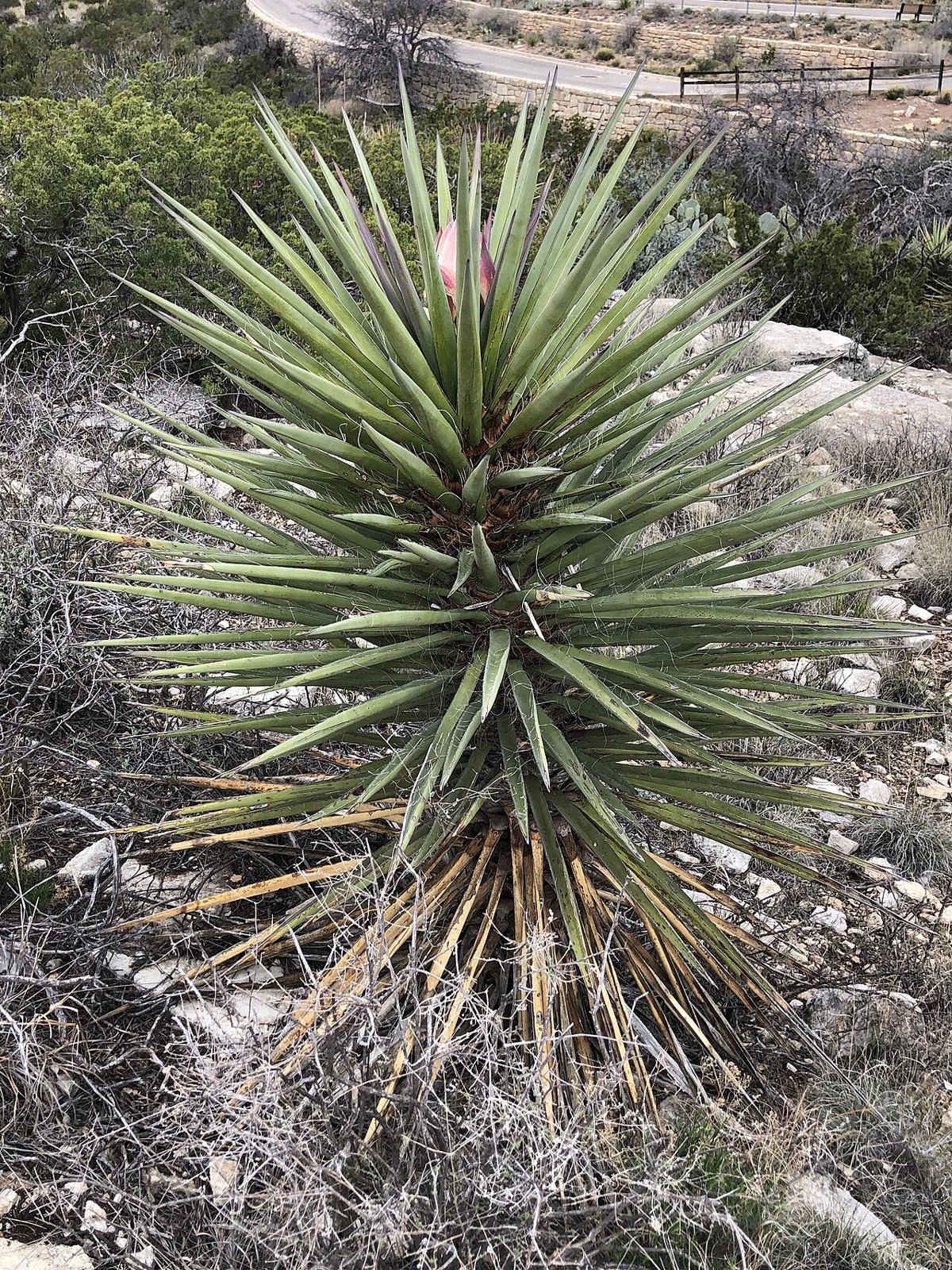
Yucca torreyi, commonly known as Torrey Yucca or Torrey’s Yucca, is one of the signature large yuccas of the Chihuahuan Desert, forming a stout, often multi-trunked rosette plant that dominates rocky slopes and desert grasslands across the Trans-Pecos region of Texas and into New Mexico. It is closely related to — and frequently confused with — Spanish Dagger (Yucca treculeana), but Torrey Yucca tends to have narrower, more rigid leaves and a shrubbier, more branched growth habit over time.
In its native habitat, Torrey Yucca grows on limestone hillsides, desert grasslands, and rocky arroyo banks from roughly 2,500 to 6,000 feet elevation, where its deep roots and waxy, moisture-conserving leaves allow it to thrive with minimal rainfall. Mature plants develop a thick trunk clothed in dried, skirt-like dead leaves, eventually reaching heights of 6 to 15 feet with one or several branching heads — giving older specimens a distinctly tree-like, sculptural silhouette that is a defining feature of the Big Bend and Guadalupe Mountains landscape.
For gardeners in the Trans-Pecos and southern New Mexico, Torrey Yucca is a dramatic, long-lived architectural plant that asks for almost nothing once established — no irrigation, no fertilizer, and no winter protection within its native range. Its creamy white-and-maroon flower spikes in spring are a genuine spectacle, and the plant’s tolerance for heat, drought, and poor rocky soil make it one of the most reliable large accent plants for xeric regional landscaping.
Identification
Torrey Yucca is a trunk-forming yucca that may grow as a single stem or, more often with age, branch into several heads, each topped with a dense rosette of leaves. Young plants are stemless or nearly so, but a visible woody trunk develops within several years and continues to thicken and sometimes lean or branch as the plant matures, eventually reaching 6 to 15 feet in height.
Bark & Stems
The trunk is typically clothed in a thick skirt of dried, downward-curving dead leaves that persist for years, giving older plants a shaggy, fibrous appearance from a distance. Beneath this skirt, the woody trunk itself is pale gray-brown and rough. Removing the dead leaf skirt (a common practice in managed landscapes) reveals a cleaner, more sculptural trunk form.
Leaves
Leaves are rigid, narrow, and sharply pointed, typically 2 to 3 feet long and under 2 inches wide, colored blue-green to gray-green. Leaf margins bear fine, curling fibers that peel away from the edges — a useful identification trait distinguishing it from the smoother-edged Spanish Dagger. The leaf tips are needle-sharp and can cause serious puncture wounds, so this species is best planted well away from paths and seating areas.
Flowers
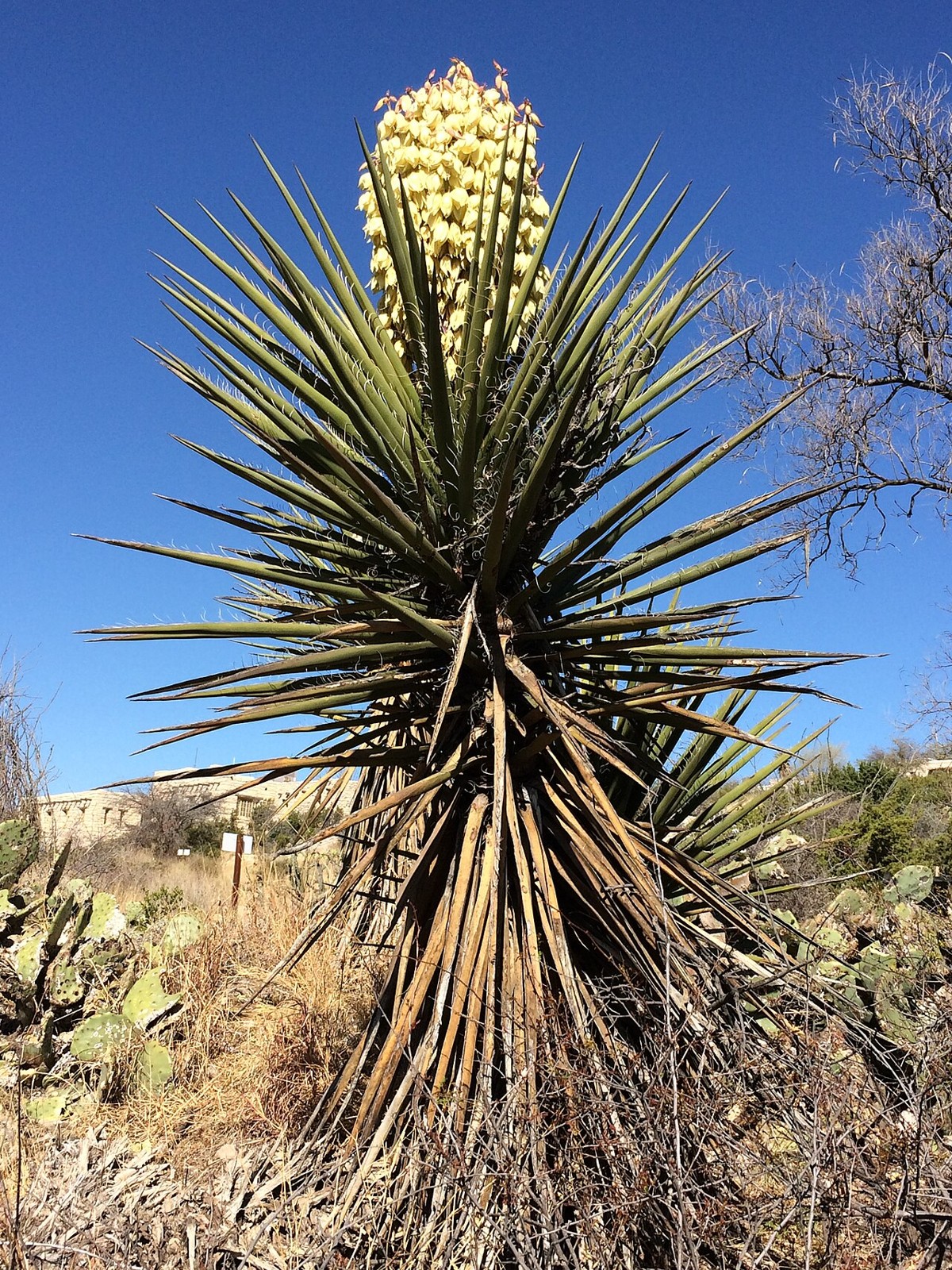
Torrey Yucca blooms in spring, typically March through May, sending up a dense, often partially leaf-enclosed flower panicle 2 to 4 feet tall directly from the center of the rosette. The bell-shaped flowers are creamy white, frequently blushed with maroon or dusky purple-red at the petal tips and bases, creating a striking two-toned effect. Like all yuccas, pollination is carried out almost exclusively by specialized yucca moths in a tightly coevolved relationship essential to seed production.
Fruit & Seeds
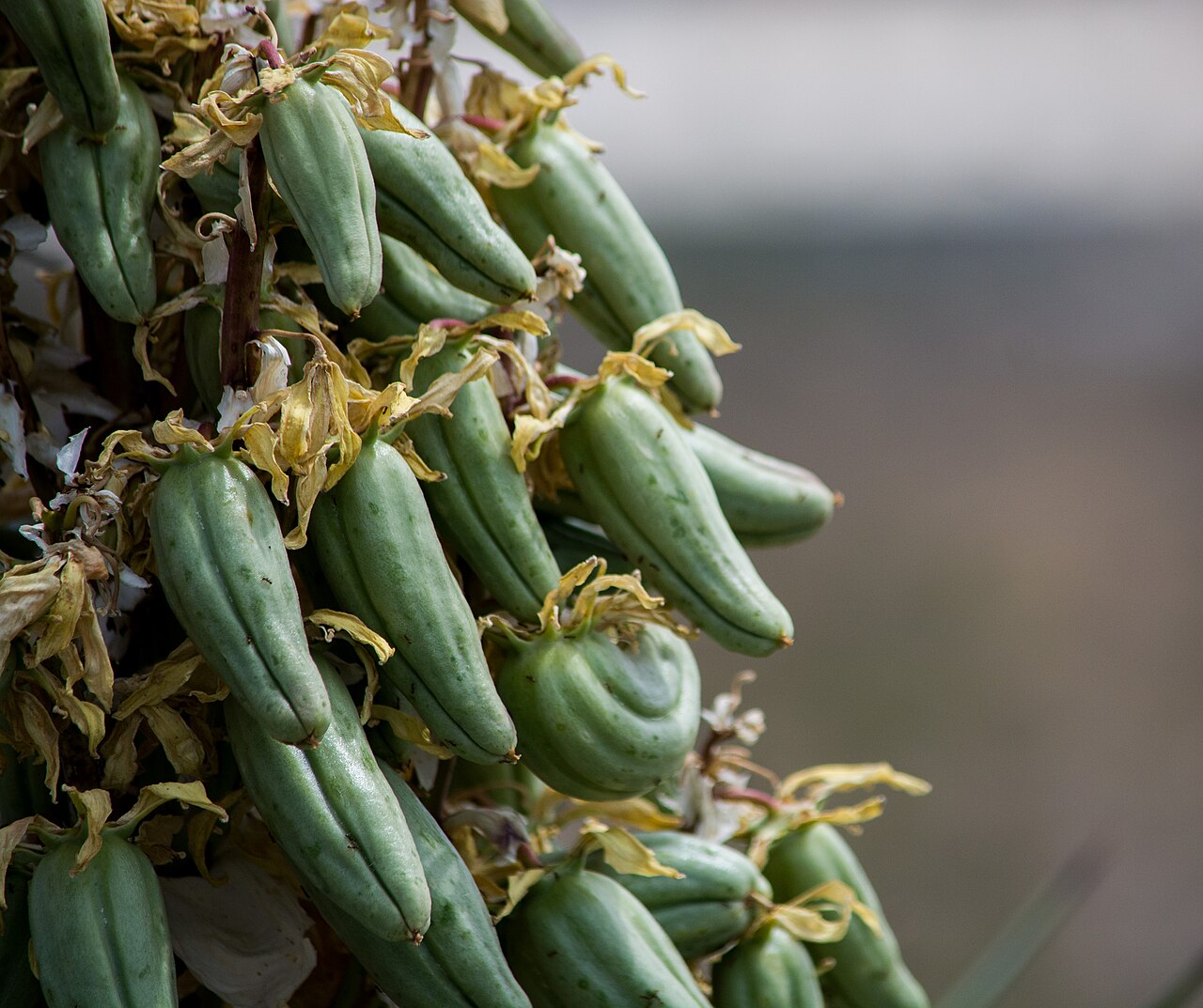
After pollination, Torrey Yucca produces a fleshy, cylindrical fruit 3 to 5 inches long that ripens from green to brown and eventually dries, splitting to release flat black seeds. Unlike the dry capsules of some yuccas, the fruit of Torrey Yucca is semi-fleshy when fresh and was historically eaten after roasting.
Quick Facts
| Scientific Name | Yucca torreyi |
| Family | Asparagaceae (formerly Agavaceae) |
| Plant Type | Evergreen Succulent Shrub/Small Tree |
| Mature Height | 6–15 ft |
| Mature Spread | 4–8 ft, wider with branching age |
| Growth Rate | Slow |
| Sun Exposure | Full Sun |
| Water Needs | Low |
| Soil Type | Rocky, caliche or sandy, well-drained |
| Soil pH | 7.0–8.5 (neutral to alkaline) |
| Bloom Time | March – May |
| Flower Color | Creamy white, often blushed maroon or purple-red |
| Fall Color | None (evergreen) |
| Fruit | Fleshy, cylindrical capsule, green ripening to brown |
| Deer Resistant | Yes (sharp, rigid leaves deter browsing) |
| USDA Hardiness Zones | 7–10 |
Native Range
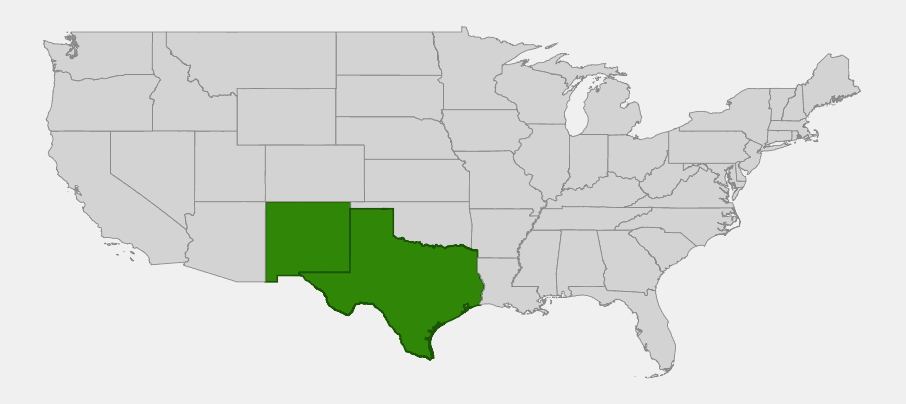
Torrey Yucca is a Chihuahuan Desert species, native to the Trans-Pecos region of far west Texas and extending through south-central and southeastern New Mexico, with its range continuing south into northern Mexico. Within Texas it is most numerous in the Trans-Pecos but also reaches into parts of central Texas, growing alongside related yuccas on limestone hills and desert grassland.
Across this range, Torrey Yucca favors well-drained, rocky or gravelly soils on limestone hillsides, desert grassland flats, and the margins of arroyos and canyons, typically between 2,500 and 6,000 feet elevation. It is a conspicuous component of Chihuahuan Desert scrub and grassland, often growing with sotols, agaves, and other yuccas in classic Big Bend and Guadalupe Mountains plant communities.
Because its native range spans both Texas and New Mexico, Torrey Yucca is appropriate for regional native-plant lists covering the South and West Texas Trans-Pecos as well as Arizona and New Mexico landscapes. Gardeners east of the Trans-Pecos or outside the Chihuahuan Desert region should note this species is not native to those areas and may struggle with excess humidity and poorly drained soils.
📋 Regional plant lists featuring Torrey Yucca: South and West Texas · Arizona & New Mexico
Growing & Care Guide
Torrey Yucca is exceptionally low-maintenance once established, but its eventual size and needle-sharp leaves mean site selection deserves real thought before planting.
Light
Full sun is essential for a compact, healthy rosette and reliable flowering. In shade, Torrey Yucca becomes etiolated and sparse and rarely blooms well.
Soil & Water
This species demands sharp drainage above all else. Rocky, gravelly, or sandy alkaline soils that mimic its native Chihuahuan Desert hillsides are ideal; heavy clay or any soil that stays wet will quickly rot the roots and crown. Established plants need no supplemental irrigation within their native range and should be watered only sparingly, if at all, once roots are established — typically after the first year.
Planting Tips
Plant from containers in spring or fall, siting the plant well away from walkways, patios, and play areas given its eventual size and dagger-sharp leaf tips. Allow at least 6 to 8 feet of clearance in all directions for a mature specimen. Raised beds or slopes improve drainage in gardens with heavier native soil.
Pruning & Maintenance
Torrey Yucca needs essentially no regular pruning. Some gardeners remove the skirt of dead leaves along the trunk for a cleaner look, though leaving it intact provides habitat and matches the plant’s natural wild appearance. Spent flower stalks can be cut back after seed drop if a tidier appearance is desired.
Landscape Uses
Torrey Yucca’s bold architectural form suits a range of xeric landscape roles:
- Specimen or focal point in desert and xeriscape gardens
- Chihuahuan Desert habitat restoration plantings
- Security barrier plantings beneath windows, thanks to its sharp leaves
- Rock gardens paired with agave, sotol, and native grasses
- Erosion control on dry limestone or caliche slopes
- Wildlife gardens supporting specialized native pollinators
Wildlife & Ecological Value
Torrey Yucca is a keystone plant of the Chihuahuan Desert, providing food, shelter, and a highly specialized pollination relationship that supports an entire community of desert wildlife.
For Pollinators
Like other yuccas, Torrey Yucca depends almost entirely on yucca moths for pollination. The moth actively packs pollen onto the flower’s stigma while laying eggs in the ovary, and her larvae later consume a portion of the developing seeds — an obligate mutualism in which neither species can easily reproduce without the other. Other native bees occasionally visit for nectar but contribute little to pollination.
For Birds
The dense, spine-tipped rosette offers excellent predator-proof nesting and roosting cover for desert birds, including cactus wrens and various sparrows, which use the stiff leaves as protection from snakes and other predators.
For Mammals
Javelina, mule deer, and other desert mammals will browse the flower stalks and fruit, which are more palatable than the sharp leaves. Small mammals shelter among the dense leaf bases and beneath the fallen leaf skirt at the trunk base.
Ecosystem Role
As a long-lived, slow-growing structural plant, Torrey Yucca provides vertical habitat structure in otherwise low desert grassland and scrub, and its extensive root system helps stabilize rocky slopes against erosion. Its dependable, heavy spring bloom is an important early-season nectar and pollen resource in an environment where flowering plants can be sparse.
Cultural & Historical Uses
Torrey Yucca has deep historical significance to Indigenous peoples of the Trans-Pecos and Chihuahuan Desert region, including the Mescalero Apache and other groups, who used its tough leaf fibers for cordage, rope, sandals, baskets, and mats. The sharp, rigid leaf tips themselves were sometimes used as natural needles, with the attached fiber serving as thread in a single extracted tool.
The semi-fleshy fruits were historically roasted or dried and used as a food source, and the flower buds and stalks of various Chihuahuan Desert yuccas were likewise prepared and eaten by Indigenous communities. The root of related yucca species contains saponins and was sometimes used as a soap substitute, pounded and agitated in water to produce suds for washing.
Today, Torrey Yucca remains culturally significant to the region and is increasingly valued in xeriscape and native-plant horticulture as an iconic, drought-adapted symbol of the Trans-Pecos and Chihuahuan Desert landscape.
Frequently Asked Questions
How is Torrey Yucca different from Spanish Dagger?
Torrey Yucca (Yucca torreyi) typically has narrower, more rigid leaves with curling marginal fibers and a shrubbier, more branching habit, while Spanish Dagger (Yucca treculeana) tends to have broader leaves and a more single-trunked form. The two species overlap in range and can hybridize, making field identification challenging.
How long does it take Torrey Yucca to develop a trunk?
Trunk development typically begins after several years of growth, with the trunk slowly thickening and sometimes branching over subsequent decades. Growth is slow throughout the plant’s life.
Is Torrey Yucca dangerous to have in the yard?
The leaf tips are extremely sharp and can cause deep puncture wounds, so it should be planted well away from walkways, seating areas, and places children or pets frequent. It is not reported as toxic if accidentally contacted, but the physical injury risk from the spines is real.
Can Torrey Yucca survive cold winters?
Yes, within its native Trans-Pecos and New Mexico range it tolerates winter lows well into the single digits Fahrenheit without protection, reflecting its adaptation to high desert elevations with cold winter nights.
Does Torrey Yucca need a yucca moth to produce seed?
Effectively yes — reliable seed set depends on the specialized yucca moth pollination relationship, so isolated garden specimens far outside the moth’s range may flower abundantly but produce little viable seed.

Looking for a nursery that carries Torrey Yucca?
Browse our native plant nursery directory: Texas · New Mexico