
Turpentine Broom (Thamnosma montana)
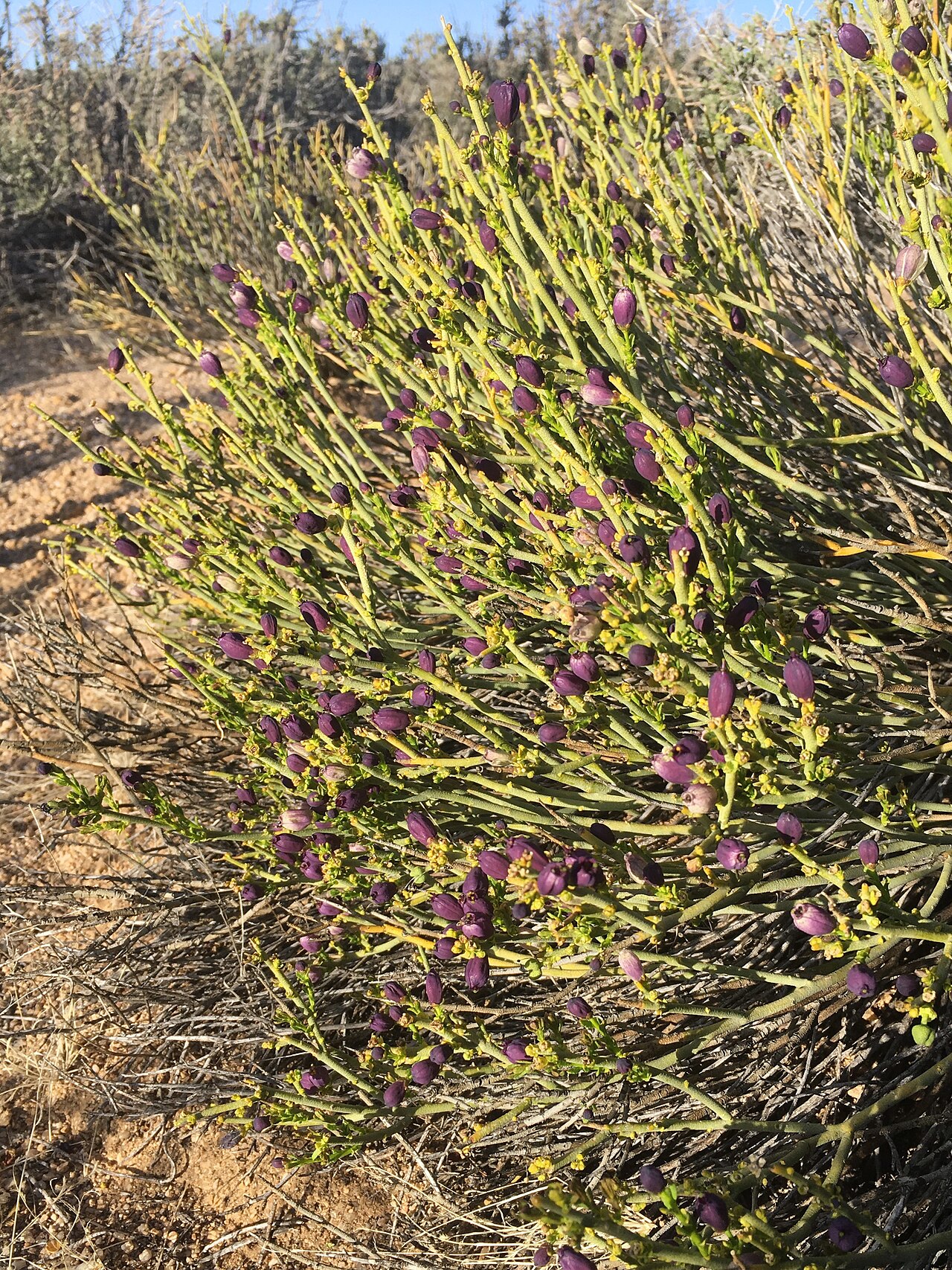
Thamnosma montana, known as Turpentine Broom (USDA: turpentinebroom), is a small, aromatic desert shrub of the Mojave and Sonoran Deserts. It is a member of the citrus family (Rutaceae), and like its relatives it is dotted with oil glands. The stems give off a strong turpentine-like smell when brushed, which explains its common name.
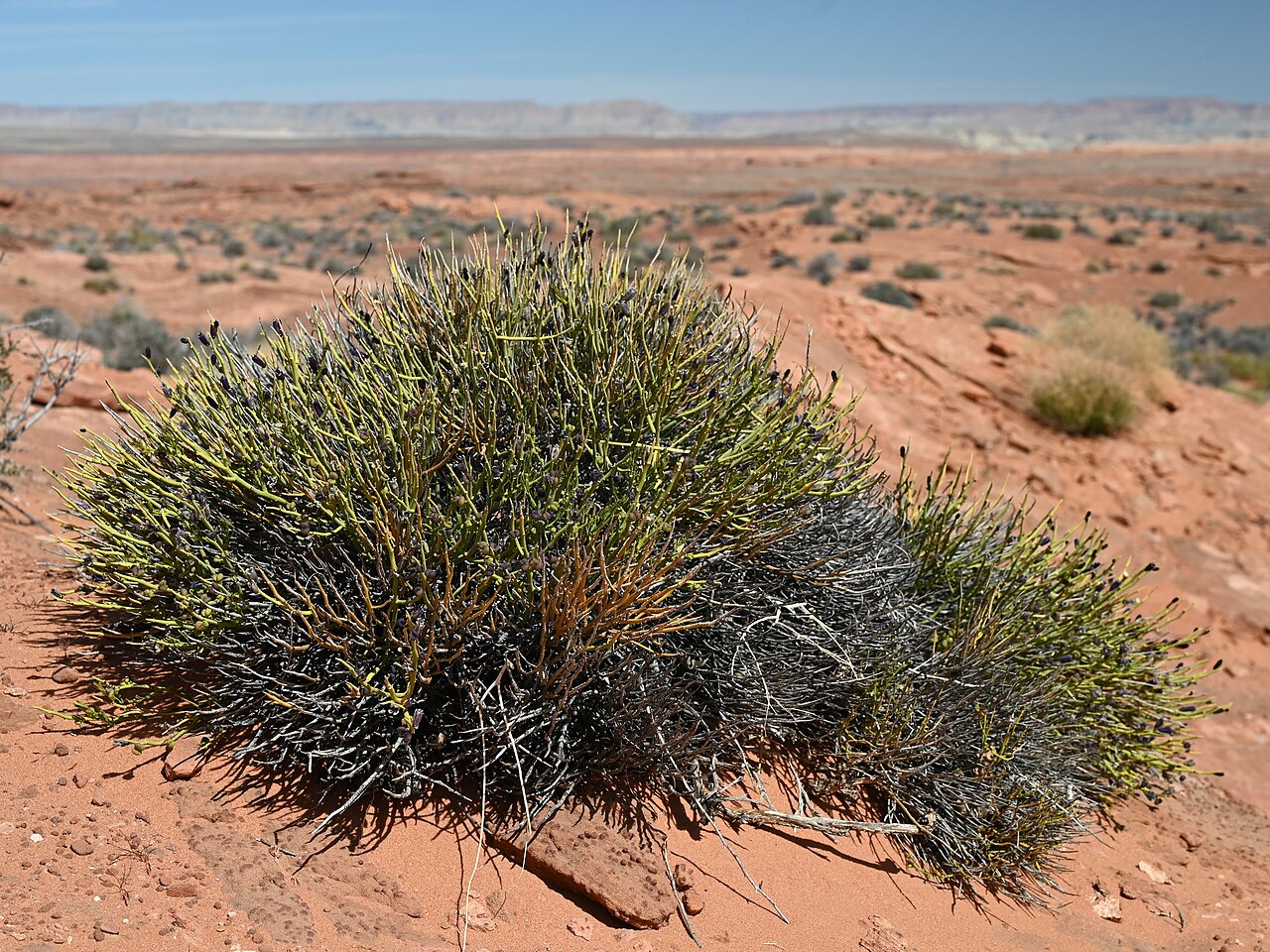
The plant is a rounded clump of slender, yellow-green, nearly leafless stems 1 to 2 feet tall, looking much like a small broom. In late winter and spring it is covered with small, urn-shaped flowers in an unusual deep blue-purple, followed by curious two-lobed fruits. It grows on rocky and gravelly slopes, mesas and washes from southeastern California and southern Nevada to southwestern Utah and western Arizona.
Safety note: turpentine broom contains furanocoumarins and other compounds that can make skin sensitive to sunlight. Handling the stems and then going into the sun can cause redness, blisters and dark patches (phytophotodermatitis). Wear gloves when handling it, do not eat any part of the plant, and keep pets and livestock from grazing it.
Identification
Few desert shrubs are as easy to recognize by smell. Brush the stems and sniff your hand: a sharp, turpentine or citrus-peel odor and green, gland-dotted stems point to turpentine broom.
Growth Habit
A low, rounded, densely branched shrub, usually 1 to 2 feet tall and about as wide, occasionally a little larger. The many upright stems arise from a woody base and do most of the plant’s photosynthesis, a common adaptation of desert shrubs that drop their leaves early.
Stems & Leaves
The stems are slender, yellow-green and covered with small, raised, dark oil glands, like tiny warts. Small, narrow leaves up to about 1/2 inch long appear on new growth after rains but soon fall, leaving the plant almost leafless for most of the year.
Flowers
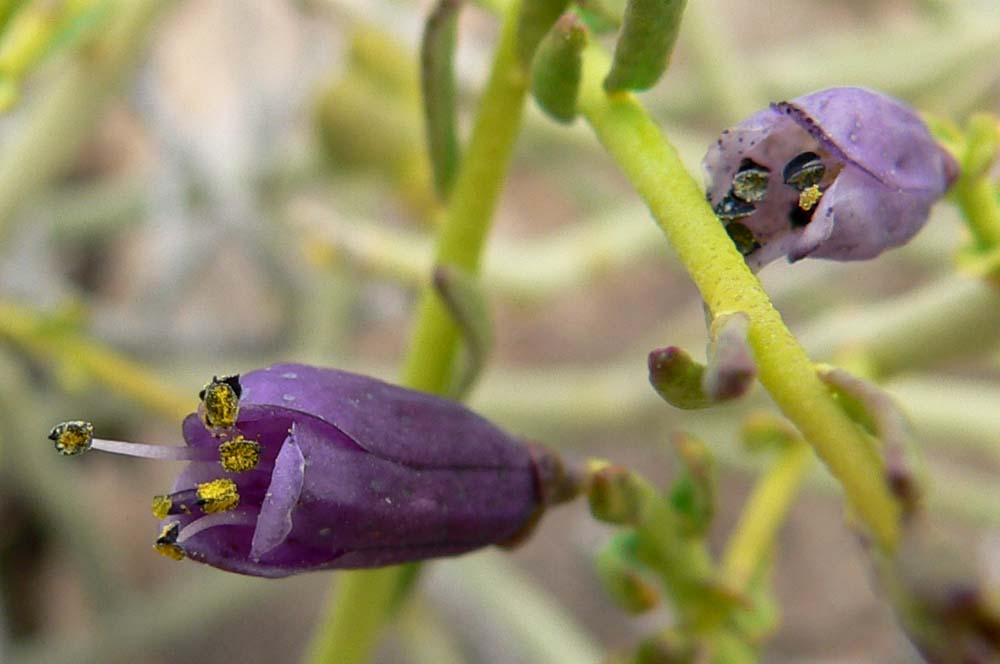
Flowers appear from about February to May, depending on elevation and rainfall. Each is about 1/2 inch long, urn- or bell-shaped, with four thick, dark purple to blue-violet petals that barely open at the tip. Yellow anthers peek out from the mouth of the flower.
Fruit
The fruit is distinctive: a leathery, two-lobed capsule about 1/4 to 1/2 inch across, like two small round balls joined side by side, green turning yellowish-brown. It is dotted with oil glands like the stems and contains a few seeds in each lobe.
Look-alikes
Mormon tea and jointfirs (Ephedra) also have green, broom-like stems but have jointed stems with tiny scale leaves at the nodes, no oil glands and no showy flowers. Desert broom (Baccharis sarothroides) is larger and has white, fluffy seed heads. Rush milkweed (Asclepias subulata) has milky sap.
Safety
Turpentine broom contains furanocoumarins (psoralens) and other irritating compounds. Skin contact followed by sun exposure can cause phytophotodermatitis, a burn-like rash that may blister and leave dark spots. Its relative, Texas desert-rue (Thamnosma texana), is known to cause photosensitization in grazing livestock. Do not eat the plant or use it as a home remedy, wear gloves to prune it, and keep animals from browsing it.
Quick Facts
| Scientific Name | Thamnosma montana |
| Family | Rutaceae (citrus family) |
| Plant Type | Small aromatic shrub, nearly leafless |
| Mature Height | 1–2 ft |
| Mature Spread | 1–2 ft |
| Growth Rate | Slow |
| Sun Exposure | Full sun |
| Water Needs | Very low; drought tolerant |
| Soil Type | Rocky, gravelly or sandy, very well drained |
| Soil pH | About 7.0–8.5 (neutral to alkaline; tolerates limestone) |
| Bloom Time | February–May |
| Flower Color | Dark purple to blue-violet |
| Fall Color | None; green stems all year |
| Fruit | Two-lobed, gland-dotted leathery capsule |
| Deer Resistant | Yes; strongly aromatic and rarely browsed |
| USDA Hardiness Zones | 7–10 |
Native Range
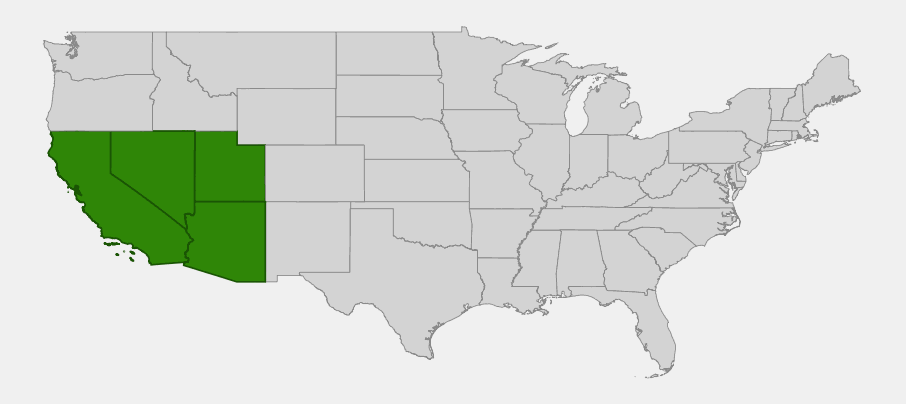
Turpentine broom is native to the Mojave and Sonoran Deserts. USDA PLANTS lists it as native in Arizona, California, Nevada and Utah, and it also extends south into northwestern Mexico. The Lady Bird Johnson Wildflower Center describes its range as southern Nevada, extreme southwestern Utah, southeastern California and scattered parts of the western half of Arizona.
In California it grows across the Mojave Desert and the Colorado Desert, including Joshua Tree National Park, Anza-Borrego Desert State Park and the Mojave National Preserve. In Nevada it is common around the Las Vegas valley and the Spring Mountains. In Utah it is limited to the south, mainly the far southwestern corner around St. George, and in Arizona it is scattered through the western deserts and north to the Grand Canyon region and the sandstone country around Page.
It grows on rocky and gravelly slopes, mesas, alluvial fans and washes, often on limestone or other alkaline soils, usually below about 4,500 feet. Typical companions are creosote bush, white bursage, blackbrush and Joshua tree.
📋 Regional plant lists featuring Turpentine Broom: Utah & Western Colorado · Arizona & New Mexico · California & Nevada
Growing & Care Guide
Turpentine broom is rarely sold, but it is offered occasionally by desert native plant nurseries and seed suppliers. It is best for desert gardens within its native range, where it needs almost no care once established. Handle it with gloves because of its skin-sensitizing oils.
Light
Plant it in full sun. In shade it grows sparse and weak, and it is adapted to the intense light and heat of open desert slopes.
Soil & Water
It needs very fast-draining rocky, gravelly or sandy soil and tolerates alkaline and limestone soils. Water a new plant every week or two through its first warm season, then only occasionally during long droughts. Overwatering and heavy soils quickly cause root rot. No fertilizer is needed.
Planting Tips
Plant small container plants in fall or late winter so roots can grow before summer heat. Space plants 2 to 3 feet apart in a rock garden, on a gravel slope or among boulders. Keep it away from paths where people will brush against it.
Pruning & Maintenance
Little pruning is needed. If a plant becomes leggy, cut a few old stems near the base after flowering, wearing gloves and long sleeves and washing your skin afterward. Avoid summer irrigation once it is established.
Propagation
It is grown from seed. Collect the two-lobed fruits when they turn brown in late spring. Germination can be slow and irregular; sow in a very well-drained mix outdoors in fall or after a few weeks of cold, moist treatment. Cuttings are difficult.
Landscape Uses
- Desert and xeric gardens: a tough, aromatic, nearly leafless accent shrub
- Rock gardens: fits gravel slopes and boulder plantings
- Habitat gardens: larval host for the desert black swallowtail
- Restoration of desert slopes: a native shrub of rocky Mojave and Sonoran sites
- Interpretive plantings: a striking example of an aromatic desert citrus relative
Wildlife & Ecological Value
Despite its harsh oils, turpentine broom supports desert insects, especially butterflies, and its early flowers feed native bees.
For Pollinators
The tubular purple flowers bloom early in the desert spring and are visited by native bees and other small insects that crawl into the flower mouth.
For Birds
It provides small amounts of cover for desert birds and lizards. Its fruits and seeds are not known as an important bird food.
For Mammals
Most mammals avoid its aromatic, irritating stems. Deer and livestock rarely browse it, and grazing animals that eat it may suffer sunlight sensitivity.
Ecosystem Role
Turpentine broom is a key larval host for the desert form of the black swallowtail butterfly (Papilio polyxenes coloro), whose caterpillars feed on its stems and leaves and may take up some of its defensive compounds. It also helps hold soil on rocky slopes and alluvial fans.
Cultural & Historical Uses
Several Indigenous peoples of the Mojave Desert and southern Great Basin used turpentine broom as a medicine, for example in preparations for colds, aches and other complaints. Because of its skin-sensitizing compounds, it should not be used today without expert knowledge.
The genus name Thamnosma comes from Greek words meaning “shrub” and “smell,” a fitting name for these strongly aromatic plants. Thamnosma is one of the few native genera of the citrus family in the deserts of the American Southwest, with relatives in Texas and Mexico and, remarkably, in southern Africa and the Arabian region.
Hikers in Joshua Tree, Death Valley and the Mojave National Preserve often notice turpentine broom first by its smell. Its unexpected dark purple flowers make it one of the more memorable shrubs of the desert spring.
Frequently Asked Questions
Why is it called turpentine broom?
The stems are full of oil glands that release a sharp, turpentine-like odor when touched, and the plant’s green, nearly leafless stems resemble a small broom.
Is turpentine broom poisonous?
It contains furanocoumarins that can cause a sunlight-activated skin rash, and it is not edible. Wear gloves when handling it and keep pets and livestock from eating it.
Is turpentine broom related to citrus?
Yes. It belongs to the citrus family (Rutaceae), and its oil glands and fragrance are family traits.
Which butterfly uses turpentine broom?
It is a host plant for the desert form of the black swallowtail, whose caterpillars feed on the stems.
Can I grow turpentine broom outside the desert?
It needs a hot, dry climate and very well-drained soil. Outside the Southwest deserts it rarely survives wet winters or humid summers.

Looking for a nursery that carries Turpentine Broom?
Browse our native plant nursery directory: Arizona · California · Nevada · Utah