Western Peony (Paeonia brownii)
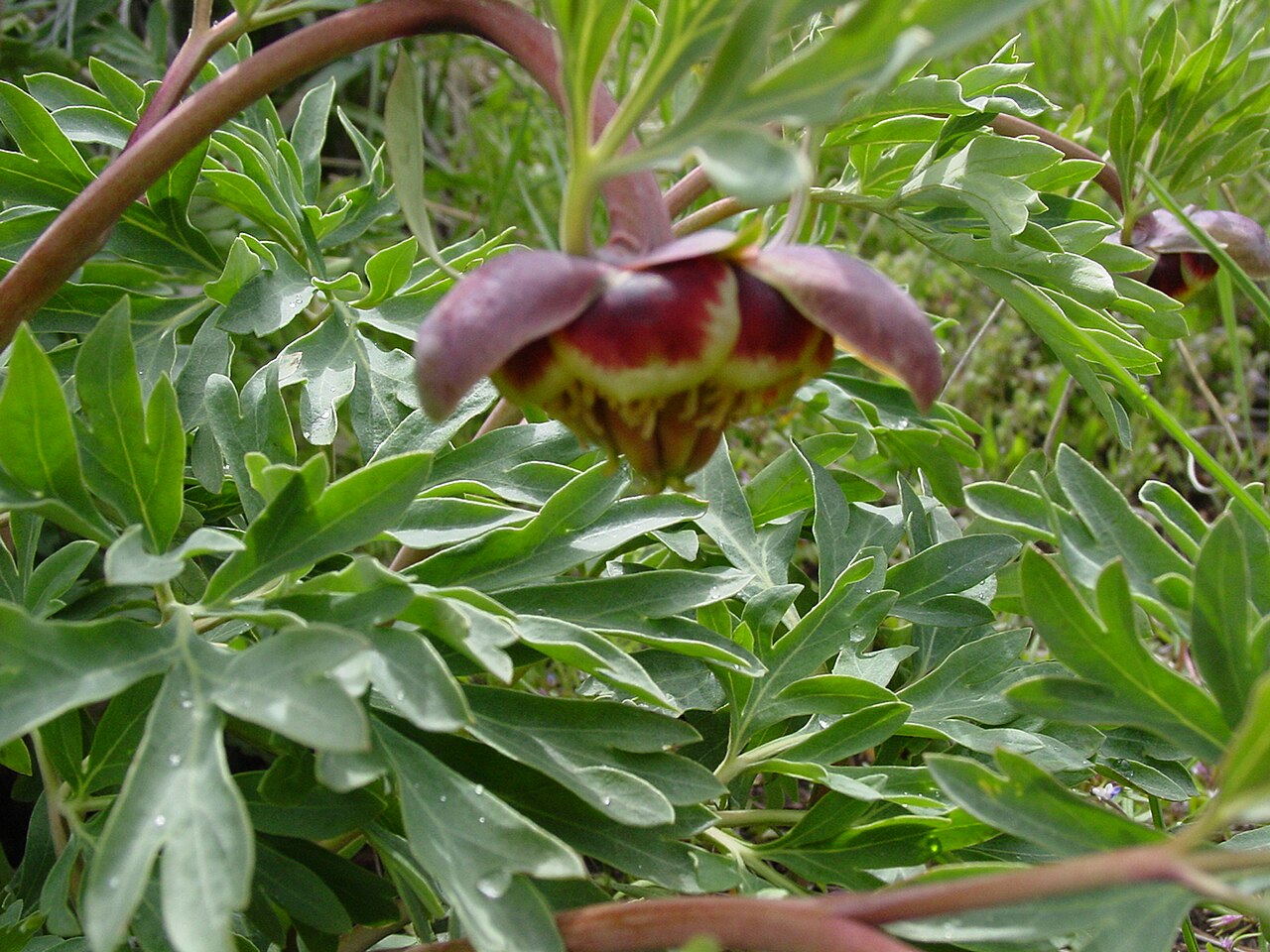
Paeonia brownii, commonly called Western Peony or Brown’s Peony, is a low, clumping wildflower of the dry interior mountains and high desert of the western United States. It is one of only two peony species native to North America — the other being its close relative, the California peony (Paeonia californica) — and together they form a small, isolated section of the genus found nowhere else in the Americas. Most of the roughly 30 peony species worldwide are native to Eurasia, which makes this pair of western natives a botanical curiosity as much as a garden plant.
Unlike the big, blowsy garden peonies sold at nurseries, western peony is a modest plant of open pine woods, sagebrush flats and mountain brush, usually standing well under knee height. Its flowers do not face upward and outward the way a florist’s peony does; instead they nod downward on the stem, cupped and mostly closed, in muted tones of maroon, bronze and greenish-yellow. It is a plant built for a hard climate — long, cold winters, a short growing season and bone-dry summers — and it disappears underground entirely by midsummer, storing everything it needs in a thick, fleshy root to begin again the following spring.
Western peony is rarely offered in the nursery trade and is not well suited to a typical irrigated flower bed, but for a rock garden, a dry slope planting or a naturalistic sagebrush-country landscape, it is a genuinely distinctive native wildflower found nowhere in cultivation at a garden center. It rewards gardeners who can replicate its need for excellent drainage and a long, dry summer rest.
Identification
Western peony is a low, clumping, herbaceous perennial that reaches only about 8 to 16 inches (20–40 cm) tall, with up to ten fleshy, somewhat sprawling stems rising from a single thick rootstock. The whole plant has a smooth, bluish-gray (glaucous) cast that helps distinguish it at a glance from other wildflowers sharing its habitat.
Leaves
Each stem carries five to eight compound, deeply cut leaves that are bluish-green, hairless and somewhat fleshy, often developing a faint purple tinge along the edges in cool weather. The leaflets are oval to inverted-egg shaped, with a noticeably narrowed, stalk-like base — a detail that helps separate western peony from its southern relative, California peony, whose leaflets lack that narrowed base.
Flowers
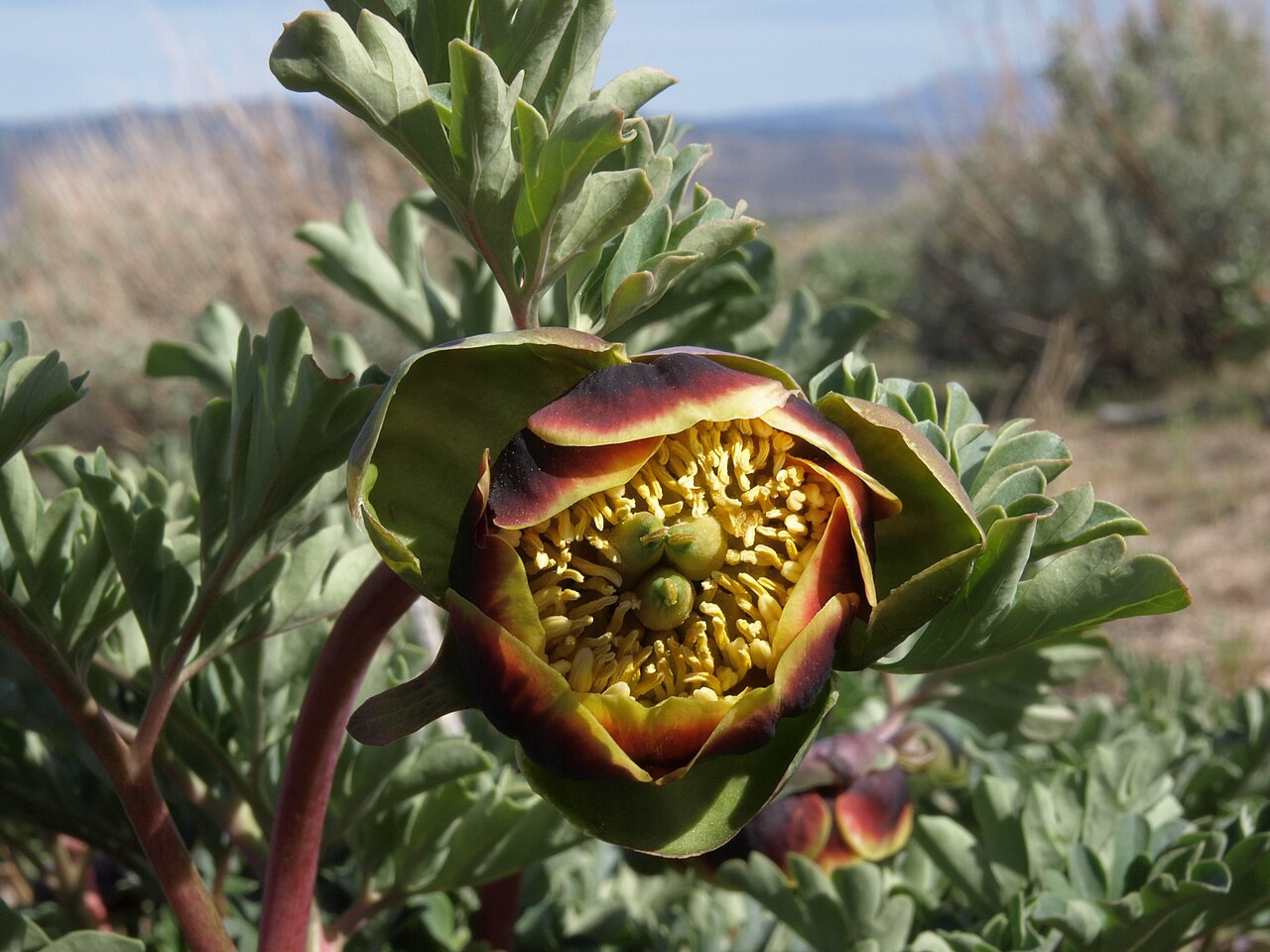
The flowers are cup-shaped, roughly 1 to 1¼ inches (2–3 cm) across when open, and nod singly from the tip of each stem rather than facing outward. Five or six overlapping, purplish-green sepals persist around the bloom, cupping five to ten rounded petals that are shorter than the sepals and grade in color from brownish-maroon at the base through wine-red to a yellowish-green edge. At the center, 60 to 100 yellow stamens open in succession over several days, shedding pollen around a cluster of two to six carpels. Flowering runs from March to June, peaking in mid-April to mid-May, and each individual bloom lasts nine to fifteen days.
Fruit & Dormancy
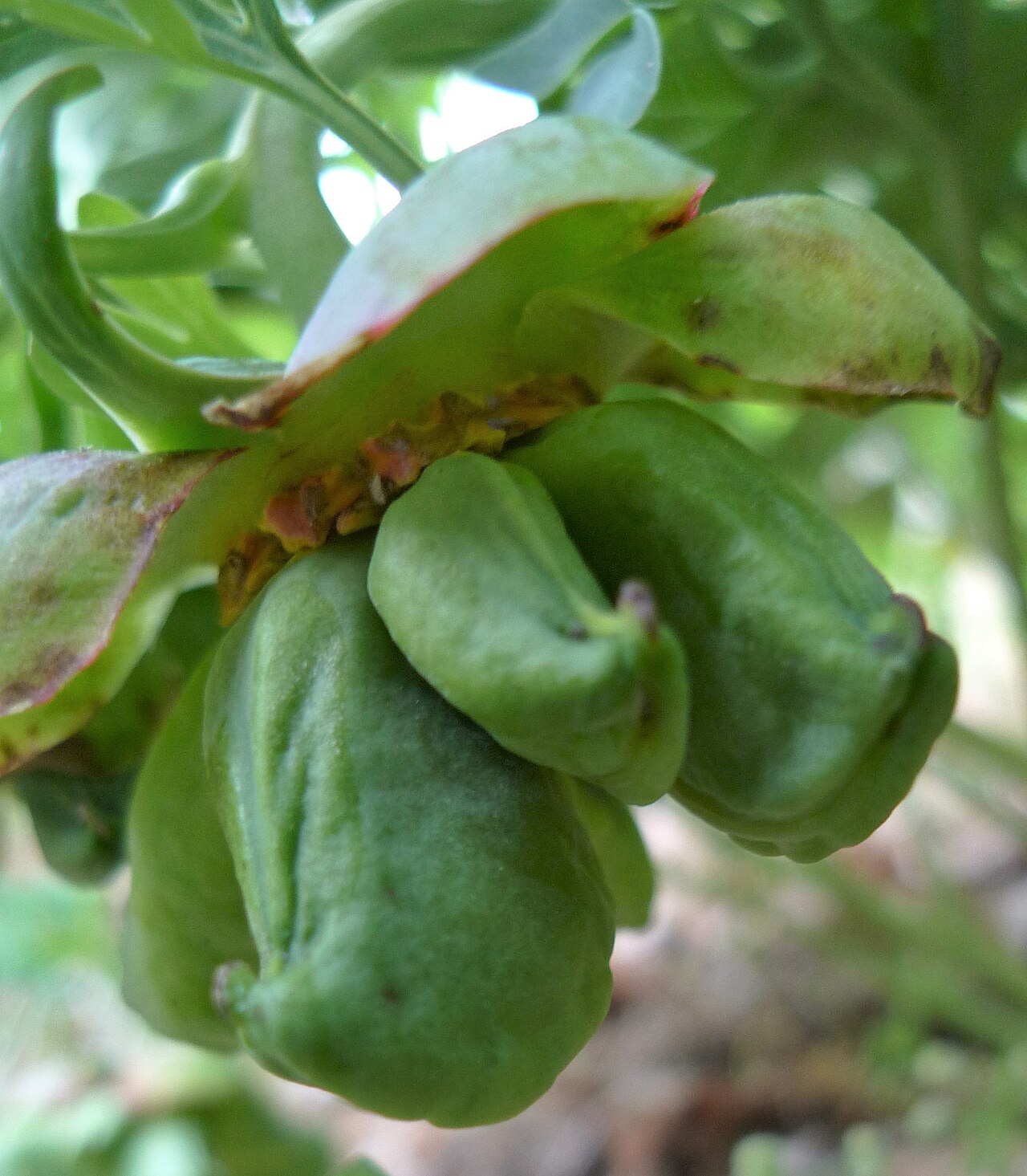
Pollinated flowers develop into plump, leathery, banana-shaped follicles about ¾ to 1½ inches (2–4 cm) long, usually two to six per flower, that split open when ripe to release four or so round to oval seeds per pod, yellowish-brown ripening to black. Soon after fruiting, the entire plant yellows and dies back to the ground, disappearing completely for the rest of summer and fall. If the foliage or roots are bruised, the plant gives off a sharp, unpleasant, bitter odor — a trait that likely discourages browsing.
Quick Facts
| Scientific Name | Paeonia brownii |
| Family | Paeoniaceae (Peony) |
| Plant Type | Herbaceous perennial wildflower, summer-dormant |
| Mature Height | 8–16 in (20–40 cm) |
| Mature Spread | 12–20 in, loose clump of several stems |
| Growth Rate | Slow |
| Sun Exposure | Part Shade to Full Sun |
| Water Needs | Low; needs a dry summer rest, do not irrigate once dormant |
| Soil Type | Well-drained gravelly, sandy or rocky loam |
| Soil pH | About 6.0–7.5 (neutral) |
| Bloom Time | March – June (mostly mid-April to mid-May) |
| Flower Color | Maroon to bronze-red with yellowish-green margins, nodding |
| Fall Color | None; foliage yellows and dies back by early summer |
| Fruit | Leathery brown follicles, 2–4 per flower, ripening midsummer |
| Deer Resistant | Yes; bitter, strong-smelling foliage |
| USDA Hardiness Zones | 4–8 |
Native Range
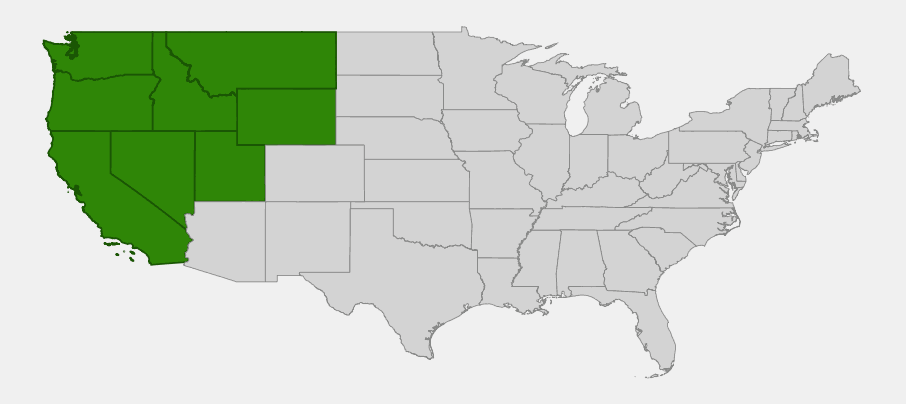
Western peony is native to the interior mountains and high desert of the western United States, occurring in California (mostly the northern two-thirds of the state, including the Sierra Nevada and Klamath ranges), Idaho, Montana, Nevada, Oregon, Utah, Washington and Wyoming. In Washington it is found only east of the Cascade crest, in the drier interior of the state, not in the wetter lowlands west of the mountains. It is not native to Canada; old reports from British Columbia are now understood to be a mix-up between Vancouver, Washington, and Vancouver, BC.
Typical habitat is open, dry pine forest — especially ponderosa pine — along with sagebrush steppe, mountain brush and aspen stands, from about 650 to 9,800 feet (200–3,000 m) in elevation, wherever winters are long and cold and the growing season is short. It tends to grow as scattered undergrowth in part shade rather than forming dense colonies. The species is particular about drainage: it does poorly in soil that stays wet, but it also will not thrive if the soil becomes too dry during the growing season, so it is most often found on well-drained slopes and benches rather than true desert flats.
Common habitat associates across its range include big sagebrush, ponderosa pine, quaking aspen and arrowleaf balsamroot, along with redstem ceanothus, mountain snowberry and a variety of native bunchgrasses and spring wildflowers that share the same dry, open ground.
📋 Regional plant lists featuring Western Peony: Idaho, Eastern Oregon & Eastern Washington · Montana & Wyoming · Utah & Western Colorado · California & Nevada
Growing & Care Guide
Western peony is not a plant for a conventional, regularly watered flower border. It is best suited to dry-climate gardeners trying to recreate a sagebrush-country or mountain-foothill look, where its very particular needs for drainage and a dry summer rest can be met. It is slow to establish and slow to flower from seed, so patience is part of growing it.
Light
In the wild, western peony typically grows as scattered undergrowth beneath an open pine canopy or among shrubs, so it generally does best with some part-day shade, especially in hotter, lower-elevation gardens. It will also grow in full sun at higher, cooler elevations similar to its natural range, as long as the soil never stays soggy.
Soil & Water
Excellent drainage is the single most important requirement. Plant it in gravelly, sandy or rocky loam rather than heavy clay, and avoid any site that collects water after rain or irrigation. Western peony needs regular moisture only during its brief spring growth and bloom period; once the foliage begins to yellow in early summer, the plant wants to be left completely dry until the following spring. Summer watering, even incidental overspray from a nearby lawn or bed, can rot the fleshy roots and kill the plant — this is the most common reason it fails in cultivated gardens.
Planting Tips
Because of its sensitivity to summer moisture, western peony is best planted on a dry slope, in a rock garden, or among other dry-summer natives rather than near irrigated lawn or perennial beds. Plant container-grown specimens or divisions in fall, giving the roots time to settle before spring growth begins. Raised beds or berms with coarse, mineral soil can help replicate the fast drainage of its native rocky ground in gardens with heavier native soil.
Pruning & Maintenance
Little maintenance is needed beyond leaving the plant alone during its summer dormancy. Once the foliage yellows and collapses, it can be cut back or simply left to dry in place; avoid digging or disturbing the dormant root. The plant needs no fertilizer and is rarely bothered by pests or disease, in part because of its bitter, strongly scented foliage.
Landscape Uses
- Dry rock gardens paired with other true drought-dormant natives
- Sagebrush-steppe and high-desert native plantings alongside big sagebrush
- Open woodland gardens beneath thinned conifers, especially near ponderosa pine
- Collector and native-plant specialty gardens, since it is rarely seen in cultivation
- Interpretive or restoration plantings in its native dry-mountain habitat type
Wildlife & Ecological Value
Western peony is a minor but genuine contributor to the wildflower communities of dry western mountains, flowering early enough in spring to provide nectar and pollen before many later-blooming species appear.
For Pollinators
The nodding flowers, with their ring of 60 to 100 yellow stamens, are visited by native bees and other insects that work their way into the cupped blooms for pollen. Because the flowers open and shed pollen gradually over several days, they provide a sustained, if modest, nectar and pollen source during the plant’s brief bloom window in spring.
For Herbivores
The bitter, strongly scented foliage and roots discourage most browsing, which is one reason the plant is considered deer resistant. Documented insect feeders are limited, though caterpillars of a few moth species, including dark gray dart moths in the genus Euxoa, have been recorded feeding on western peony where their ranges overlap.
Ecosystem Role
As an early-emerging, summer-dormant perennial, western peony occupies a niche shared by many dry-climate spring ephemerals: it completes its above-ground growth, flowering and fruiting in the brief window of spring soil moisture, then retreats underground to avoid the harsh, dry summer that follows. This life cycle helps stabilize soil on the dry slopes and benches where it grows, alongside the grasses, sagebrush and other perennials that make up the same plant community.
Cultural & Historical Uses
Western peony has a documented history of use among Indigenous peoples of the interior Northwest. Northwestern tribes historically prepared a tea from the roots and used it as a treatment for lung ailments and related respiratory complaints. The genus name Paeonia itself comes from Paeon, the physician to the gods in Greek mythology, reflecting a long association between peonies and healing across very different cultures and continents.
These traditional root preparations are a matter of historical and ethnobotanical record rather than a current recommendation; peony roots and other plant parts have not been evaluated for safety as a home remedy, and self-medicating with wild-harvested plant material carries real risk. Western peony is also uncommon enough in the wild, and slow enough to establish from seed, that it should never be dug or harvested from natural populations — any interest in growing it should be met with nursery-propagated stock or seed from a reputable native plant source, not wild collection.
Frequently Asked Questions
Is western peony the same as garden peonies sold at nurseries?
No. The large, fragrant peonies sold for cut-flower gardens are mostly Paeonia lactiflora hybrids and tree peony cultivars native to Asia. Western peony is a much smaller, wild, nodding-flowered species native to dry western mountains, and it is almost never sold at conventional nurseries. See our guide to growing garden peonies if you are looking for the showier cultivated types, or our roundup of white peony varieties for pale-flowered garden selections — neither applies directly to this wild native species, but both explain the care that cultivated peonies need, which is quite different from western peony’s dry-summer requirements.
How is western peony different from California peony?
The two are each other’s closest relatives and the only peonies native to North America. Western peony has glaucous, blue-green leaves with leaflets that narrow abruptly into a stalk-like base, stays under about 16 inches tall, and ranges across the interior Northwest and Great Basin. California peony has greener, non-glaucous leaves without that narrowed leaflet base, grows taller (to about 30 inches), and is confined to the coastal mountains and chaparral of central and southern California, where it blooms earlier, from winter into spring.
Can I grow western peony in a regular garden bed?
Not successfully in most cases. It needs sharp drainage and an absolutely dry summer dormancy; a bed that gets regular irrigation for other plants will rot its roots. It is best reserved for dedicated dry gardens, rock gardens or native plantings where no summer water reaches it.
Why does my western peony disappear in summer?
This is normal, not a sign of a dying plant. Western peony is summer-dormant: after flowering and setting seed in late spring, the foliage yellows and dies back completely, and the plant survives underground on its fleshy root until the following spring. Resist the urge to water it during this dormant period.
Is western peony toxic?
Like other peonies, the foliage, roots and seeds are bitter and are not used as food. Peony plant parts can cause stomach upset if eaten in quantity, so it should not be treated as an edible plant; keep an eye on children and pets around any peony planting.

Looking for a nursery that carries Western Peony?
Browse our native plant nursery directory: California · Idaho · Montana · Nevada · Oregon · Utah · Washington · Wyoming