Western Roseroot (Rhodiola integrifolia)
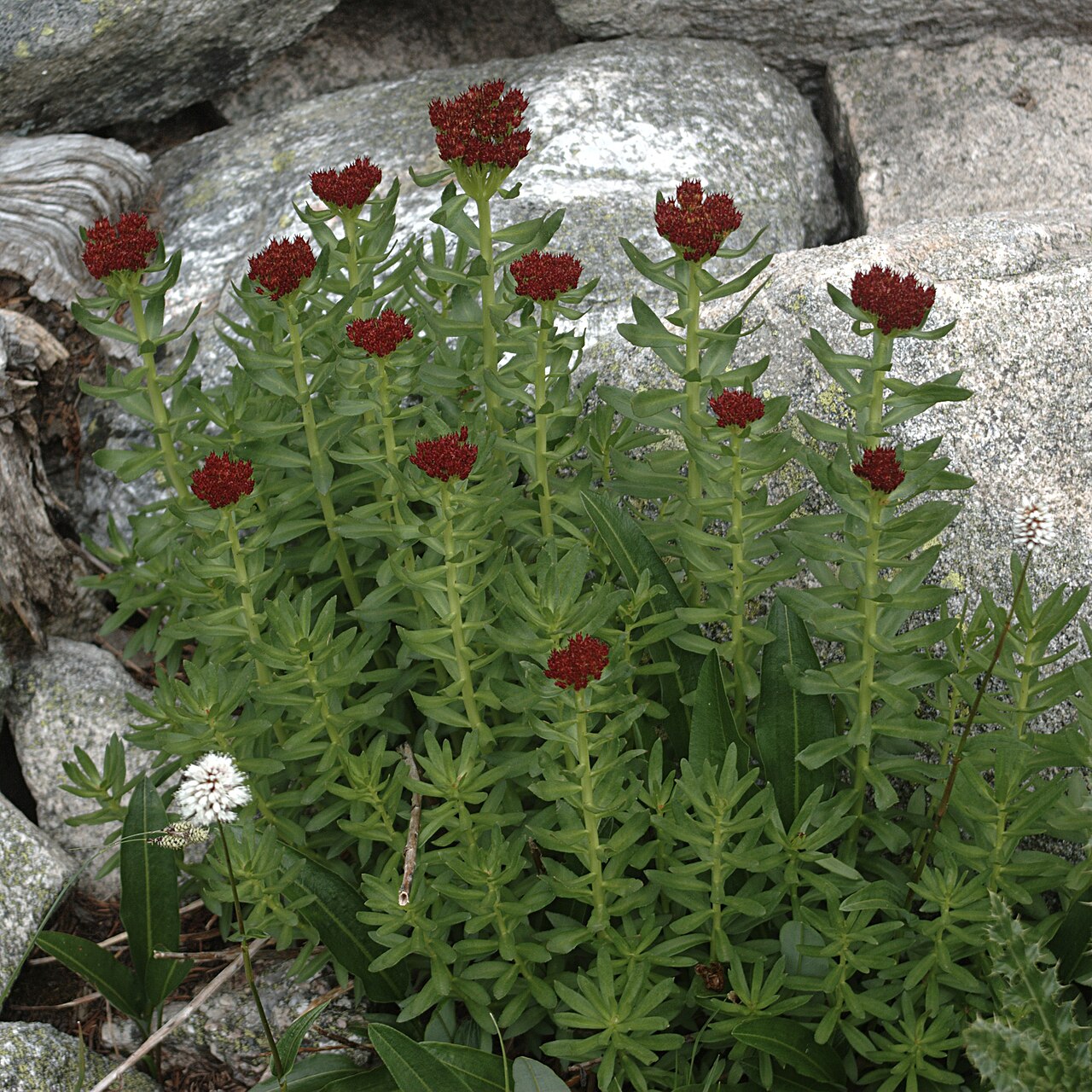
Rhodiola integrifolia, commonly known as Western Roseroot (also called ledge stonecrop or king’s crown), is a striking succulent perennial of alpine and subalpine mountains across western North America. It belongs to the stonecrop family (Crassulaceae) along with the Sedum species, and shares their thick, water-storing leaves and love of rocky, well-drained sites — but western roseroot stands out with dense, dark red to maroon flower clusters that top upright, fleshy stems, often blooming amid some of the most dramatic alpine scenery in the Rockies, Sierra Nevada, and Cascades.
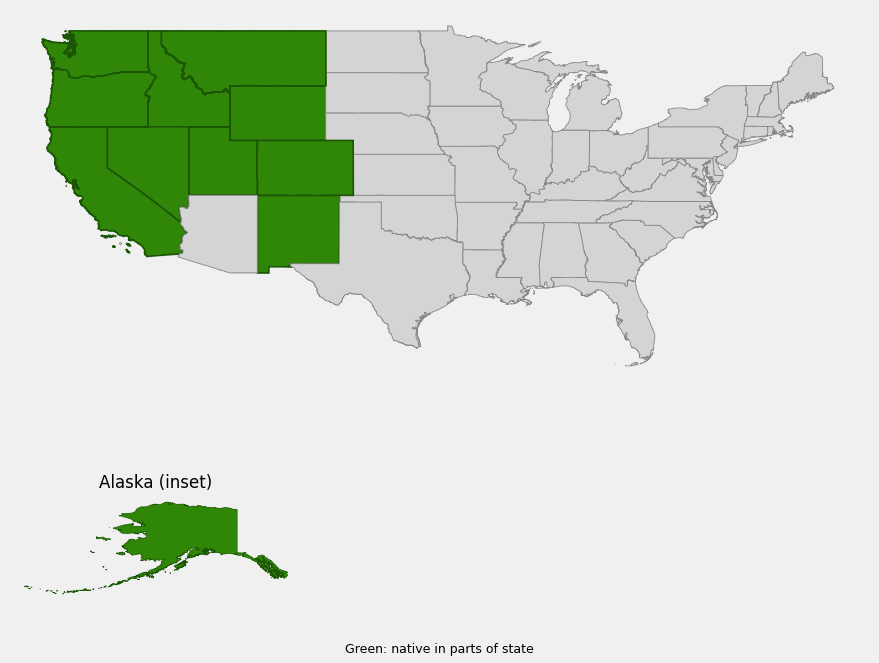
The species gets the “roseroot” name from its thick, branching rhizome, which is said to smell faintly of roses when freshly cut — a trait shared with its Old World relative Rhodiola rosea, long used in traditional herbal preparations in Europe and Asia. Western roseroot itself grows in cliff crevices, talus slopes, and wet alpine meadows from Alaska south through the high peaks of California, Nevada, Utah, Colorado, and into a small, isolated population in the mountains of New Mexico.
For gardeners at higher elevations or anyone building an alpine or rock garden that can mimic cool, moist, rocky conditions, western roseroot offers a genuinely striking native alternative to garden-center sedums — bold foliage, a dramatic early-summer bloom, and real toughness once it is sited correctly. It is not an easy plant for hot, dry lowland gardens, but where conditions suit it, few native succulents make as strong a visual statement.
Identification
Western roseroot is an upright, clump-forming succulent perennial, typically reaching 4 to 12 inches tall, occasionally more in favorable sites, growing from a stout, branching caudex (a woody base at or near the soil surface).
Growth Habit
Multiple fleshy stems arise each year from the thick caudex, standing upright rather than sprawling, giving the plant a more structured, almost shrubby look compared to many mat-forming stonecrops. Clumps slowly widen over years as the caudex branches, but the plant never becomes aggressive or weedy.
Leaves
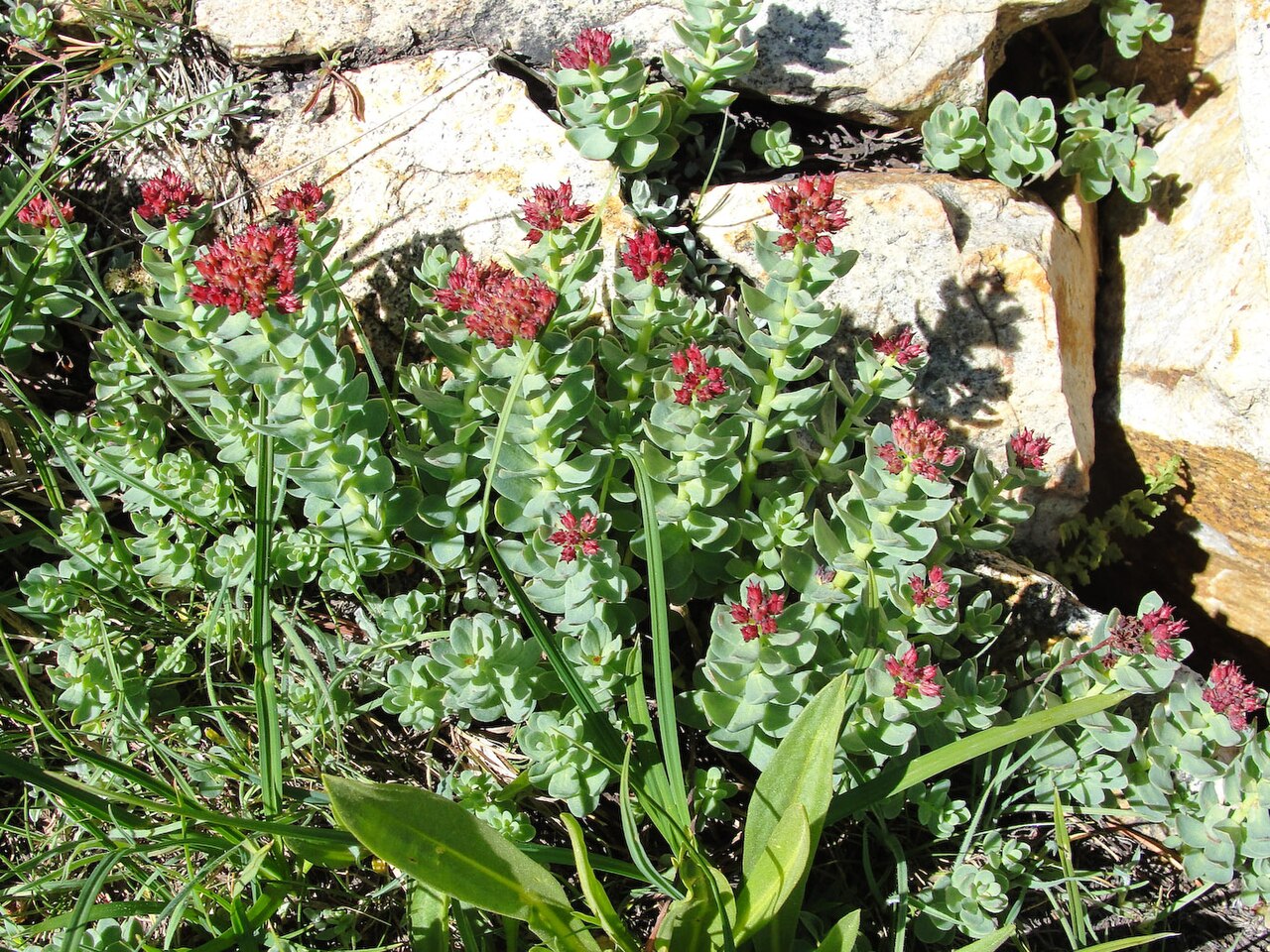
Leaves are thick, fleshy, and alternately arranged along the stems, widely lance-shaped to oval and pointed, flat but curving slightly upward toward the tip, reaching about an inch long. New leaves emerge green and often age to striking shades of orange, rose, or red as the season progresses, adding ornamental interest well after bloom.
Flowers
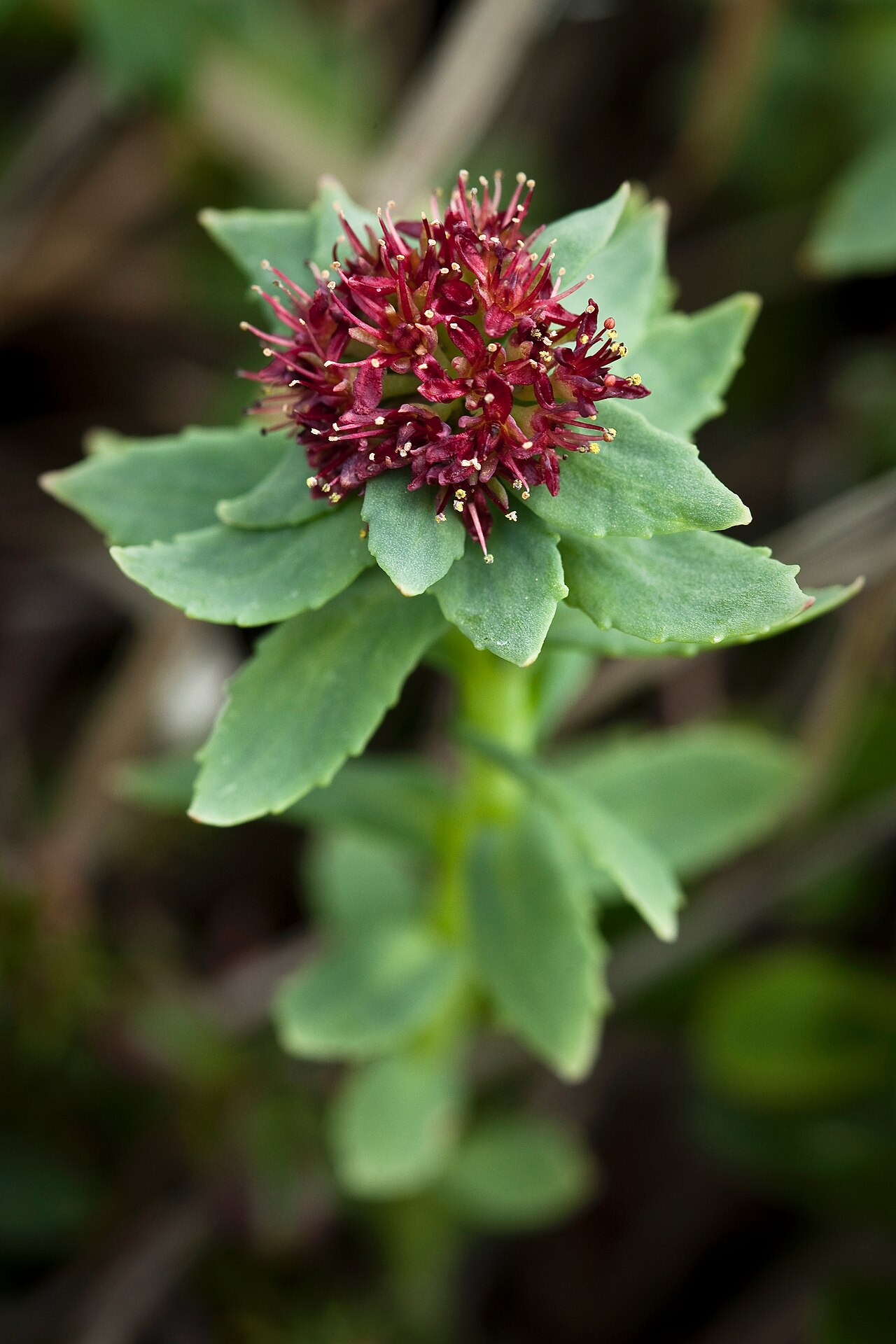
From June into August depending on elevation and snowmelt timing, each stem is topped by a dense, rounded to slightly flattened cyme crowded with up to 50 small flowers in shades of bright red to deep maroon-purple, with petals that are fleshy rather than papery. The effect from a distance is a cluster of deep red “crowns” rising above the foliage — distinctive enough among alpine wildflowers that it is rarely confused with anything else in its range.
Fruit & Seeds
Flowers mature into small, red, rounded fruits with pointed tips (follicles), which split to release fine seed by late summer. The reddish fruiting heads can be nearly as showy as the flowers themselves and often persist into early fall.
Quick Facts
| Scientific Name | Rhodiola integrifolia (syn. Sedum integrifolium, Sedum rosea subsp. integrifolium) |
| Family | Crassulaceae (Stonecrop) |
| Plant Type | Succulent Perennial |
| Mature Height | 4–12 in |
| Mature Spread | 6–12 in, slowly clumping |
| Growth Rate | Slow |
| Sun Exposure | Full Sun to Part Sun |
| Water Needs | Moderate; more than most stonecrops |
| Soil Type | Rocky, gravelly, humus-flecked; good drainage with consistent moisture |
| Soil pH | 5.5–7.0 |
| Bloom Time | June – August (elevation dependent) |
| Flower Color | Dark red to maroon-purple |
| Fall Color | Foliage ages to orange, rose, or red |
| Fruit | Small red, pointed follicles |
| Deer Resistant | Yes |
| USDA Hardiness Zones | 2–7 |
Native Range
Western roseroot is a circumboreal-affiliated alpine species, with its North American range running from Alaska south through the coastal and interior mountains of British Columbia into Washington, Oregon, California, Nevada, Idaho, Montana, Wyoming, Utah, and Colorado, with a disjunct subspecies reaching the Sacramento Mountains and Sierra Blanca of southern New Mexico. Across this range it is a true high-mountain plant, found almost exclusively in subalpine and alpine zones where snow lingers into early summer.
Typical habitat is cliff faces, rock ledges, talus slopes, and wet alpine meadows and seeps, often rooted directly in rock crevices where a bit of soil and moisture accumulate — exactly the conditions suggested by one of its common names, ledge stonecrop. It frequently grows alongside other classic alpine wildflowers such as alpine spring beauty and bistort, forming small but vivid patches of color against gray granite or basalt.
Botanists also recognize a very different side of this species’ range: a vanishingly rare, federally protected subspecies, Rhodiola integrifolia ssp. leedyi, that survives as a handful of relict populations on cold, glacier-chilled cliff faces in southeastern Minnesota and upstate New York — far outside the main western mountain range and far too rare and legally protected for garden use. This guide covers the common western mountain form of the species, which is the one gardeners in the Rocky Mountain and Pacific states are likely to encounter and may responsibly grow from nursery-propagated stock.
📋 Regional plant lists featuring Western Roseroot: Alaska · Western Oregon & Western Washington · Idaho, Eastern Oregon & Eastern Washington · California & Nevada · Utah & Western Colorado · Montana & Wyoming · Arizona & New Mexico
Growing & Care Guide
Western roseroot is a plant for gardeners who can offer cool roots, excellent drainage, and more consistent moisture than most garden sedums want — think alpine trough, rock garden seep, or a cool, high-elevation yard rather than a hot lowland xeriscape bed. Reviewing a broader regional plan in our guides to drought-tolerant native plants for Utah or drought-tolerant native plants for Colorado can help place it alongside appropriate companions in a mountain garden.
Light
Full sun is ideal at higher, cooler elevations, but in warmer lowland gardens within its native states, afternoon shade or a cool, east-facing exposure will reduce heat stress and extend the bloom.
Soil & Water
Give it a gritty, rocky soil with good drainage, but unlike many stonecrops, do not let it dry out completely — in the wild it is frequently found near seeps, snowmelt channels, or in crevices that stay slightly moist even after surrounding rock has dried. A rock garden pocket with extra organic matter worked into an otherwise gritty mix suits it well, and it benefits from supplemental water during hot, dry spells, particularly at lower elevations.
Planting Tips
Plant in spring once the ground has warmed, siting it in a rock crevice, raised bed, or alpine trough where roots can run into cool, slightly moist pockets between stones. It performs best in climates with cool summer nights; gardeners in hot, humid, or low-elevation sites outside its natural comfort zone may find it short-lived.
Pruning & Maintenance
Minimal. Spent flower stalks can be cut back after bloom, and the clump otherwise needs no regular pruning. Established plants are long-lived and need little intervention beyond occasional watering in dry spells.
Propagation
Divide established clumps in early spring, separating sections of the caudex with roots attached. Seed can also be collected from the dried follicles and sown on gritty, slightly moist mix, though germination can be slow and uneven.
Landscape Uses
- Alpine and rock gardens with cool, gritty, moisture-retentive pockets
- Rock crevice and trough plantings
- High-elevation native plant collections
- Accent plant for its dramatic red flower clusters and colorful foliage
- Pollinator gardens at higher elevation sites
Wildlife & Ecological Value
In the sparse, resource-poor alpine zones where it grows, western roseroot is a disproportionately important plant for pollinators and a visible part of the short, intense alpine growing season.
For Pollinators
The dense red flower clusters attract native bees, flies, and butterflies that work the alpine zone during its brief summer window, offering a concentrated, high-visibility nectar source in a landscape where blooming plants are often small and widely scattered.
For Birds
While not a major bird food plant, the fruiting heads and surrounding vegetation provide limited foraging opportunities for alpine-associated songbirds during the short high-elevation summer.
For Mammals
Pikas, marmots, and other alpine mammals may browse the succulent foliage opportunistically, though it is not a primary forage species; its rocky, often inaccessible habitat limits heavy grazing pressure from larger herbivores.
Ecosystem Role
As one of relatively few vascular plants able to establish directly in rock crevices and talus at high elevation, western roseroot contributes to early soil development and microhabitat creation in otherwise barren alpine rock, and its presence often signals a site with just enough moisture retention to support a slightly richer alpine plant community nearby.
Cultural & Historical Uses
The genus Rhodiola has a long history of traditional use in Europe and Asia, particularly the Old World species Rhodiola rosea, whose root has been used in Scandinavian, Russian, and Central Asian folk traditions for centuries. Western roseroot’s thick rhizome shares the mildly rose-scented quality that gives the genus its common name, and botanical and ethnobotanical literature suggests some Indigenous peoples across its North American range were familiar with the plant, though specific, well-documented traditional uses of this particular western species are less thoroughly recorded than those of its Eurasian relative.
Mountaineers, alpine botanists, and wildflower enthusiasts have long prized western roseroot as one of the most visually striking plants of the high peaks it grows on, frequently noted in historical accounts of alpine flora from the Sierra Nevada to the Rockies for its bold color against stark granite and talus.
Today its significance is largely horticultural and botanical rather than historical — valued by alpine garden enthusiasts and native plant societies as a dramatic, hardy succulent suited to cold, rocky gardens, and studied by botanists interested in the remarkable disjunct populations, such as the federally protected relict subspecies far to the east in Minnesota and New York.
Frequently Asked Questions
Is western roseroot the same plant as the “rhodiola” sold as an herbal supplement?
No. Commercial rhodiola supplements are almost always derived from the Eurasian species Rhodiola rosea, not the North American western roseroot (Rhodiola integrifolia) covered here. This page describes the plant purely as a native wildflower and garden plant, not as a supplement source.
Can I grow western roseroot in a lowland garden?
It can be grown outside true alpine elevations if given cool roots, good drainage, and protection from intense summer heat, but it generally performs best, and lives longest, in cooler mountain climates similar to its native habitat.
Why does my plant need more water than other sedums?
Unlike many drought-adapted stonecrops, western roseroot naturally grows near seeps, snowmelt channels, and moist rock crevices, so it tolerates and even prefers more consistent moisture than typical rock-garden sedums.
Is the rare Minnesota/New York population the same plant I can buy for my garden?
No. That population belongs to a distinct, exceedingly rare, and federally protected subspecies (ssp. leedyi) restricted to a few relict cliff sites far outside the species’ main western range. It should never be collected and is not part of the horticultural trade; garden plants come from the common western mountain form described here.
When is the best time to see it blooming in the wild?
Bloom timing tracks snowmelt and ranges from June at lower subalpine elevations to as late as August on the highest alpine ridges, so timing a hike to see it in flower depends heavily on elevation and that year’s snowpack.

Looking for a nursery that carries Western Roseroot?
Browse our native plant nursery directory: Alaska · Washington · Oregon · California · Nevada & New Mexico · Idaho · Montana · Wyoming · Utah · Colorado