
White-Flowered Rhododendron (Rhododendron albiflorum)
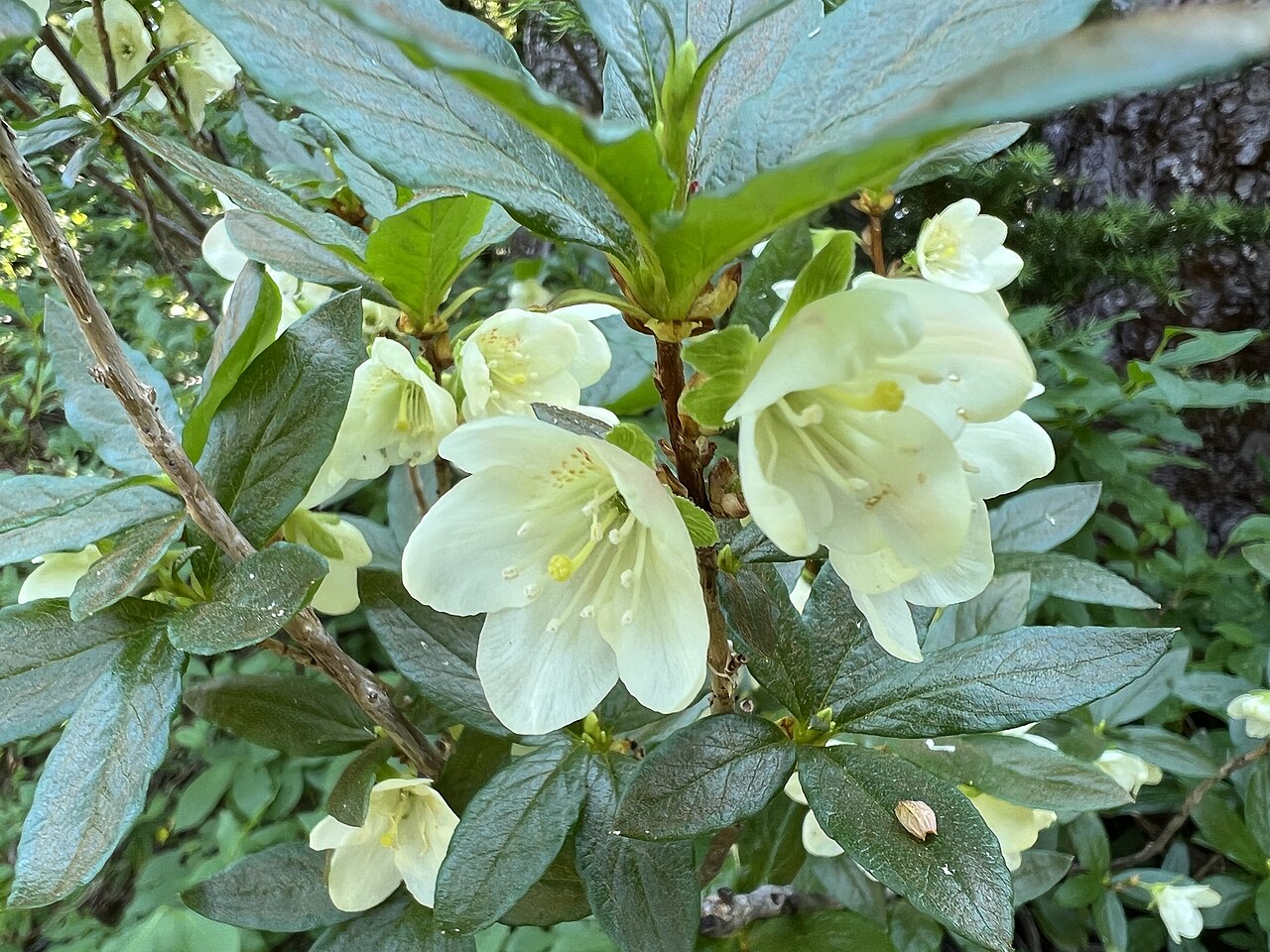
Rhododendron albiflorum, known as White-Flowered Rhododendron, white rhododendron or Cascade azalea, is a deciduous shrub of the heath family (Ericaceae) that grows in cool, snowy subalpine forests of the Pacific Northwest and the northern Rocky Mountains. It usually grows 3 to 6 feet tall, with slender, upright branches, clusters of thin, bright green leaves at the branch tips, and in early to midsummer, cup-shaped, creamy white flowers about an inch across. In fall the leaves turn bronze, orange and crimson.
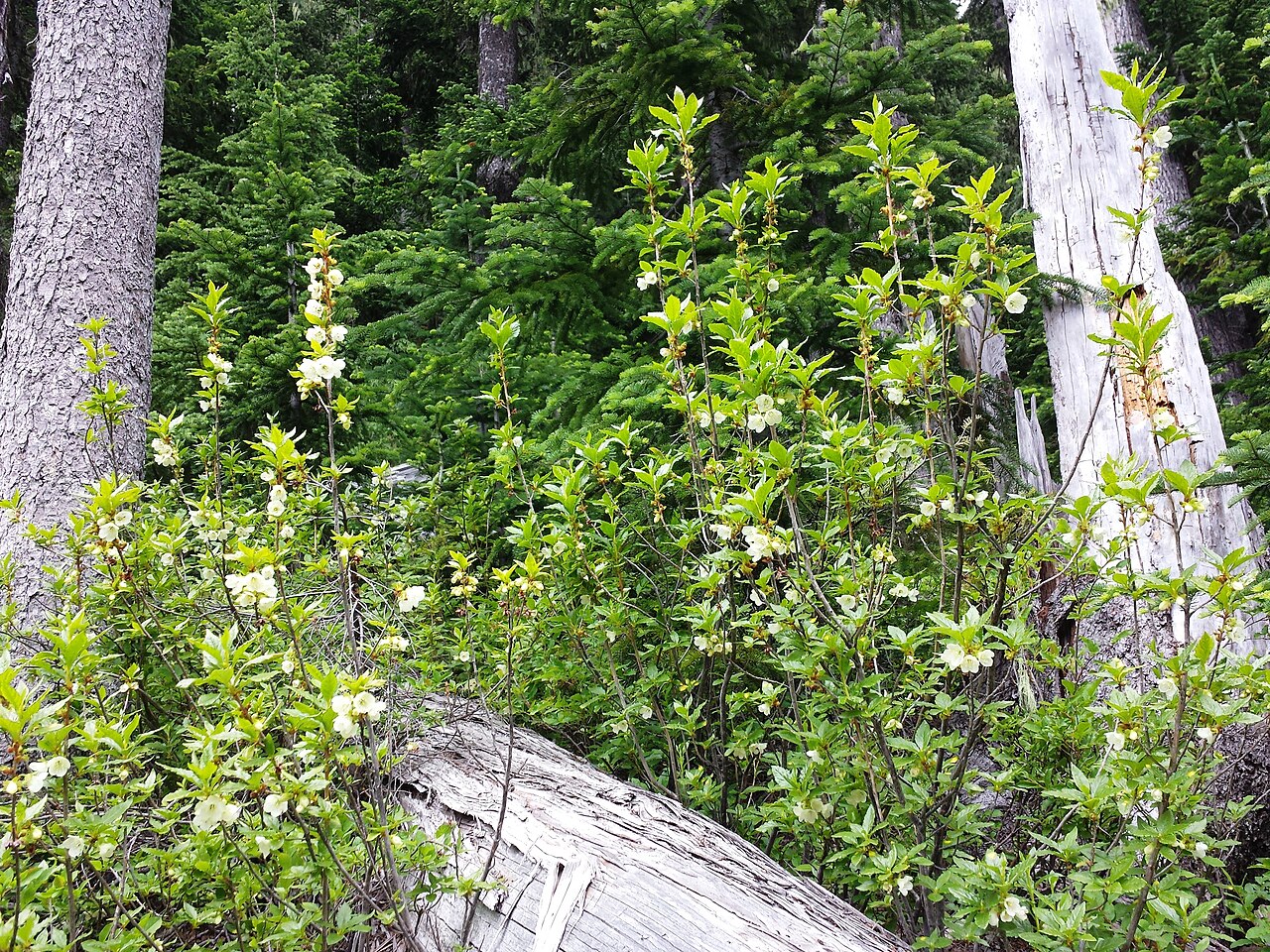
USDA PLANTS lists it under the common name Cascade azalea. It is unusual among rhododendrons because its flowers grow from buds along the sides of the previous year’s twigs instead of in clusters at the branch tips. It forms dense thickets on moist slopes, in avalanche paths and along streams near timberline, often with huckleberries, mountain heathers and subalpine fir.
Safety note: like other rhododendrons and azaleas, all parts of white-flowered rhododendron contain grayanotoxins, which are poisonous to people, pets and livestock if eaten. Honey made mainly from rhododendron nectar can also be toxic. It is a beautiful plant to see in the mountains, but it is very difficult to grow at low elevations, and wild plants should never be dug.
Identification
Look for an upright, deciduous shrub with thin, bright green leaves crowded at the twig tips and creamy white, cup-shaped flowers hanging in small groups along the sides of the branches, in snowy subalpine forests.
Growth Habit
It is an erect, deciduous shrub, usually 3 to 6 feet tall (occasionally to 7 feet), with several slender, flexible stems that grow upward from the base. Young twigs are covered with stiff, reddish-brown hairs, and older bark is gray and shreddy. Plants often grow in dense patches, bent downslope by heavy snow.
Leaves
The leaves are alternate but clustered in whorl-like tufts at the ends of the twigs. They are elliptic to lance-shaped, 1 1/2 to 3 1/2 inches long, thin, light to bright green, and sprinkled with rusty hairs, especially on the veins and edges. In fall they turn bronze, orange and red before dropping.
Flowers
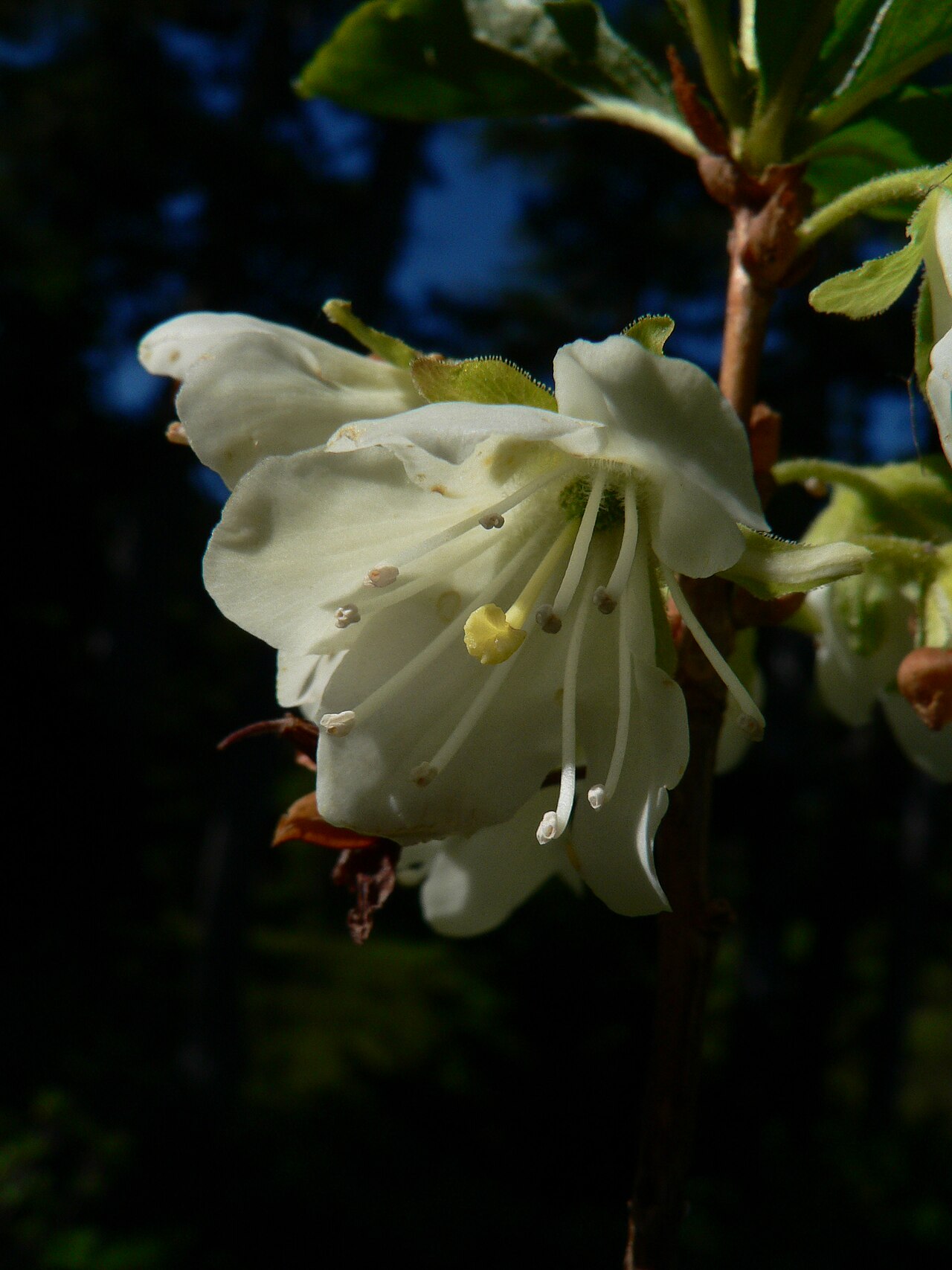
The flowers open from about June to August, depending on snowmelt, in groups of one to four from lateral buds below the leaf tufts. Each flower is about 3/4 to 1 inch across, cup- to bowl-shaped with five rounded lobes, white to creamy white, sometimes with a yellow or orange blotch inside. There are ten stamens. The sepals and flower stalks are glandular-sticky.
Fruit
The fruit is a small, egg-shaped, woody capsule about 1/4 to 1/2 inch long that splits into five parts in fall to release many tiny, dust-like seeds.
Look-alikes
Fool’s huckleberry or rusty menziesia (Rhododendron menziesii, formerly Menziesia ferruginea) grows in the same forests and has similar leaf tufts, but its flowers are small, urn-shaped and pinkish orange to salmon, hanging at the twig tips. Western azalea (R. occidentale) grows at lower elevations in Oregon and California and has large, fragrant, funnel-shaped white flowers with a yellow blotch, in clusters at the branch ends. Pacific rhododendron is evergreen with big pink flower trusses.
Quick Facts
| Scientific Name | Rhododendron albiflorum |
| Family | Ericaceae (heath family) |
| Plant Type | Deciduous shrub |
| Mature Height | 3–6 ft |
| Mature Spread | 3–5 ft |
| Growth Rate | Slow |
| Sun Exposure | Part shade to full sun in cool climates |
| Water Needs | Moist; never dry |
| Soil Type | Acidic, humus-rich, well-drained but moist |
| Soil pH | Acidic (about 4.5–6.0) |
| Bloom Time | June–August |
| Flower Color | White to creamy white |
| Fall Color | Bronze, orange and red |
| Fruit | Small woody capsule with tiny seeds |
| Deer Resistant | Yes; toxic foliage is rarely browsed |
| USDA Hardiness Zones | 3–6 |
Native Range
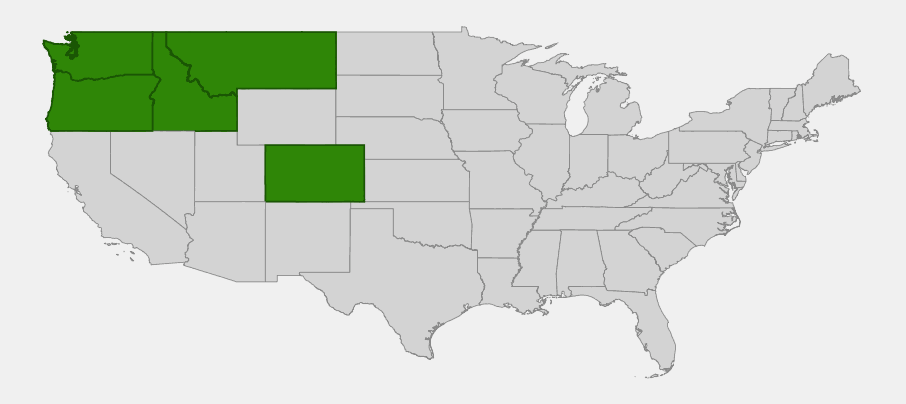
White-flowered rhododendron is native to western North America, from British Columbia and southwestern Alberta south through the Cascade Range of Washington and Oregon and east through the mountains of northern Idaho and western Montana. USDA PLANTS lists it as native in Colorado, Idaho, Montana, Oregon and Washington.
It is most common in the Cascades of Washington and in the Olympic Mountains, including Mount Rainier and North Cascades National Parks, and it grows on both the wet western and drier eastern slopes of the Cascades. In Oregon it reaches south along the Cascades to the central part of the state. In the Rocky Mountains it grows in the Selkirk, Bitterroot and other ranges of northern Idaho and western Montana, including Glacier National Park. A small, isolated population grows far to the southeast in the Park Range of north-central Colorado, where it is a rare disjunct.
It grows in moist subalpine forests of subalpine fir, Engelmann spruce, mountain hemlock and whitebark pine, on north-facing slopes, in avalanche chutes, at the edges of meadows and along streams, usually from about 3,000 to 7,500 feet, where snow lies deep and late into spring.
📋 Regional plant lists featuring White-Flowered Rhododendron: Idaho, Eastern Oregon & Eastern Washington · Montana & Wyoming · Western Oregon & Western Washington
Growing & Care Guide
White-flowered rhododendron is notoriously hard to grow outside its mountain home. It needs cool summers, reliable winter snow cover, constant moisture and very acidic soil. It is rarely sold; if you find it, buy only nursery-propagated plants, and expect success mainly in high-elevation or cool northern gardens.
Light
Part shade or dappled light is best in most gardens. In cool, cloudy mountain climates it tolerates full sun. Hot afternoon sun burns the thin leaves.
Soil & Water
Plant in acidic, humus-rich soil with plenty of leaf mold or conifer needle duff. It needs steady moisture through the growing season but also good drainage; soggy soil causes root rot. Never let it dry out in summer. A thick mulch of conifer needles or bark keeps the roots cool.
Planting Tips
Plant in spring in a cool, sheltered spot such as the north side of a building or under tall conifers. Add generous organic matter but do not bury the crown, as rhododendron roots are shallow. It is best suited to high-elevation gardens in the Pacific Northwest and northern Rockies. In warm, low-elevation gardens it usually declines within a few years.
Pruning & Maintenance
Very little pruning is needed. Remove dead or broken stems after flowering. Avoid cultivating around the shallow roots, and do not fertilize heavily; if needed, use a small amount of fertilizer for acid-loving plants in spring.
Propagation
It can be grown from the tiny seeds sown on the surface of moist, acidic peat or moss, or from cuttings or layering, but all methods are slow. Do not dig plants from the wild; they rarely survive and many grow in national parks where collecting is prohibited.
Landscape Uses
- Mountain gardens: a native shrub for cool, high-elevation gardens in the Northwest
- Woodland gardens: under conifers with huckleberries and ferns
- Fall color: bronze, orange and red leaves in autumn
- Restoration: helps stabilize slopes in subalpine forests and avalanche paths
- Wildflower viewing: look for it in bloom along Cascade and Rocky Mountain trails in July
Wildlife & Ecological Value
White-flowered rhododendron is a characteristic shrub of the snowy subalpine forests of the Northwest and plays several roles in these ecosystems.
For Pollinators
The flowers are visited by bumblebees and other bees, which are the main pollinators in the cool subalpine zone. They bloom at a time when many mountain bees are building their colonies.
For Birds
Dense thickets provide cover and nesting sites for subalpine birds such as thrushes, juncos and sparrows. Grouse shelter beneath them.
For Mammals
The leaves are toxic and are rarely eaten by deer, elk or mountain goats. The thickets provide cover for small mammals, and bears often travel through and feed in the huckleberry patches where it grows.
Ecosystem Role
Its flexible stems bend under heavy snow and spring back, letting it survive in avalanche chutes and on steep slopes where trees cannot. Its dense roots and stems help hold soil and snow on mountainsides.
Cultural & Historical Uses
The species was described by the British botanist William Jackson Hooker in the 1830s from plants collected in the Rocky Mountains of Canada by Thomas Drummond. The name albiflorum means “white-flowered.”
There are few records of food or medicinal use, and because it contains grayanotoxins, it is dangerous to eat or use as a home remedy. Grayanotoxin poisoning can cause vomiting, low blood pressure, slow heart rate and weakness. Keep children and pets from chewing on any part of the plant.
Gardeners have tried for many years to grow white-flowered rhododendron, but it has a reputation as one of the most difficult rhododendrons to cultivate. Botanists have studied it as an example of a rhododendron that grows in the coldest, snowiest habitats of western North America.
Frequently Asked Questions
Is white-flowered rhododendron poisonous?
Yes. Like other rhododendrons and azaleas, all parts contain grayanotoxins, which are toxic to people, pets and livestock if eaten.
Is white-flowered rhododendron the same as Cascade azalea?
Yes. USDA PLANTS uses the common name Cascade azalea, and it is also called white rhododendron.
Can I grow white-flowered rhododendron in my garden?
Only in cool, moist, high-elevation or northern gardens with acidic soil. It usually declines in warm, low-elevation gardens.
Does white-flowered rhododendron grow in Colorado?
Yes, but only as a small, isolated population in the Park Range of north-central Colorado, far from its main range in the Northwest.
When does it bloom?
From June to August, depending on elevation and how late the snow melts.

Looking for a nursery that carries White-Flowered Rhododendron?
Browse our native plant nursery directory: Colorado · Idaho · Montana · Oregon · Washington

